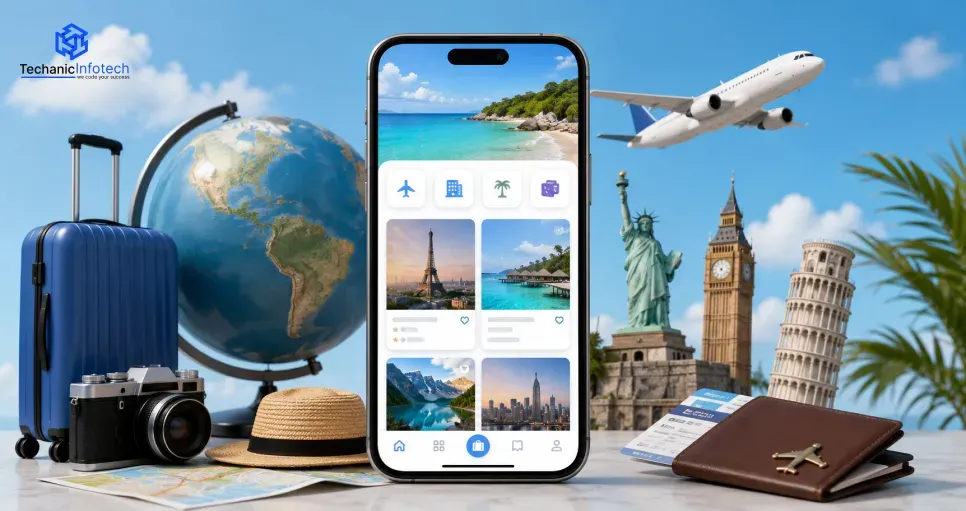
Travel App Development
Travel App Development: Benefits, Features, Cost, Technology & Process
September 2, 2026
September 2, 2026
Key Takeaways:
Travel app development can support hotel bookings, flights, tours, activities, itinerary management, transportation, and other travel services.
The right business model determines how the platform earns revenue and which features should be prioritized.
Essential features include search, booking, payments, maps, notifications, reviews, itinerary management, customer support, and administration tools.
A practical travel app development cost range is $8,000–$90,000+, depending on platform complexity, integrations, supported services, and scalability.
AI can improve personalization, recommendations, itinerary planning, and customer support when implemented around clear business needs.
Travel has become increasingly digital as people rely on smartphones to discover destinations, compare prices, book accommodations, reserve flights, plan itineraries, and manage trips. Instead of using separate websites and applications for every part of a journey, travelers increasingly expect a connected experience that brings essential services together.
This shift has created strong opportunities for businesses investing in travel app development. A well-designed travel platform can connect travelers with hotels, airlines, tour operators, activity providers, transportation services, and other travel businesses through a single digital ecosystem.
However, building a successful travel application involves much more than creating a booking interface. Businesses need to consider their target audience, business model, required features, third-party travel APIs, payment systems, location services, personalization, security, and long-term scalability.
Whether you're planning a travel marketplace, itinerary planner, hotel booking platform, flight reservation application, or an all-in-one travel solution, understanding the development requirements before starting the project can help you make better technology and investment decisions.
This guide covers the essentials of travel app development, including its benefits, business models, core features, monetization opportunities, development process, technology stack, estimated cost, and the key challenges businesses should prepare for.
The global travel market size was valued at USD 1683.16 billion in 2025. The market is projected to grow from USD 1816.23 billion in 2026 to USD 3338.41 billion by 2034, exhibiting a CAGR of 7.91% during the forecast period.
According to WTTC.org, travel & tourism contributed approximately $11.6 trillion to global GDP in 2025, representing 9.8% of the global economy.
According to WTTC.org, the global travel & tourism sector supported approximately 366 million jobs in 2025, equivalent to almost 1 in 9 jobs worldwide.
WTTC reported that Travel & Tourism GDP in Asia-Pacific reached approximately $3.29 trillion in 2025, with the region recording the strongest regional growth.
Travel businesses are increasingly using digital platforms to create direct relationships with customers and simplify the booking journey. A mobile travel application can give businesses greater control over reservations, customer communication, promotions, and personalized experiences.
Travelers want quick access to prices, availability, reviews, maps, itineraries, and bookings. A mobile application can bring these services together in a convenient interface.
A branded travel app allows businesses to communicate directly with customers instead of depending entirely on third-party marketplaces. This can support loyalty programs, personalized promotions, push notifications, and repeat bookings.
A single platform can combine hotels, flights, tours, activities, transportation, and travel packages. Businesses can start with one service and expand the platform over time.
Travel apps can provide itinerary management, booking reminders, digital tickets, location-based information, and real-time updates, creating a more connected experience before and during a trip.
Travel businesses can use customer preferences, search activity, past bookings, and travel behavior to deliver more relevant recommendations. AI can further improve this experience through intelligent recommendations and automated assistance.
Travel applications can serve different markets, including leisure travelers, corporate travelers, tour operators, travel agencies, hotels, airlines, and local experience providers.
For businesses working with a travel app development company, the key is to choose a product strategy that solves a specific travel problem while leaving room for future expansion.
Investing in a travel application can create value for both travelers and businesses. Beyond simplifying reservations, a well-designed platform can improve customer engagement, increase direct revenue, and streamline travel operations.
Customers can search destinations, compare options, make reservations, complete payments, and manage their trips from a single application. This reduces friction and makes the booking journey easier.
A branded travel application gives businesses a direct sales channel and reduces reliance on third-party booking platforms. Direct bookings can also provide more opportunities to promote additional services such as tours, transfers, activities, and travel packages.
Push notifications, personalized offers, loyalty programs, booking reminders, and destination recommendations help businesses stay connected with travelers before, during, and after their trips.
A scalable travel platform can start with one core service and later expand into hotel booking app development, tours, activities, airport transfers, travel insurance, or local experiences.
Travel platforms can generate income from commissions, booking fees, premium services, advertising, subscriptions, affiliate partnerships, and cross-selling travel products.
Centralized booking management, customer records, payment processing, analytics, and partner management can reduce manual work and improve operational visibility.
Travel apps can use customer preferences, previous bookings, search behavior, and location data to provide more relevant recommendations. Businesses can also introduce AI-powered assistants for itinerary planning, travel suggestions, and customer support.
Analytics can help businesses understand booking patterns, popular destinations, customer preferences, cancellation behavior, and seasonal demand. These insights can improve pricing, promotions, and product planning.
For businesses planning a broader digital ecosystem, working with a mobile app development company can help integrate customer-facing travel services with scalable backend systems and third-party travel providers.
Before starting development, businesses need to decide how the travel platform will make money and which participants it will serve. The business model affects the required features, integrations, user roles, and overall development complexity.
The platform connects travelers with hotels, airlines, tour operators, or activity providers and earns a commission from completed bookings.
Best for: Travel marketplaces, OTAs, and multi-provider booking platforms.
A hotel, airline, tour company, or travel brand can use its own application to accept direct bookings and communicate with customers without depending entirely on third-party platforms.
Best for: Hotels, travel agencies, tour operators, and established travel brands.
Users pay a recurring fee to access premium benefits such as exclusive deals, advanced travel planning, loyalty rewards, or additional services.
Best for: Travel membership platforms and premium travel services.
Travel businesses can generate revenue by promoting hotels, destinations, tours, restaurants, activities, or other travel-related services within the application.
Best for: Travel discovery and content-driven platforms with a large active audience.
Core travel discovery and planning features remain free, while premium functionality is offered through paid upgrades.
Premium features may include:
Advanced itinerary planning
Exclusive deals
AI travel assistance
Offline travel guides
Premium destination content
Advanced trip management
Affiliate Revenue Model
The platform earns referral commissions by directing users to external hotels, airlines, rental companies, tour providers, or activity platforms.
Many successful platforms combine several revenue models. For example, a travel application can earn booking commissions while also offering premium memberships, advertising, affiliate partnerships, and paid travel-planning services.
Choosing the right model early helps businesses prioritize the right functionality and create a product roadmap that supports sustainable growth.
Travel app development companies features depend on the business model and target audience. A hotel booking application will require different functionality from an all-in-one travel marketplace, but most modern travel platforms need a combination of discovery, booking, payment, communication, and trip-management features.
Allow travelers to create accounts using email, phone numbers, or social login. Profiles can store preferences, saved destinations, booking history, loyalty information, and traveler details.
Users should be able to explore destinations, attractions, hotels, tours, restaurants, and activities through rich content, images, maps, ratings, and reviews.
The search should allow travelers to filter results by:
Location
Price
Travel dates
Property or service type
Ratings
Amenities
Availability
Traveler preferences
Hotel & Accommodation Booking
Travelers can search available properties, compare prices, select rooms, review policies, and confirm reservations directly through the application.
For platforms focused on air travel, flight booking app development can enable users to search available flights, compare fares, check schedules, select seats, and complete reservations directly through the application. Integration with airline or flight APIs can also provide real-time availability, pricing, booking confirmations, and digital tickets.
Users should be able to discover and reserve tours, attractions, excursions, events, and local experiences based on destination and travel dates.
A centralized itinerary can bring flights, hotel reservations, tours, transportation, and activities together so travelers can manage their complete trip from one place.
Support credit and debit cards, digital wallets, refunds, invoices, and other relevant payment methods. Multi-currency support can be valuable for international travel platforms.
Push notifications can provide booking confirmations, payment updates, check-in reminders, itinerary changes, cancellation alerts, and travel-related notifications.
Map integration can help users discover nearby attractions, hotels, restaurants, transportation options, and activities while also supporting navigation and location-based recommendations.
Verified reviews help travelers evaluate accommodations, tours, activities, and service providers while giving businesses useful customer feedback.
Travelers can save hotels, destinations, tours, and activities for future consideration and organise them around upcoming trips.
In-app chat, FAQs, automated assistance, and support tickets can help users resolve booking or travel-related issues quickly.
AI can analyze user preferences, search behavior, previous bookings, and trip context to recommend destinations, accommodations, activities, and personalized itineraries.
A successful travel application requires a structured development process that connects business goals with traveler needs and technical requirements. Building the product in phases helps reduce risk, control the initial investment, and create a foundation for future expansion.
Start by identifying your target users, geographic market, travel services, and business model. Decide whether the platform will focus on hotel bookings, flights, tours, itinerary planning, or multiple travel services. A focused concept makes it easier to identify the features required for the initial release.
Analyze competitors, customer expectations, pricing strategies, popular destinations, and existing booking platforms.
This research can help identify gaps in the market and determine how your application can provide a better or more specialized travel experience.
Prioritize the functionality required to operate the platform, such as destination search, booking, payments, notifications, itinerary management, and customer accounts. Advanced functionality can be introduced later based on user demand.
Create wireframes, prototypes, and user journeys for travelers, administrators, and travel partners.
The booking flow should remain simple, with clear search results, transparent pricing, minimal checkout steps, and easy access to reservations.
Develop the mobile application, backend services, databases, APIs, payment systems, mapping functionality, and administrative dashboards.
Businesses investing in custom software development costs can tailor workflows around their specific travel services instead of adapting their operations to generic software.
Travel platforms often depend on third-party APIs for hotels, flights, maps, payments, weather, currency conversion, and other services.
Reliable API integration is essential because availability, pricing, and booking information may change in real time.
Testing should cover search, availability, booking, payments, cancellations, refunds, notifications, account security, and compatibility across supported devices.
Performance testing is especially important before launch because travel platforms may experience significant traffic during holiday periods and promotional campaigns.
Instead of launching every planned feature, businesses can begin with a focused version that delivers the core booking experience.
An MVP makes it possible to collect real customer feedback, validate the business model, and identify which features should receive additional investment.
After launch, track booking conversions, cancellations, customer retention, search behavior, and support requests.
These insights can guide improvements to the user experience, pricing strategy, features, and future product roadmap.
As demand increases, businesses can expand into new destinations, suppliers, travel services, languages, currencies, and markets.
Working with an experienced software development company can help maintain the platform's scalability while adding new integrations and features without rebuilding the product from scratch.
The technology behind a travel application determines how reliably it handles bookings, payments, third-party travel APIs, maps, user accounts, and real-time updates. Businesses should select technologies based on expected traffic, platform requirements, integration needs, and long-term scalability.
|
Technology Layer |
Recommended Technologies |
Primary Purpose |
|
Mobile Applications |
Flutter, React Native, Swift, Kotlin |
iOS and Android travel applications |
|
Web Platform |
React.js, Next.js, Angular |
Travel portals and partner dashboards |
|
Backend & APIs |
Node.js, Python, Java, .NET |
Booking logic, authentication, integrations |
|
Database |
PostgreSQL, MongoDB, MySQL |
Users, bookings, listings, itineraries |
|
Cloud Infrastructure |
AWS, Microsoft Azure, Google Cloud |
Hosting, storage, scalability, backups |
|
Maps & Location |
Google Maps API, Mapbox |
Destination discovery and navigation |
|
Payments |
Stripe, PayPal, Razorpay |
Online payments and refunds |
|
Notifications |
Firebase Cloud Messaging, OneSignal, Twilio |
Booking and travel updates |
|
Analytics |
Firebase Analytics, Google Analytics, Power BI |
User and booking insights |
|
AI & Personalization |
Python, OpenAI APIs, ML services |
Recommendations and intelligent assistance |
A travel app can generate revenue through multiple channels, depending on whether the platform focuses on direct bookings, marketplaces, travel discovery, or premium services. Combining several monetization models can create a more stable revenue stream as the user base grows.
A travel marketplace can charge hotels, tour operators, activity providers, airlines, or other partners a commission for every completed reservation. This model works particularly well for platforms that connect travelers with multiple service providers.
The platform can add a small service or convenience fee to selected bookings. The fee may vary depending on the type of travel service, reservation value, or level of support provided.
Travelers can subscribe to premium plans that provide benefits such as exclusive deals, loyalty rewards, advanced itinerary planning, priority support, or premium travel content.
Hotels, tour operators, restaurants, attractions, and activity providers can pay to promote their listings within search results or destination pages. Featured placement can become an additional revenue stream without changing the core booking experience.
Travel businesses can promote destinations, hotels, tours, transportation services, travel products, or other relevant offerings through targeted advertising.
A travel application can earn referral commissions by directing users to external providers such as hotels, airlines, car rental companies, travel insurance providers, or activity platforms.
Businesses can combine multiple services into premium travel packages, such as hotel + tour + airport transfer bundles. The platform can earn through package margins, commissions, or service fees depending on the business model.
Travel platforms can offer dedicated plans for companies that manage employee travel. Corporate features may include centralized bookings, approval workflows, expense reporting, and business travel analytics.
Advanced travel apps can monetize intelligent features such as personalized trip planning, AI itinerary creation, destination recommendations, and virtual travel assistance through premium subscriptions or paid upgrades.
The travel app development cost depends on the type of travel platform, number of booking modules, third-party APIs, supported platforms, UI/UX complexity, payment systems, and level of customization.
A basic travel application can be developed with a focused budget, while a comprehensive platform combining flights, hotels, tours, transportation, AI, and multiple suppliers requires significantly more engineering.
A practical development range is $8,000–$90,000+.
|
Platform Level |
What It Includes |
Estimated Cost |
Development Timeline |
|
Basic Travel App |
Destination discovery, user accounts, listings, basic booking, notifications |
$8,000–$15,000 |
2–3 months |
|
Standard Travel Booking Platform |
Hotel/tour bookings, payments, search, maps, itinerary, admin dashboard |
$15,000–$30,000 |
3–5 months |
|
Advanced Travel Marketplace |
Multiple suppliers, flight + hotel + tour APIs, reviews, partner dashboards, analytics |
$30,000–$50,000 |
5–7 months |
|
Smart Travel Platform |
AI recommendations, intelligent itinerary planning, personalization, automation, advanced analytics |
$50,000–$70,000 |
7–9 months |
|
Enterprise Travel Ecosystem |
Multi-location operations, multiple booking modules, enterprise integrations, advanced security, and scalable infrastructure |
$70,000–$90,000+ |
9–12+ months |
The final travel app development cost can vary within each range depending on team expertise, platform selection, API pricing, design complexity, integrations, security requirements, and post-launch maintenance.
Two travel applications can offer similar booking functionality but require very different development budgets. The difference usually comes from the complexity behind the user interface, integrations, infrastructure, and business workflows.
A platform offering only tour bookings is simpler than one combining hotels, flights, activities, airport transfers, travel insurance, and transportation. Each additional service introduces new APIs, booking rules, payment workflows, and testing requirements.
Travel applications often depend on external APIs for hotel inventory, flight availability, maps, currency conversion, weather, payment processing, and other services. Integration complexity and recurring API charges can significantly influence the total project investment.
Travel applications are highly visual. Interactive maps, destination galleries, booking calendars, comparison screens, itinerary builders, and personalized recommendations require additional design and development effort.
Features such as live flight updates, room availability, booking confirmations, travel alerts, location tracking, and dynamic pricing require real-time data synchronization and reliable backend infrastructure.
Basic recommendations can use predefined rules, while advanced systems may analyze user behavior, travel preferences, previous bookings, and contextual information.
Businesses working with an AI development company can introduce intelligent recommendations, itinerary generation, virtual assistants, or predictive insights, but these capabilities increase both development and ongoing operating costs.
Developing for iOS and Android requires more work than supporting a single platform. Adding a web portal, partner dashboard, or travel-agent interface further increases the scope.
Travel platforms process customer profiles, payment information, bookings, and sometimes identity documents. Secure authentication, encryption, payment security, access controls, and appropriate privacy measures can increase development and testing requirements.
A local tour-booking application has very different infrastructure requirements from a global platform handling large booking volumes across multiple markets.
Building a travel app is an opportunity to create a convenient digital experience while giving businesses a stronger channel for bookings, customer engagement, and revenue growth.
The most effective approach is to start with a clear business model, prioritize the features that matter most to travelers, choose a scalable technology foundation, and expand the platform as customer demand grows.
Whether you're creating a tour booking application, a hotel and flight marketplace, or a complete travel ecosystem, thoughtful planning can help control development costs while creating a product that remains flexible enough to support future services, markets, and technologies.
Travel app development generally costs $8,000–$90,000+, depending on features and complexity.
Search, bookings, payments, maps, itineraries, notifications, reviews, and customer support are essential.
Yes. APIs can connect the app with hotel and flight booking providers.
Yes. AI can power personalized recommendations, itinerary planning, and virtual travel assistance.
A basic app may take 2–3 months, while advanced platforms can take 9–12 months or more.
Common models include commissions, booking fees, subscriptions, advertising, affiliate revenue, and premium services.
Yes. An MVP can validate the concept before advanced features are added.


Abhishek Jangid is the CEO of Techanic Infotech, with extensive experience in mobile app and web development. He specializes in helping businesses turn innovative ideas into scalable digital solutions through strategic planning and modern technology.