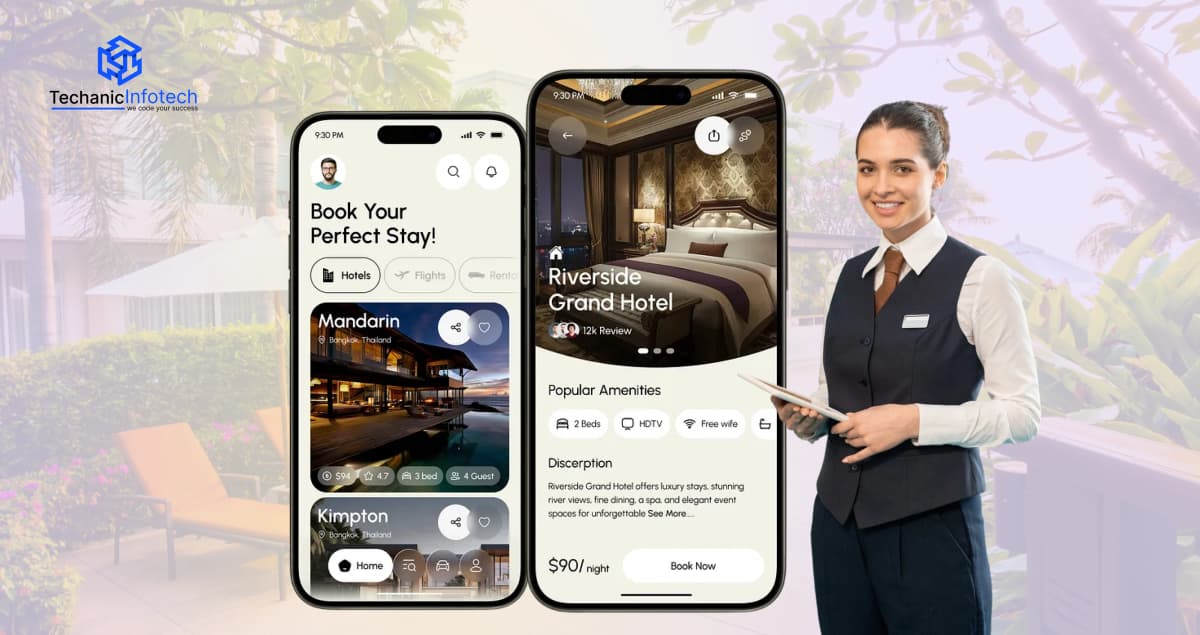
Hotel Booking App Development
Hotel Booking App Development Guide: Features, Cost, Ideas and Monetization Models
January 22, 2026
January 22, 2026
The travel and hospitality industry has seen a massive shift toward digital platforms, making hotel booking apps essential for travelers and hotel owners alike. With just a few taps, users can search, compare, and reserve hotels instantly, while hotel owners gain a streamlined system for managing bookings and customer engagement.
If you’re wondering how to build a hotel booking app for your business, understanding the development process, features, and market trends is crucial. This guide provides a step-by-step approach, helping you navigate everything from app design and development to monetization strategies and challenges.
Whether you want to develop a hotel booking app for iOS, Android, or both, this complete guide to hotel booking app development will give you the insights needed to launch a successful, user-friendly, and revenue-generating platform.
The hotel booking app market has experienced significant growth, reflecting the increasing reliance on digital platforms for travel planning and reservations. Here are some key statistics:
1.Global Market Valuation: The global hotel market was valued at $523 billion in 2024, with projections to reach $1.3 trillion by 2030. Online Travel Agencies (OTAs) hold a 55% market share, indicating the dominance of digital platforms in hotel bookings.
2. Revenue Generation: Travel apps generated $629 billion in revenue in 2024, marking a 13% increase from the previous year. This growth underscores the expanding role of mobile applications in the travel industry.
3. Mobile Booking Trends: Mobile devices accounted for 70.5% of global online travel traffic in 2024, highlighting the shift towards mobile-first strategies in the hospitality sector.
4. User Engagement: Booking.com reported over 100 million users on its mobile app in 2024, with mobile bookings accounting for 60% of its total bookings, emphasizing the importance of mobile platforms in customer acquisition.
5. Market Growth Projections: The online accommodation booking market is expected to experience a robust compound annual growth rate (CAGR) of 15.06% from 2025 to 2035, indicating sustained growth in the sector.
Now that we’ve seen how big the market is, let’s understand what hotel booking apps really are and how they help travelers book rooms easily.
Hotel booking apps are mobile applications that allow users to search, compare, and book hotel accommodations directly from their smartphones or tablets.
These apps provide a convenient and efficient way for travelers to plan their stays, offering features that enhance the user experience and streamline the booking process.
The functionality of hotel booking apps can be broken down into several key steps:
1. User Registration and Profile Creation: Users create an account by providing personal details, preferences, and payment information, enabling personalized services and secure transactions.
2. Hotel Search and Filtering: Users input their destination, check-in/check-out dates, and number of guests to search for available accommodations. Filters such as price range, amenities, and star rating help narrow down the options.
3. Hotel Selection and Room Booking: After reviewing the search results, users select a hotel and choose a specific room type. They can view detailed information, including photos, amenities, and cancellation policies.
4. Payment Processing: Once the room is selected, users proceed to payment. Secure payment gateways facilitate transactions using various methods, including credit/debit cards, digital wallets, and sometimes even cryptocurrencies.
5. Booking Confirmation and Notifications: Upon successful payment, users receive a booking confirmation with details such as reservation number, check-in/check-out times, and hotel contact information. Push notifications or emails may be sent for reminders or updates.
6. Check-In and Check-Out: Some apps offer digital check-in/check-out features, allowing users to bypass the front desk. Users can also access their booking details and invoices through the app.
7. Post-Stay Reviews and Ratings: After their stay, users can rate and review the hotel, providing valuable feedback for future travelers and helping maintain quality standards.
By integrating these functionalities, hotel booking apps offer a seamless and user-friendly experience, catering to the evolving needs of modern travelers.
With the basics covered, let’s explore the different types of hotel booking apps available today.
Hotel booking apps can vary widely in features, target audience, and booking approach. Understanding the types helps in planning your app if you want to create a hotel booking app that stands out.
These apps, like Booking.com and Expedia, list multiple hotels in one platform. They provide comparisons, reviews, pricing, and availability, allowing users to choose the best option.
Features include real-time availability, discounts, and reviews. These apps are ideal if you want to develop a hotel booking app that offers variety and flexibility.
These apps are built specifically for a hotel brand or chain, allowing direct booking of rooms, loyalty program management, and personalized offers.
Examples include Hilton Honors and Marriott Bonvoy apps. They are perfect for businesses that want to build a hotel booking app focused on a single brand.
Some apps target luxury or boutique hotels, catering to high-end travelers.
They focus on premium experiences, exclusive deals, and concierge services. If your goal is to create a hotel booking app for luxury clients, this type provides a curated, high-value experience.
These apps allow last-minute reservations, instant confirmations, and sometimes same-day deals.
They target travelers seeking immediate solutions and are often combined with AI recommendations. Businesses can build a hotel booking app with on-demand features to attract spontaneous bookings.
These apps combine hotels with flights, activities, and local transport.
They provide complete travel solutions and attract users looking for convenience. A complete guide to hotel booking app development can help integrate these features seamlessly.
To get a better idea, here’s a look at some of the most popular hotel booking apps in the US market.
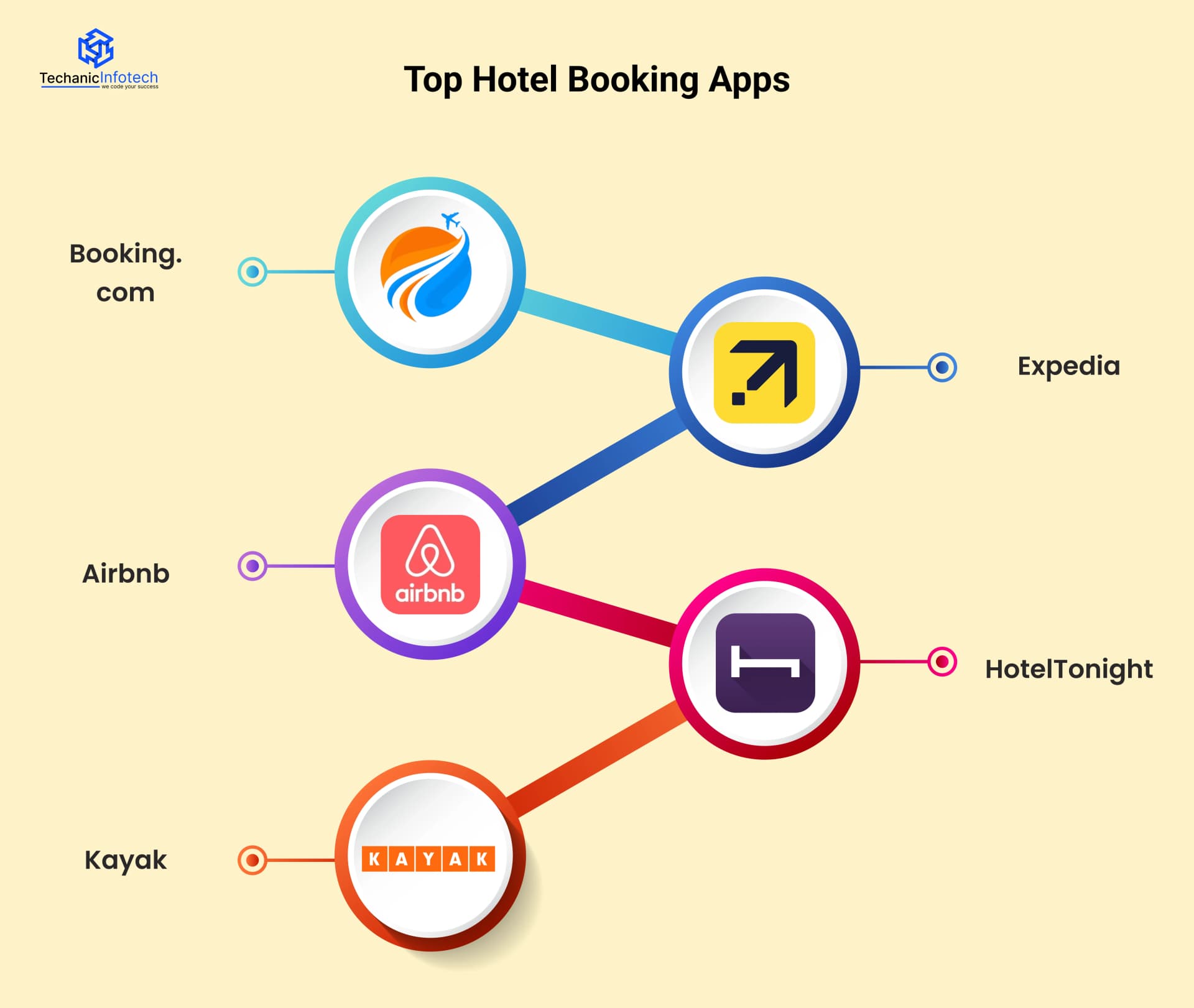
If you're considering how to develop a hotel booking app that resonates with. travelers, analyzing leading platforms can provide invaluable insights. Below are some of the most popular hotel booking apps in the U.S., highlighting their unique features and offerings:
As one of the world's largest online travel agencies, Booking.com offers a vast selection of accommodations, including hotels, apartments, and resorts.
Key Features:
Extensive Inventory: Access to millions of properties worldwide.
User Reviews: Detailed guest reviews and ratings to assist in decision-making.
Flexible Booking Options: Free cancellation on many listings.
Multi-Service Booking: Ability to book flights, car rentals, and airport taxis.
Ideal For: Travelers seeking a comprehensive platform with a wide range of options and services.
Expedia is a well-established travel booking platform offering a variety of accommodations, flights, and vacation packages.
Key Features:
Bundle Deals: Discounts when booking hotels and flights together.
Loyalty Program: Earn Expedia Rewards points for bookings.
Mobile App: Manage bookings and receive notifications on the go.
24/7 Customer Support: Assistance available for travelers at any time.
Ideal For: Travelers looking for package deals and a user-friendly mobile experience.
Airbnb revolutionized travel by allowing individuals to rent out their homes or rooms to guests, offering unique and personalized lodging experiences.
Key Features:
Diverse Accommodations: From shared rooms to entire homes and unique stays like treehouses.
Local Experiences: Book activities hosted by locals.
Verified Listings: Host and guest reviews ensure trust and safety.
Instant Booking: Many listings offer immediate booking confirmation.
Ideal For: Travelers seeking authentic, local experiences and unique accommodations.
HotelTonight specializes in last-minute hotel bookings, offering discounted rates for same-day or upcoming stays.
Key Features:
Daily Deals: Exclusive discounts on last-minute bookings.
Simple Interface: Quick and easy booking process.
Curated Selection: Handpicked hotels to ensure quality.
User Reviews: Ratings and reviews to assist in choosing accommodations.
Ideal For: Spontaneous travelers or those needing accommodations on short notice.
Kayak is a travel search engine that compares hundreds of travel sites to help users find the best deals on hotels, flights, and car rentals.
Key Features:
Price Alerts: Get notified when prices drop.
Flexible Search Options: Filter results by price, amenities, and more.
Travel Planning Tools: Create itineraries and track flights.
Mobile App: Manage bookings and receive real-time updates.
Ideal For: Travelers who want to compare prices across multiple platforms and find the best deals.
Looking at these apps, you can see what features make them stand out, let’s dive into the key functionalities every hotel booking app should have.
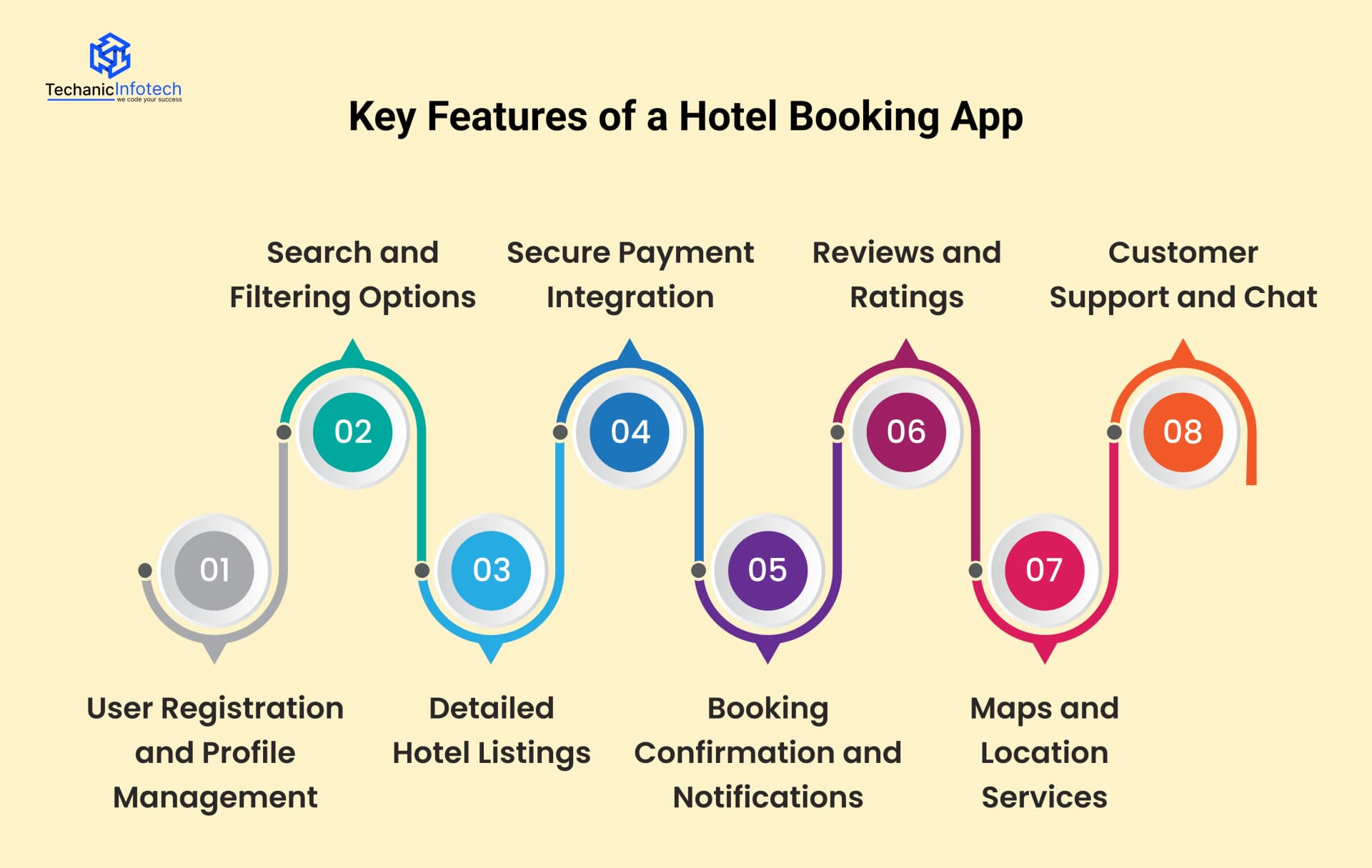
A successful hotel booking app offers a seamless experience for both travelers and hotel owners. To create a hotel booking app that stands out in the competitive market, it’s essential to integrate mobile app features that simplify bookings, enhance convenience, and provide personalization. Here are the key features every modern hotel booking app should have:
Allow users to quickly register using email, phone number, or social accounts. A profile lets users save preferences, payment details, and booking history. This makes it easier to build a hotel booking app that offers personalized suggestions and faster bookings.
An efficient search system is crucial. Users should be able to search hotels by location, dates, price, amenities, star ratings, and guest reviews. Advanced filters help travelers find exactly what they want, ensuring a smooth experience. This feature is a must when you develop a hotel booking app.
Each hotel should have a dedicated page with photos, room types, pricing, amenities, and cancellation policies. Clear information helps users make informed decisions and builds trust.
Integrate multiple payment methods such as credit/debit cards, digital wallets, or in-app payments. Ensure security with encryption and PCI compliance. Offering a smooth checkout experience is vital when you make a hotel booking app.
Users should receive instant booking confirmations via email, SMS, or push notifications. Reminders about check-in, special offers, or booking updates enhance user engagement.
Allow users to leave ratings and reviews after their stay. Feedback not only helps other travelers but also encourages hotels to maintain quality services.
Integrate GPS and maps to help users find hotels easily and explore nearby attractions. This feature adds convenience and improves the overall experience.
Provide in-app support through chatbots or live agents to assist users with booking issues, cancellations, or inquiries.
Including these features ensures your hotel app development is user-friendly, reliable, and competitive. A well-designed app improves user satisfaction, increases bookings, and establishes trust between travelers and hotel providers.
Once you know the must-have features, here’s a step-by-step guide on how to actually develop a hotel booking app
The hospitality industry has seen a huge shift toward digital solutions, and hotel booking app development has become a vital part of modern travel.
Whether you’re a startup or an established hotel chain, creating an efficient, user-friendly hotel booking app can significantly increase bookings, streamline management, and improve customer satisfaction. This hotel booking app development guide provides a step-by-step approach to building your own on-demand hotel booking app.
Before you create an on-demand hotel booking app, it’s important to understand the market. Analyze your target audience, competitors, and existing apps like Booking.com, Expedia, and Hotels.com.
Identify gaps or opportunities that your app can address. For example, focusing on last-minute bookings or luxury boutique hotels could differentiate your app. Market research also helps estimate demand, revenue potential, and key hotel booking app features that users expect.
The next step in hotel booking app development is outlining essential features. These include user registration, hotel search, advanced filters, room selection, booking and payment options, push notifications, and reviews.
Additional features like loyalty programs, virtual tours, or dynamic pricing can enhance the app’s appeal. Defining clear functionality ensures your mobile app development is targeted, efficient, and cost-effective.
Decide whether your app will be for iOS, Android, or both. Cross-platform frameworks like Flutter or React Native can save time and cost while reaching a broader audience.
Platform choice affects mobile app design, development tools, and the selection of third-party services for maps, payment gateways, or analytics. This step is crucial if you want your hotel management app development to have a smooth user experience across devices.
A clean, intuitive interface is key to user retention. During the hotel booking app development services phase, focus on creating simple navigation, attractive layouts, and easy booking flows.
Wireframes and prototypes help visualize the app, while user feedback ensures usability. Incorporate branding elements and interactive features to make the app engaging and professional.
The backend manages data, user accounts, bookings, hotel listings, payments, and notifications.
For hotel booking app development, a robust backend with the right tech stack ensures smooth operations and security. Use scalable cloud solutions like AWS or Firebase for storage, and implement APIs for maps, payment gateways, and third-party integrations.
A strong backend also supports advanced features like dynamic pricing and real-time availability updates.
Frontend development is where the app comes to life. Develop screens for search, hotel listings, booking, payments, and reviews.
Ensure responsiveness and smooth navigation. Integrate animations, push notifications, and feedback prompts. This step ensures that your hotel booking app features are interactive, user-friendly, and visually appealing.
Secure payment integration is essential for any hotel reservation app development. Incorporate multiple payment methods like credit/debit cards, PayPal, digital wallets, or even cryptocurrencies.
Additionally, connect your app with hotel property management systems (PMS) to ensure real-time booking and availability updates.
Thorough testing is critical in hotel booking app development. Test for bugs, responsiveness, speed, security, and usability.
Conduct both alpha and beta testing with real users to gather feedback. Testing ensures that your hotel app development is reliable and efficient and provides a seamless user experience.
Deploy your app on Play Store, App Store, or both. Before launch, ensure all marketing materials, app descriptions, and screenshots are ready.
Use pre-launch campaigns, email notifications, and social media promotion to generate anticipation. A successful launch increases downloads and sets the stage for long-term growth.
The hotel booking app development company should offer post-launch maintenance and support to fix bugs, update features, and enhance performance.
Regular updates improve app functionality, security, and user engagement. Collect user feedback to understand pain points and implement new hotel booking app features that enhance the experience.
Beyond the basics, adding innovative features can set your app apart, here are some trending ideas to consider.
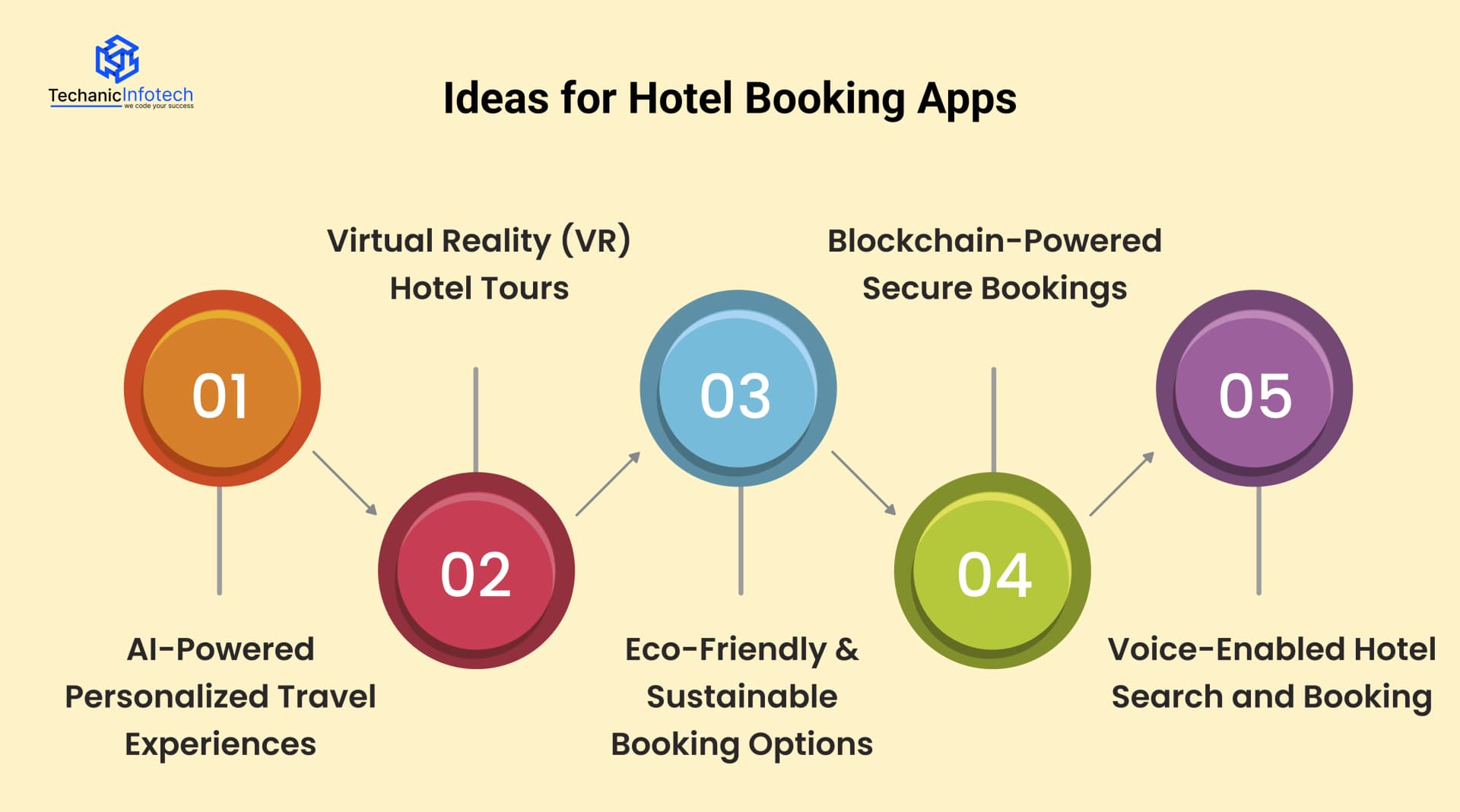
As the travel and hospitality industry evolves, customers now expect more than just basic listings or payment options. To build a successful app, it’s essential to integrate innovation and technology-driven mobile app trends that enhance convenience, personalization, and trust.
Here are five innovative ideas shaping the future of hotel booking app development in 2026 and beyond:
Artificial Intelligence (AI) is at the heart of the new hotel booking app development era. With AI-driven recommendations, predictive analytics, and virtual assistants, apps can offer an unmatched user experience.
Key Features:
Personalized hotel and destination suggestions
Smart chatbots for instant booking and support
Predictive pricing based on travel history and demand
Why It Works: Travelers prefer apps that “understand” their preferences. By leveraging AI, your hotel reservation app development strategy can deliver customized results, increase bookings, and improve retention.
Visual experience matters! With VR integration, users can explore hotel rooms, amenities, and nearby attractions before booking, creating trust and excitement.
Key Features:
360° virtual room tours
Immersive lobby and facility previews
Street-level views of nearby landmarks
Why It Works: VR technology makes the booking experience more interactive and transparent. It reduces uncertainty and helps users make confident booking decisions, enhancing your app’s credibility.
Sustainability is becoming a global movement. Adding “Green Stay” or eco-friendly hotel filters is a trend that can attract conscious travelers.
Key Features:
Highlight hotels with eco-certifications
Display sustainability metrics (energy use, waste reduction, etc.)
Reward users with eco-points for booking sustainable stays
Why It Works: Modern travelers are increasingly eco-conscious. This approach not only appeals to them but also strengthens your brand image as a socially responsible hotel booking app development company.
Blockchain technology brings transparency and enhanced security to hotel management app development. It can simplify payments, prevent fraud, and enable smart contracts for faster, trust-based transactions.
Key Features:
Decentralized payment gateways
Smart contracts for automated confirmations
Verified hotel listings and reviews
Why It Works: With blockchain integration, users can trust that their data and payments are safe. It’s a strong differentiator for those who want to create an on-demand hotel booking app with high security standards.
With the growing use of virtual assistants like Alexa, Siri, and Google Assistant, voice technology is becoming a major trend in hotel booking app development services.
Key Features:
Voice-based hotel search and filtering
Voice confirmation for bookings
Multilingual voice recognition
Why It Works: Voice-enabled bookings make the process faster and more convenient, especially for travelers on the go. It also enhances accessibility for users with visual or mobility limitations.
With features and innovation in mind, let’s check how much it costs to bring your hotel booking app to life.
The cost to develop a hotel booking app depends on various factors such as features, complexity, technology stack, and developer location. On average, building a hotel booking app can cost between $10,000 and $35,000, depending on whether you create a simple MVP or a full-featured platform.
If you want to create an on-demand hotel booking app with core features like hotel listings, booking management, payments, and reviews, the starting cost may be around $8,000–$20,000. However, if you want to include advanced features like AI-based recommendations, dynamic pricing, and multilingual support, the mobile app development cost can rise up to $35,000–$50,000 or more.
Choosing an experienced hotel booking app development company can also impact your budget, but it ensures professional design, scalability, and post-launch support.
Additional costs may include API integrations (for maps, payments, and calendars), backend development, and regular maintenance. The development timeline typically ranges from 3 to 6 months, depending on project scope and team size.
Below is a table highlighting the major cost factors that influence the total hotel booking app development cost:
|
Cost Factor |
Description |
Average Cost (USD) |
|
App Design (UI/UX) |
Custom interface design and user experience |
$2,000 – $5,000 |
|
Frontend & Backend Development |
Core coding, APIs, and database integration |
$8,000 – $20,000 |
|
Features & Functionalities |
Booking system, payments, filters, user profiles, etc. |
$5,000 – $15,000 |
|
Third-party Integrations |
Payment gateways, Google Maps, social login |
$1,000 – $3,000 |
|
Testing & Quality Assurance |
App testing for performance and bugs |
$1,500 – $3,000 |
|
Deployment & Maintenance |
Launch, updates, and post-launch support |
$1,000 – $2,500 |
Overall, the total hotel booking app development cost varies based on your requirements, desired features, and level of customization. Investing in quality development ensures better performance, long-term scalability, and higher user engagement.
Now that you know the investment, let’s see why creating a hotel booking app is worth it for both users and hotels.

Creating a hotel booking app isn’t just good for business, it also brings a host of advantages for the people using it. Let’s first look at the benefits for users (travelers).
With the help of hotel booking apps, users can book hotels in just a few taps. No need to call reception desks or visit multiple websites, everything happens instantly. Features like real-time availability, secure payment gateways, and instant confirmation make the process smooth and stress-free.
A mobile hotel booking app allows travelers to browse, compare, and book hotels anytime, from anywhere. Whether it’s a last-minute weekend trip or a planned vacation, users can make bookings on their schedule without depending on business hours or agents.
Most hotel booking app development solutions integrate comparison features and dynamic pricing options. Users can easily compare prices across hotels and access app-exclusive discounts, offers, or reward programs, saving both time and money.
Modern apps use AI and data analytics to understand user preferences. This enables the app to suggest hotels based on previous searches, location, budget, and past bookings. Such personalization creates a convenient and customized experience for every traveler.
Users can check verified reviews and ratings before booking. This transparency builds trust and helps travelers make informed decisions about where to stay. It also improves the overall reliability of the booking process.
By investing in hotel booking app development services, hotels can encourage direct bookings without relying on third-party OTAs. This reduces commission costs and helps increase profit margins. A direct communication channel also allows hotels to manage offers and promotions more effectively.
A mobile app keeps your hotel brand in front of potential customers 24/7. With push notifications, social sharing, and loyalty programs, hotels can build stronger brand awareness and stay top of mind when users plan their next trip.
A custom hotel management app development solution can automate many daily operations, from managing bookings and room inventory to handling customer enquiries. This leads to fewer errors, faster check-ins, and improved guest satisfaction.
Through built-in analytics, hotels can access data about customer behaviour, booking patterns, and market trends. This helps in creating better pricing strategies, improving customer service, and forecasting demand more accurately.
When hotels develop a hotel booking app, they gain a direct connection with their guests. This allows personalized marketing, targeted offers, and follow-up engagement, helping hotels turn one-time guests into loyal customers.
Understanding the benefits is great, but how do these apps actually generate revenue? Let’s explore the monetization strategies.
Building a hotel booking app is not just about convenience, it’s also a highly profitable business model. Once you create a hotel booking app, you can explore multiple revenue generation strategies that ensure long-term profitability and business growth.
Let’s look at how most successful hotel booking platforms earn revenue:
This is the most widely used revenue model in hotel booking apps. In this approach, hotels pay a commission for every successful booking made through the app. The commission usually ranges from 10% to 25%, depending on visibility, pricing, and location.
Well-known platforms like Booking.com and Expedia primarily rely on this model, making it one of the most effective monetization strategies.
In the subscription model, hotels pay a fixed monthly or yearly fee to list their properties on the app. This provides stable and predictable revenue for the app owner.
Platforms offering premium business tools and listings, such as Airbnb (for hosts), use subscription-style benefits to give better visibility and management features.
Hotels can pay extra to appear at the top of search results or in highlighted sections of the app. This improves visibility and increases booking chances.
Apps like Agoda use featured placements and promotional listings as a strong revenue source.
Hotel booking apps often display ads from related businesses such as airlines, travel insurance companies, car rentals, or local attractions.
Platforms like Trivago effectively monetize traffic through ads without directly charging users.
Some apps earn commissions by redirecting users to partner services. These may include airlines, tour operators, or experience providers.
For example, Kayak earns revenue through affiliate partnerships and referrals.
Many apps charge users a small service or convenience fee per booking. While minimal per transaction, this adds up at scale and helps cover operational costs.
This model is commonly used alongside other monetization methods in hotel reservation app development.
Finally, no app journey is without hurdles, here’s how you can overcome common challenges in hotel booking app development.
Building a hotel booking app may sound straightforward, but behind every smooth booking experience lies a complex process filled with challenges. From syncing room availability in real time to protecting user data, businesses must address several hurdles to ensure long-term success in hotel booking app development.
Here are some of the most common challenges and effective ways to overcome them:
Maintaining accurate, real-time room availability is one of the toughest parts of hotel reservation app development. A mismatch between hotel inventory and app listings can cause double bookings, leading to poor user experiences and reduced trust.
Solution: Use PMS (Property Management System) integration and cloud-based APIs to connect directly with hotel databases. This ensures instant updates on room availability, pricing, and offers across all platforms.
A hotel booking app must support various payment modes like credit/debit cards, wallets, and PayPal. However, managing secure transactions while maintaining user trust can be challenging.
Solution: Integrate trusted gateways such as Stripe, Braintree, or PayPal, ensuring PCI DSS compliance and data encryption. Two-factor authentication and fraud detection systems add extra layers of protection.
Hotel apps collect sensitive user data, from contact details to payment info. Any data breach can damage reputation and violate compliance regulations.
Solution: Adopt GDPR-compliant policies, apply end-to-end encryption, and schedule security audits regularly. Building a transparent privacy policy also boosts user confidence.
The hotel booking industry is crowded with big names like Booking.com and Expedia. Competing with them requires differentiation and innovation.
Solution: Offer unique hotel booking app features like personalized deals, AI-based suggestions, or loyalty programs. Provide a fast, intuitive UI and excellent post-booking support to retain users.
As your user base grows, your app must handle increasing traffic and data loads without lag. Poor performance can lead to negative reviews and customer loss.
Solution: Use scalable cloud infrastructure such as AWS or Google Cloud. Conduct performance and stress testing regularly to ensure smooth user experiences even during peak booking seasons.
While building a hotel booking app for one of our clients, our team faced many of the same challenges that are common in hotel booking app development.
One major issue was keeping room availability accurate at all times. During testing, we noticed delays in updates that could lead to double bookings. To fix this, we connected the app directly with the hotel’s system so availability and prices updated instantly.
Secure payments were another key focus. We added trusted payment options to make bookings safe and smooth for users. We also paid close attention to user data protection by following strong security practices.
To help the app compete in a crowded market, we designed a clean, easy-to-use interface and added personalized booking options. The app was built to handle growth without slowing down as users increased.
Turning your idea into a high-performing hotel booking app requires more than just coding, it takes expertise, innovation, and a deep understanding of the travel industry. That’s exactly where Techanic Infotech stands out.
As a leading hotel booking app development company, Techanic specializes in crafting custom, scalable, and feature-rich solutions that help businesses connect hotels with travelers effortlessly. Our experienced developers and designers use the latest tools and technologies to build apps that deliver seamless performance, strong security, and a user experience travelers love.
From UI/UX design and payment integration to cloud deployment and ongoing maintenance, we handle every step of the hotel app development process. Whether you want to create an on-demand platform like Booking.com or a niche app for boutique hotels, our team tailors every feature to your business goals.
Partner with Techanic Infotech to bring your vision to life, and build a hotel booking app that stands out in today’s competitive market.
The hotel booking industry is evolving rapidly, and mobile apps have become the primary choice for travelers seeking convenience, transparency, and personalized experiences. From understanding market trends to implementing advanced features like AI recommendations, VR tours, and sustainable booking options, a well-built app can transform how users search, compare, and reserve accommodations.
For businesses, investing in hotel booking app development not only boosts direct bookings and brand visibility but also streamlines operations and provides valuable insights for better decision-making.
By following a structured development process, choosing the right technology stack, and incorporating innovative features, you can create a competitive, user-friendly platform that stands out in the crowded market.
With expert guidance from a professional hotel booking app development company, like Techanic Infotech, you can turn your vision into a powerful, scalable, and secure app that delights travelers and drives business growth. Now is the perfect time to create a hotel booking app and capture the opportunities in the digital travel space.
The cost depends on features, design complexity, and platform choice. On average, building a full-featured hotel booking app ranges from $10,000 to $35,000.
A standard hotel booking app typically takes 3–6 months to develop, depending on the complexity and the number of features.
Essential features include real-time hotel listings, secure payments, user reviews, booking management, notifications, and AI-based recommendations.
Yes, you can integrate payment gateways, maps, social logins, and third-party APIs to enhance functionality and user experience.
A professional company ensures secure, scalable, and feature-rich app development with ongoing support, making your platform competitive and reliable.


Shailendra is a dedicated professional known for his strong client-focused approach and clear understanding of business needs. He brings a thoughtful understanding of client needs and focuses on building long-term relationships through clear communication and quality-driven work. With a blend of strategic thinking, content expertise, and a hands-on approach, Shailendra plays a key role in shaping content that aligns with both business goals and user expectations.