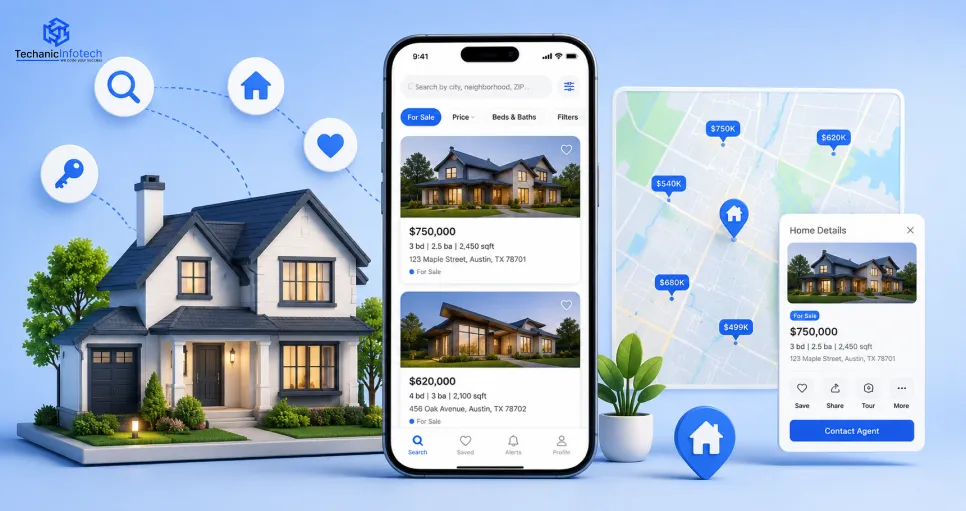
Key Takeaways
A successful Zillow clone app development project requires a scalable marketplace strategy rather than simply replicating Zillow's features.
Launching with an MVP allows startups to validate their business idea, reduce development costs, and expand based on user feedback.
Essential capabilities include smart property search, agent management, interactive maps, AI-powered recommendations, and secure marketplace administration.
Multiple revenue streams, such as featured listings, subscriptions, advertising, and lead generation, help create a sustainable real estate business.
Development costs typically range from $8,000 to $70,000+, depending on platform complexity, AI integrations, and marketplace scalability.
The real estate industry has undergone a significant digital transformation over the past decade. Buyers no longer rely solely on newspaper listings or local agents to find properties. Instead, they expect instant access to verified property listings, neighbourhood insights, virtual tours, mortgage calculators, and real-time communication, all from a single mobile application.
Platforms like Zillow have redefined the property search experience by combining technology, data, and user-friendly interfaces into one comprehensive marketplace. As demand for digital property platforms continues to grow, many startups, brokers, and real estate enterprises are investing in Zillow clone app development to launch scalable online marketplaces that connect buyers, sellers, landlords, and agents.
In this guide, you'll learn how a Zillow-like platform works, what features drive user engagement, how to develop a competitive real estate marketplace, the challenges you'll face, and the investment required to build a successful product.
The U.S. real estate market is expected to reach USD 172.13 billion by 2030, growing at a 4.1% CAGR from 2025 to 2030. Grand View Research
Zillow's Zestimate analyzes millions of properties to provide AI-powered home value estimates, making it one of the largest real estate data platforms in the U.S.
According to Zillow's 2024 Consumer Housing Trends Report, the median self-reported home sale price was $300,000, while the Zillow Home Value Index (ZHVI) reached approximately $363,000.
Zillow is one of the leading online real estate marketplaces that helps users buy, sell, rent, and explore residential and commercial properties. Founded in 2006, the platform offers property listings, interactive maps, Zestimate home value estimates, mortgage tools, and direct connections with real estate agents, all in one place.
Its marketplace model has transformed how people search for properties and has become a popular benchmark for businesses investing in real estate marketplace app development.
Zillow connects buyers, sellers, real estate agents, and property owners on a single digital marketplace, making property discovery and transactions faster and more convenient.
Homeowners, builders, and agents create property listings by adding photos, descriptions, pricing, amenities, and location details. The platform verifies listings before publishing them to maintain quality and trust.
Buyers search for properties using filters such as location, budget, property type, size, and amenities. A well-designed property listing app development platform ensures users can quickly find properties that match their preferences.
Many modern platforms leverage AI integration in mobile apps to recommend relevant properties based on browsing history, saved searches, preferred locations, and budget, creating a more personalised experience.
Once users find a suitable property, they can contact agents through in-app messaging, phone calls, or viewing requests to schedule property visits and discuss details.
Administrators manage listings, verify users, monitor marketplace activity, resolve disputes, and oversee platform performance to ensure a secure and reliable real estate ecosystem.
Building a health insurance app requires careful planning, strong security measures, and seamless healthcare integrations. Following a structured development process helps insurers create a secure, scalable, and user-friendly platform.
Start by identifying the purpose of the application and its target users, such as policyholders, insurance agents, hospitals, or administrators. Clearly define the core features, compliance requirements, and business objectives before development begins.
Create wireframes and user-friendly interface designs that simplify policy purchases, claims submission, premium payments, and policy management. A well-designed user experience improves customer engagement and reduces operational complexity.
Select technologies that support scalability, security, and healthcare integrations. Consider cross-platform frameworks, cloud infrastructure, secure databases, payment gateways, and authentication solutions to build a reliable application.
Develop essential functionalities such as user registration, policy management, premium payments, digital insurance cards, claims processing, document uploads, notifications, and role-based dashboards for different users.
Connect the application with payment gateways, hospital management systems, identity verification services, notification platforms, AI tools, and analytics solutions to create a seamless digital insurance ecosystem.
Perform comprehensive testing to identify bugs, validate workflows, ensure data security, and optimise performance. Verify that the application complies with healthcare and insurance regulations before launch.
Launch the application on Android, iOS, and web platforms after successful testing. Configure cloud infrastructure, monitor system performance, and ensure a smooth rollout for all users.
Regularly monitor the application, release security updates, improve performance, add new features, and adapt to changing healthcare regulations and customer expectations to ensure long-term success.
Before digital marketplaces became mainstream, property transactions were often slow, fragmented, and heavily dependent on local agencies. Buyers had limited access to property information, while sellers struggled to reach a broader audience.
Instead of browsing multiple websites or visiting several agencies, users can explore residential, commercial, rental, and investment properties on a single platform. Powerful search tools make it easy to compare listings, neighbourhoods, pricing, and amenities before scheduling a visit.
Modern property search app development platforms provide more than listings. They deliver property history, estimated valuations, nearby schools, transportation options, neighbourhood statistics, and market trends that help users make confident buying decisions.
A successful real estate marketplace serves multiple audiences simultaneously:
Home buyers searching for properties.
Property owners listing homes for sale or rent.
Real estate agents managing clients and listings.
Administrators are monitoring marketplace operations.
Each user interacts with a dedicated interface while remaining part of the same digital ecosystem.
Today's users expect intelligent experiences rather than simple search portals. Many businesses collaborate with real estate app development companies to build platforms that include AI-powered recommendations, virtual property tours, mortgage calculators, map-based searches, lead management, and automated communication.
Launching a Zillow-like platform is no longer limited to large enterprises. With the right product strategy and modern development technologies, startups can create a minimum viable product to validate their idea, attract early users, and gradually expand into a full-scale marketplace.
Launching a successful real estate marketplace isn't about building every feature on day one; it's about validating the business idea, attracting users, and scaling the platform strategically.
Every successful marketplace starts with solving a core problem. Instead of investing in a fully featured platform, businesses should first create a minimum viable product that focuses on the essential buying and property listing experience.
A typical MVP includes:
User registration and authentication
Property listings
Search and filtering
Property details page
Interactive maps
Contact agent functionality
Basic admin dashboard
Launching an MVP allows startups to validate demand, gather user feedback, and refine the product before making larger investments.
Once the MVP gains traction, the next step is transforming it into a complete real estate mobile app development platform capable of serving buyers, sellers, and agents at scale.
This phase typically introduces:
Agent dashboards
Property verification
Saved searches
Favorites and wishlists
Push notifications
Mortgage calculators
Appointment scheduling
Review and rating systems
As the marketplace grows, the platform should also support increasing property listings, concurrent users, and expanding business operations.
To compete with established platforms like Zillow, businesses need more than property listings. The focus shifts toward delivering intelligent experiences that simplify property discovery and improve customer engagement.
At this stage, businesses often introduce the following:
AI-powered property recommendations
Smart pricing insights
Virtual property tours
Interactive neighborhood analytics
Investment calculators
Personalized dashboards
Working with an experienced, top mobile app development company helps organisations implement advanced technologies while maintaining scalability and performance.
As the platform matures, it evolves beyond a property marketplace into a complete real estate ecosystem. This stage focuses on expanding services, improving operational efficiency, and supporting long-term business growth.
Key expansion opportunities include the following:
MLS integrations
CRM integration for agents
Rental property management
Commercial real estate listings
Multi-city and multi-country support
Enterprise analytics
Advertising and lead management
Cloud-based scalability
Businesses planning long-term growth often collaborate with providers offering mobile app development services and custom software development for SMBs to continuously enhance the platform, introduce new capabilities, and adapt to changing market demands.
The success of a real estate marketplace depends on delivering the right experience to every user. Buyers expect accurate property information, sellers want maximum visibility, agents need efficient lead management, and administrators require complete control over marketplace operations.
Buyers use the platform to discover, compare, and evaluate properties before making one of the biggest financial decisions of their lives. The application should simplify every step of this journey.
1. Smart Property Search: Advanced search filters allow users to narrow down listings based on:
Location
Budget
Property type
Bedrooms & bathrooms
Property size
Amenities
New listings
Interactive Maps
Map-based browsing enables buyers to explore neighbourhoods, nearby schools, hospitals, public transportation, restaurants, and other local amenities before scheduling a visit.
2. Property Comparison: Users can compare multiple properties side by side based on pricing, specifications, location, amenities, and investment potential.
3. Mortgage & EMI Calculator: Built-in financial calculators help buyers estimate monthly payments, loan eligibility, and overall affordability before contacting an agent.
Property owners need tools that make listing and managing properties simple while maximising visibility to potential buyers.
1. Easy Property Listing: Owners can upload high-quality images, descriptions, pricing, amenities, floor plans, and property documents through an intuitive listing interface.
2. Listing Performance Dashboard: Analytics help owners monitor property views, enquiries, scheduled visits, and buyer engagement, allowing them to optimise listings for better performance.
3. Lead Management: A centralised dashboard enables sellers to organise buyer enquiries, respond quickly, and manage follow-up communication from one place.
Agents play a critical role in closing transactions. Dedicated agent tools help improve productivity while strengthening client relationships.
1. Client & Lead Management: Agents can organise leads, monitor buyer preferences, schedule appointments, and track communication history without relying on multiple systems.
2. Appointment Scheduling: Integrated calendars simplify property visit bookings, reducing scheduling conflicts and improving the overall customer experience.
3. Property Portfolio Management: Agents can manage multiple listings, update availability, edit pricing, and publish new properties through a single dashboard.
Administrators ensure the marketplace remains secure, reliable, and well-managed as the platform grows.
1. User & Listing Verification: Admins can verify agents, review property submissions, detect duplicate listings, and maintain marketplace quality.
2. Marketplace Analytics: Comprehensive dashboards provide insights into user growth, listing performance, revenue, engagement, and conversion rates to support data-driven decisions.
3. Advertisement & Subscription Management: The platform should support featured listings, premium memberships, banner advertising, and promotional campaigns to generate additional revenue streams.
Launching a real estate marketplace isn't just about connecting buyers and sellers—it's about building a sustainable business model. While property listings form the foundation of the platform, successful marketplaces generate revenue from multiple sources that continue to grow as user adoption increases.
One of the most common monetisation strategies is offering premium property placements. Sellers and real estate agencies can pay to feature their listings at the top of search results, category pages, or homepage banners, helping them gain greater visibility and generate more enquiries.
Real estate professionals often require advanced tools to manage multiple listings and clients. Subscription packages can include benefits such as the following:
Unlimited property listings
Lead management dashboard
Detailed analytics
Priority customer support
Verified agent badges
Marketing and promotional tools
This recurring revenue model provides predictable monthly or annual income for the platform.
As traffic grows, the application becomes an attractive advertising channel for businesses connected to the real estate industry. Revenue can be generated by partnering with:
Mortgage providers
Banks and financial institutions
Home insurance companies
Interior design businesses
Furniture brands
Moving and relocation services
Displaying targeted advertisements creates additional income without affecting the core user experience.
Many real estate agents are willing to pay for verified buyer enquiries rather than general website traffic. The platform can charge per qualified lead or offer lead packages based on location, property type, or buyer intent.
Beyond buying and selling properties, users often require additional services throughout their real estate journey. Integrating these services creates new monetisation opportunities while improving customer convenience.
Examples include:
Property valuation services
Virtual property tours
Legal documentation assistance
Home inspection bookings
Loan eligibility checks
Mortgage consultation
Property management services
AI-Powered Premium Experiences
Modern Zillow-like app development platforms increasingly use AI integration in mobile apps to deliver premium features such as personalised property recommendations, intelligent pricing estimates, investment insights, and predictive market trends.
The cost of Zillow clone app development depends on your product vision, business model, and long-term growth strategy. Rather than investing in every advanced feature from the beginning, most successful real estate startups launch with a focused marketplace, validate demand, and expand the platform in phases.
The first phase focuses on creating a functional platform where buyers can browse properties, sellers can publish listings, and agents can receive enquiries.
Estimated Investment: $8,000–$20,000
Ideal for:
Real estate startups
Local property marketplaces
MVP validation
Early-stage PropTech businesses
After validating the business model, additional capabilities such as agent dashboards, saved searches, mortgage calculators, appointment scheduling, property verification, and advanced filtering can be introduced to improve user engagement.
Estimated Investment: $20,000–$45,000
Ideal for:
Growing PropTech companies
Regional property portals
Multi-agent businesses
Expanding marketplaces
At this stage, the platform evolves into a full-scale ecosystem with AI-powered recommendations, MLS integration, advanced analytics, virtual property tours, enterprise dashboards, and cloud-native scalability.
Estimated Investment: $45,000–$70,000+
Ideal for:
Enterprise real estate businesses
National property portals
Franchise networks
Large real estate marketplaces
A Zillow-inspired marketplace is more than a property listing application; it's a digital ecosystem that connects buyers, sellers, agents, and businesses through a seamless real estate experience. experience. Success depends on understanding user needs, building a scalable platform, and introducing features that create real value rather than simply replicating an existing product.
Whether you're launching a local property portal or planning a nationwide marketplace, investing in a well-structured development strategy will help you create a platform that can grow alongside your business and adapt to the changing demands of the real estate industry.
Zillow clone app development is the process of building a real estate marketplace application that allows users to search properties, list homes, connect with agents, schedule property visits, and manage real estate transactions through a centralised platform.
The cost typically ranges from $8,000 to $70,000+, depending on the platform's complexity, AI capabilities, MLS integration, third-party services, and overall business requirements.
A successful platform should include property listings, advanced search filters, interactive maps, saved searches, mortgage calculators, agent dashboards, appointment scheduling, property verification, and administrative controls.
Development timelines generally range from 2 to 10 months, depending on the project's scope, feature set, and level of customisation.
Yes. AI can enhance property recommendations, estimate property values, detect user preferences, automate customer support, and provide market insights, creating a more personalised experience for buyers and sellers.
MLS integration is highly beneficial because it provides access to verified and regularly updated property listings, helping improve the accuracy and reliability of the marketplace.
Absolutely. Many startups begin with a Minimum Viable Product (MVP) that includes essential marketplace features and then expand the platform with AI capabilities, advanced search tools, and enterprise functionality as the business grows.


Abhishek Jangid is the CEO of Techanic Infotech, with extensive experience in mobile app and web development. He specializes in helping businesses turn innovative ideas into scalable digital solutions through strategic planning and modern technology.