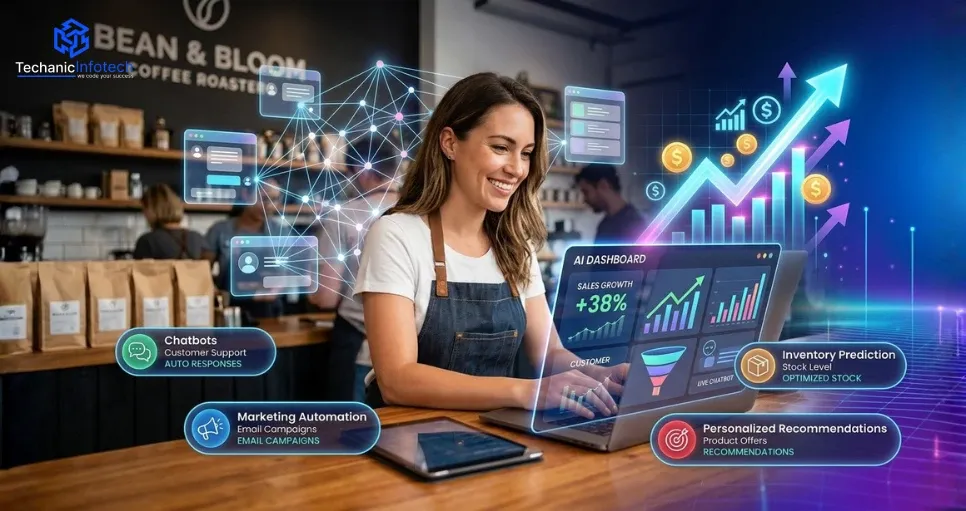
Artificial Intelligence (AI) is no longer limited to large corporations—it has become a game-changer for small businesses in 2026.
From improving marketing strategies to optimizing inventory management, AI tools are helping small businesses operate more efficiently and make smarter decisions.
By leveraging AI, small enterprises can achieve faster growth, reduce operational costs, and enhance competitiveness.
The integration of AI into daily operations is transforming the business landscape, making it essential for small businesses to adopt AI to survive and thrive in a rapidly evolving digital world.
AI adoption is reshaping small businesses, enabling smarter strategies, operational efficiency, and enhanced innovation, ensuring competitiveness in a rapidly evolving digital economy.
Modern AI tools have become increasingly affordable, allowing small businesses to access an advanced tech stack for a mobile app without significant investment, democratizing innovation for smaller enterprises.
AI-driven processes reduce human error, automate repetitive tasks, and significantly improve operational productivity, freeing valuable time for strategic initiatives.
Leveraging AI for analytics empowers small businesses to extract actionable insights from data, guiding informed decision-making and market strategies.
Intelligent chatbots and virtual assistants provide instant, 24/7 communication, boosting customer satisfaction and improving engagement experiences.
AI platforms scale effortlessly as businesses grow, accommodating expanding operations without proportional increases in workforce or AI chatbot development cost.
AI is no longer optional for small enterprises; it is a crucial driver of efficiency, growth, personalization, and strategic decision-making in the 2026 marketplace.
Leveraging AI to automate repetitive, time-consuming tasks liberates employees to concentrate on high-value, strategic initiatives.
This drives unparalleled productivity, minimizes burnout, and significantly elevates overall operational performance.
By harnessing AI to analyze intricate customer behaviors, businesses can deliver exquisitely tailored product recommendations, targeted offers, and personalized services boosting engagement, fostering deep customer loyalty, and maximizing lifetime value.
Sophisticated AI algorithms anticipate market trends, optimize inventory management, and refine strategic planning, empowering businesses to proactively adapt to shifting demands with precision and agility.
AI meticulously identifies bottlenecks, redundancies, and inefficiencies in workflows, recommending actionable improvements that reduce costs, eliminate resource waste, and streamline complex operational processes.
AI rapidly processes massive and multifaceted datasets to generate insightful, predictive intelligence, enabling leaders to make faster, smarter, and highly informed decisions that drive sustainable growth.
Modern AI technologies are accessible and versatile, enabling small businesses to enhance operations, improve customer engagement, and generate actionable insights in 2026.
Machine Learning uses algorithms to analyze large datasets and discover patterns without explicit programming.
Businesses use ML to forecast sales, predict customer behavior, optimize marketing campaigns, detect fraud, and support strategic decision-making through data-driven insights.
Natural Language Processing enables computers to understand, interpret, and respond to human language.
It powers chatbots, voice assistants, and sentiment analysis tools, allowing businesses to analyze customer feedback, automate support services, and improve communication with users.
Computer Vision allows machines to interpret and analyze images or videos. In business operations, it helps with automated product recognition, defect detection in manufacturing, facial recognition, and inventory tracking, reducing manual inspection and improving operational accuracy.
Robotic Process Automation uses software robots to automate repetitive and rule-based tasks such as data entry, invoice processing, payroll management, and report generation.
It increases efficiency, minimizes human errors, and allows employees to focus on more strategic work.
AI analytics platforms analyze massive amounts of data using artificial intelligence and advanced algorithms.
They convert raw data into meaningful insights, identify mobile app development trends and patterns, and help organizations make faster, evidence-based decisions that improve business performance.
Artificial Intelligence empowers small businesses to automate tasks, analyze data, and personalize customer interactions, boosting productivity, efficiency, and competitiveness in today’s fast-paced digital marketplace.
The adoption of Artificial Intelligence offers substantial advantages for small businesses by improving productivity, strengthening customer engagement, increasing operational efficiency, and enhancing competitive positioning in today’s rapidly evolving digital marketplace.
AI significantly streamlines repetitive and time-consuming tasks such as data entry, scheduling, and report generation.
By minimizing human errors and accelerating workflow processes, it enables employees to dedicate more time to strategic planning and business growth initiatives.
AI-powered tools provide personalized interactions, intelligent chat support, and predictive recommendations.
These capabilities allow businesses to respond faster to customer inquiries, understand customer preferences more effectively, and deliver experiences that increase satisfaction and long-term loyalty.
Through advanced analytics and machine learning algorithms, the process to build an AI app involves vast amounts of data to identify hidden patterns, predict market trends, and provide actionable insights.
This empowers business leaders to make more accurate, timely, and data-driven decisions.
AI enhances digital marketing strategies by analyzing consumer behavior, optimizing advertising placements, and identifying highly targeted audiences.
This leads to more effective campaigns, improved engagement rates, and higher conversions while maximizing return on marketing investment.
AI transforms business operations, sales, and marketing by driving efficiency, boosting revenue, enhancing customer experiences, and enabling data-driven decisions for smarter, faster, and more impactful outcomes while building a mobile app.
AI-powered chatbots deliver instant, highly personalized responses, drastically reduce customer wait times, and free human agents to handle complex issues, creating superior, seamless, and efficient customer support experiences.
AI analyzes historical and real-time data to accurately predict demand trends, helping businesses optimize inventory, prevent stockouts, and maximize revenue, ultimately enabling smarter strategic sales decisions.
AI personalizes campaign content based on individual behavior, significantly boosting customer engagement, increasing click-through rates, and driving higher conversions, while ensuring more relevant, impactful, and timely communications.
AI forecasts product demand with precision, automates stock replenishment, and minimizes excess inventory, improving operational efficiency, reducing costs, and enhancing overall profitability and supply chain performance.
AI monitors and identifies unusual patterns in real-time transactions, strengthening security measures and safeguarding businesses and customers from financial losses, fraud, and potential reputational damage.
Adopting AI in minimum viable product development can transform small businesses by improving efficiency, reducing costs, and enhancing customer experience.
Here’s a step-by-step guide to implementing AI effectively.
Identify specific areas where AI can add value whether in customer service, marketing, inventory, or operations.
Clear goals help determine which AI tools are the best fit for your business challenges and objectives.
AI systems thrive on data. Begin collecting relevant data from various sources like sales, customer interactions, and web traffic.
Proper data organization ensures AI can generate meaningful insights for your business processes.
Explore user-friendly AI tools that fit your business's budget. Consider options like chatbots, predictive analytics, or automation software.
AI app development company now cater specifically to small businesses, making the selection easier.
For successful AI adoption, provide training to your employees. Familiarize them with AI tools and demonstrate how these can improve efficiency.
A well-trained team ensures smoother integration and better usage of AI tools.
Implement AI step by step, starting with smaller projects.
For example, automate one task, such as customer support or scheduling, before expanding to more complex systems. Gradual integration minimizes disruption while allowing for testing and refinement.
After deploying AI tools, continuously monitor their performance. Collect feedback and make necessary adjustments.
AI systems improve over time, so optimization ensures you get the best results and refine the AI to your needs.
As AI starts providing tangible benefits, look for additional areas where you can expand its use.
Whether it's scaling marketing automation, expanding data analysis, or automating more operational tasks, scaling AI can lead to long-term growth.
As AI technology continues to evolve, small businesses are increasingly adopting AI in product development to streamline operations, enhance customer experiences, and boost efficiency. Here are key trends to watch.
Small businesses will increasingly use AI chatbots and virtual assistants to provide 24/7 customer support.
This will reduce operational costs and improve customer satisfaction with faster response times.
AI tools will allow businesses to analyze customer data and create hyper-personalized marketing strategies.
This will help small businesses better target their audience with tailored content, offers, and recommendations.
By leveraging AI, small businesses can anticipate customer behavior and market trends.
Predictive models will help businesses optimize inventory, pricing, and staffing, improving efficiency and profitability.
Small businesses will adopt AI for automating repetitive tasks like data entry, scheduling, and accounting.
This frees up time for employees to focus on creative and strategic activities, increasing productivity.
AI-powered cybersecurity tools will enhance small business protection against cyber threats.
These systems will detect and respond to potential risks faster, ensuring sensitive data remains safe without requiring large security teams.
Artificial Intelligence is transforming how small businesses operate, compete, and grow in 2026.
By automating repetitive tasks, analyzing large volumes of data, and enabling personalized customer experiences, AI empowers small enterprises to operate with the efficiency of larger organizations.
From intelligent chatbots and predictive analytics to automated marketing and inventory management, AI tools help businesses reduce operational costs while improving decision-making and productivity.
As AI technologies become more affordable and accessible, small businesses can implement them gradually to achieve sustainable growth.
Almost every small business can benefit from AI, including retail, eCommerce, healthcare, finance, logistics, and service-based industries. AI is especially useful for businesses that rely on customer data, marketing, or repetitive operational tasks.
No, many modern AI tools are designed with user-friendly interfaces that require little to no coding knowledge. However, for advanced solutions like custom AI app development, working with experts may be beneficial.
AI analyzes customer behavior, optimizes ad targeting, personalizes campaigns, and automates email marketing—resulting in higher engagement, better conversions, and improved return on investment.
Yes, AI levels the playing field by giving small businesses access to automation, analytics, and personalization capabilities that were previously only available to large enterprises.
Generative AI helps create content such as blog posts, social media captions, product descriptions, and ad copy, saving time and ensuring consistent, high-quality marketing output.
Implementation time varies depending on the complexity. Simple AI tools like chatbots can be deployed in a few days, while more advanced systems may take weeks or months.
Yes, most AI platforms come with strong security measures. However, businesses should choose trusted providers, follow data protection practices, and ensure compliance with regulations.
Common challenges include lack of awareness, limited budget, data quality issues, and resistance to change. These can be overcome with proper planning and gradual implementation.
Startups can integrate AI into their minimum viable product (MVP) by focusing on one key feature, such as recommendation systems, chatbots, or analytics, to validate value before scaling.
Costs vary depending on the solution. Subscription-based AI tools are affordable, while custom AI solutions or chatbot development may require higher initial investment but deliver long-term ROI.


Bharat Sharma is the CTO of Techanic Infotech, bringing deep technical expertise in software architecture, mobile app development, and scalable system design. He leads the engineering team with a strong focus on innovation, performance, and security.