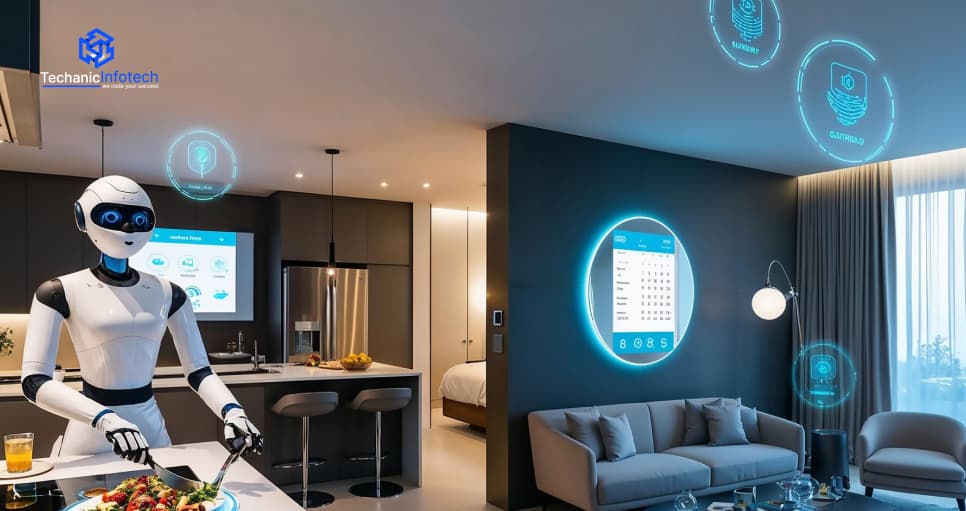
Artificial Intelligence (AI) is transforming home services in Australia by automating routine tasks, improving efficiency, and enhancing customer experience.
AI in home services refers to the use of technologies like machine learning, chatbots, and predictive analytics to streamline operations such as booking, maintenance, and energy management.
From smart scheduling to predictive maintenance, AI is helping businesses operate more efficiently while reducing costs.
This article explores the cost of implementing AI, key use cases across the industry, and the real-world impact it is creating for home service providers and customers throughout Australia.
AI is widely used in home services to automate customer interactions, optimize operations, predict maintenance issues, enhance home design, and improve energy efficiency, making services faster, smarter, and more reliable.
AI chatbots and virtual assistants handle customer inquiries instantly, enabling 24/7 booking and support.
They reduce response times, improve customer satisfaction, and free human staff to focus on complex service requests.
AI improves technician efficiency through intelligent route planning and automated job allocation.
It minimizes travel time, reduces delays, and ensures the right professional is assigned to the right job quickly.
AI detects appliance faults before breakdowns occur by analyzing performance data.
It enables proactive maintenance of HVAC and electrical systems, reducing downtime, lowering repair costs, and improving service reliability.
AI tools used for mobile app development generate realistic renovation visualizations and offer personalized interior design suggestions.
Homeowners can preview changes, optimize layouts, and make better design decisions based on preferences and budget constraints.
AI-driven systems optimize energy consumption by analyzing usage patterns.
Smart thermostats and load balancing reduce electricity costs, improve efficiency, and support sustainable living through automated energy management.
Implementing AI in home services typically costs between $8,000 and $50,000+, depending on complexity, features, and scale, ranging from basic automation tools to advanced enterprise-level intelligent systems.
The table below summarizes different levels of AI solutions for home services in Australia, highlighting their associated cost of AI app development and key benefits.
It helps businesses understand the investment required and the advantages offered by small, mid-scale, and enterprise-level AI systems.
|
AI Solution Level |
Cost (AUD) |
Key Features & Benefits |
|
Small AI Solutions |
$8,000 – $15,000 |
- Basic chatbots or scheduling automation - Improves customer support - Enhances operational efficiency |
|
Mid-scale Implementations |
$15,000 – $30,000 |
- Integrates multiple AI tools - Predictive maintenance - Smart scheduling - Enhances workflow and service quality |
|
Enterprise-level Systems |
$50,000+ |
- Full automation - Advanced analytics - System-wide integration - Maximizes efficiency and scalability for large businesses |
These include basic tools like chatbots, virtual assistants, or scheduling automation. They are typically accessible for small home service businesses, with costs ranging from around $8,000 to $15,000.
Despite the lower investment, they significantly improve customer support and streamline daily operations.
Mid-scale AI solutions integrate multiple tools, such as predictive maintenance and smart scheduling, to provide broader automation across operations.
These implementations usually cost between $15,000 and $30,000 and are ideal for growing businesses seeking to enhance workflow efficiency and deliver a better customer experience across several service areas.
Enterprise solutions offer full automation, advanced analytics, and end-to-end integration across all operations.
With investments typically starting at $50,000 and higher, these systems are designed for large businesses with complex service networks, providing maximum efficiency, predictive insights, and scalable solutions.
AI App Development and setup may cost $5,000–$20,000, integration with existing systems $2,000–$15,000, and ongoing maintenance or subscriptions range from $1,000 to $10,000+, depending on complexity and service requirements.
|
Cost Component |
Description |
Estimated Cost Impact (%) |
|
Development and setup |
Initial AI system design, customization, and deployment |
$5,000 – $20,000+ |
|
System integration |
Connecting AI with CRM, scheduling, billing, and other tools |
$2,000 – $15,000 |
|
Data preparation |
Data cleaning, structuring, and migration for accurate AI performance |
$1,000 – $8,000 |
|
Training and onboarding |
Staff training to effectively use AI tools and workflows |
$500 – $5,000 |
|
Ongoing maintenance & support |
System updates, monitoring, bug fixes, and performance improvements |
$1,000 – $10,000+ |
|
Cloud and API costs |
Hosting, storage, and API usage are based on scale and usage |
$500 – $3,000+ |
Initial AI development for business applications and setup typically costs between $5,000 and $20,000, depending on customization, features, and vendor expertise, with higher costs for advanced automation or predictive capabilities.
Integrating AI with existing tools like CRM, scheduling, and billing systems ranges from $2,000 to $15,000, depending on compatibility, required customization, and the complexity of the current software infrastructure.
Data cleaning, structuring, and migration can cost $1,000 to $8,000, as accurate and organized data is essential for effective AI performance, forecasting, and decision-making in home service operations.
Employee training and onboarding may cost between $500 and $5,000, depending on team size and system complexity, ensuring staff can effectively use AI tools and workflows.
Maintenance, updates, and support typically range from $1,000 to $10,000+ annually, covering system monitoring, bug fixes, performance improvements, and adapting AI models to business changes.
Cloud hosting, storage, and API usage fees can add $500 to $3,000+ per year, depending on data usage, number of users, and scalability requirements of the AI solution.
The cost of implementing AI in Australia’s home services industry varies widely depending on operational, technical, and strategic factors.
Understanding these cost drivers helps businesses plan investments effectively and maximize return while minimizing unnecessary expenses.
|
Factor |
How It Affects AI Cost |
Estimated Cost Impact (%) |
Typical Cost Range |
|
Business size and complexity |
Larger businesses require scalable, customized AI systems; smaller ones use simpler tools |
15% – 25% |
$3,000 – $15,000+ |
|
Data readiness |
Clean, structured data lowers costs; poor data increases preparation and error handling |
10% – 20% |
$1,000 – $8,000 |
|
Custom vs off-the-shelf |
Custom solutions cost more but offer flexibility; off-the-shelf reduces upfront expenses |
20% – 30% |
$5,000 – $20,000+ |
|
Technology infrastructure |
Modern systems reduce cost; outdated tech increases upgrade and compatibility expenses |
10% – 20% |
$2,000 – $10,000 |
|
Integration with systems |
Complex integrations raise development time and cost |
15% – 25% |
$2,000 – $15,000 |
|
Ongoing maintenance & support |
Continuous updates, monitoring, and improvements add recurring costs |
10% – 20% annually |
$1,000 – $10,000+ per year |
Business size and complexity determine AI investment for Australian home services.
Larger operations need scalable systems, while small businesses benefit from simpler tools with faster deployment and lower upfront costs.
Data readiness is critical for AI adoption in Australian home services.
Clean, structured data enables accurate predictions, scheduling, and customer insights, while poor data quality increases costs and limits impact.
Choosing between custom and off-the-shelf AI solutions depends on budget, mobile app development timeline, and needs.
Custom systems offer flexibility and competitive advantage, while ready-made tools reduce costs, implementation time, and technical complexity.
Existing technology infrastructure significantly impacts AI costs.
Businesses with modern systems can integrate AI more easily, while outdated platforms require upgrades, increasing implementation time, complexity, and overall investment requirements.
Integrating AI with current tools like CRM, scheduling, and billing systems affects costs.
Seamless AI integration in mobile app development reduces disruption, while complex or incompatible systems demand additional development, increasing both expenses and deployment timelines.
AI systems require continuous monitoring, updates, and support. Costs include model improvements, system maintenance, and troubleshooting.
Businesses must budget for long-term expenses to ensure consistent performance and sustained value from AI investments.
AI delivers strong ROI by reducing operational costs, improving efficiency, enhancing customer experiences, and increasing revenue, often paying for itself within a short implementation period.
AI reduces dependency on large support teams by automating repetitive tasks like booking, inquiries, and scheduling.
Businesses save significantly on salaries, training, and human errors, making AI a cost-effective long-term investment compared to hiring additional staff.
AI streamlines workflows by automating scheduling, dispatching, and diagnostics.
This reduces delays, improves job completion rates, and allows businesses to handle more requests without increasing workforce size, boosting overall operational efficiency and productivity.
Faster response times, personalized services, and proactive maintenance improve customer satisfaction.
Happy customers lead to repeat business, positive reviews, and referrals, ultimately driving higher revenue and a stronger brand reputation in competitive markets.
Most home service businesses recover their AI investment within 6 to 18 months.
Faster ROI is achieved through reduced labor costs, increased efficiency, and improved customer retention, making AI financially viable even for growing businesses.
Australian home service businesses are actively adopting AI across property management, customer service, energy systems, and renovation planning, demonstrating practical benefits in efficiency, cost reduction, and customer experience.
Property managers use AI to automate tenant communication, rent tracking, and maintenance scheduling.
These tools reduce administrative workload, improve response times, and enhance tenant satisfaction while enabling managers to handle larger property portfolios efficiently.
Many Australian service companies use AI receptionists to answer calls, book appointments, and handle inquiries.
This ensures 24/7 availability, reduces missed opportunities, and provides consistent customer service without requiring additional staff.
AI-driven energy systems monitor usage patterns and automatically adjust consumption.
Australian households benefit from reduced electricity bills, improved sustainability, and better control over energy usage through smart automation technologies.
Home renovation companies use AI to create realistic visual previews of projects.
Customers can see design changes before execution, reducing uncertainty, improving decision-making, and increasing satisfaction with final renovation outcomes.
AI tools help detect leaks, pressure issues, and system inefficiencies early.
Service providers can fix problems proactively, reducing emergency repairs, lowering costs, and improving reliability for homeowners across Australia.
AI in Australia’s home service sector is evolving rapidly, with advancements in automation, IoT integration, and affordability expected to transform how professional mobile app development services are delivered and managed in the near future.
Homes will increasingly use AI to self-manage systems like lighting, security, and appliances.
These autonomous systems will reduce human intervention, improve efficiency, and create seamless living experiences through intelligent automation.
Voice assistants will enable customers to book services, manage appointments, and control home systems using simple voice commands.
This trend will enhance convenience and accessibility for users across all age groups.
The integration of AI with IoT devices will enable real-time monitoring and smarter decision-making.
Connected systems will communicate seamlessly, improving maintenance, energy efficiency, and overall home management capabilities.
As AI tools become more accessible and cost-effective, small and medium-sized businesses will adopt them more widely.
Lower costs and scalable solutions will drive broader adoption across the home service industry.
AI is a valuable investment for home service businesses, especially when managing rising costs, increasing customer expectations, and operational inefficiencies.
It helps streamline scheduling, improve customer service, and enhance decision-making.
Small and medium businesses can begin by seeking help from an AI app development company with cost-effective tools, while larger enterprises can implement advanced, fully integrated systems for greater impact.
Reduces operational costs through automation
Improves customer experience with faster responses
Optimizes scheduling and workforce management
Scales easily with business growth
Provides data-driven insights for better decisions
A strategic approach, identifying pain points, setting goals, and choosing scalable solutions, ensures long-term value and measurable returns.
AI is reshaping the home service industry in Australia by delivering smarter, faster, and more efficient solutions.
From customer support automation to predictive maintenance and energy optimization, AI helps businesses reduce costs while improving service quality.
Although the initial investment ranges from $8,000 to $50,000+, the long-term benefits, such as increased efficiency, reduced labor costs, and higher customer satisfaction, make it a worthwhile investment.
Real-world adoption across Australia shows that both small businesses and large enterprises can benefit from AI.
As technology becomes more affordable and advanced, AI will continue to play a critical role in transforming home services, making them more reliable, personalized, and future-ready.
AI implementation typically costs between $8,000 and $50,000+, depending on the solution type, business size, and level of customization required for automation and analytics.
Yes, small businesses can start with affordable AI tools like chatbots and scheduling software, which require lower investment and deliver quick efficiency improvements without high upfront costs.
The best AI tool depends on business needs. Popular options include chatbots for support, scheduling software, and predictive maintenance systems tailored to specific service operations.
Most businesses see ROI within 6 to 18 months through cost savings, improved efficiency, and increased customer satisfaction, making AI a practical investment.
AI implementation can be simple with ready-made tools. However, custom solutions may require technical expertise, integration, and proper planning to ensure successful deployment.
AI does not replace workers but enhances productivity by automating repetitive tasks, allowing employees to focus on more complex and value-driven activities.
Industries like HVAC, plumbing, electrical services, cleaning, and property management benefit significantly from AI-driven automation and predictive maintenance capabilities.
Yes, most AI systems follow strict security protocols, but businesses must ensure compliance with data protection regulations and implement proper cybersecurity measures.
AI improves satisfaction through faster responses, personalized services, and proactive issue resolution, leading to better customer experiences and higher retention rates.
The future includes autonomous systems, voice-based interactions, and deeper IoT integration, making home services more efficient, intelligent, and user-friendly.


Bharat Sharma is the CTO of Techanic Infotech, bringing deep technical expertise in software architecture, mobile app development, and scalable system design. He leads the engineering team with a strong focus on innovation, performance, and security.