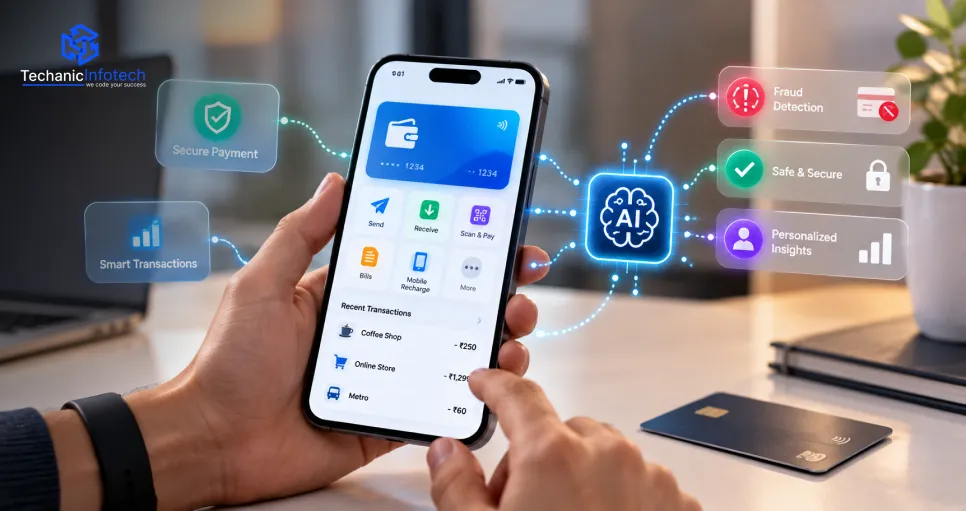
EWallet App Development
How to Build an AI Powered eWallet App With Smart Payments and Fraud Detection?
September 10, 2026
September 10, 2026
Digital wallets have already made everyday payments easier. Users can transfer money, pay bills, scan QR codes, manage cards, and track transactions without carrying cash.
The next change is intelligence.
Artificial intelligence can help an eWallet do more than process a payment. It can analyze transaction behavior, identify suspicious activity, personalize financial insights, improve customer support, and help users understand how they spend money.
For businesses planning a digital payment product, this creates an interesting opportunity. Instead of competing only on transaction speed or cashback offers, an AI powered wallet can provide a more useful experience around the payment itself.
Building one requires much more than adding an AI chatbot to a normal wallet. Payment infrastructure, APIs, banking integrations, identity verification, security, fraud monitoring, backend architecture, and AI models need to work together.
This is where an experienced eWallet app development company can help turn the idea into a secure and scalable payment product.
An AI powered eWallet is a digital wallet that uses artificial intelligence alongside standard payment functionality.
The core wallet may still provide familiar features such as money transfers, bill payments, QR payments, wallet funding, transaction history, and account management.
AI adds intelligence around those transactions.
For example, the app might notice that a payment does not match the user's normal behavior and request additional verification.
It could analyze previous spending and provide a useful monthly summary.
It could understand a question such as:
How much did I spend on food last month?
and generate an answer from the user's transaction history.
The important distinction is that AI supports the payment experience. It does not replace the secure systems responsible for actually moving money.
Payment apps generate large amounts of behavioral and transaction data.
Used responsibly, that information can help an application identify patterns that traditional fixed rules may miss.
Consider fraud detection.
A conventional system may block a transaction because it exceeds a particular amount.
An AI based system can look at several signals together. A payment may be unusual because of its amount, location, device, timing, merchant category, and difference from previous behavior.
The amount alone may not be suspicious. The context may be.
AI can also improve areas that are less security focused, including customer assistance, transaction search, spending analysis, personalization, and financial recommendations.
The opportunity is therefore not simply to create a smarter wallet. It is to reduce friction around how users manage and understand their payments.
Businesses do not need every possible AI feature at launch. The best features are the ones that improve trust, convenience, or financial visibility.
Fraud detection is one of the strongest use cases for artificial intelligence in digital wallets.
Every transaction creates signals.
These can include the transaction amount, device, merchant, frequency, location, account behavior, and recent activity.
Machine learning models can analyze these signals and estimate whether an activity looks normal or unusual.
Imagine a user normally makes small domestic payments from one device. Suddenly, the account attempts a much larger transaction from a new device and unfamiliar location.
The system can recognize the combination of unusual behavior and respond appropriately.
Depending on the risk level, it might request additional verification, temporarily hold the transaction, or send the case for further review.
This approach can be more flexible than relying only on static fraud rules.
Security is already one of the more difficult parts of wallet development. Businesses evaluating the technical risks can also review the common eWallet app development challenges, including security, compliance, scalability, and payment integration issues.
Payments do not always need to follow exactly the same route.
An eWallet may work with several banking systems, payment processors, cards, or local payment methods.
A smart payment system can use available information to determine the most appropriate route for a transaction.
The decision may consider processing success, transaction type, availability, user preference, or other operational factors.
For the user, the process should remain simple.
They tap pay.
The complexity stays behind the interface.
This can become particularly useful for wallets operating across several markets or supporting multiple payment methods.
Transaction histories can become difficult to understand when users make dozens or hundreds of payments every month.
AI can automatically categorize spending into useful groups such as groceries, transportation, entertainment, subscriptions, shopping, or utilities.
The system can also learn from corrections.
If a particular merchant is categorized incorrectly, the user's change can help improve future organization.
This turns a basic transaction log into something closer to a financial overview.
Once transactions are categorized, the app can provide more useful financial information.
Instead of showing only a list of payments, an AI powered wallet might explain that restaurant spending increased compared with the previous month or that several subscriptions are due within the next week.
The goal should not be to overwhelm users with constant financial advice.
Useful insights are specific and timely.
A simple message such as your recurring payments are higher this month because two annual subscriptions renewed is more valuable than a generic suggestion to spend less.
Conversational AI can make wallet information easier to access.
Users may not want to search through transaction filters every time they need an answer.
They could instead ask:
Show my largest transactions this month.
How much did I send to Rahul in the last six months?
Which subscriptions were charged this week?
The assistant can interpret the request and retrieve relevant information from the wallet.
This requires controlled access.
The language model should only receive the information the authenticated user is allowed to access.
The assistant should also distinguish between providing information and performing financial actions.
Showing a transaction history carries much less risk than transferring money.
That difference needs to be reflected in permissions and approval flows.
Traditional fraud systems are still useful.
Rules can block known risky actions quickly and consistently.
AI should usually complement those controls rather than remove them.
For example, a fixed rule may require extra verification for certain high risk actions. An AI model can examine behavioral patterns that do not fit neatly into one predefined rule.
A strong fraud system can therefore combine both approaches.
|
Area |
Traditional Rules |
AI Fraud Detection |
|
Decision logic |
Predefined conditions |
Pattern based analysis |
|
Adaptation |
Requires rule updates |
Can improve using new data |
|
Behavioral analysis |
Limited |
Stronger across multiple signals |
|
Explainability |
Usually straightforward |
Requires careful model monitoring |
|
Best use |
Known fraud patterns |
Complex or changing behavior |
The aim is not to choose one and discard the other. Payment security usually benefits from multiple layers of protection.
A smart payment begins before money moves.
The app first identifies the user and validates the payment request.
The backend then checks the transaction details, wallet balance or funding source, permissions, and relevant payment rules.
AI can analyze contextual signals during this process.
If the transaction appears normal, it continues through the payment infrastructure.
If it looks unusual, the application may request additional verification.
After processing, the app updates the wallet balance and transaction history and can use the new transaction as another signal for future analysis.
The user sees a simple payment flow, but several systems may be communicating behind the scenes.
This is why APIs are so important. Payment gateways, KYC providers, banking systems, authentication services, notifications, and wallet balances all need reliable connections. The detailed guide to eWallet API integration explains the role these integrations play in digital wallet architecture.
AI should enhance the wallet, not distract from its basic purpose.
Before introducing advanced intelligence, the application still needs dependable payment features.
A practical eWallet may require secure registration, identity verification, wallet funding, money transfers, QR payments, bill payments, transaction history, notifications, account management, and customer support.
Advanced features can then be added according to the business model.
These may include biometric access, rewards, multi currency support, merchant payments, subscription management, or AI based financial insights.
The balance matters.
Users will not care how intelligent the wallet is if basic payments are unreliable.
An AI wallet usually contains several distinct layers.
The mobile interface handles registration, authentication, payments, transaction history, notifications, financial insights, and user interaction.
It must remain fast even when AI features require additional processing.
The backend manages business logic, account information, transaction processing, payment gateways, banking APIs, and communication between different services.
This layer should remain separate from the AI model.
An AI assistant may recommend an action, but secure backend systems should determine whether that action is actually permitted.
This layer can support fraud detection, transaction categorization, predictive analytics, personalization, or conversational features.
Different tasks may use different models.
A fraud model and a conversational assistant, for example, solve completely different problems and should not be treated as one AI system.
Wallet applications handle highly sensitive information.
Databases may store account data, transaction records, preferences, merchant information, and system logs.
AI features should receive only the data needed for their specific task.
APIs connect the wallet with banks, payment processors, identity verification providers, bill payment services, currency services, notification systems, and other external platforms.
Choosing the right technical foundation matters because every layer affects payment performance and security. Businesses planning the architecture can use the eWallet app tech stack guide to understand how frontend, backend, databases, APIs, security technologies, and cloud infrastructure fit together.
The development process should begin with the payment use case, not with the AI model.
First decide what kind of wallet the business needs.
A closed wallet may operate within one company ecosystem.
A semi closed wallet may work across an approved merchant network.
A broader payment wallet may require more extensive banking and regulatory integrations.
The business model affects almost every technical decision that follows.
The next step is identifying where intelligence creates enough value to justify the additional complexity.
Fraud detection may be a priority for a transaction heavy product.
A consumer finance wallet may benefit more from spending insights and conversational search.
A merchant wallet may need predictive analytics and transaction monitoring.
Trying to introduce every AI feature in the first version can increase development cost without improving the core payment experience.
Payment flows, wallet balances, transaction records, security controls, and external integrations need to be mapped before development.
The team should define what happens during successful payments, failed payments, refunds, reversals, suspicious activity, and unavailable external services.
AI then fits into those workflows where it adds value.
Development covers the mobile interface, backend, databases, payment integrations, identity systems, AI models, notifications, and administrative tools.
Payment and AI components should be tested both independently and together.
Payment apps need more than basic functional testing.
The team should test unusual transaction patterns, failed external services, incorrect user information, high transaction volume, delayed responses, fraud alerts, and account recovery situations.
AI models also need evaluation against legitimate unusual behavior so the fraud system does not create unnecessary blocks for genuine users.
Fraud detection is important, but AI should not become the only security layer.
An eWallet still needs secure authentication, encryption, controlled API access, transaction monitoring, session management, and appropriate verification mechanisms.
Users should also receive clear information when an unusual transaction requires additional verification.
The system should not simply decline payments without giving legitimate users a reasonable recovery path.
Payment products need to balance security and usability.
Too little security creates obvious risk.
Too much friction can push genuine users away.
The cost depends on how much functionality the wallet needs.
A basic wallet with conventional payments and one AI feature will require less development than a multi currency platform with merchant services, advanced fraud detection, financial analytics, conversational assistance, and several banking integrations.
Major cost factors include the wallet type, mobile platforms, AI complexity, payment gateways, KYC integrations, backend architecture, security requirements, and third party services.
AI also creates operating costs after launch.
Models, cloud infrastructure, monitoring, storage, and fraud analysis may all contribute to ongoing expenses.
For a detailed breakdown of these variables, the guide to eWallet app development cost covers wallet types, development complexity, integrations, security, platforms, and maintenance considerations.
A useful AI eWallet needs strong payment engineering before it needs impressive AI.
Techanic Infotech can help businesses plan the wallet model, design transaction flows, build the mobile application and backend, integrate payment APIs, implement appropriate AI capabilities, test the product, and prepare it for deployment.
AI features can then be selected according to the actual business need.
A high volume payment product may prioritize fraud detection.
A consumer wallet may need personalized spending intelligence.
A merchant platform may benefit from transaction analysis, automation, and smarter financial dashboards.
Businesses that are still at the planning stage can also review the practical guide on how to start an eWallet business, which covers business models, wallet features, security, integrations, and launch planning.
The strongest implementation is rarely the one with the longest list of AI features.
It is the one where payments remain fast and trustworthy while intelligence quietly makes the wallet safer and easier to use.
AI can move an eWallet beyond basic payment processing.
It can help detect suspicious behavior, organize transactions, personalize financial insights, improve search, and give users a more useful way to understand their money.
But payments leave little room for careless implementation.
AI features need to work alongside secure transaction infrastructure, reliable APIs, clear permissions, strong authentication, and appropriate human or rule based controls.
Businesses should therefore begin with the wallet problem they want to solve.
If fraud is the biggest concern, start there.
If users struggle to understand their spending, improve financial insights.
If support volume is becoming difficult to manage, introduce intelligent assistance.
Build the payment foundation first, then add intelligence where it earns its place.
An AI powered eWallet combines digital payment functionality with artificial intelligence for features such as fraud detection, transaction categorization, personalized insights, intelligent support, and predictive analysis.
AI can analyze transaction behavior and signals such as amount, device, location, frequency, merchant activity, and previous usage patterns to identify unusual activity that may require additional verification.
Useful features include fraud detection, spending categorization, personalized financial insights, smart payment routing, conversational assistance, predictive analytics, and intelligent transaction search.
No. AI fraud detection should work alongside authentication, encryption, secure APIs, transaction controls, verification mechanisms, and other established security measures.
The timeline depends on wallet type, platforms, integrations, features, AI complexity, and security requirements. The detailed eWallet app development timeline explains how requirements, architecture, payment integrations, testing, and deployment affect development time.
Yes. Techanic Infotech can build custom eWallet applications that combine payment processing, banking and payment integrations, user management, AI capabilities, fraud monitoring, and scalable backend systems according to the product requirements.


Abhishek Jangid is the CEO of Techanic Infotech, with extensive experience in mobile app and web development. He specializes in helping businesses turn innovative ideas into scalable digital solutions through strategic planning and modern technology.