Creating an eWallet application is not just about coding, it’s about building a secure and reliable financial solution that users can trust. Every successful app starts with the right eWallet app tech stack, which plays a key role in performance, security, and scalability.
Choosing the right digital wallet tech stack helps handle important functions like payments, user authentication, and data protection smoothly. It also ensures your app can grow as user demand increases.
In this guide, you’ll understand what an eWallet app tech stack is, why it matters, the core features involved, real-world examples, and the common challenges you may face while building a digital wallet app
Let’s get started!
The eWallet app tech stack refers to the set of technologies used to build, run, and manage a digital wallet application. It includes everything from the user interface to backend systems, databases, APIs, and payment integrations.
When you develop a digital wallet, it’s not just one system, it’s a combination of multiple layers working together. A well-planned digital wallet tech stack ensures your app is fast, secure, and scalable.
Here are the key layers of a tech stack for the eWallet app:
Frontend (User Interface): This is the part users interact with. It includes app design, navigation, and overall user experience. A clean and responsive frontend helps users complete transactions quickly and easily.
Backend (Server & Logic): The backend handles all core operations like user authentication, transaction processing, and payment verification. A strong backend is essential for smooth and secure financial operations.
Database (Data Storage): This layer stores user data, transaction history, and app configurations. Since eWallet apps deal with sensitive data, databases must be secure, fast, and reliable.
APIs & Integrations: APIs connect your app with external services such as payment gateways, banking systems, and notification services. They play a key role in expanding app functionality.
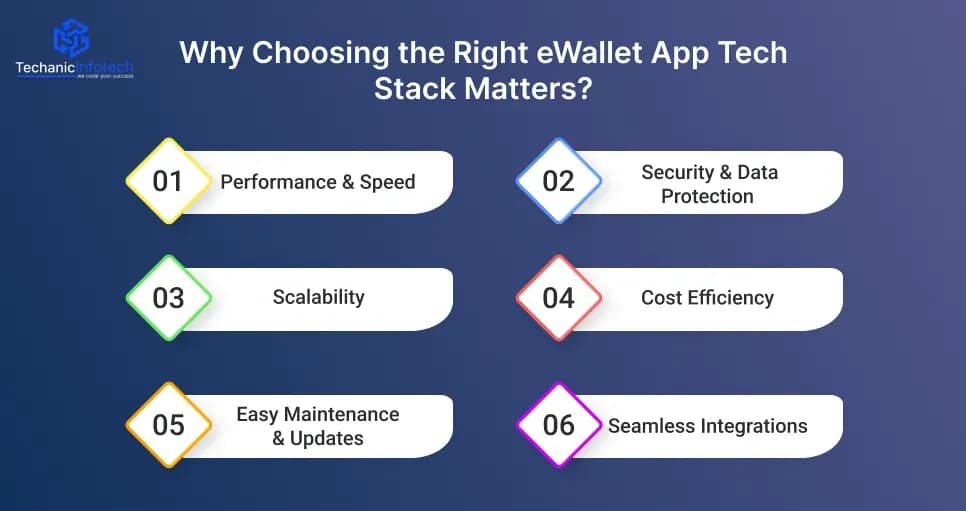
Choosing the right eWallet app tech stack is not just a technical decision, it directly impacts your app’s performance, security, and overall e-wallet app development cost. A well-planned digital wallet tech stack helps you build a fast, secure, and scalable application.
Here’s why it matters:
A strong tech stack for digital wallet apps ensures fast transactions and smooth navigation.
Users expect instant payments; any delay can lead to drop-offs and poor retention. Faster performance directly improves user satisfaction and increases app engagement.
eWallet apps deal with sensitive financial data, so security is critical. The right tech stack for the eWallet app supports encryption, secure APIs, and compliance standards like PCI-DSS, building user trust. Strong security measures reduce risks and help build long-term customer confidence.
As your user base grows, your app should handle more transactions without slowing down.
A scalable eWallet app tech stack ensures your app performs well even during peak usage. Scalability ensures your app can grow without affecting performance or user experience.
Choosing the right technologies helps reduce development time and maintenance costs. A well-optimized digital wallet tech stack prevents unnecessary expenses in the long run.
Smart tech decisions help you maximize ROI while keeping development within budget.
A clean and modern tech stack makes it easier to update features, fix bugs, and keep your app relevant in a fast-changing market. Faster updates help your app stay competitive and aligned with user expectations.
Your app needs to connect with payment gateways, banking APIs, and analytics tools. The right tech stack for digital wallet apps ensures smooth integrations and better functionality. Better integrations enhance app capabilities and deliver a complete user experience.
Let’s break down the key components of a common tech stack for eWallet apps. Below is a table that outlines various elements and their purposes.
|
Component |
Technology |
Purpose |
|
Frontend |
React Native, Flutter |
For cross-platform |
|
Backend |
Node.js, Python |
For server-side logic and APIs |
|
Database |
MongoDB, PostgreSQL |
For storing user and transaction data |
|
Payment Gateway |
Stripe, PayPal |
For processing payments securely |
|
Authentication |
OAuth, JWT |
For secure user authentication |
|
Cloud Hosting |
AWS, GCP |
For scalable and reliable app hosting |
|
APIs |
RESTful APIs |
For communication between front-end and back-end |
The frontend is what users interact with, design, navigation, and overall experience. For eWallet apps, performance and simplicity are critical.
Common technologies include Swift (iOS), Kotlin (Android), and cross-platform frameworks like Flutter or React Native. Native apps offer better performance but cost more, while cross-platform solutions reduce development cost by up to 30–40%.
Cost Impact: Frontend development can range between $1,000 to $5,000, depending on design complexity and platform choice.
The backend is the core of any eWallet app tech stack. It handles transactions, user data, authentication, and overall app logic.
Popular backend technologies include Node.js, Python (Django), and Java (Spring Boot). For real-time transactions, a strong backend is essential to ensure speed and reliability.
Cost Impact: Backend development is one of the most expensive parts, typically costing $3,000 to $8,000+, depending on complexity and scalability requirements.
eWallet apps deal with sensitive financial data, so choosing the right database is crucial.
Technologies like PostgreSQL, MySQL, MongoDB, and cloud storage solutions are commonly used. Databases must be optimized for fast transactions and secure data storage.
Cost Impact: Database setup and optimization can cost around $1,000 to $5,000, with additional ongoing costs for cloud storage and scaling.
APIs are essential in any tech stack for the eWallet app. They connect your app with external services like payment gateways, banking systems, KYC verification, and notifications.
Common integrations include Stripe, PayPal, Razorpay, Plaid, and SMS/email services.
Cost Impact: API integration can cost between $2,000 to $5,000+, plus ongoing transaction or subscription fees.
Security is the backbone of any digital wallet tech stack. Without strong security, users won’t trust your app.
Key technologies include end-to-end encryption, biometric authentication, tokenization, and fraud detection systems. Compliance with standards like PCI DSS is also necessary.
Cost Impact: Security implementation can cost $1,000 to $6,000+, depending on compliance requirements and features.
Cloud infrastructure ensures your app runs smoothly and scales with user growth. Platforms like AWS, Google Cloud, and Azure are widely used.
DevOps tools help automate deployment, monitoring, and updates, improving efficiency and reducing downtime.
Cost Impact: Initial setup may cost $1500 to $6,000, while ongoing cloud costs range from $100 to $1,000+ per month depending on usage.
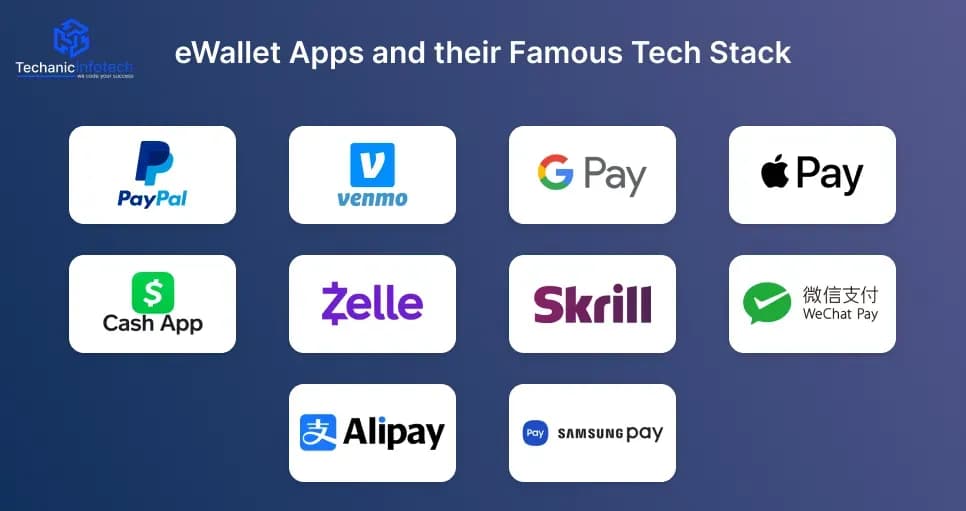
There are many famous eWallet apps present in the market. One thing is for sure, they all use solid technology and frameworks, and knowing their eWallet app tech stack will help you to make better decisions.
Let’s get to know them below:
PayPal is one of the biggest e-commerce companies around the world that allows a consumer to send money online.
Millions of merchants are accepting this platform. It also features invoice generation, subscription services, and international money transfers. To create an app like PayPal, you should consider the below-given tech stack..
TechStack:
• Front-end: React, JavaScript
• Back-end: Java, Node.js
• Database: MySQL, MongoDB
• Payment Gateway: PayPal API
• Cloud Provider: AWS
Venmo is a mobile payment service that is owned by PayPal, basically used among youths for social payments.
Venmo's success doesn’t only attract users but investors too to create an app like Venmo. The service makes it easy to send money to friends with a message that also serves as a social message, making it a social networking app for payments.
Tech Stack:
• Frontend: React Native
• Backend: Node.js, Go
• Database: PostgreSQL
• Payment Gateway: Braintree (owned by PayPal)
• Cloud Provider: AWS
Pay using Google Pay online, in apps, and in-store with Android devices.
It also follows Google services for a more integrated experience across different applications, making it a great model if you want to create an app like Google Pay .
Tech Stack:
• Front-end: Angular, JavaScript
• Back-end: Java
• Database: Bigtable
• Payment Gateway: Google's proprietary payment processing services
• Cloud Provider: GCP
Apple Pay makes the mobile device a relatively safe in-store and online means to pay using the same Apple devices.
It incorporates NFC technology for contactless payments, thereby merging well with the rich Apple ecosystem.
Tech Stack:
• Frontend: Swift (for iOS)
• Backend: Java
• Database: Oracle Database
• Payment Gateway: API owned by Apple
• Cloud Provider: AWS
Square created the Cash App to make it convenient for users to send and receive money. Users can use a cash card for purchases, stock trades, and, interestingly, Bitcoin transactions.
If you want to create an app like Cash , focus on offering diverse features like money transfers, a cash card, and cryptocurrency support.
Tech Stack:
• Frontend: React Native
• Backend: Ruby on Rails
• Database: PostgreSQL
• Payment Gateway: Square API
• Cloud Provider: AWS
Zelle is a digital payment network that allows sending money directly from one bank account to another in the U.S. It's deeply integrated with most banking apps, so there's no need for an app download to transfer money.
Many look to create an app like Zelle, aiming to provide seamless, & direct bank-to-bank transfers.
Tech Stack:
• Front-end: React, JavaScript
• Back-end: Java
• Database: Oracle
• Payment Gateway: Zelle API
• Cloud Provider: AWS
Skrill is an online payment service that allows a user to send and receive money, accept online payments, or exchange currencies. Known for international transfers, Skrill also allows a prepaid card option.
In case, you want to develop an app like Skrill , you should need to focus on secure payment systems
Tech Stack:
• Front-end: Angular, JavaScript
• Back-end: Java, Node.js
• Database: MySQL
• Payment Gateway: Skrill API
• Cloud Provider: AWS
WeChat Pay is also an embedded service within the WeChat messaging app.
Sending money, bill payments, and others are carried out within the app itself. It has a wide usage base in China and it also has advanced eWallet app features such as QR code payments, group transfers, etc.
Tech Stack:
• Frontend: JavaScript, Vue.js
• Backend: Java, Python
• Database: MySQL
• Payment Gateway: WeChat Pay API
• Cloud Provider: Tencent Cloud
Alipay is a mobile payment service created by Ant Financial, Alibaba Group's financial affiliate. The online services it offers are highly diversified online payments, money transfers, and bill payments, mainly in China.
Tech Stack:
• Front-end: React, JavaScript
• Back-end: Java, Go
• Database: Oracle Database
• Payment Gateway: Alipay API
• Cloud Provider: Alibaba Cloud
Samsung Pay is a mobile payment service that works on any Samsung device, and it accepts both NFC and magnetic stripe transactions, which gives versatility to in-store payments.
Tech Stack:
• Frontend: Swift (iOS), Kotlin (Android)
• Backend: Java
• Database: MySQL
• Payment Gateway: Samsung's proprietary payment API
• Cloud Provider: AWS
Selecting the right eWallet app tech stack is a critical decision that affects performance, security, and long-term scalability. A well-planned digital wallet tech stack helps you build a reliable and future-ready application.
Here are the best practices to follow:
Before choosing a tech stack for digital wallet apps, identify your app’s core features such as payment processing, user authentication, and transaction management.
Consulting an experienced eWallet app development company at this stage can help you define the right requirements and avoid costly mistakes. A clear roadmap helps reduce unnecessary development costs and ensures better performance.
Security is non-negotiable in any eWallet app tech stack. Your app must support encryption, secure APIs, and compliance standards like PCI-DSS. Strong security builds user trust and protects sensitive financial data.
Your frontend defines the user experience. Frameworks like Flutter or React Native help build smooth and responsive interfaces across devices. A well-designed UI improves user engagement and increases app retention.
A scalable backend ensures your app can handle increasing users and transactions without performance issues. Technologies like Node.js or cloud platforms like AWS are widely used. Scalability helps your app grow without frequent infrastructure changes.
Your tech stack for the eWallet app should support easy integration with payment gateways like Stripe, PayPal, or Razorpay. Smooth transactions improve user experience and reduce drop-offs.
Fast loading time and quick transactions are essential for digital wallet apps. Lightweight frameworks and optimized databases improve performance. Better performance leads to higher user satisfaction and retention.
Technology evolves quickly, so your digital wallet tech stack should support updates and new features. Staying updated keeps your app competitive and future-ready.
Developing an eWallet app is a big challenge, which involves careful planning and execution.
The chosen tech stack of an eWallet app determines how well this will function, its security level, and the experience of the user.
This could be deciding on the appropriate frontend and backend technologies or ensuring robust security measures.
It all counts from choosing the right frontend and backend technologies to ensuring robust security measures.
Knowing your competition and the challenges you might face will all guide you in making the necessary right choices that would make your digital wallet app a success.
Remember, the right technologies, nothing more than the proper selection of a tech stack for an eWallet application, can be what sets you apart from the crowd.
An eWallet app tech stack refers to the combination of technologies used to build and run a digital wallet app, including frontend, backend, database, APIs, and security systems.
A common tech stack for digital wallet apps includes Swift or Kotlin for frontend, Node.js or Python for backend, PostgreSQL for database, and cloud platforms like AWS.
The chosen digital wallet tech stack affects development time, scalability, and maintenance, which directly impacts the overall cost of building the app.
Popular backend technologies include Node.js, Django (Python), and Java Spring Boot, which handle transactions, authentication, and data processing.
Security is critical because eWallet apps handle sensitive financial data. Technologies like encryption, tokenization, and secure APIs help protect user information.
Yes, frameworks like Flutter and React Native can be used, but for high-security financial apps, native development is often preferred.
APIs for payment gateways (Stripe, PayPal), KYC verification, notifications, and banking integrations are essential in a tech stack for the eWallet app.
It usually takes 3 to 6 months, depending on features, integrations, and the complexity of the eWallet app tech stack.
Core features include user registration, payment processing, transaction history, notifications, and security features like biometric authentication.
You can reduce costs by starting with an MVP, choosing scalable technologies, and working with an experienced eWallet app development company.
Cloud platforms like AWS or Google Cloud help manage data, improve scalability, and ensure smooth performance for growing user bases.
Scalability ensures your app can handle increasing users and transactions without performance issues, supporting long-term growth.


Abhishek Jangid is the CEO of Techanic Infotech, with extensive experience in mobile app and web development. He specializes in helping businesses turn innovative ideas into scalable digital solutions through strategic planning and modern technology.