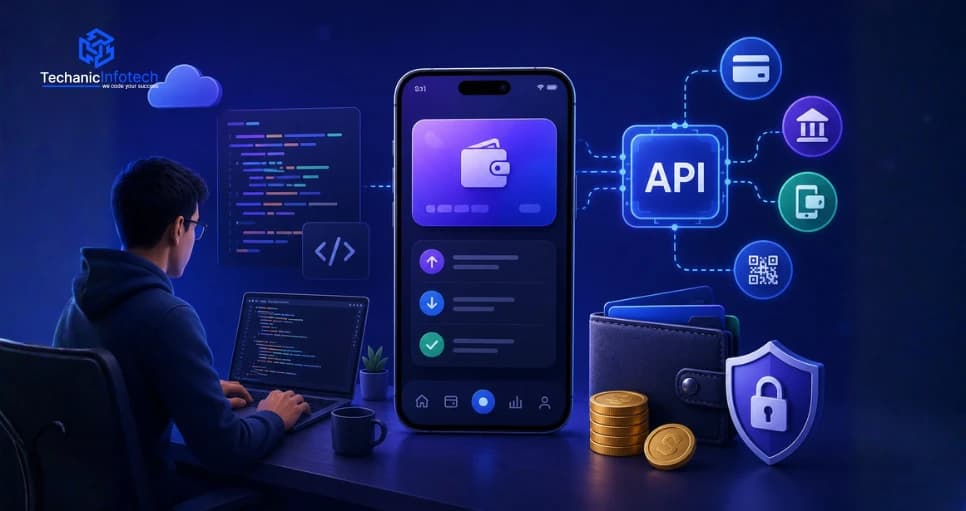
EWallet App Development
Complete Guide to eWallet APIs Integration for Digital Wallet Apps
May 25, 2026
May 25, 2026
Thinking about launching your own digital wallet or payment app?
You're in the right place.
Whether you're building a fintech platform from scratch or adding wallet functionality to your existing app, understanding how eWallet APIs work is crucial.
These APIs are the behind-the-scenes powerhouses that let your app handle payments, store funds, manage transactions, and connect securely with banks or other services.
But not all APIs are created equal. Choosing from the best eWallet APIs means better security, smoother user experiences, and faster development.
In this quick guide, we’ll walk you through the essentials of eWallet API integration, what it is, why it matters, and how to get it right without the headaches.
No tech jargon overload. Just the real stuff you need to make smart decisions and build a reliable digital wallet product.
Let’s dive in!
If you’ve ever wondered how apps like PayPal, Google Pay, or Venmo handle payments so effortlessly, the answer lies in eWallet APIs.
These powerful tools allow your app to interact with payment gateways, banks, and financial systems behind the scenes. Whether it’s verifying users, storing balances, or facilitating transactions, everything happens through the magic of APIs.
When you decide to create an eWallet app, you’ll need a reliable API integration to support your core features. This eWallet APIs guide gives you everything you need to get started, from understanding the basics to choosing the right tools.
Now, let’s dive deeper into why these APIs are a non-negotiable part of your digital wallet journey.
Choosing the right API is like picking the perfect engine for your car; it powers the whole ride.
In the case of digital wallets , a robust API handles all the back-end complexity so you can deliver a seamless user experience.
It also simplifies your development process, making the entire journey smoother for both you and your end users.
Let’s break down why eWallet APIs are so important for your product’s success.
With the best eWallet APIs, you can offer users a flawless transaction experience.
These APIs handle transfers, payments, and balance updates in real-time. No delays, no confusion – just simple, instant money movement.
Users love apps that “just work,” and a powerful transaction engine makes that happen.
Plus, these APIs help you offer cool features like split bills, recurring payments, and one-click checkouts. Trust us, your users will notice.
Digital wallet security isn’t optional, especially when handling money.
Good eWallet APIs come equipped with encryption protocols, tokenization, fraud detection, and tools to support KYC (Know Your Customer) and AML (Anti-Money Laundering) regulations.
These aren’t just buzzwords; they're essential for legal compliance and user trust.
Integrating these security layers through an API saves your development team time and shields your app from threats. A well-secured API is your first line of defense.
Time is money, literally. Thanks to clear documentation and pre-built functionality, a well-chosen API can significantly cut down development time.
That means you can get your product to market faster and start capturing customers before the competition does.
A detailed guide to eWallet APIs will help your developers plug into these services with fewer headaches and more focus on building great user-facing features.
Every app is different, and cookie-cutter solutions just don’t cut it anymore.
With flexible eWallet APIs, you can customize everything, from the way users top up their wallets to how they view transaction histories.
Want to offer loyalty rewards or support international payments? No problem.
APIs give you the modularity to build a product that truly fits your market’s needs, not just what the default settings allow.
You’re not just building for today; you’re building for the future.
As your user base grows, your wallet app needs to handle higher volumes of transactions and users without crashing.
High-performance APIs are built to scale, whether you’re serving hundreds or millions.
With proper eWallet API integration, you can grow confidently, knowing your infrastructure is up to the task.
Rolling out new features and fixes shouldn’t feel like surgery.
With modular API architecture, updates are easier, testing is cleaner, and downtime is minimal.
That means your team spends less time debugging and more time innovating.
Keeping up with the digital wallet trend becomes easier when your system is built for continuous improvement.
Before choosing an API, it helps to know the different types that make up the digital wallet ecosystem.
Each API serves a distinct role, and together they form the foundation of a smart, feature-rich wallet app.
This section in our eWallet APIs guide breaks down the most important types of APIs you’ll need to understand.
These are the engine of your digital wallet.
They handle credit/debit card payments, UPI, net banking, and wallet-to-wallet transfers.
Think Stripe, Razorpay, Adyen, these are your go-to tools for seamless money movement.
A must-have in every guide to eWallet APIs, these APIs manage authorization, settlements, and refunds with minimal friction.
Role of eWallet APIs:
Without these, your app is basically a fancy calculator. They’re essential to making money move.
Security starts with identity.
These APIs manage logins, biometrics, OTPs, and two-factor authentication.
Tools like Auth0 or Firebase make eWallet API integration easy and reliable.
In the age of financial fraud, robust authentication helps win trust fast.
Understanding APIs:
This type of API ensures only the right user can access the right wallet at the right time, every time.
Skip the paperwork, automate compliance.
These APIs help you meet local and international legal requirements.
They handle ID verification, face-matching, document uploads, and background checks.
Onboard users in minutes, not days, without risking compliance violations.
How to Choose the Right eWallet API for Integration?
Pick one that meets your region’s KYC standards and scales as your user base grows.
Give users real-time financial visibility.
Instantly fetch available wallet balances and transaction limits.
Offer up-to-date info without forcing users to refresh or reload.
These APIs enhance UX and reduce support queries.
Role of eWallet APIs:
A smooth user experience depends on knowing how much money they have at all times.
Show users where their money went, and when.
These APIs provide detailed transaction logs, dates, descriptions, and merchant names.
Include filters by category, time range, or type for a professional feel.
Boost user confidence with total transparency.
eWallet APIs guide tip:
Don’t just show data, make it meaningful. Include visual summaries and search filters to improve navigation.
Going global? This one’s critical.
These APIs pull live exchange rates and perform conversions on the fly.
Help users understand foreign transactions with clarity.
Ideal for cross-border payments and international wallet apps.
Understanding APIs:
They’re more than just math, they help your app ride the global trends with ease.
Turn every transaction into a reason to return.
Reward users with cashback, points, or referral bonuses.
These APIs track loyalty metrics and automate reward redemption.
Great for gamifying the app and boosting engagement.
Guide to eWallet APIs tip:
Choose an API that supports customizable rules so you can adjust your loyalty strategy over time.
Let users manage their lives, without leaving your app .
Enable payments for utilities, subscriptions, mobile recharges, and more.
These APIs support one-time and recurring payments, often with invoice validation.
Useful in markets where eWallets are replacing traditional banking.
Types of APIs to consider:
Pick one with multi-biller support and strong uptime, as it’s frustrating when the electricity bill can’t be paid due to downtime.
Tap, scan, done, offline meets online.
These APIs support quick in-store payments using QR codes or NFC-enabled devices.
Great for retail, cafes, and other brick-and-mortar settings.
Build experiences similar to Apple Pay or Google Pay.
eWallet APIs guide tip:
These APIs are critical for enabling a smooth digital wallet feature that your users expect in physical spaces.
Connect with banks like a pro.
These APIs link your wallet app to user bank accounts.
Enable account verification, transfers, balance sync, and direct debits.
Essential for building a full-stack payment experience.
Role of eWallet APIs:
These are foundational for modern wallets; they bring legitimacy and flexibility to your app’s financial ecosystem.
Picking the right wallet API isn’t just about checking boxes, it’s about making smart, future-ready decisions. A strong API can make your app feel fast, secure, and seamless. A poor one? That’s a guaranteed ticket to stress, bugs, and user complaints.
This part of our eWallet APIs guide will walk you through the key factors to help you make the right call, save on unnecessary costs, and build a wallet experience your users will actually enjoy.
Let’s break it down.
Start by answering a simple question: What should your app actually do?
If you’re planning to include bill payments, peer-to-peer transfers, loyalty rewards, or NFC-based checkout, your API needs to support those use cases from the get-go. Make a list of essential features and match them with API capabilities.
This clarity also helps minimize digital wallet app development challenges later on, since you’ll avoid the trap of retrofitting unsupported features mid-project.
Money’s involved, so security isn’t just a feature, it’s your foundation.
Your eWallet API should be PCI-DSS compliant, support strong encryption, and include multi-factor authentication options. Bonus if it comes with built-in KYC/AML support so you stay compliant without coding everything from scratch.
Security-focused APIs also influence your design, users feel more confident using apps that show attention to privacy and data protection from screen one.
You may be launching an MVP today, but where will your app be six months from now?
Opt for APIs that support high transaction volumes, global currencies, and multi-region deployment. That means fewer headaches down the road and fewer code rewrites when your user base explodes.
Poor scalability is one of the hidden problems many businesses don’t see coming—until it’s too late.
An API might be powerful, but if it takes your team weeks to integrate, it’s not worth it.
Look for options that come with robust documentation, pre-built SDKs, testing environments, and active developer communities. These save hours (and sanity) during development and troubleshooting.
Also, don’t underestimate the impact of integration on the cost of digital wallet app development. A hard-to-work-with API can quickly inflate timelines and expenses.
Most APIs advertise their base pricing, but there’s more than meets the eye.
Look out for additional fees: per-transaction charges, limits on API calls, support tiers, or extra costs for international transactions. What seems affordable now might become expensive as your app scales.
Having a clear view of these costs helps you budget more accurately and better manage the overall expenses in the long term.
API documentation is great, but sometimes you just need a human.
A reliable support team can be the difference between a five-minute fix and a five-hour breakdown. Choose providers known for responsive customer service and a solid SLA (Service Level Agreement).
Also, consider uptime history, downtime during a major sale or promotion? Not a good look.
Reliability in your API partner means more time focused on crafting features, like refining your eWallet app design, instead of putting out fires.
Never launch an integration without thorough testing.
Simulate every scenario: failed transactions, expired tokens, slow internet, and currency mismatches. A staging environment lets you break things safely before users experience the chaos.
This habit not only improves app quality but also shields you from unexpected issues.
That could arise after launch.
We believe you have an idea about all the important elements through this eWallet API guide.
When you're searching for an eWallet app development company that gets both the tech and the vision, you need a partner like Techanic Infotech.
We don’t just build eWallet apps; we craft intelligent, secure, and user-first solutions powered by modern APIs and industry best practices.
From seamless eWallet API integration to flawless UI/UX and compliance support, we handle the heavy lifting so you can focus on growth.
Be it a fintech startup or an enterprise brand, our scalable solutions and expert team will help you launch fast, stay compliant, and keep users coming back.
Selecting the appropriate tools is as crucial as selecting the appropriate team.
With this eWallet API guide, you've learned the fundamentals of types of APIs, what to expect, and how to steer clear of digital wallet mistakes.
From payment processing to KYC/AML, the function of eWallet APIs is at the heart of building secure, scalable, and user-friendly wallet applications.
Use this eWallet APIs guide as your blueprint, and when you are ready to construct, rely on the experts who comprehend both the vision and technology involved in your application.
Let us at Techanic Infotech bring your wallet concept to life
An eWallet API allows apps to securely manage payments, wallet balances, and financial transactions.
They simplify payment processing, improve security, and speed up wallet app development.
Common types include payment, authentication, KYC, banking, rewards, and QR payment APIs.
They securely process transactions, transfers, refunds, and payment settlements in real time.
KYC verifies user identities to prevent fraud and comply with financial regulations.
Yes, most APIs use encryption, tokenization, and multi-factor authentication for security.
Choose an API based on security, scalability, pricing, features, and developer support.
Yes, many APIs support global transactions and multi-currency payments.
They enable fast and contactless in-store digital payments.
Integration time depends on app complexity and required features.


Abhishek Jangid is the CEO of Techanic Infotech, with extensive experience in mobile app and web development. He specializes in helping businesses turn innovative ideas into scalable digital solutions through strategic planning and modern technology.