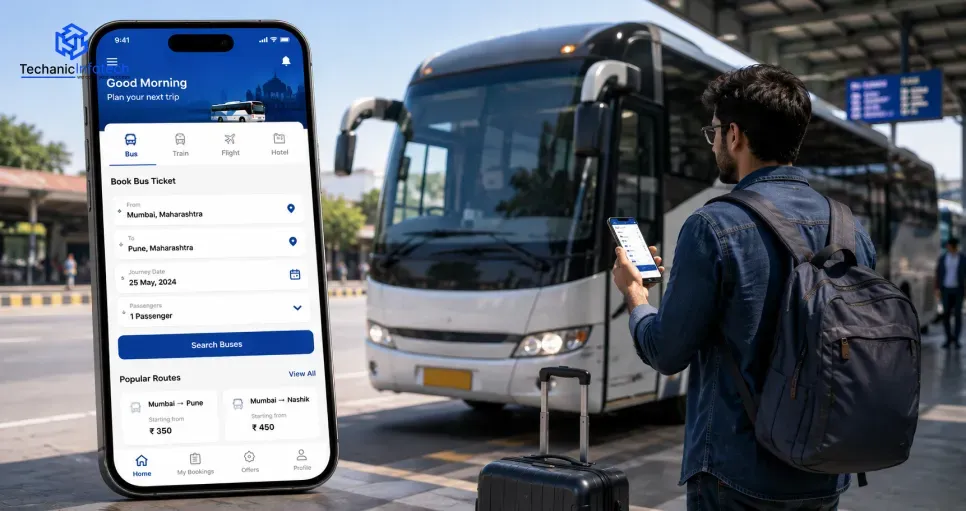
Mobile App Development
Bus Ticket Booking App Development: A Complete Guide for Businesses
August 27, 2026
August 27, 2026
Key Takeaways:
Bus ticket booking app development can cost around $6,000–$70,000+, depending on complexity, features, platforms, and integrations.
A basic MVP may take 2–3 months, while an enterprise-level platform can require 7–10+ months.
Essential functionality includes route search, bus listings, seat selection, online payments, digital tickets, notifications, and booking management.
Separate interfaces for passengers, bus operators, drivers, and administrators can improve platform management.
GPS tracking, travel APIs, AI, dynamic pricing, and advanced analytics can increase both functionality and development cost.
Bus travel is increasingly shifting toward digital booking, allowing passengers to search routes, compare schedules, select seats, make payments, and manage reservations through mobile applications. For transport operators, travel startups, and booking platforms, a dedicated bus ticketing application can simplify reservations while creating new opportunities to reach and retain customers.
A successful bus ticket booking app development project requires more than basic ticket reservations. The platform may need real-time schedules, seat availability, route information, secure payments, GPS tracking, notifications, cancellation management, and separate interfaces for passengers, operators, drivers, and administrators.
Businesses should also consider their revenue model, target audience, technology requirements, scalability, and future expansion before development begins. Whether the goal is to launch an on-demand bus booking service or a multi-operator marketplace, defining the right scope can help control development complexity.
This bus ticket booking app guide covers the major aspects of building a bus booking platform, including its benefits, working model, essential features, development process, technology stack, AI opportunities, estimated cost, and development timeline.
The intercity bus travel market size in 2026 is estimated at USD 21.81 billion, growing from the 2025 value of USD 20.43 billion, with 2031 projections showing USD 30.19 billion, growing at 6.74% CAGR over 2026-2031.
The global online bus ticket service market size was valued at USD 10.14 billion in 2025 and is projected to grow from USD 11.48 billion in 2026 to USD 30.95 billion by 2034, registering a CAGR of 13.2% during the forecast period from 2026 to 2034.
Asia Pacific dominated the online bus ticket service market with a market share of 41.8% in 2025.
According to Straits Research, India's online bus ticketing market was valued at $593.67 million in 2024 and is projected to reach $2.01 billion by 2030, representing a 25.9% CAGR. Mobile was the leading segment in 2024.
The growing preference for digital travel services is creating opportunities for businesses to provide convenient and flexible bus reservation experiences. A mobile booking platform can connect passengers with bus operators while simplifying the entire ticketing process.
Passengers increasingly expect to search routes, compare schedules, check seat availability, and book tickets online instead of visiting physical counters. A mobile-first booking platform can meet these changing expectations.
A digital platform allows bus operators and booking businesses to reach customers across different cities and regions. Users can discover available routes and reserve tickets from anywhere.
Digital reservations can reduce manual ticketing, paperwork, and counter-based processes. Automated booking confirmations, cancellations, payments, and notifications can also reduce administrative workload.
Passengers can view available seats and select their preferred option before completing a reservation. Operators can simultaneously manage inventory and reduce the risk of duplicate bookings.
Push notifications, personalized offers, loyalty programs, booking reminders, and digital support can help businesses maintain ongoing relationships with customers.
A bus booking platform can generate revenue through booking commissions, service fees, operator subscriptions, premium listings, advertising, and partnerships with other travel businesses.
Businesses can start with selected routes and gradually expand to additional cities, operators, and transportation services. The platform can eventually expand into complementary services such as hotel booking app development and flight reservations, creating a broader travel ecosystem.
A well-designed bus ticket booking platform can benefit both passengers and transportation businesses. By moving reservations and related services online, businesses can improve operational efficiency while providing customers with a more convenient travel experience.
Passengers can search routes, compare schedules, select seats, make payments, and receive digital tickets without visiting a physical booking counter.
A mobile application can help bus operators reach customers across different locations and make their services available beyond traditional ticket counters.
A scalable platform can support additional routes, operators, cities, and transportation services, including train ticket booking app development, as the business grows.
Automated reservations, payments, confirmations, cancellations, and notifications can reduce paperwork and minimise repetitive administrative tasks.
Operators can manage seat availability in real time, reduce duplicate bookings, and keep reservation information synchronized across the platform.
Features such as live bus tracking, booking reminders, digital tickets, route information, customer support, and personalized offers can improve the overall journey.
Booking history and customer activity can provide insights into popular routes, peak travel periods, customer preferences, and revenue performance.
Businesses can generate income through commissions, service charges, premium listings, subscriptions, advertisements, and partnerships with other travel providers.
Businesses can also integrate complementary services through travel app development companies, allowing users to access hotels, flights, local transportation, or other travel-related services from the same platform.
A bus ticket booking app connects passengers, bus operators, drivers, and administrators through a centralized digital platform. Each user type has specific functions, while the backend manages routes, schedules, seats, bookings, payments, and notifications.
Passengers can create an account, search routes, select travel dates, compare buses, check seat availability, choose seats, make payments, and receive digital tickets.
Operators can add buses, create routes, update schedules, manage fares, monitor seat availability, view reservations, and track revenue through a dedicated dashboard.
A driver interface can provide assigned routes, passenger information, trip schedules, pickup details, and relevant journey updates.
The admin panel provides centralized control over users, operators, buses, routes, bookings, payments, commissions, cancellations, reviews, and reports.
Typical Booking Workflow
The passenger enters the departure and destination locations.
The app displays available buses and schedules.
The passenger applies filters and selects a suitable bus.
Available seats and fare details are displayed.
The passenger selects a seat and enters required information.
Payment is completed through the selected payment method.
The booking is confirmed, and a digital ticket is generated.
The passenger receives confirmation and travel notifications.
The operator receives updated booking information.
Real-Time Synchronization
The backend must synchronize seat availability, schedules, fares, and bookings across passengers and operators. This helps prevent duplicate reservations and ensures customers see accurate information.
For businesses planning to build a bus ticket booking app, a well-structured booking workflow is essential for delivering reliable reservations and smooth coordination between passengers and transport operators.
The right features determine how easily passengers can search, book, and manage their journeys while helping operators manage routes, buses, schedules, and reservations.
User registration and secure login
Route and destination search
Date and schedule selection
Bus listing and comparison
Seat availability and seat selection
Fare details
Online ticket booking
Multiple payment options
Digital tickets
Booking history
Cancellation and refund requests
Push notifications
Ratings and reviews
Customer support
GPS-based bus tracking
Operator registration and verification
Bus and fleet management
Route and schedule management
Fare management
Real-time seat inventory
Booking management
Passenger information
Trip management
Earnings and commission tracking
Reports and analytics
Driver profile
Assigned trip details
Route information
Passenger list
Trip status updates
Navigation and GPS tracking
Emergency or support contact
User and operator management
Bus and route management
Booking and cancellation management
Payment and commission management
Content management
Reviews and complaints
Promotions and offers
Analytics and reports
Notifications management
A more advanced platform can include AI-powered recommendations, dynamic pricing, multilingual support, multiple currencies, loyalty programs, live trip tracking, automated customer support, and personalized travel offers.
A structured development process helps businesses turn a bus booking idea into a reliable and scalable platform. Each stage should be planned according to the target market, user requirements, and business model.
Identify the target users, routes, bus operators, service area, revenue model, and core booking requirements.
Analyze competing booking platforms, customer expectations, pricing models, and gaps in existing services to identify opportunities for differentiation.
Separate essential features from advanced functionality. Prioritize booking, route search, seat selection, payments, notifications, and operator management for the initial release.
Create wireframes, user flows, prototypes, and final interfaces for passengers, operators, drivers, and administrators. The booking process should remain simple and intuitive.
Choose appropriate mobile frameworks, backend technologies, databases, cloud services, APIs, and security tools based on the expected platform scale.
Develop the passenger application, operator dashboard, driver interface, admin panel, backend services, booking engine, and payment system.
Integrate payment gateways, maps, GPS tracking, SMS, email, push notifications, analytics, and other required APIs.
Conduct functional, usability, performance, security, compatibility, and payment testing. Seat availability and booking synchronization should receive particular attention.
Deploy the application to the required platforms, configure production servers, complete app-store submissions, and monitor the first release.
After launch, analyze customer feedback and application performance. Fix bugs, release updates, improve features, and expand routes or operators based on demand.
Working with an experienced bus ticket booking app development company and following a clear bus booking app development process can help businesses control project scope, reduce development risks, and create a platform that can scale with growing bookings.
Technology choices and third-party integrations can contribute significantly to the overall development budget. The exact expense depends on the selected technologies, number of integrations, customization requirements, and platform complexity.
|
Technology / Integration |
Estimated Cost |
|
Mobile App Development |
$2,000–$6,000 |
|
Frontend Web Development |
$1,500–$4,000 |
|
Backend Development |
$3,000–$8,000 |
|
Database Setup |
$800–$2,000 |
|
Cloud Infrastructure Setup |
$600–$2,000 |
|
Maps & GPS Integration |
$800–$2,500 |
|
Payment Gateway Integration |
$500–$2,500 |
|
SMS & Push Notifications |
$300–$1,000 |
|
Third-Party Travel APIs |
$1,000–$4,000+ |
|
Security & Authentication |
$800–$2,500 |
|
Analytics & Monitoring |
$300–$1,200 |
These figures are estimates rather than fixed prices. The final ticket booking app development cost depends on the required technology architecture, number of platforms, integrations, development location, and project complexity.
AI can make bus booking platforms more personalized, efficient, and responsive. Businesses can use AI to automate routine tasks, improve recommendations, and analyze travel data.
AI can analyze travel history, preferred destinations, schedules, and booking patterns to recommend suitable routes and buses.
AI chatbots can answer common questions about routes, fares, bookings, cancellations, and travel policies without requiring constant human support.
AI can identify customer preferences and provide relevant discounts, promotional offers, and travel recommendations.
Predictive analytics can help operators understand demand patterns and identify busy routes, peak travel periods, and potential booking trends.
AI-powered pricing systems can adjust fares based on demand, seasonality, seat availability, and other market factors.
AI can identify unusual payment activity, suspicious bookings, duplicate accounts, and other potentially fraudulent behavior.
AI can determine when customers are most likely to need reminders about upcoming trips, payments, cancellations, or schedule changes.
Adding AI capabilities can increase the overall project budget depending on the model, APIs, data requirements, and level of customization. Basic AI chatbot or recommendation features may require around $2,000–$5,000, while advanced predictive analytics, dynamic pricing, or custom AI systems can cost $5,000–$15,000+.
Working with an experienced AI development company can help businesses identify practical AI use cases and integrate them without unnecessarily increasing the initial development scope.
The estimated bus ticket booking app development cost can range from $6,000 to $70,000+, depending on the app's complexity, features, number of platforms, integrations, technology stack, and development team.
|
App Type |
Estimated Cost |
Development Timeline |
|
Basic Bus Booking App |
$6,000–$15,000 |
2–3 months |
|
Standard Bus Booking Platform |
$15,000–$30,000 |
3–5 months |
|
Advanced Bus Booking App |
$30,000–$50,000 |
5–7 months |
|
Enterprise Bus Booking Platform |
$50,000–$70,000+ |
7–10+ months |
Businesses can reduce the initial mobile app development cost by launching an MVP with essential booking functionality and gradually adding advanced features based on user demand.
The final cost of a bus booking platform depends on more than the number of features. Technical requirements, integrations, platforms, and business needs can all affect the overall budget.
A basic booking application costs less than a multi-operator platform with live tracking, advanced analytics, dynamic pricing, and AI functionality.
Developing separate iOS and Android applications, along with web dashboards for operators and administrators, increases development effort.
Features such as real-time seat availability, GPS tracking, digital tickets, refunds, loyalty programs, and automated notifications require additional development and testing.
Payment gateways, maps, GPS services, SMS providers, travel APIs, analytics tools, and other external services can increase both development and recurring operational costs.
A customized interface with detailed user flows, animations, interactive seat maps, and personalized experiences requires more design and development resources.
A platform serving multiple operators and high booking volumes needs scalable servers, databases, monitoring, backups, and security systems.
AI recommendations, chatbots, fraud detection, demand forecasting, and dynamic pricing can increase development costs depending on the level of customization.
Secure authentication, payment protection, encryption, data privacy, and access controls add to development and testing requirements.
Developer rates vary significantly by region and expertise. Choosing an experienced software development company can help businesses balance technical expertise, development quality, and the overall project budget.
Post-launch bug fixes, OS compatibility updates, API changes, security patches, cloud costs, and new features should also be included in the long-term budget.
Understanding these factors before development begins can help businesses estimate the ticket booking app development cost more accurately and avoid unexpected expenses during the project.
The mobile app development timeline depends on the app's complexity, number of platforms, integrations, and customization requirements. A basic MVP can be launched faster, while an enterprise-level platform requires more time for development and testing.
|
Development Stage |
Estimated Timeline |
|
Market Research & Planning |
1–2 weeks |
|
UI/UX Design |
2–4 weeks |
|
Frontend Development |
3–6 weeks |
|
Backend Development |
4–8 weeks |
|
API & Payment Integrations |
2–4 weeks |
|
Testing & QA |
2–4 weeks |
|
Deployment |
1–2 weeks |
|
Overall Development |
2–10+ months |
The timeline can increase when the project includes multiple apps, complex operator dashboards, real-time GPS tracking, extensive travel APIs, AI functionality, or advanced payment workflows.
Businesses should finalize the feature scope before development begins to create a realistic bus ticket booking app development roadmap. A phased approach can also help launch essential functionality sooner and introduce advanced features in later releases.
A bus ticket booking app can simplify reservations for passengers while helping operators manage routes, schedules, seats, and bookings through a centralized platform. The estimated development cost can range from $6,000 to $70,000+, depending on the project's scope and complexity.
Businesses should prioritize essential booking functionality first and gradually introduce advanced capabilities such as GPS tracking, AI recommendations, dynamic pricing, loyalty programs, and detailed analytics.
A scalable technology architecture, secure payment system, reliable integrations, and a well-planned development process can provide a strong foundation for long-term growth. With the right strategy, a bus booking platform can improve customer convenience while creating multiple opportunities for revenue generation.
The development cost can range from $6,000 to $70,000+, depending on features, platforms, integrations, and complexity.
A basic MVP may take 2–3 months, while an advanced or enterprise platform can take 5–10+ months.
Route search, bus schedules, seat selection, online payments, digital tickets, booking management, notifications, and GPS tracking are common features.
Common revenue models include booking commissions, service fees, operator subscriptions, premium listings, advertising, and travel partnerships.
Yes. AI can support personalized recommendations, chatbots, demand forecasting, dynamic pricing, and fraud detection.
Yes. A multi-operator platform can allow different bus companies to manage their buses, routes, schedules, fares, and bookings through dedicated dashboards.
Features, number of platforms, UI/UX complexity, integrations, backend architecture, AI capabilities, security, and development team rates can affect the final cost.


Bharat Sharma is the CTO of Techanic Infotech, bringing deep technical expertise in software architecture, mobile app development, and scalable system design. He leads the engineering team with a strong focus on innovation, performance, and security.