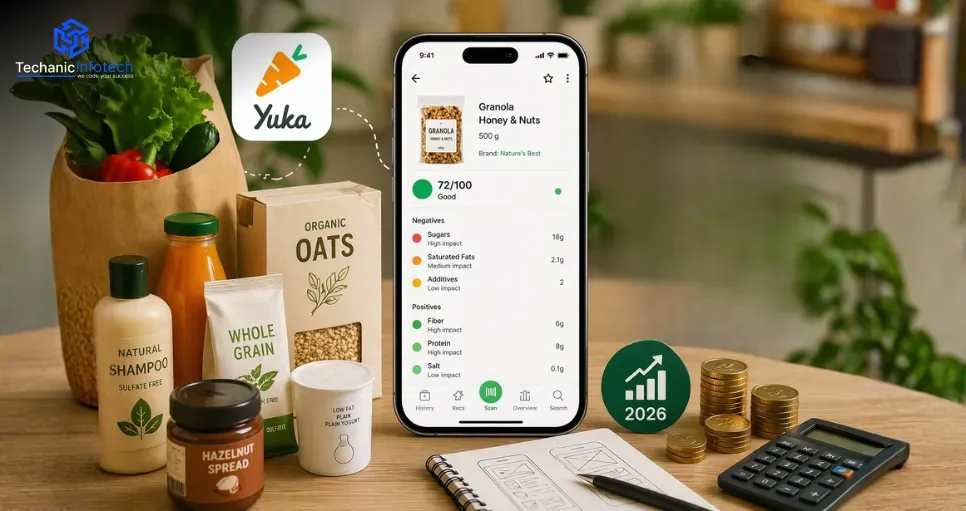
Key Takeaways
Developing an app like Yuka in 2026 requires strategic planning, with costs influenced by features, data accuracy, and backend infrastructure, typically starting from $8,000 and increasing with complexity.
Core cost drivers include barcode scanning technology, product database integration, health scoring systems, and personalized user insights.
Development stages such as requirement analysis, UI/UX design, development, and testing each contribute to the total cost, depending on the level of functionality and precision required.
Hidden and ongoing costs such as database updates, API subscriptions, cloud hosting, maintenance, and marketing also play a crucial role in long-term sustainability.
Businesses can optimize costs by focusing on MVP development, selecting the right technology stack, and hiring cost-effective development teams, ensuring a balance between performance, scalability, and user experience.
Building an app like Yuka typically ranges from $8,000 to $80,000+, depending on features, platform, and technical complexity.
In contrast, a fully-featured app with advanced health scoring, personalized recommendations, multilingual support, and AI-driven insights will require a significantly higher investment.
Additionally, ongoing costs such as database management, API integrations, cloud hosting, and regular updates to maintain product accuracy contribute to long-term expenses.
Businesses should clearly define their target audience, data sources, and scalability goals to create a competitive and cost-efficient app similar to Yuka.
Developing an app like Yuka in 2026 requires strategic planning, especially since costs can vary depending on features, data accuracy requirements, and scalability.
Understanding the key cost-driving factors helps businesses allocate resources effectively while building a reliable, user-friendly, and future-ready health and product analysis app.
The overall complexity of the app significantly impacts development costs. Core mobile app features include barcode scanning, product analysis, ingredient breakdown, and health scoring systems.
Advanced functionalities such as personalized health recommendations, allergen detection, AI-based insights, and dietary filters (vegan, gluten-free, etc.) can substantially increase both development time and budget.
Selecting the right mobile app development company affects both cost and performance. Native development for iOS and Android ensures better performance and seamless integration with device features like cameras for barcode scanning.
However, it increases costs compared to cross-platform development, which is more budget-friendly but may limit performance optimization in data-heavy applications.
A clean, intuitive, and informative interface is crucial for apps like Yuka. Users expect quick scan results, easy-to-understand health scores, and smooth navigation.
Investing in high-quality design enhances user engagement and trust, though it adds to the upfront development cost.
The location of your mobile app development team plays a major role in overall expenses.
Developers in North America or Western Europe typically charge premium rates, while skilled teams in Asia or Eastern Europe offer more cost-effective solutions without compromising quality.
A robust backend is essential for storing and processing large volumes of product data. Costs include database creation, API integrations, cloud hosting, and real-time data retrieval systems.
Maintaining accurate, up-to-date product information is critical, making backend development a key investment area.
Ongoing mobile app maintenance is crucial for long-term success. This includes regular updates, bug fixes, performance improvements, and continuous expansion of the product database.
As the user base grows, scaling infrastructure and ensuring data accuracy become recurring operational costs that businesses must plan for.
Developing an app like Yuka in 2026 involves multiple mobile app development cost factors, from data integration to user-focused features, each influencing the total budget ranging between $8,000 and $80,000+.
A Yuka-like app relies heavily on accurate barcode scanning and quick product identification. This involves integrating camera functionality, barcode recognition APIs, and fast data retrieval systems.
Ensuring high accuracy and speed increases development complexity, making this a key cost contributor within the $4,000–$8,000+ range.
Such apps require a large, well-structured database of products, ingredients, and nutritional information. Costs depend on data sourcing, API integrations, and database maintenance.
Using scalable cloud services for storing and managing data adds recurring expenses, making this a major operational and development cost factor.
One of the core features is the health rating system that evaluates products based on ingredients and nutritional value.
Implementing scoring algorithms and personalized recommendations requires significant backend logic and possibly AI in product development. This increases development effort and contributes notably to the overall app cost.
Ensuring the accuracy of health data and compliance with regulations is critical. Security measures such as data encryption, secure APIs, and user privacy protection add to development complexity.
These elements require continuous updates and significantly impact both initial and long-term maintenance costs.
Features like user profiles, dietary preferences (vegan, gluten-free, etc.), favorites, and notifications enhance user experience.
Building these features requires scalable backend systems and intuitive UI/UX design, making them an important contributor to development costs within the $8,000–$80,000+ range.
The stages of an app like Yuka in 2026 impact mobile app development costs differently, with each phase requiring specific resources, expertise, and budget allocation starting from $8,000.
Requirement analysis typically costs around $1,000–$1,500. It includes defining core features like barcode scanning, product analysis, and health scoring, along with identifying data sources and technical needs.
Proper planning minimizes future errors and ensures smoother development with better cost control.
Mobile app design ranges from $1,200–$2,000. This phase includes wireframing, prototyping, and designing intuitive interfaces for seamless product scanning and easy-to-understand health insights.
A clean and user-friendly design improves engagement and trust, making it a crucial early investment.
Development is the most resource-intensive stage, costing approximately $4,000–$5,000.
It covers frontend and backend development, barcode scanning integration, database setup, and health scoring algorithms.
The complexity of features like AI recommendations and real-time data processing significantly influences this cost.
Mobile app testing and QA cost around $1,000–$1,500. This stage ensures accurate product scanning, reliable health data, and smooth performance across devices.
It involves both manual and automated testing to eliminate bugs and improve overall app quality.
Deployment typically costs $500–$800. It includes cloud setup, API configuration, and app store submission.
Proper deployment ensures the app runs efficiently and is accessible to users without performance issues during launch.
Maintenance and support costs around $1,200–$1,800 initially. It includes regular updates, bug fixes, database expansion, and performance monitoring.
Continuous maintenance is essential to keep product data accurate, ensure security, and maintain long-term user satisfaction.
Features play a major role in the cost of developing an app like Yuka in 2026, as each added capability increases complexity, development time, and resource requirements, starting from a base budget of $8,000.
Core features like barcode scanning, product identification, ingredient breakdown, and basic health scoring typically cost $2,000–$3,000.
These are essential for the app’s core functionality and form the foundation for delivering quick and reliable product insights to users.
Personalization features such as dietary preferences (vegan, gluten-free), allergen alerts, and tailored product recommendations cost around $1,500–$2,500.
These features enhance user experience but require more complex logic and data processing, increasing overall development effort.
AI-driven insights, product scoring improvements, and intelligent recommendations cost approximately $1,500–$2,500.
These features involve data analysis, machine learning models, and continuous optimization, adding significant technical complexity.
Integrating APIs for product databases, nutrition data, and external services costs about $1,000–$1,500.
These integrations improve data accuracy and app functionality but require careful API management, testing, and ongoing maintenance.
Ensuring seamless performance across iOS and Android devices costs around $1,500–$2,500.
This includes responsive design, fast scanning capabilities, and smooth navigation, improving accessibility while increasing development scope.
Customization and scalability options cost approximately $1,200–$2,000.
Building a flexible architecture that supports future feature expansion and handles growing user data ensures long-term success but adds to initial development complexity and budget.
The cost of developing an app like Yuka in 2026 varies based on complexity, features, and infrastructure, with different software levels and services influencing the total budget starting from $8,000.
Basic software costs range from $8,000–$15,000. It includes essential features like barcode scanning, basic product lookup, ingredient information display, and simple health scoring.
This level is suitable for startups validating their idea, offering limited scalability and basic functionality focused on core user needs.
Mid-level software ranges from $15,000–$30,000. It includes enhanced UI/UX, more accurate product databases, personalized health insights, allergen detection, and improved performance.
This level balances cost and functionality, making it suitable for growing platforms aiming to expand their user base.
Enterprise-level software costs between $30,000–$80,000+. It includes advanced AI-driven recommendations, large-scale product databases, real-time updates, high security, and strong scalability.
This level supports large user bases and requires significant infrastructure, development expertise, and long-term investment.
Cloud-based solutions cost around $5,000–$15,000 initially, depending on storage, API usage, and traffic.
They include hosting product data, managing databases, and enabling fast barcode lookup. Ongoing costs vary based on user activity and data volume.
Integration and API development typically costs $3,000–$8,000. It includes connecting nutrition databases, third-party product APIs, and analytics tools.
These integrations enhance accuracy and functionality but require secure implementation and regular maintenance.
Maintenance and upgrades cost approximately $2,000–$10,000 annually. This includes bug fixes, database updates, performance improvements, and security enhancements.
Regular maintenance ensures long-term reliability, data accuracy, and compatibility with evolving technologies and user expectations.
Beyond initial product scanner app development, apps like Yuka involve hidden and ongoing costs that significantly impact long-term budgets, requiring careful planning to ensure sustainability, data accuracy, and continuous growth.
As new products enter the market, the database must be continuously updated with accurate ingredient and nutritional information.
Costs increase due to data sourcing, API subscriptions, and verification processes, making database maintenance a continuous and essential expense.
As user activity grows, cloud infrastructure must scale to handle increased barcode scans, product lookups, and data processing.
Costs rise based on storage usage, API calls, and server load, making backend scaling a key ongoing operational expense.
Many Yuka-like apps rely on external nutrition databases and APIs. These services often charge based on usage or subscription models.
Increased traffic leads to higher costs, making API licensing a recurring expense that must be included in long-term budgeting.
Regular security updates, data protection measures, and compliance with privacy regulations require continuous investment.
Protecting user data and ensuring secure transactions are critical to maintaining trust and avoiding potential penalties.
Providing user support for scanning issues, incorrect product data, and account-related queries requires dedicated support systems or teams.
As the user base grows, these operational costs increase and become an important part of long-term app management.
Attracting new users through digital marketing, influencer campaigns, and promotions is an ongoing expense.
In competitive markets, continuous marketing investment is essential for growth, retention, and brand visibility.
Developing an app like Yuka in 2026 requires a balanced approach between features, data accuracy, performance, scalability, and budget planning.
The overall cost is influenced by multiple factors such as barcode scanning technology, product database integration, AI-driven health scoring systems, cloud infrastructure, and backend complexity.
While basic versions can be built at a lower investment level, advanced platforms with personalized recommendations, real-time product updates, and large-scale data processing require significantly higher resources.
Businesses should carefully evaluate their goals, target audience, and data strategy before development. Starting with an MVP approach can help control costs while validating the idea and ensuring accurate product insights.
The cost typically starts from $8,000 and can increase depending on features, data complexity, AI integration, and scalability requirements.
Key factors include app complexity, barcode scanning features, product database size, health scoring algorithms, UI/UX design, backend infrastructure, and development team location.
Basic apps cost less with limited features like simple scanning and product lookup, while advanced apps require a higher investment due to AI insights, personalization, and large-scale data management.
Development time can range from a few weeks for a basic MVP to several months for a fully featured and data-rich health analysis platform.
Yes, by starting with an MVP, using cross-platform frameworks, relying on third-party product databases, and focusing only on essential scanning and scoring features first.
Ongoing costs include cloud hosting, database updates, API subscriptions, maintenance, security updates, and marketing for user acquisition and retention.
Technologies include Flutter or React Native for frontend, Node.js or Python for backend, cloud platforms like AWS or Google Cloud, barcode scanning SDKs, and nutrition/product databases APIs.
A product database is essential for providing accurate ingredient details, nutritional information, and health scoring, making it the core backbone of the application.
Yes, startups can begin with an MVP version focusing on barcode scanning and basic product information, then gradually scale with better data coverage and AI features.
AI features like health scoring improvements, personalized recommendations, and ingredient analysis increase development complexity by requiring data models, training, and continuous optimization, raising overall costs.


Abhishek Jangid is the CEO of Techanic Infotech, with extensive experience in mobile app and web development. He specializes in helping businesses turn innovative ideas into scalable digital solutions through strategic planning and modern technology.