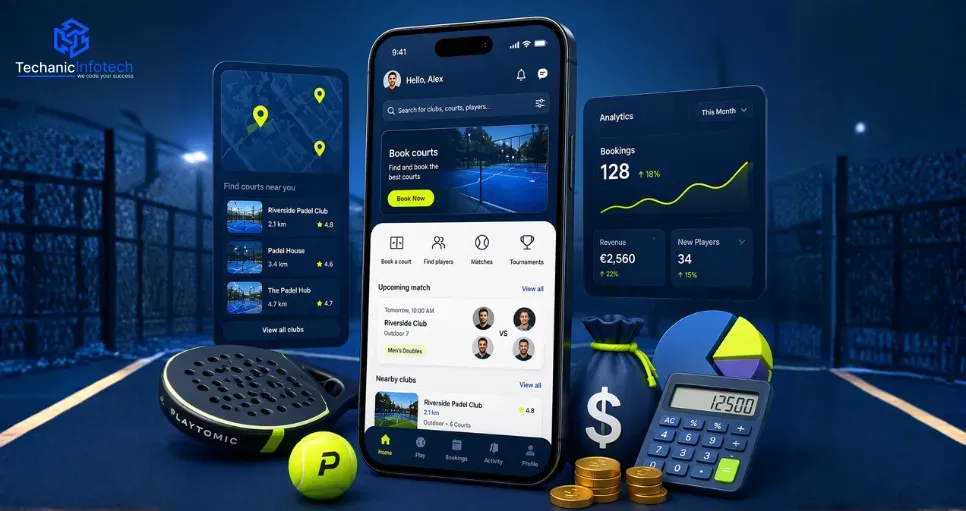
The cost to create an app like Playtomic typically starts around $9,000 and can increase significantly based on features, scalability, and advanced integrations.
Core features like real-time booking, secure payments, and smart search directly influence both development complexity and overall budget.
Hidden expenses such as API subscriptions, cloud hosting, and ongoing maintenance can add substantial long-term costs.
Choosing the right tech stack, platform, and experienced development team helps control expenses while ensuring strong performance.
A well-defined monetisation strategy is essential to recover costs and achieve long-term profitability and sustainable growth.
Sports booking apps are transforming how players discover and reserve courts, especially for tennis and padel.
But how much investment does it really take to build a similar platform? The cost to create an app like Playtomic depends on several factors, including features, real-time booking systems, and scalable infrastructure.
From user-friendly interfaces to secure payment integrations, every component plays a role in shaping the final budget.
In this guide, we’ll break down the development cost, essential features, key cost-driving factors, and smart strategies to optimise your investment while building a competitive sports booking app.
Apps like Playtomic are sports booking platforms that connect players with courts and communities. Their potential lies in simplifying bookings, increasing participation, and creating scalable revenue opportunities in the growing sports-tech ecosystem.
The global sports app market is expected to reach $4.8 billion in 2026, driven by rising smartphone usage and fitness trends, highlighting strong growth opportunities for booking platforms.
Playtomic alone serves over 3.1 million players across 60+ countries, showing massive global adoption and strong demand for sports booking and social play platforms.
In 2025, Playtomic saw UK bookings grow by 125% in a year, proving increasing user engagement and the rising popularity of digital court booking solutions.
The total development cost depends on multiple factors, including mobile app features, design, and technology choices. Understanding these elements helps you plan your budget effectively and avoid unexpected expenses.
The number and type of features directly impact pricing. The Playtomic clone app cost stays lower with basic booking tools but rises with advanced features like real-time availability and player matchmaking.
Choosing one platform reduces cost, while building for both increases investment. The Playtomic app development cost depends heavily on whether you go native or choose a cross-platform approach.
A simple interface costs less, while custom designs require more effort. Following a strong mobile app design guide helps create intuitive navigation and engaging visuals that improve user retention.
A reliable backend ensures smooth bookings and real-time updates. The sports booking app development cost increases when you build scalable systems capable of handling growing user traffic and data securely.
Integrating payment systems, maps, and notifications enhances usability. The Playtomic-like app development cost rises as more third-party tools are added to improve functionality and overall user experience.
Hiring skilled developers ensures quality output but affects the budget. Teams experienced in sports fantasy app development or similar domains may charge more due to their specialised expertise and industry knowledge.
Understanding where your budget goes helps you plan smarter. The overall mobile app development cost depends on multiple stages, features, and the level of customisation required for your sports booking platform.
Proper planning ensures your app meets market needs. The cost to build an app like Playtomic starts with research, feature mapping, and defining a clear product roadmap for successful execution.
|
Element |
Description |
Cost |
|
Market Research |
Industry and competitor analysis |
$700–$850 |
|
Feature Planning |
Defining app functionalities |
$750–$900 |
|
Product Strategy |
Roadmap and business planning |
$800–$900 |
Prototyping helps visualise the app before development begins. The cost to make a Playtomic app includes building interactive models that validate ideas and reduce risks early.
|
Element |
Description |
Cost |
|
Clickable Prototype |
Interactive app model |
$700–$880 |
|
User Flow Mapping |
Navigation structure planning |
$750–$900 |
|
Design Validation |
Early feedback and improvements |
$720–$860 |
Secure login systems are essential for protecting user data. The Playtomic app development pricing increases with features like social login, OTP verification, and secure authentication layers.
|
Element |
Description |
Cost |
|
Email Login |
Basic authentication setup |
$700–$820 |
|
Social Login |
Google/Facebook integration |
$750–$900 |
|
OTP Verification |
Secure user validation |
$780–$900 |
Efficient search improves user experience and retention. Starting with MVP development, you can include basic filters and gradually expand to advanced discovery features as your app scales.
|
Element |
Description |
Cost |
|
Advanced Search |
Filters and sorting options |
$700–$850 |
|
Location Discovery |
Nearby court suggestions |
$750–$900 |
|
Recommendation Engine |
Personalized suggestions |
$800–$900 |
Scheduling features are core to booking apps. The sports booking app, like Playtomic, costs increase with real-time synchronisation, accurate slot management, and seamless booking experiences.
|
Element |
Description |
Cost |
|
Calendar Integration |
Booking calendar setup |
$720–$880 |
|
Time Slot Logic |
Slot allocation system |
$750–$900 |
|
Availability Sync |
Real-time updates |
$800–$900 |
Engagement features keep users active and loyal. The cost to create an app like Playtomic grows as you add push notifications, rewards, and social sharing capabilities.
|
Element |
Description |
Cost |
|
Push Campaigns |
Promotional notifications |
$700–$840 |
|
Loyalty Programs |
Rewards and incentives |
$750–$900 |
|
Social Sharing |
Invite and share features |
$720–$860 |
Strong security ensures user trust and data protection. Ongoing mobile app maintenance also includes keeping systems secure, updated, and compliant with evolving data privacy standards.
|
Element |
Description |
Cost |
|
Data Encryption |
Securing sensitive data |
$800–$900 |
|
Compliance Setup |
Legal and privacy standards |
$750–$880 |
|
Secure APIs |
Safe data communication |
$780–$900 |
Analytics help track performance and user behaviour. The Playtomic app development cost also includes tools that provide insights to improve features, engagement, and overall app performance.
|
Element |
Description |
Cost |
|
User Analytics |
Tracking user activity |
$700–$850 |
|
Revenue Reports |
Monitoring earnings |
$750–$900 |
|
Performance Metrics |
App performance insights |
$780–$900 |
While planning your budget, it’s important to look beyond basics. The cost to create an app like Playtomic often increases due to hidden expenses that impact performance, scalability, and long-term operations.
Many features rely on external APIs like maps, payments, and notifications. The cost to build an app like Playtomic rises with ongoing subscription or usage-based fees for these essential integrations.
Publishing your app requires platform fees and compliance costs. The Playtomic clone app cost also includes app store registrations, developer accounts, and any licensing needed for regional operations.
Choosing the right tech stack for your app directly affects hosting and server expenses. Scalable cloud infrastructure, storage, and bandwidth costs increase as your user base and app usage grow.
Implementing secure systems is critical for user trust. The sports booking app development cost increases with encryption, secure transactions, and compliance with data protection regulations like GDPR.
Regular updates are essential to stay competitive. Adding new features, fixing bugs, and improving performance require ongoing investment that is often overlooked during initial cost planning.
Providing reliable support requires tools and manpower. Partnering with a professional mobile app development company can help manage operations efficiently while maintaining a smooth user experience.
Building a sports booking app like Playtomic in 2026 requires careful planning, smart budgeting, and a clear understanding of both visible and hidden costs.
From core features to advanced integrations, every element impacts your overall investment and long-term success.
The key is to start with a scalable approach, prioritise essential features, and expand as your user base grows.
Partnering with the right iOS app development company can make a significant difference in delivering a high-quality, performance-driven app.
With the right strategy, technology stack, and monetisation model, you can create a competitive platform that drives engagement, ensures user satisfaction, and generates consistent revenue over time.
The cost to create an app like Playtomic typically starts from $9,000 for a basic version and increases based on features, integrations, scalability, and advanced functionalities like real-time booking systems.
Key factors include feature complexity, platform selection, UI/UX design, backend infrastructure, third-party integrations, and development team expertise, all of which directly influence the total cost.
Essential features include user registration, court booking, real-time availability, secure payments, search filters, notifications, and admin panel management for smooth operations.
A basic app can take 2–4 months, while advanced apps with custom features, integrations, and scalable architecture may take 5–8 months or longer.
Yes, you can start with an MVP, focus on essential features, use cross-platform development, and scale gradually to reduce initial development costs.
Hidden costs include API subscriptions, cloud hosting, app store fees, security compliance, maintenance, updates, and customer support operations.
These apps generate revenue through booking commissions, subscriptions, in-app purchases, advertisements, and partnerships with sports facilities.
Choosing iOS, Android, or both depends on your target audience and budget. Cross-platform development is a cost-effective option for reaching a wider audience.
Yes, a scalable backend is essential to handle real-time bookings, user data, and growing traffic without performance issues.
A professional team ensures quality development, better UI/UX, secure architecture, faster delivery, and long-term support for your Playtomic-like app.


Bharat Sharma is the CTO of Techanic Infotech, bringing deep technical expertise in software architecture, mobile app development, and scalable system design. He leads the engineering team with a strong focus on innovation, performance, and security.