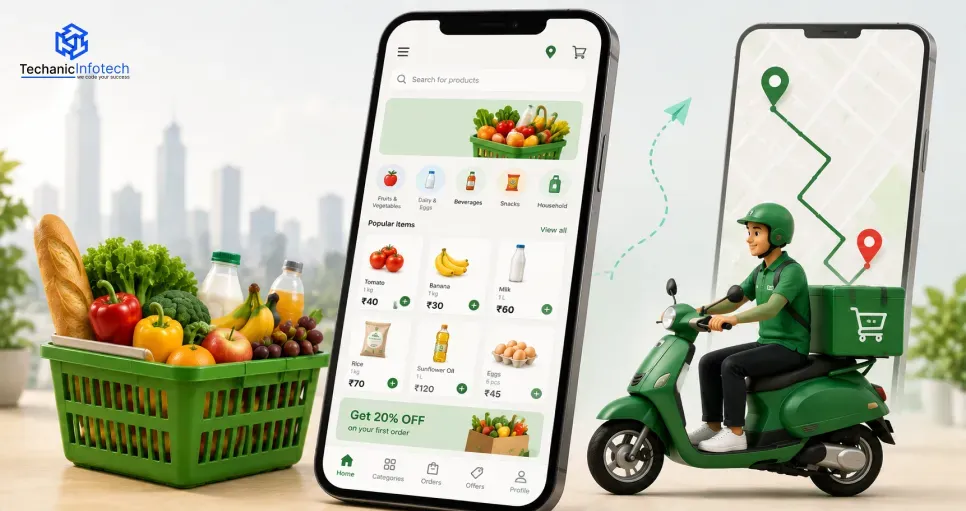
Grocery Delivery App Development
Grocery Delivery App Development Cost: Features, Technology & Timeline
August 24, 2026
August 24, 2026
Key Takeaways:
Grocery delivery app development cost can range from $8,000 to $70,000+, depending on complexity and features.
Basic grocery apps may cost $8,000–$18,000, while enterprise platforms can exceed $70,000.
Features such as GPS tracking, real-time inventory, multi-vendor support, AI, and advanced logistics can increase development costs.
A suitable grocery delivery app technology stack improves scalability, performance, and long-term maintenance.
The development timeline can range from 2–3 months for basic apps to 7–10+ months for enterprise solutions.
Starting with an MVP can help businesses validate demand before investing in advanced functionality.
The growing demand for convenient online shopping has made grocery delivery apps an attractive opportunity for retailers, supermarkets, startups, and entrepreneurs. Customers can browse products, compare prices, place orders, choose delivery slots, and track deliveries without visiting a physical store.
The grocery delivery app development cost typically ranges from $8,000 to $70,000+, depending on the app's complexity, number of platforms, features, integrations, technology, and development requirements.
A basic grocery platform may include product browsing, cart management, online payments, order tracking, and an admin panel. More advanced solutions can support multiple vendors, real-time inventory synchronization, delivery management, personalized recommendations, recurring orders, and AI-powered features.
Businesses can also choose between different models, such as a single-store application, multi-vendor marketplace, supermarket delivery platform, or specialized service such as milk and daily essentials delivery.
Before starting grocery delivery app development, it is important to define the business model, target audience, required features, technology architecture, and expected scale. These decisions directly influence both the initial investment and the long-term operating cost.
This guide explains the grocery delivery app development cost, major cost factors, essential features, technology stack, development timeline, maintenance expenses, and practical ways to control the overall budget.
The online grocery delivery market size was valued at USD 0.75 trillion in 2025 and estimated to grow from USD 0.91 trillion in 2026 to reach USD 2.43 trillion by 2031, at a CAGR of 21.68% during the forecast period (2026-2031).
According to Mordor Intelligence, by product category, staples and cooking essentials accounted for 27.96% of the online grocery delivery market size in 2025; fresh produce is advancing at a 24.6% CAGR to 2031.
According to Mordor Intelligence, by delivery type, scheduled services captured 59.72% of the online grocery delivery market share in 2025, whereas instant/on-demand services are growing at more than 30% year-over-year in leading urban centres.
Regionally, Asia-Pacific is poised for a 26.95% CAGR, outpacing all other regions, while North America remained the largest geography with a 40.85% share in 2025.
The grocery delivery app development cost generally falls between $8,000 and $70,000+. The final budget depends on the number of platforms, feature complexity, UI/UX requirements, integrations, backend architecture, security, and the development team's expertise.
A mobile app development company may estimate the project differently based on whether you need only a customer application or a complete ecosystem with customer, delivery partner, vendor, and admin interfaces.
|
App Type |
Estimated Cost |
Estimated Timeline |
Typical Features |
|
Basic |
$8,000–$18,000 |
2–3 months |
Product catalog, search, cart, checkout, payments, notifications, and admin panel |
|
Mid-Level |
$18,000–$35,000 |
3–5 months |
Delivery tracking, coupons, reviews, multiple payment options, delivery partner app, and inventory management |
|
Advanced |
$35,000–$50,000 |
5–7 months |
Multi-vendor support, real-time inventory, advanced analytics, GPS tracking, recurring orders, and integrations |
|
Enterprise |
$50,000–$70,000+ |
7–10+ months |
Multi-location operations, AI features, ERP/POS integrations, advanced logistics, scalable infrastructure, and customized workflows |
Depending on the project scope, the development budget can cover:
UI/UX design
Customer mobile application
Vendor or store dashboard
Delivery partner application
Admin panel
Backend and APIs
Payment gateway integration
GPS and delivery tracking
Product and inventory management
Notifications
Testing and deployment
Businesses should also consider recurring expenses such as cloud hosting, third-party API charges, payment processing fees, app-store fees, maintenance, security updates, and ongoing feature development.
For startups, beginning with a focused MVP can reduce the initial investment while allowing the platform to expand as customer demand increases.
The scope of a grocery platform has a direct impact on development expenses. A simple store-based application requires fewer resources than a multi-vendor marketplace with real-time logistics and advanced automation.
A basic solution is suitable for a single grocery store or startup testing the market. It can include product listings, search, cart, checkout, online payments, order history, notifications, and a simple admin dashboard.
Estimated cost: $8,000–$18,000
Timeline: 2–3 months
This approach is useful for businesses that want to build a grocery delivery app with essential functionality before expanding the platform.
A mid-level platform can support customer and delivery applications, GPS tracking, coupons, ratings, multiple payment methods, inventory management, and delivery scheduling.
Estimated cost: $18,000–$35,000
Timeline: 3–5 months
This model works well for businesses moving beyond a basic store application and adopting on-demand app development capabilities.
An advanced platform can support multiple vendors, real-time inventory synchronization, advanced analytics, recurring orders, route optimization, automated notifications, and third-party integrations.
Estimated cost: $35,000–$50,000
Timeline: 5–7 months
Businesses may also integrate specialized services such as logistics app development functionality to improve delivery allocation, route planning, and fleet coordination.
An enterprise-level platform is designed for large retailers, supermarket chains, or businesses operating across multiple locations.
It can include multi-store management, advanced logistics, ERP/POS integrations, AI-powered recommendations, personalized offers, real-time analytics, scalable cloud infrastructure, and custom business workflows.
Estimated cost: $50,000–$70,000+
Timeline: 7–10+ months
The more complex the platform becomes, the more important it is to establish a scalable architecture early. Choosing the right custom software development approach can help businesses avoid expensive redevelopment as the platform grows.
The grocery delivery app features you choose directly affect the development budget. Basic ordering functionality requires less investment, while advanced automation, real-time tracking, and multi-vendor capabilities increase development effort.
|
Feature |
Purpose |
Cost Impact |
|
User Registration |
Account creation and login |
Low |
|
Product Catalog |
Display products, prices, and availability |
Low–Medium |
|
Search & Filters |
Help users find products quickly |
Low–Medium |
|
Shopping Cart |
Manage selected products and quantities |
Low |
|
Online Payments |
Process secure digital transactions |
Medium |
|
Delivery Scheduling |
Allow customers to select delivery slots |
Medium |
|
GPS Tracking |
Track delivery status and location |
Medium–High |
|
Inventory Management |
Synchronize stock and product availability |
Medium–High |
|
Vendor Management |
Support multiple grocery sellers |
High |
|
Delivery Partner App |
Manage drivers and assigned orders |
High |
|
Real-Time Notifications |
Send order and delivery updates |
Low–Medium |
|
Ratings & Reviews |
Collect customer feedback |
Low |
|
Coupons & Loyalty |
Manage discounts and rewards |
Medium |
|
Recurring Orders |
Automate repeat grocery purchases |
Medium |
|
AI Recommendations |
Personalize product suggestions |
High |
|
Analytics Dashboard |
Monitor sales, users, and operations |
Medium–High |
For a startup, it is usually better to begin with essential features such as product browsing, cart, checkout, payments, order management, notifications, and basic delivery tracking.
Advanced features such as AI recommendations, demand forecasting, route optimization, and complex inventory synchronization can be introduced after validating the initial product.
If the platform includes specialized services such as milk, daily essentials, or other recurring products, milk delivery app development functionality can also be integrated into the broader grocery platform.
The goal should be to select features that support the business model without unnecessarily increasing the initial grocery delivery app development cost.
The grocery delivery app technology stack affects development speed, performance, scalability, security, and long-term maintenance. Choosing technologies based on the required features can help control the overall budget.
|
Technology Layer |
Recommended Technologies |
Purpose |
Cost Impact |
|
Mobile App |
Flutter, React Native, Swift, Kotlin |
Customer and delivery apps |
Medium |
|
Frontend |
React.js, Angular, Vue.js |
Web and dashboard interfaces |
Medium |
|
Backend |
Node.js, Python, Java, .NET |
APIs and business logic |
Medium–High |
|
Database |
PostgreSQL, MySQL, MongoDB |
Products, users, orders, and inventory |
Medium |
|
Cloud |
AWS, Azure, Google Cloud |
Hosting and scalability |
Medium |
|
Maps & GPS |
Google Maps API, Mapbox |
Location and delivery tracking |
Medium |
|
Payments |
Stripe, PayPal, Razorpay |
Online payments and refunds |
Medium |
|
Notifications |
Firebase, Twilio |
Push, SMS, and alerts |
Low–Medium |
|
AI/ML |
Python, TensorFlow, OpenAI APIs |
Recommendations and forecasting |
High |
|
Analytics |
Google Analytics, Firebase Analytics |
User and business insights |
Low–Medium |
|
Security |
OAuth, JWT, MFA, encryption |
Authentication and data protection |
Medium–High |
A cross-platform framework such as Flutter or React Native can reduce development effort when launching on both Android and iOS. Native development with Swift and Kotlin may be preferred when platform-specific performance is a priority.
For advanced grocery platforms, scalable cloud infrastructure and a well-designed backend are particularly important because the system may need to process large numbers of products, orders, inventory updates, and delivery requests.
Businesses can also work with an AI development company when implementing recommendation engines, demand forecasting, personalized offers, or automated customer support.
The right mobile app tech stack should therefore be selected according to the expected user base, feature requirements, scalability goals, and available development budget rather than simply choosing the most popular technologies.
The grocery delivery app development process involves several stages, from business planning and design to development, testing, and launch. A clear process helps control both development time and overall cost.
Define the target customers, delivery area, business model, competitors, pricing strategy, and required services.
Finalize customer, vendor, delivery partner, and admin features. Prioritize essential functionality for the first release.
Create wireframes and interfaces for the mobile apps and dashboards, focusing on simple product discovery, checkout, and delivery tracking.
Develop APIs, database architecture, authentication, product management, order processing, payments, inventory, and user management.
Build the customer app, delivery partner app, vendor dashboard, and admin panel based on the approved designs.
Integrate payment gateways, maps, notifications, analytics, and other APIs. Test functionality, performance, security, payments, and different devices.
Prepare the applications and backend for production, complete store submissions, configure hosting, and launch the platform.
Monitor user feedback and performance, fix issues, and gradually introduce advanced features such as AI recommendations, loyalty programs, and automated logistics.
Estimated Development Timeline
|
Development Level |
Timeline |
|
Basic |
2–3 months |
|
Mid-Level |
3–5 months |
|
Advanced |
5–7 months |
|
Enterprise |
7–10+ months |
Working with a grocery delivery app development company can help coordinate design, development, integrations, testing, and deployment while keeping the project aligned with its planned budget.
Several factors can significantly influence the final grocery delivery app development cost. Identifying them early helps businesses create a more accurate budget.
Developing separate Android, iOS, web, vendor, and delivery applications increases development effort compared with a single-platform MVP.
Basic ordering features cost less, while GPS tracking, real-time inventory, recurring orders, AI recommendations, route optimization, and advanced analytics require additional development.
A single-store app is generally simpler than a multi-vendor marketplace because marketplace platforms require vendor management, commissions, payouts, and additional workflows.
Payment gateways, maps, POS systems, ERP platforms, inventory software, analytics tools, and notification services can increase both development and ongoing costs.
Custom interfaces, personalization, multilingual support, accessibility, and complex user journeys can increase design and development time.
Secure authentication, encrypted data, role-based access, payment protection, and security testing are important for protecting customer and business information.
The team's location, expertise, technology experience, and project complexity can affect development rates. Choosing an experienced software app development company can help reduce technical errors and unnecessary redevelopment.
A platform designed for thousands or millions of users requires a more robust backend, cloud infrastructure, database architecture, and monitoring system than a small local grocery app.
Businesses should also budget for bug fixes, server costs, security updates, API changes, app-store updates, and future feature development.
Careful planning and prioritization can help businesses control the initial investment while keeping the platform flexible enough to scale.
The business model you choose can significantly influence the overall development budget. Each model requires different features, integrations, and operational workflows.
|
Grocery App Model |
Estimated Cost |
Key Requirements |
|
Single-Store App |
$8,000–$20,000 |
Product catalog, ordering, payments, inventory, delivery, and admin panel |
|
Multi-Store App |
$20,000–$35,000 |
Multiple stores, vendor management, commissions, inventory, and separate dashboards |
|
Multi-Vendor Marketplace |
$30,000–$50,000 |
Vendor onboarding, product management, payouts, order allocation, reviews, and analytics |
|
Enterprise Grocery Platform |
$50,000–$70,000+ |
Multi-location operations, POS/ERP integration, advanced logistics, AI, analytics, and scalable infrastructure |
Businesses expanding into regulated categories can also integrate services such as alcohol delivery app development company, provided they comply with applicable local regulations.
Choosing the right model before development begins helps businesses avoid unnecessary features and maintain better control over the initial investment.
Third-party integrations can improve a grocery delivery app's functionality but also add development and maintenance expenses. The final cost depends on the number and complexity of external services required.
|
Integration |
Purpose |
Cost Impact |
|
Payment Gateway |
Online payments, refunds, and transaction processing |
Medium |
|
Google Maps/Mapbox |
Location search, navigation, and delivery tracking |
Medium |
|
POS/ERP Systems |
Product, pricing, and inventory synchronization |
High |
|
SMS & Email Services |
OTPs, order updates, and notifications |
Low–Medium |
|
Push Notifications |
Real-time order and delivery alerts |
Low |
|
Analytics Tools |
User, sales, and operational insights |
Low–Medium |
|
Inventory APIs |
Real-time stock synchronization |
Medium–High |
|
AI APIs |
Recommendations, chatbots, and forecasting |
Medium–High |
|
Logistics Platforms |
Delivery assignment and route management |
High |
Each integration requires API configuration, authentication, testing, error handling, and ongoing maintenance. Complex integrations with POS, ERP, inventory, or logistics systems may require additional backend development.
For example, businesses adopting logistics app development capabilities may need real-time driver allocation, route optimization, delivery status synchronization, and fleet management integrations.
Similarly, payment and inventory integrations need to remain reliable as the platform scales. Choosing only the integrations that directly support the business model can help keep the initial mobile app development cost under control.
Businesses should also account for third-party subscription or usage fees separately from the core development budget, as these charges vary by provider and usage volume.
AI can improve personalization, forecasting, customer support, and delivery operations, but adding AI capabilities can also increase the initial development budget.
|
AI Feature |
Use Case |
Cost Impact |
|
Product Recommendations |
Suggest products based on customer behavior |
Medium |
|
Demand Forecasting |
Predict product demand and reduce stock issues |
Medium–High |
|
AI Chatbot |
Automate customer support |
Medium |
|
Personalized Offers |
Create targeted discounts and promotions |
Medium |
|
Smart Search |
Improve product discovery using natural language |
Medium |
|
Route Optimization |
Suggest efficient delivery routes |
High |
|
Inventory Prediction |
Predict low-stock and replenishment requirements |
High |
|
Fraud Detection |
Identify unusual orders and transactions |
High |
Launching a grocery delivery app is not the end of the investment. Regular maintenance keeps the platform secure, compatible, and reliable as users, orders, and integrations increase.
|
Maintenance Area |
What It Includes |
|
Bug Fixes |
Resolving functional and performance issues |
|
Security Updates |
Patches, vulnerability fixes, and access control updates |
|
OS Updates |
Maintaining compatibility with new Android and iOS versions |
|
Server & Cloud |
Hosting, storage, backups, and infrastructure monitoring |
|
API Maintenance |
Updating payment, maps, notification, and other integrations |
|
Performance Optimization |
Improving loading speed and system reliability |
|
Feature Enhancements |
Adding new features based on customer feedback |
|
App Store Updates |
Managing releases and platform requirements |
A common approach is to reserve around 15–20% of the initial development budget annually for ongoing maintenance and improvements. The actual amount varies depending on the app's complexity, user volume, integrations, and support requirements.
For example, a platform developed for $30,000 might require approximately $4,500–$6,000 per year for routine maintenance, excluding major new features or significant platform upgrades.
Working with a food delivery app development company or an experienced grocery-focused development team can also help businesses manage ongoing technical improvements, integrations, and scalability after launch.
Businesses can control the initial budget without compromising the core customer experience by making strategic development decisions.
Launch with essential features such as product browsing, cart, checkout, payments, order management, and basic delivery tracking. Advanced features can be added after validating the market.
Using Flutter or React Native can reduce the effort required to build separate Android and iOS applications, particularly for startups with limited budgets.
Avoid developing every possible feature at launch. Focus on functionality that directly supports ordering, payments, inventory, and delivery operations.
Payment gateways, maps, notifications, analytics, and communication APIs can often be integrated instead of developing equivalent systems from scratch.
A well-planned architecture allows businesses to add vendors, locations, services, and advanced functionality later without rebuilding the entire application.
Instead of investing in the complete platform immediately, divide development into MVP, growth, and advanced phases. This spreads investment according to business growth.
An experienced grocery delivery app development company can help identify unnecessary development expenses, select appropriate technologies, and create a realistic development roadmap.
Reusable UI components, backend modules, authentication systems, and APIs can reduce development time when the platform expands to additional services.
A highly customized platform can increase development time considerably. Start with a clean, scalable design and introduce advanced customization after the core product has been validated.
A cost-efficient approach does not mean choosing the cheapest development option. It means investing in the right features, technology, and architecture while avoiding unnecessary complexity during the first release.
Building a grocery delivery app requires careful planning around features, technology, integrations, and scalability. The grocery delivery app development cost can range from $8,000 to $70,000+, depending on the project's complexity and business requirements.
Starting with an MVP, prioritizing essential features, and using a scalable technology architecture can help control the initial investment. As the business grows, advanced capabilities such as AI recommendations, real-time inventory, route optimization, and multi-vendor support can be introduced.
A well-planned development strategy allows businesses to launch efficiently while creating a platform that can adapt to increasing customers, orders, stores, and delivery operations.
The grocery delivery app development cost typically ranges from $8,000 to $70,000+, depending on features, platforms, integrations, and complexity.
A basic app can take 2–3 months, while an advanced or enterprise platform may take 7–10+ months.
Key features include product listings, search, cart, payments, order management, delivery tracking, notifications, inventory, and admin management.
Yes. An MVP can include core ordering, payment, product management, and delivery features before advanced functionality is added.
Common technologies include Flutter, React Native, Node.js, Python, PostgreSQL, AWS, Google Maps API, and payment APIs.
The main factors include features, platforms, UI/UX, integrations, technology, security, AI capabilities, and development team rates.
Yes. AI can support product recommendations, demand forecasting, personalized offers, customer support, and route optimization.


Abhishek Jangid is the CEO of Techanic Infotech, with extensive experience in mobile app and web development. He specializes in helping businesses turn innovative ideas into scalable digital solutions through strategic planning and modern technology.