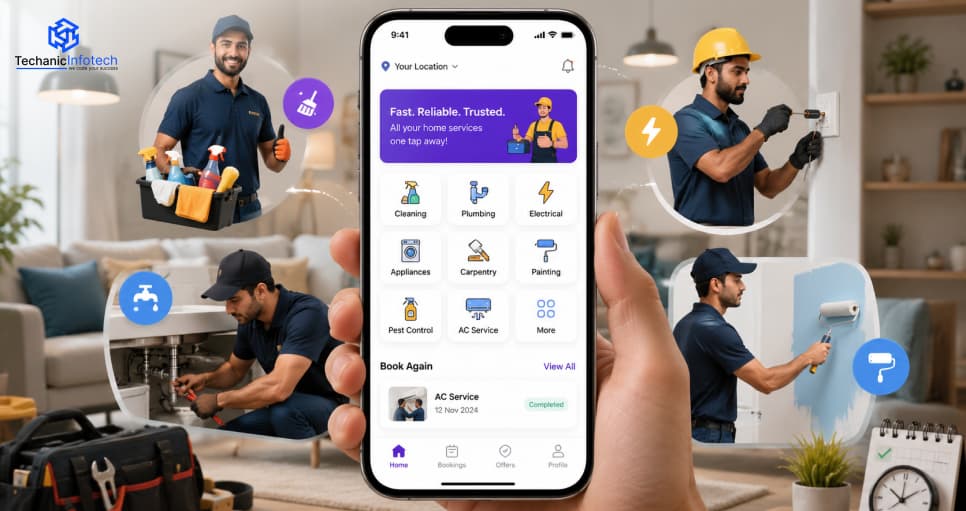
If you're about to release a home service app, you're entering a very lucrative domain of consumers who want convenience and easy service delivery at the tap of a button.
Owners of single-family homes require specific services, such as plumbing, electrical, cleaning, and pest control, at the click of a button to arrive at their front door.
The first consideration is that features are life or death for the app.
Perhaps you're a startup founder, product manager, or dev, but being aware of what you should include in your app is not only imperative but essential.
Let’s break down the best features to have in home service apps to be successful in the market.
A home service app is a mobile application that connects users to professionals who provide services in the home, such as appliance repair, house cleaning, plumbing, and also offers conveniences for navigation, scheduling, payment, etc.
Home service apps allow users to find and book services, pay for services, check reviews of services using their phones, and much more.
Users will be able to do everything (browse a bunch of services, book a service, pay for a service, and keep track of the status of the job) all in one application.
If you're targeting small urban apartments or kitchens or dense suburban neighborhoods with larger homes or yards, a good home service app could become a digitized one-stop shop for the everyday little things to you realize later on are quite inconvenient.
If this is a market you are thinking of entering, yes, you understand the importance of developing a home service app that can meet the necessities of its users.
It's essential to get the features of a home service app right away before we go headfirst into development.
You don't simply need an app that works you need a home service app that meets users where they are, keeps them coming back, increases trust, and facilitates repeat bookings. Below is the breakdown of the absolute home service app features you can't avoid:
First impressions matter. This is one of the fundamental aspects of home service app development.
Enable users to sign up via phone number, email, or social logins. They should find it easy to manage personal information, delivery address, saved credit cards, and service preferences. A well-organized profile section encourages familiarity and trust.
Ensure that you incorporate OTP verification or email confirmation to avoid spam accounts and integrate security in this flow from day one.
Individuals desire simplicity and ease of use while looking through services. This home service app feature enables individuals to search through services according to categories cleaning, electrical, pest control, carpentry, salon at home, etc.
The simpler it is to locate a service, the quicker the users convert. Introduce intelligent filters such as price, user rating, closest availability, and proficiency level. Utilize icons and color coding for improved UX.
This case is one of the most user-centric features in the home service app and has a direct effect on conversion.
Nobody likes to wait.
One of the most appealing features of a home service app is checking availability and booking slots in real time. Be it same-day pickup or future booking, your app should show real-time slots, particularly on weekends or holiday seasons.
Also, equip users with a "Cancel" or "Reschedule" option that does not come across as a penalty.
Embedded payment methods facilitate transactions more quickly and more securely.
Users must be provided the facility to pay by credit/debit card, net banking, mobile wallets, or UPI. Secure payment gateways such as Razorpay, Stripe, or PayPal should be integrated. Allow saving of payment options and generating GST-compliant bills.
This home service app feature establishes serious user trust if refunds and price breakdown are transparent.
Don't let customers miss important notifications. Push notifications are an essential home service app functionality to update customers on pending bookings, promotions, technician arrival time, and reminders for feedback.
They are also a highly effective re-engagement mechanism. But do not spam; let users control what they wish to receive.
This feature in the home service app allows users to view when the technician is en route and monitor the real-time location.
Utilize GPS integration to display ETA and facilitate live updates throughout the service. This alleviates no-show tension and enhances professionalism. It's a necessity in on-demand times like these.
Trust is everything in a service marketplace.
Permit users to rate experts, leave longer reviews, and post photos after service. Home service apps' this feature also assists with vendor quality control and enables other customers to make better decisions.
Let experts answer reviews it establishes a two-way conversation and depicts accountability.
Things do not always go as expected.
Providing real-time communication with the customer support or the technician can enable users to clear their doubts or make modifications on a real-time basis. Such an attribute in a home service app enhances user satisfaction and avoids cancellations of bookings.
Include quick-reply options, canned responses, and escalation triggers for more streamlined experiences.
We all love a good deal.
Have a separate section for seasonal discounts, initial user coupons, and rewards for loyalty. Promo codes are an effective method of increasing conversions and keeping users. This home service app feature makes your app rewarding every time they open it.
Users appreciate transparency and the ability to view previous transactions.
Provide a well-structured history section displaying finished services, bill, payment method, technician information, and the facility to re-book a session with a single click.
This easy facility of the home service app promotes repeat behavior.
Want to be regionally authentic?
Multiple language support is essential, particularly in highly diverse nations. This home service app facility enhances reach, retention, and accessibility.
Begin with the most 2 or 3 popularly spoken languages in your target geography and scale according to user demand.
Intelligent location identification saves users from re-entering the PIN code each time.
This feature in the home service app links customers with local professionals, reduces wait times for arrival, and enables hyperlocal business models.
Think of enabling users to manually select their location, too, for vacation homes or gifting services.
However, handling geolocation accuracy and real-time syncing with nearby service providers is one of the common challenges in home service app development that must be addressed early.
Referrals are an affordable growth trick.
Let friends refer users and get credits. Reward the referee and the new user both a virtuous circle. This home services app feature makes your users brand loyalists.
Add social share buttons for WhatsApp, Instagram, and SMS to induce virality.
Why should loyalty be unrewarded?
Implement a basic points system wherein each booking generates cashback or credits. Customers can earn a wallet balance and use it towards future services. You can also introduce tiers such as Silver, Gold, and Platinum users to level up engagement.
This home service app feature maximizes lifetime value and minimizes churn.
Not all services are planned in advance.
Include an "Emergency" button through which customers can book a plumber, electrician, or cleaner in an instant for emergency situations. Such bookings should cut across normal schedules and alert the closest available expert.
Such a high-utility feature of a home service app addresses actual pain points and distinguishes you from others.
All of these features of a home service app not only make your users happier but also your app more competitive, user-friendly, and growth-oriented.
Do not try to implement all features simultaneously. Begin with the basics, test your market, and deploy advanced features as your base increases.
After you've mastered the fundamentals, it's time to think about the advanced features of a home service app that provide you with a serious competitive advantage in a crowded market.
If what you want is to own your niche or future-proof your offering, then these future-proof home service app features are what you need.
They're not day-one must-haves, but they can significantly enhance the user experience, operational efficiency, and long-term retention once your platform begins to scale.
Picture this: You open up the app and you get customized service recommendations, such as an AC service when summer arrives or pest control when the monsoons begin.
AI-powered recommendations study user behavior, previous bookings, area, and even season to make intelligent, context-aware suggestions.
This home service app feature not just enhances convenience but also drives order frequency, as well as increases the cost to develop a home service app, but worth the investment.
Desire to maintain service quality at its best? A backend performance tracking dashboard that monitors technician performance in terms of punctuality, rating, cancellations, and job speed benefits you in keeping your best performers engaged, or figuring out training needs.
This operational aspect of the home service app puts information at your fingertips and enables improved vendor management.
Texting is too old-fashioned, particularly on the go. Voice search integration in your app enables users to simply say, "Book a bathroom cleaning service this Sunday," and receive results right away.
Voice assistants such as Google Assistant or Siri can be utilized to make your app more convenient. This is amongst the coolest features of the home service app for tech-friendly users.
It's not all about the customer make things easier for your service partners as well. Include an in-app GPS navigation system that leads experts directly to the doorstep, eliminating delays and increasing reliability.
This home service app feature also enhances vendor productivity and prevents miscommunication.
Provide monthly or annual plans where customers receive discounted services, priority scheduling, or complimentary emergency visits. Subscriptions bring stable revenue and retain customers.
Example: "3 cleanings + 1 pest control per month at ₹1,299." This feature in the home service app stabilizes your business model while providing customer value.
Some users are charged extra during weekends or holidays. Others are based on region, urgency, or technician availability.
An intelligent dynamic pricing engine dynamically prices according to real-time triggers. This Uber-like app feature for home services enables you to equilibrium supply-demand without any manual intervention and maintains fairness regardless.
For complex services such as interior design or appliance repair, customers may require a viewing before booking.
Add brief videos describing what the service entails, or enable live consultations where technicians assess the problem through a video call. It provides transparency and trust.
Users may be offline at times, but still desire to book.
Let them schedule a request that synchronizes when they're going online. You can even allow your employees to call for confirmation and confirm it. This aspect of the home service app demonstrates that you're concerned about real-world functionality.
After you've mastered the fundamentals, it's time to think about the advanced features of a home service app that provide you with a serious competitive advantage in a crowded market.
With so many options, how do you determine which home service app features to start building?
It's tempting to get caught up in the new and shiny, but intelligent feature selection is all about balance what your users truly require, what your business objectives need, and what your development capabilities can realistically handle.
Rather than getting caught up in the "build everything at once" trap, adopt a strategic plan to deliver value quickly and grow smartly.
Here's how to make wiser decisions without overbuilding:
It all begins with the user. Who are you creating this app for?
Are they time-strapped professionals searching for one-click answers? Are they stay-at-home parents searching for booking recurring services with reliable professionals? Or do you have property managers seeking to reserve bulk services?
Create 2–3 in-depth user personas. Their actions, pain points, and comfort with technology will determine which home service app features are most important and how they need to function.
For instance, younger users might anticipate voice search, instant payment, and a clean UI. Older users might appreciate simplicity, large text, and easier access to customer support.
Your MVP (Minimum Viable Product) is your rocket ship, not your destination.
Begin with 6–8 core home service app features: user registration, booking engine, in-app payment, service types, real-time tracking, push notifications, and rating options. These address 80% of initial user requirements.
Prioritize getting these features stable, intuitive, and bug-free. Leverage early adopters to gather feedback, iterate quickly, and gain trust.
Your objective here is not perfection. It is a quick validation.
Why reinvent the wheel?
Research leading players such as Urban Company, TaskRabbit, and Handy, as well as regional players. Download their apps, book services, cancel services, and try support features.
Note down what they are doing right and what they are doing wrong. Then create home service app features that address those missed opportunities or improve UX.
Competitive benchmarking not only reduces development time but also provides you with solid product positioning.
You can't do everything simultaneously so do what is most important first.
Utilize a 2x2 impact-effort matrix to prioritize each idea. Prioritize features with high impact and low effort, such as referral programs, service history, and chat support.
Postpone features that are costly to implement but provide little benefit, such as complex gamification or test-driven AI features.
This allows you to remain lean, focused, and budget-conscious.
Not all awesome ideas are for your app at least, not initially.
Before creating something like a subscription model, loyalty wallet, or live video consults, test the demand. Conduct a brief user survey, build a clickable prototype, or provide a manual version of the service upfront.
Tools like Typeform, Google Forms, or even Instagram Polls can provide you with significant insights. A tested feature is a valuable investment.
Most startups create features that are gorgeous at 1,000 users but don't hold up at 10,000.
When selecting home service app features, consider where you want the business to be in 1–2 years. Can your booking system process 500 simultaneous requests? Is your chat scalable on Firebase, or should you implement third-party APIs like Sendbird?
Features like real-time tracking, in-app wallet, and support chat often require server-side architecture planning and maintenance, so scale smart.
Every feature isn’t just a launch task it’s a long-term commitment.
You’ll need to keep testing, updating, debugging, and supporting it. If it breaks during peak hours or doesn’t get used, it becomes technical debt.
Occasionally, even the most straightforward-appearing feature in a home service app, such as a couponing system, can become backend headaches if not well-thought-out.
Ask yourself: "Is this feature worth maintaining over the next 12–24 months?"
If the answer is no, save it for later.
Building a successful home services platform requires more than just adding popular features. The real challenge lies in creating a seamless user experience, ensuring scalability, maintaining security, and supporting future business growth.
Working with an experienced home service app development company can help businesses identify the right feature set, reduce development risks, and launch a market-ready solution faster. From MVP planning to advanced integrations, the right development strategy can significantly improve user retention and long-term profitability.
Home service apps are not merely marketplaces they're problem-solvers for everyday convenience.
But their success depends on selecting the right home service app features that address authentic user needs. From sign-up to real-time tracking and sophisticated tools like AI and dynamic pricing, each piece contributes to the factors that drive trust and engagement.
Begin lean, pay attention to your users, and scale judiciously. And if you ever need professional assistance along the way, Techanic Infotech's got your back.
We can assist you in transforming your feature wish list into a successful, lucrative home services solution that your customers will be crazy about using.
Essential features include user registration, service listings, real-time booking, payments, tracking, reviews, and notifications.
The development cost typically ranges from $10,000 to $120,000+, depending on features and complexity.
Real-time tracking improves transparency, enhances customer trust, and provides accurate technician arrival updates.
AI recommendations, voice search, subscription plans, dynamic pricing, and live consultations enhance user experience.
Home service apps generate revenue through commissions, subscriptions, advertisements, service fees, and premium features.
A professional development company helps build scalable, secure, and feature-rich solutions that accelerate business growth.


Bharat Sharma is the CTO of Techanic Infotech, bringing deep technical expertise in software architecture, mobile app development, and scalable system design. He leads the engineering team with a strong focus on innovation, performance, and security.