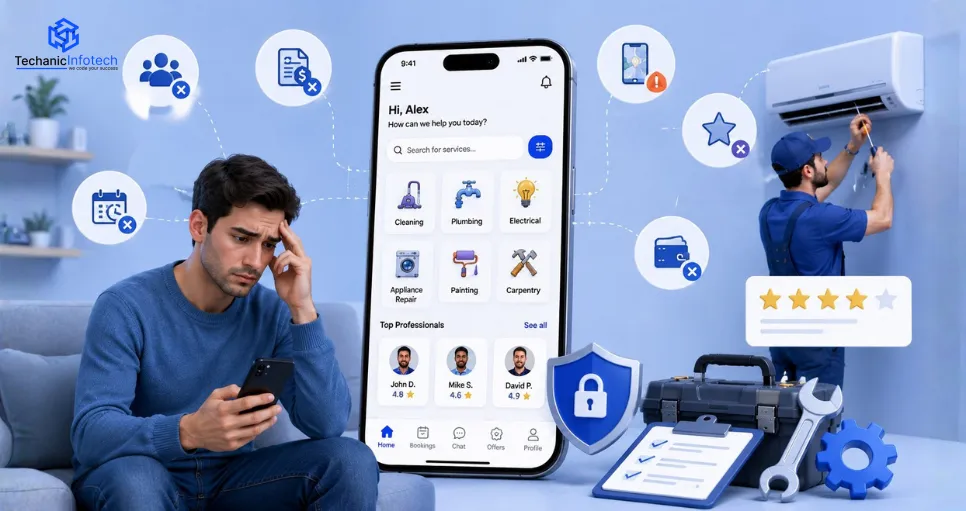
The home services industry has undergone a major transformation over the last decade. Whether it's booking a plumber, scheduling a deep cleaning session, hiring an electrician, or arranging appliance repairs, customers now expect everything to happen through a few taps on their smartphones.
This shift in consumer behavior has created a huge opportunity for businesses looking to develop a home service app. Companies worldwide are investing in digital platforms that connect customers with service professionals quickly and efficiently.
However, building a successful home service platform is much more complex than it appears.
Behind every smooth booking experience lies a sophisticated system handling provider availability, payments, location tracking, customer support, service matching, and thousands of daily interactions.
Many startups underestimate these complexities and end up facing serious scalability, operational, and user retention problems after launch.
In this article, we'll explore the biggest home service app development challenges, how successful companies solve them, and what businesses should consider before launching their platform.
The market opportunity for home service applications continues to expand as consumers increasingly prefer convenience, speed, and digital-first experiences.
1. Massive Market Growth
The global online on-demand home services market was valued at approximately $3.71 billion in 2021 and is projected to reach nearly $14.7 billion by 2030, growing at a CAGR of 16.7%.
2. Mobile-First Consumer Behavior
More than 60% of consumers now prefer booking services through mobile applications rather than making phone calls or visiting physical locations.
3. Growth of the Gig Economy
The global gig economy continues to expand rapidly, creating a larger workforce available for on-demand home services.
4. Increasing Digital Adoption
Consumers increasingly expect:
Real-time booking
Transparent pricing
Service tracking
Digital payments
Verified professionals
This expectation is driving businesses to invest heavily in digital service platforms.
Many founders focus heavily on features but underestimate operational challenges.
A beautiful user interface won't save an app if:
Providers don't show up
Scheduling breaks down
Payments fail
Customer disputes increase
Servers crash during peak demand
The real challenge isn't building an app.
The real challenge is building a scalable marketplace that works consistently for customers, service providers, and administrators.
Let's examine the biggest obstacles.
One of the most common home service app development challenges is maintaining accurate provider availability.
Service professionals frequently:
Accept offline bookings
Take personal leave
Extend job durations
Cancel appointments
Without real-time synchronization, double bookings become inevitable.
Customer frustration
Negative reviews
Lost revenue
Reduced provider trust
Dynamic scheduling systems
Calendar synchronization
Buffer times between jobs
Automated availability updates
Appointment reminders
Successful platforms update availability instantly to prevent conflicts.
Location plays a critical role in home services.
Incorrect addresses, inaccurate GPS coordinates, or service requests outside provider coverage zones can create major operational problems.
Delayed arrivals
Increased travel costs
Failed service requests
Poor customer experiences
Use advanced geolocation technologies such as:
Google Maps API
Mapbox
Geo-fencing
Real-time route optimization
Allow providers to define specific service areas while enabling users to manually verify addresses before booking.
Unlike food delivery apps, home service providers often enter customers' homes.
Trust becomes one of the most important success factors.
Customers naturally ask:
Is this professional verified?
Can I trust this person?
What happens if something goes wrong?
Implement:
Government ID verification
Background checks
Provider certifications
Verified badges
Customer ratings
Review systems
Transparency significantly improves conversion rates.
Payment systems are far more complicated than simply accepting transactions.
Home service platforms often need to manage:
Customer payments
Provider payouts
Platform commissions
Refunds
Taxes
Discounts
Poor payment systems can create accounting issues and damage trust.
Use trusted payment gateways such as:
Stripe
Razorpay
PayPal
Features should include:
Split payments
Automated payouts
Invoice generation
Refund management
Fraud detection
Connecting customers with the right professional is harder than it sounds.
Many new platforms rely on basic location matching, which often leads to poor service experiences.
Wrong skill match
Low-quality service
Higher cancellation rates
Poor customer retention
Use intelligent matching algorithms that consider:
Availability
Location
Ratings
Experience
Service history
Job specialization
As your platform grows, AI-powered recommendation systems can further improve matching accuracy.
Many apps work perfectly during testing but struggle during peak demand periods.
Imagine:
Weekend bookings
Holiday spikes
Seasonal demand surges
Without scalable infrastructure, performance quickly deteriorates.
Slow loading times
Failed bookings
Payment issues
User abandonment
Build cloud-native infrastructure using:
AWS
Microsoft Azure
Google Cloud
Implement:
Auto scaling
Load balancing
CDN optimization
Database optimization
Scalability should be planned before launch, not after growth begins.
Last-minute cancellations create operational chaos.
Both customers and providers can contribute to this issue.
Wasted time
Revenue loss
Reduced provider satisfaction
Lower platform efficiency
Create fair cancellation policies.
Include:
Automated reminders
Cancellation fees
Rescheduling options
Provider reliability scores
Customer accountability measures
Acquiring users is expensive.
Retaining them is where profitability happens.
Many platforms lose customers after the first booking.
Poor user experience
Lack of loyalty incentives
Weak engagement strategies
Introduce:
Loyalty programs
Membership plans
Personalized offers
Rebooking shortcuts
Maintenance reminders
Platforms that increase repeat bookings typically achieve much stronger long-term growth.
A platform targeting multiple regions cannot rely solely on one language or cultural approach.
Customers expect localized experiences.
Language barriers
Currency differences
Regional regulations
Cultural expectations
Support:
Multiple languages
Regional currencies
Local payment methods
Location-specific content
Localization often becomes a major competitive advantage.
No marketplace is perfect.
Problems inevitably occur:
Poor service quality
Billing disputes
Late arrivals
Communication issues
How your platform handles these situations determines customer trust.
Implement:
Live chat support
In-app ticketing
Email support
Escalation workflows
Issue tracking systems
Fast dispute resolution significantly improves retention.
|
Challenge |
Business Impact |
Recommended Solution |
|
Scheduling Conflicts |
Lost bookings |
Real-time calendar sync |
|
Location Errors |
Delayed service |
GPS verification and geo-fencing |
|
Trust Issues |
Lower conversions |
Background checks and verification |
|
Payment Complexity |
Revenue leakage |
Automated payment systems |
|
Poor Matching |
Low satisfaction |
Smart matching algorithms |
|
Server Overload |
Downtime |
Cloud infrastructure |
|
Cancellations |
Revenue loss |
Flexible cancellation policies |
|
Low Retention |
High acquisition costs |
Loyalty programs |
|
Localization Issues |
Limited growth |
Multi-language support |
|
Customer Disputes |
Poor reviews |
Dedicated support systems |
Many startups assume that once their app is launched, growth will happen automatically.
The reality is very different.
Even some of the largest home service platforms have faced significant operational and technical challenges while scaling their businesses. Understanding how these companies solved their problems can help you avoid costly mistakes when you develop a home service app.
Founded in India, Urban Company (formerly UrbanClap) has become one of the world's leading home service marketplaces.
As the platform expanded across multiple cities and countries, maintaining service quality became one of its biggest challenges.
Thousands of service professionals joining the platform
Maintaining consistent service quality
Verifying provider skills
Managing customer complaints
Standardizing service delivery
Urban Company invested heavily in:
Provider training programs
Professional certification systems
Background verification
Customer rating systems
Performance monitoring
Today, provider ratings and customer feedback play a major role in maintaining platform quality.
Never assume onboarding providers is enough.
Continuous monitoring and quality control are essential for long-term success.
TaskRabbit built its reputation by helping users find local professionals for various household tasks.
As the platform grew, matching the right customer with the right service provider became increasingly difficult.
Different service categories
Varying skill levels
Availability conflicts
Location-based limitations
The company developed advanced matching systems that consider:
Provider skills
Ratings
Availability
Location
Previous performance
This significantly improved booking success rates and customer satisfaction.
Smart matching systems directly influence user retention and platform growth.
Handy experienced rapid growth in the home cleaning and maintenance industry.
However, trust became a major challenge.
Customers wanted assurance that professionals entering their homes were reliable and qualified.
Provider verification
Appointment reliability
Customer complaints
Service consistency
Handy strengthened its platform through:
Background checks
Provider screening
Customer reviews
Insurance protection
Performance tracking
Trust is not a feature.
Trust is a system built through transparency, verification, and accountability.
Understanding challenges is important.
Avoiding them is even more valuable.
Here are some proven best practices followed by successful platforms.
The average customer wants to book a service in under a minute.
Complicated workflows create abandonment.
Focus on:
Simple navigation
Quick booking
Clear pricing
Fast checkout
Easy cancellations
A great user experience often becomes your biggest competitive advantage.
Many businesses only think about scaling after growth begins.
This often leads to expensive rebuilds.
Choose technologies that support future expansion.
Whether you're working with an experienced Android app development company or an iOS app development company, scalability should be part of the initial architecture.
Consider:
Cloud infrastructure
Modular architecture
API-first development
Load balancing
Database optimization
Home service applications handle sensitive information including:
Customer addresses
Payment information
Contact details
Service history
Security should never be treated as an optional feature.
Implement:
SSL encryption
Secure authentication
Role-based access controls
Secure payment processing
GDPR compliance where applicable
Many businesses obsess over customer features while ignoring service providers.
Without providers, there is no marketplace.
Your provider panel should include:
Schedule management
Earnings tracking
Job notifications
Customer communication
Performance reports
Happy providers typically deliver better service and stay on the platform longer.
Data-driven decisions help businesses scale faster.
Track:
Booking completion rates
Provider response times
Cancellation percentages
Customer satisfaction scores
Repeat booking rates
Analytics often reveal problems long before customers complain.
While the top ten challenges receive most attention, several hidden issues frequently appear as platforms scale.
Different countries and regions have unique regulations regarding:
Worker classification
Tax reporting
Consumer protection
Data privacy
Ignoring compliance can create legal and financial risks.
Pricing becomes more difficult as demand grows.
Questions quickly arise:
Should prices increase during peak demand?
How should emergency services be priced?
Should providers set their own rates?
A flexible pricing engine can solve many of these challenges.
Fraud affects both customers and providers.
Common examples include:
Fake bookings
Payment fraud
Identity fraud
Referral abuse
Strong verification systems and fraud detection tools help protect the platform.
Many entrepreneurs spend months perfecting ideas before taking action.
In reality, successful platforms typically start with a Minimum Viable Product (MVP).
An MVP focuses on:
Core booking functionality
Provider management
Payments
Reviews
Notifications
Once user demand is validated, additional features can be added gradually.
If you're planning to develop a home service app, launching with a focused MVP often reduces both risk and development costs.
Every challenge discussed in this article has a direct impact on development budgets.
For example:
|
Feature Area |
Cost Impact |
|
Real-Time Scheduling |
Medium |
|
GPS Tracking |
Medium |
|
Payment Integration |
Medium |
|
Smart Matching |
High |
|
Scalability Infrastructure |
High |
|
Multi-Language Support |
Medium |
|
Customer Support System |
Medium |
|
AI-Based Recommendations |
High |
Businesses that understand these requirements early can better estimate the cost to develop a home service app and avoid unexpected expenses later.
Many home service startups fail because they hire teams that understand app development but lack marketplace experience.
Building a home service marketplace involves:
Customer applications
Provider applications
Admin panels
Payment systems
Real-time communication
Location services
Analytics infrastructure
An experienced home service app development company can help businesses avoid common mistakes and accelerate time to market.
Whether you're building for Android, iOS, or both platforms, selecting the right technology partner can significantly influence project success.
The home services industry continues to grow rapidly as consumers increasingly rely on digital platforms for everyday needs.
However, building a successful platform requires much more than attractive design and basic booking functionality.
Businesses must overcome challenges related to scheduling, provider management, trust, payments, scalability, customer support, localization, and retention.
Companies like Urban Company, TaskRabbit, and Handy demonstrate that success comes from solving operational challenges as effectively as technical ones.
The businesses that invest in strong infrastructure, smart provider management, seamless user experiences, and scalable technology are the ones most likely to dominate this competitive market.
If you're planning to launch a marketplace platform, understanding these home service app development challenges before development begins can save significant time, money, and resources while improving your chances of long-term success.
Some of the biggest challenges include real-time scheduling, provider management, payment processing, customer retention, trust building, scalability, and dispute resolution.
The cost depends on features, platforms, integrations, and complexity. A basic MVP may cost between $10,000 and $120,000+, while advanced marketplace platforms can exceed $100,000.
A basic MVP typically takes 3 to 4 months. More advanced applications with provider panels, analytics, and custom integrations can take 6 to 12 months.
Core features include user registration, provider profiles, booking systems, payments, notifications, reviews, ratings, GPS tracking, and customer support.
Provider verification helps establish trust, improve service quality, reduce fraud, and increase customer confidence.
Popular choices include Flutter, React Native, Node.js, Laravel, AWS, Firebase, and PostgreSQL, depending on project requirements.
Yes. Most successful platforms provide separate experiences for customers and service providers while managing everything through a centralized admin panel.
Revenue models commonly include commissions, subscription plans, featured listings, lead generation fees, and service booking charges.
Yes. AI can improve provider matching, demand forecasting, customer support automation, pricing optimization, and personalized recommendations.
Look for experience with marketplace applications, strong technical expertise, scalability planning, transparent communication, and a proven portfolio of successful projects.


Bharat Sharma is the CTO of Techanic Infotech, bringing deep technical expertise in software architecture, mobile app development, and scalable system design. He leads the engineering team with a strong focus on innovation, performance, and security.