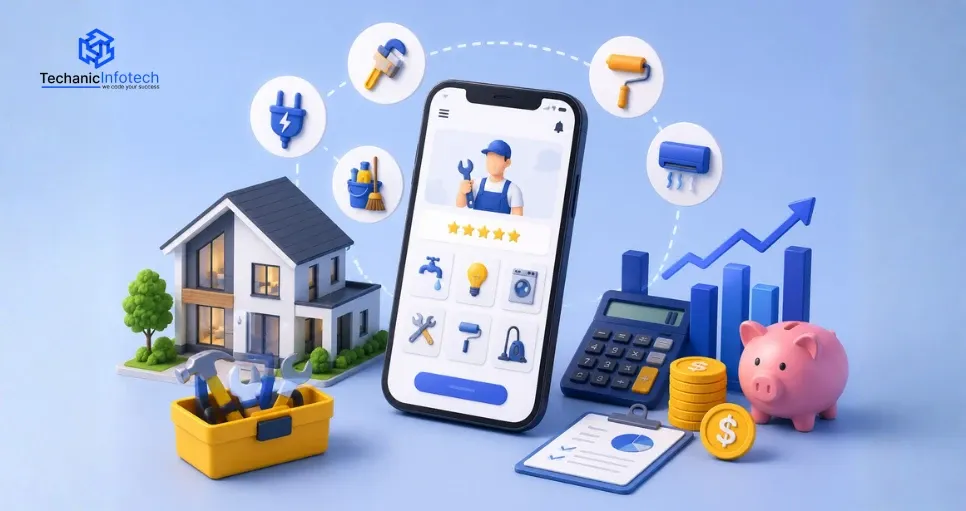
Key Takeaways
The cost to develop a home service app generally ranges between $10,000 and $120,000+ depending on features, integrations, and scalability requirements.
Important home service app features include booking systems, real-time tracking, secure payments, reviews, and push notifications.
Cross-platform frameworks like Flutter and React Native help businesses reduce development costs significantly.
Commission models, subscriptions, advertisements, and premium listings are major monetization strategies for home service apps.
Strong backend infrastructure, cloud systems, and security features are essential for scalable app performance.
Partnering with an experienced home service app development company helps businesses build scalable and feature-rich on-demand service platforms efficiently.
Ever wished to fix a leaky faucet or get your couch professionally cleaned while booking AC service with just a few taps on your phone?
That’s the power of home service apps.
The on-demand service industry is rapidly growing because users increasingly prefer convenience, instant booking systems, secure payments, and real-time service tracking directly from mobile applications.
Today, businesses offering plumbing, cleaning, electrical repair, beauty, appliance repair, and handyman services are investing heavily in scalable digital platforms.
The cost to develop a home service app generally ranges between $10,000 and $120,000+ depending on app complexity, features, backend infrastructure, AI integrations, and platform selection.
Businesses planning scalable service platforms often collaborate with an experienced home service app development company to build feature-rich and customer-focused applications.
Companies offering scalable on-demand app development services and mobile app development company solutions help startups and enterprises launch secure and scalable home service applications faster.
In this blog, we’ll explore home service app development costs, important features, market statistics, hidden expenses, monetization strategies, and ways to reduce overall development costs.
The on-demand home service industry is growing rapidly because users increasingly prefer booking household services digitally.
According to market reports, mobile-first service booking platforms are becoming one of the fastest-growing digital business sectors globally.
The global home services market is expected to exceed USD 1.2 trillion by 2030.
The on-demand home services market is growing significantly because of smartphone penetration and digital adoption.
More users now prefer app-based booking systems because they offer convenience, faster service access, and secure online payments.
AI-powered scheduling and real-time service tracking are becoming major trends in home service app development.
These statistics clearly show why startups and enterprises are increasingly investing in home service app development solutions.
Businesses researching scalable service ecosystems also analyze modern on-demand app ideas before entering the digital service marketplace.
A home service app works like an on-demand marketplace that connects customers with professionals providing household services.
Users can book services such as:
Plumbing
Electrical repairs
Home cleaning
Pest control
Appliance repair
Salon services
AC maintenance
through a single mobile platform.
The application simplifies service discovery, booking management, payments, communication, and customer support.
Businesses researching scalable service ecosystems also analyze modern appointment booking app development strategies before building scheduling platforms.
Understanding the workflow is extremely important before starting development.
Users can sign up using:
Email addresses
Mobile numbers
Social media accounts
Simple onboarding improves customer acquisition and retention significantly.
Customers can browse available services based on:
Categories
Pricing
Ratings
Availability
Location
Advanced filtering systems improve user experience and service discovery.
Users can choose:
Preferred services
Time slots
Locations
Service professionals
Instant booking systems improve customer convenience significantly.
Users can securely pay using:
Credit/debit cards
Wallets
UPI
Net banking
Businesses offering scalable mobile app development services often prioritize secure payment infrastructure and smooth checkout experiences.
The professional arrives at the customer’s location and completes the requested task.
Real-time tracking and communication systems improve customer trust and transparency.
Customers can leave:
Ratings
Reviews
Feedback
Review systems improve service quality and platform credibility.
Businesses researching scalable marketplace ecosystems also analyze modern best home service app features before building advanced platforms.
One of the most common questions businesses ask is: how much does it cost to build a home service app?
The development cost generally ranges between $10,000 and $120,000+ depending on:
Features
Platform selection
Backend complexity
Third-party integrations
AI functionalities
Security systems
|
App Type |
Estimated Cost |
Development Timeline |
|
Basic MVP App |
$10,000 – $25,000 |
2 – 3 Months |
|
Mid-Level Home Service App |
$25,000 – $60,000 |
3 – 5 Months |
|
Advanced Scalable Platform |
$60,000 – $120,000+ |
6 – 9+ Months |
Businesses planning scalable service platforms also analyze modern home service app development cost strategies before finalizing development budgets.
Several important factors directly affect the overall development cost.
The more advanced features your app includes, the higher the development cost becomes.
Features such as:
Real-time GPS tracking
Dynamic pricing
AI recommendations
In-app chat
Live notifications
require additional backend infrastructure and development effort.
|
Feature Level |
Examples |
Estimated Cost |
|
Basic |
Login, booking, payments |
$5,000 – $15,000 |
|
Moderate |
Ratings, chat, multi-language |
$15,000 – $35,000 |
|
Advanced |
AI matching, real-time tracking |
$35,000 – $60,000+ |
Modern users expect highly interactive and easy-to-use mobile applications.
Custom UI/UX design with animations, transitions, and personalized layouts improves engagement but increases development complexity and costs.
Businesses researching scalable platforms also analyze modern mobile app development cost strategies before optimizing design budgets.
Developing apps for Android, iOS, or both platforms directly affects project cost and timeline.
Cross-platform technologies such as Flutter and React Native help businesses reduce development costs significantly.
|
Platform Type |
Estimated Cost |
|
Android or iOS Only |
$10,000 – $25,000 |
|
Cross-Platform Development |
$20,000 – $40,000 |
|
Native Both Platforms |
$40,000 – $70,000+ |
Backend infrastructure manages:
Users
Bookings
Payments
Notifications
Service providers
Scalable backend systems improve long-term app performance and operational efficiency.
Third-party integrations improve functionality but increase development complexity.
Popular integrations include:
Google Maps
Stripe
Razorpay
Twilio
Push notification APIs
Businesses researching scalable digital ecosystems also analyze modern on-demand app development services before integrating third-party systems.
Testing ensures:
Bug-free performance
Security protection
Device compatibility
Stable user experience
Advanced testing systems improve long-term app reliability significantly.
Development cost also depends on where you hire developers.
|
Region |
Hourly Rate |
|
India |
$15 – $40/hr |
|
Eastern Europe |
$40 – $70/hr |
|
USA/UK |
$80 – $150/hr |
Businesses often prefer Indian development teams because they offer cost-effective and scalable solutions.
Development does not end after launch.
Post-launch support includes:
Security updates
Bug fixes
Feature enhancements
Performance optimization
Regular maintenance is essential for long-term scalability and customer retention.
Many businesses only consider development expenses while ignoring hidden operational costs.
Publishing apps on Google Play and Apple App Store requires recurring platform fees.
These costs are small individually but become recurring operational expenses.
Apps handling user data must comply with regulations such as:
GDPR
CCPA
Payment security standards
Compliance systems improve customer trust and legal protection.
Businesses must invest in:
SEO
Social media marketing
Paid ads
Influencer campaigns
Strong marketing strategies improve app visibility and customer acquisition.
Customer support systems such as:
Live chat
Helpdesk systems
Call support
improve customer satisfaction but increase operational costs.
As user traffic grows, businesses require scalable cloud infrastructure.
Platforms such as AWS and Google Cloud support app scalability but increase monthly operational expenses.
Services like:
SMS APIs
Payment gateways
Analytics platforms
often involve recurring subscription costs.
Businesses can optimize development budgets using smart strategies.
Launching a Minimum Viable Product helps businesses validate ideas before building full-scale applications.
MVP development reduces financial risk significantly.
Frameworks such as Flutter and React Native help reduce development cost while supporting Android and iOS platforms simultaneously.
Integrating existing APIs saves development time and reduces custom coding expenses.
Hiring experienced offshore developers helps reduce operational and infrastructure costs significantly.
Businesses researching scalable development ecosystems also analyze modern hire mobile app developers strategies before outsourcing projects.
Simple and clean designs improve usability while reducing design and development expenses.
Proper planning reduces:
Rework
Feature confusion
Budget overruns
Delays
Strategic planning significantly improves project efficiency.
Understanding monetization models is extremely important before launching a platform.
The platform earns commissions from each booking completed through the app.
This remains one of the most profitable monetization models.
Service providers can pay monthly or yearly subscription fees for:
Better visibility
Premium listings
Additional features
Apps can generate revenue through:
Sponsored listings
Banner ads
Promotional campaigns
Service providers can pay for top search placements inside the application.
Businesses may charge users small convenience or service fees during checkout.
Premium vendor dashboards and analytics systems create additional recurring revenue streams.
Businesses researching scalable monetization ecosystems also analyze modern how on-demand apps make money before finalizing business models.
The on-demand service industry offers massive growth opportunities because users increasingly prefer digital convenience.
Home service apps provide:
Strong market demand
Recurring revenue opportunities
High customer engagement
Long-term scalability
Digital brand visibility
Businesses investing early in digital service ecosystems can gain strong competitive advantages.
Companies planning scalable digital marketplaces often collaborate with an experienced home service app development company to build secure, scalable, and feature-rich service platforms before entering the competitive on-demand economy.
Home service app development is becoming one of the most profitable opportunities in the growing on-demand economy.
The cost to develop a home service app generally ranges between $10,000 and $120,000+ depending on app complexity, features, integrations, and scalability requirements.
Features such as real-time tracking, AI-powered recommendations, secure payments, booking systems, and scalable backend infrastructure significantly affect overall development costs.
With the right development strategy, scalable technologies, and experienced development support, businesses can successfully build feature-rich home service applications that improve customer convenience and generate long-term business growth.
The development cost generally ranges between $10,000 and $120,000+ depending on app complexity, features, and integrations.
Important features include booking systems, GPS tracking, secure payments, push notifications, ratings, and in-app communication.
Technologies like Flutter, React Native, Node.js, MongoDB, AWS, Firebase, and Google Maps API are commonly used.
Home service apps generate revenue through commissions, subscriptions, advertisements, featured listings, and convenience fees.
Cross-platform development reduces development costs while supporting Android and iOS platforms simultaneously.
The growing on-demand economy creates strong opportunities for businesses to improve customer convenience, automate operations, and generate recurring revenue.


Shailendra is a dedicated professional known for his strong client-focused approach and clear understanding of business needs. He brings a thoughtful understanding of client needs and focuses on building long-term relationships through clear communication and quality-driven work. With a blend of strategic thinking, content expertise, and a hands-on approach, Shailendra plays a key role in shaping content that aligns with both business goals and user expectations.