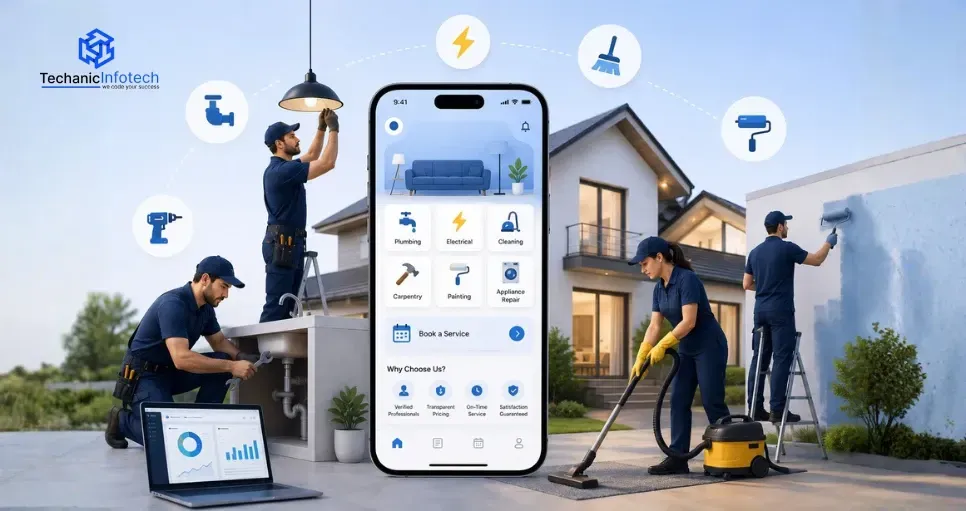
Home service apps are rapidly growing in 2026 due to increasing demand for convenient, on-demand household solutions.
Essential features like real-time booking, AI-powered recommendations, GPS tracking, and secure payment systems improve user experience and business efficiency.
Choosing the right technology stack and scalable infrastructure is crucial for building high-performing and future-ready home service applications.
Advanced technologies such as AI, IoT, AR, and automation are transforming the future of home service app development.
Partnering with an experienced development company like Techanic Infotech can help businesses build secure, scalable, and feature-rich home service platforms.
Plumbing emergencies, unexpected cleaning tasks, and never-ending furniture assembly struggles are all part of everyday life. That’s exactly why on-demand home service apps have become essential for modern users.
With the growing demand for convenience, investing in home-service app development is a smart way to enter this rapidly expanding market. A professional home service app development company can help businesses create powerful platforms that connect customers with trusted service providers in real time while simplifying bookings, payments, and service management.
This guide will walk you through the must-have features, development process, and key strategies needed to build a successful home service app that delivers real value to users.
Your app idea could be the next big name in the home services industry!
A home service app is a modern digital platform that allows users to book essential household services directly from their smartphones or tablets. From home cleaning and appliance repair to salon services, plumbing, electrical work, pest control, and AC maintenance, everything can now be scheduled online within minutes.
In 2026, home service applications are transforming the way people manage daily tasks by offering faster bookings, real-time tracking, secure online payments, and instant communication between customers and service professionals. These platforms act as a bridge between users and verified service providers, creating a smooth and hassle-free experience for both sides. A professional home service app development company can help businesses build scalable and feature-rich platforms that meet modern customer expectations.
Just as ride-booking apps have revolutionized transportation, home service apps are transforming the on-demand service industry by bringing convenience, transparency, and reliability to a single platform. Users can compare services, check ratings and reviews, choose preferred time slots, and receive doorstep assistance without making endless phone calls.
Advanced technologies such as AI-powered recommendations, smart scheduling, GPS tracking, and automated notifications are making these apps even more efficient and user-friendly in 2026. The growing impact of AI in product development is also helping businesses create smarter, faster, and more personalized home service experiences.
Businesses looking to enter this rapidly growing market should focus on developing a feature-rich home-service app that improves customer satisfaction and streamlines operations. With the right strategy and innovative features, your app idea can evolve into a trusted platform for complete home service solutions.
A home service app works as an on-demand platform that connects customers with nearby service professionals in real time. Users can quickly book services like home cleaning, plumbing, electrical repair, beauty services, appliance maintenance, and pest control directly through the app.
After selecting a service and preferred time slot, the platform matches users with verified professionals based on location, availability, ratings, and expertise. Customers can track bookings, receive live updates, and make secure online payments within the app.
In 2026, modern home service apps will also include AI-powered recommendations, GPS tracking, smart scheduling, automated reminders, and customer feedback systems to deliver a faster and smoother user experience. Businesses can efficiently manage bookings, staff, payments, and customer interactions through a centralized dashboard while overcoming common home service app development challenges such as real-time coordination, user retention, and service quality management.
Creating a successful home service app in 2026 requires much more than an attractive interface. Today’s users expect speed, security, convenience, and a personalized experience across every interaction.
A powerful home service application should provide smooth functionality for customers, service providers, and administrators while maintaining trust and operational efficiency. From instant booking systems to real-time tracking and AI-powered automation, every feature plays an important role in improving user engagement and business growth. Businesses also carefully evaluate hybrid app development costs to build scalable and budget-friendly solutions for multiple platforms.
To build a competitive and scalable platform, businesses must focus on integrating smart, user-centric features that enhance customer satisfaction and streamline daily operations.
Here are the 10 must-have features every modern home service app should include to stand out in today’s fast-growing on-demand market.
A smooth signup process is essential for user engagement. Allow users to register using email, phone numbers, or social media accounts. Users should also be able to manage personal details, saved addresses, booking history, and payment preferences easily. A simple onboarding experience helps build trust from the very first interaction.
Users should quickly find the services they need through organized categories and advanced filters. Services like cleaning, plumbing, electrical repair, pest control, and beauty services should include pricing, duration, descriptions, and ratings. Proper categorization improves user experience and simplifies navigation.
An advanced booking system allows users to check real-time availability, select preferred time slots, and receive instant confirmations. Features like calendar integration and automated reminders make scheduling more efficient and convenient for both customers and service providers.
Clear communication improves customer satisfaction. Integrated chat and calling features allow users to directly connect with service providers to discuss requirements, share updates, and resolve issues quickly. This feature adds transparency and creates a more personalized user experience.
Secure and flexible payment options are essential for modern apps. Integrate multiple payment gateways such as UPI, debit/credit cards, net banking, and digital wallets. Transaction history, digital invoices, and encrypted payment processing improve the overall security of home service apps while strengthening e-wallet app security and building customer trust.
Customer reviews and ratings help maintain service quality and improve platform credibility. Users should be able to leave feedback after service completion, helping future customers make informed decisions. A trusted mobile app development company can integrate advanced review systems with verified ratings and AI-powered moderation features.
Location-based features allow users to find nearby service providers and track professionals in real time after booking confirmation. GPS tracking is especially useful for urgent services like plumbing, appliance repair, and electrician support, improving convenience and operational efficiency.
A strong admin panel helps businesses manage users, service providers, bookings, payments, analytics, and customer support from a centralized system. Admin dashboards also provide valuable business insights, helping companies scale operations more effectively.
Modern home service apps in 2026 use AI to recommend relevant services based on user behavior, booking history, and preferences. Advanced AI app development solutions also help businesses deliver personalized user experiences, smart automation, and predictive recommendations. Push notifications, booking reminders, promotional offers, and service updates further improve customer engagement and retention.
A scalable platform should support multiple vendors and professionals across different service categories. This feature allows businesses to manage large networks of service providers efficiently. A professional handyman app development company can build advanced vendor management systems with provider verification, availability tracking, and performance monitoring tools.
Building a successful home service app in 2026 requires a smart development strategy, modern technologies, and a user-focused approach. From market research to app launch, every stage plays an important role in creating a scalable and high-performing platform.
Following a structured process helps businesses reduce risks, improve efficiency, and build an app that delivers a seamless experience for both customers and service providers.
The first step in developing a home service app is understanding your target audience and market demand. Analyze customer pain points, study competitor platforms, and identify service gaps that your app can solve.
Research also helps businesses understand user expectations, trending features, and estimated home service app development costs before starting the project. A strong market analysis creates the foundation for long-term success.
Once you understand your audience, the next step is selecting the right features for your app. Essential functionalities usually include user registration, service listings, booking systems, payment integration, notifications, and reviews.
If you plan to build a handyman app, you should also include provider management, GPS tracking, job scheduling, and service history features to improve operational efficiency and user convenience.
Selecting the right technologies directly impacts app performance, scalability, and security. Businesses should choose reliable front-end frameworks, backend architecture, APIs, and cloud services that support real-time operations and smooth performance.
A modern mobile app tech stack should support AI-powered automation, secure payment gateways, GPS tracking, live notifications, and scalable infrastructure for future growth.
User experience is one of the most important factors behind app success. A clean interface, easy navigation, fast loading speed, and visually appealing layouts improve customer satisfaction and retention.
Following a professional mobile app design guide helps businesses create intuitive experiences for customers, service providers, and administrators across different devices and screen sizes.
Begin development with an MVP (Minimum Viable Product) that includes the most important features. Businesses often choose to build a minimal viable product first to launch faster, gather real user feedback, and improve the app continuously through regular updates.
This phased development approach reduces risks while helping teams adapt quickly to changing market requirements.
Before launching the app, perform detailed testing across multiple devices and operating systems. Check app performance, security, payment systems, booking functionality, and real-time communication features.
Testing helps identify bugs, improve stability, and ensure a smooth user experience from day one.
After successful testing, launch the application on Android and iOS platforms. Businesses should carefully optimize app store listings, monitor user feedback, track app performance, and release regular updates based on analytics.
Understanding how to publish an app on the App Store properly can improve app visibility, downloads, and long-term growth in the competitive on-demand market.
Choosing the right technology stack is essential for building a secure, scalable, and high-performing home service app. The technology stack acts as the foundation of the application and directly affects speed, reliability, user experience, and future scalability.
Modern home service apps require advanced technologies that support real-time booking, GPS tracking, AI-powered recommendations, secure payments, cloud storage, push notifications, and live communication features.
A strong and scalable tech stack ensures your app can handle growing user demands while maintaining smooth performance and data security across all platforms.
|
Component |
Latest Technologies Used in 2026 |
|
Frontend (Customer App) |
Flutter, React Native, SwiftUI, Jetpack Compose |
|
Frontend (Service Provider App) |
Flutter, Kotlin Multiplatform, SwiftUI |
|
Backend Development |
Node.js, NestJS, Laravel, FastAPI |
|
Database |
PostgreSQL, MongoDB Atlas, Firebase Firestore |
|
Real-Time Features |
Firebase Realtime Database, Socket.IO, Supabase |
|
Maps & Location Services |
Google Maps Platform, Mapbox, Geoapify |
|
Payment Integration |
Stripe, Razorpay, PayPal, Apple Pay, Google Pay |
|
Push Notifications |
Firebase Cloud Messaging (FCM), OneSignal, Airship |
|
Admin Panel & Dashboard |
React.js, Next.js, Angular |
|
Cloud & Hosting |
AWS, Google Cloud Platform (GCP), Microsoft Azure |
|
AI & Automation |
OpenAI API, Google Gemini AI, TensorFlow |
|
Authentication & Security |
Firebase Auth, Auth0, Okta |
|
Analytics & Monitoring |
Mixpanel, Google Analytics 4, Datadog |
|
DevOps & Deployment |
Docker, Kubernetes, GitHub Actions |
|
Customer Support Integration |
Zendesk, Freshdesk, Intercom |
A modern tech stack ensures your home service app delivers fast performance, seamless user experiences, real-time functionality, and advanced security across all devices. The right combination of technologies also helps businesses support AI-powered features, secure payment systems, live tracking, cloud scalability, and smooth app performance even as user demand grows.
Before starting development, businesses should clearly understand the estimated budget required for the project. The overall cost of building a home service app depends on several factors, including app complexity, feature set, design quality, technology stack, third-party integrations, and the location of the development team.
Modern home service app development cost in 2026 can also vary based on advanced functionalities such as AI-powered automation, GPS tracking, real-time booking systems, secure payment integration, cloud infrastructure, and multi-platform support.
Whether you are planning a basic MVP or a fully customized on-demand platform, understanding the pricing structure helps businesses make smarter development decisions and plan scalable solutions more effectively.
Here’s a general pricing overview to help estimate the cost of developing a modern home service application.
|
App Type |
Estimated Cost Range (2026) |
|
MVP / Basic Home Service App |
$10,000 - $30,000 |
|
Mid-Level Home Service App |
$30,000 - $55,000 |
|
Advanced App with AI, AR & Automation |
$55,000 - $80,000+ |
|
Enterprise-Grade Multi-Service Platform |
$90,000 - $120,000+ |
|
Yearly Maintenance & Updates |
$5,000 - $12,000 |
|
Cloud Hosting & Third-Party Services |
$3,000 - $10,000 Per Year |
|
UI/UX Design & Prototyping |
$2,000 - $9,000 |
|
AI Integration & Smart Automation Features |
$8,000 - $25,000+ |
Keep in mind that the cost of developing a home service app in 2026 can increase based on advanced features such as AI-powered automation, real-time GPS tracking, multilingual support, custom admin dashboards, AR/VR integrations, cloud scalability, and high-end security systems. The more customized and feature-rich the platform becomes, the higher the overall development and maintenance cost will be.
Before building your own platform, it’s important to analyze the most successful home service apps dominating the market in 2026. These apps are setting new industry standards with AI-powered automation, seamless booking systems, real-time tracking, smart recommendations, and highly personalized user experiences.
Studying these platforms can help businesses understand current trends, customer expectations, and the latest innovations shaping the future of on-demand home services.
Here are the top 7 home service apps leading the industry in 2026.
Urban Company remains one of the most popular home service platforms worldwide, offering services such as beauty treatments, appliance repairs, plumbing, cleaning, and wellness solutions. Businesses looking to develop an app like Urban Company often focus on AI-powered recommendations and premium user experiences that make the platform a leader in the on-demand industry.
Features:
AI-based service recommendations
Verified and trained professionals
Real-time booking and tracking
Secure digital payments
Subscription-based home services
Best For: Complete urban home services and lifestyle solutions
TaskRabbit connects users with local professionals for tasks like furniture assembly, moving assistance, cleaning, and handyman services. Its flexible gig-based model continues to attract users looking for quick and affordable solutions.
Features:
Instant task matching
Transparent pricing system
Same-day service booking
In-app messaging and payments
Real-time provider availability
Best For: Handyman tasks and quick household jobs
Thumbtack helps users find local professionals for home improvement, repairs, wellness, events, and personal services. The platform uses smart matching algorithms to recommend the best professionals based on customer needs.
Features:
AI-powered professional matching
Personalized service quotes
Customer reviews and ratings
Secure communication system
Service comparison tools
Best For: Finding trusted local professionals
Handy specializes in home cleaning, furniture assembly, and handyman services with a focus on simplicity and reliability. Its fast booking process and subscription plans make it highly popular among busy urban users.
Features:
One-tap booking system
Recurring service scheduling
Upfront pricing transparency
Background-verified professionals
Live service tracking
Best For: Home cleaning and maintenance services
Housejoy offers appliance repairs, beauty services, home cleaning, plumbing, electrical work, and more through a single integrated platform. The app focuses heavily on customer convenience and fast service delivery.
Features:
Multi-service platform support
Real-time technician tracking
Flexible payment options
Smart booking management
24/7 customer assistance
Best For: End-to-end household service solutions
Angi (formerly Angie’s List) is one of the leading platforms for home improvement and contractor services. It helps users connect with trusted professionals for renovation, remodeling, landscaping, and repair projects.
Features:
Verified contractor marketplace
AI-based project estimates
Service scheduling tools
Customer reviews and ratings
Project management support
Best For: Home renovation and large-scale improvement projects
Helpling is a fast-growing platform specializing in professional home cleaning services across multiple countries. The app emphasizes quality assurance, easy scheduling, and subscription-based cleaning plans.
Features:
Easy recurring booking system
Instant cleaner matching
Secure online payments
Service customization options
Automated reminders and updates
Best For: Professional residential cleaning services
These leading apps showcase how modern technologies like AI automation, real-time tracking, smart scheduling, cloud infrastructure, and personalized user experiences are transforming the home service industry in 2026.
Building a modern home service app in 2026 involves much more than creating an attractive interface. Businesses must manage real-time operations, maintain service quality, secure customer data, and deliver seamless experiences across multiple devices and user groups.
As the on-demand industry becomes more competitive, companies also face increasing home service app development challenges related to scalability, automation, customer retention, and operational efficiency.
Here are some of the biggest challenges businesses face while developing a home service app and the best ways to overcome them.
Handling thousands of bookings simultaneously can create scheduling conflicts, delayed appointments, and poor user experiences if the system is not optimized properly.
Solution:
Implement AI-powered scheduling systems, real-time availability management, calendar synchronization, and automated booking updates to minimize conflicts and improve operational efficiency.
Users are often hesitant to hire unknown professionals without proper verification or reviews. Trust and transparency are essential for customer retention.
Solution:
Integrate advanced identity verification, background checks, customer ratings, verified reviews, and provider performance tracking to build a secure and trusted platform.
Online transactions always carry risks such as payment failures, fraud attempts, chargebacks, and data breaches that can damage brand reputation.
Solution:
Use PCI-compliant payment gateways, encrypted transactions, multi-factor authentication, AI-based fraud detection systems, and secure digital wallet integrations to improve payment security.
Managing service quality becomes difficult as the number of providers and service categories grows. Poor customer experiences can negatively impact ratings and retention.
Solution:
Establish strict quality standards, conduct regular provider evaluations, use AI-driven customer feedback analysis, and provide continuous training programs for service professionals.
Home service apps require separate interfaces for customers, service providers, and administrators. Each panel must deliver a smooth and intuitive experience.
Solution:
Design user-friendly dashboards for every user type, optimize app performance across devices, and conduct regular UI/UX testing to improve accessibility and usability.
As the platform grows, handling large numbers of users, bookings, and real-time requests can become technically challenging.
Solution:
Use scalable cloud infrastructure such as AWS, Google Cloud, or Microsoft Azure along with microservices architecture and load balancing technologies to maintain smooth app performance during peak traffic.
GPS inaccuracies, delayed tracking updates, and route optimization issues can impact service delivery and customer satisfaction.
Solution:
Integrate advanced location technologies like Google Maps Platform, AI-powered route optimization, and real-time tracking systems for accurate provider navigation and faster service delivery.
Many apps struggle to retain users after the first booking due to lack of personalization and engagement strategies.
Solution:
Use AI-powered recommendations, loyalty programs, personalized offers, push notifications, and subscription-based services to improve customer engagement and long-term retention.
The home service industry is rapidly evolving with the adoption of advanced technologies and smart automation. In 2026, businesses are focusing on delivering faster, safer, and more personalized on-demand experiences.
Future home service apps are expected to integrate technologies such as:
AI-powered automation and smart recommendations
IoT-enabled smart home integrations
Voice assistant support
AR-based service visualization
Predictive maintenance systems
Contactless digital payments
Real-time analytics and automation
Blockchain-powered payment security
Businesses that adopt these emerging technologies early will gain a competitive advantage and create smarter, more scalable home service platforms for the future.
|
Trend |
Description |
|
AI-Powered Personalization |
Advanced AI analyzes user behavior, booking history, and preferences to recommend personalized home services and smart offers automatically. |
|
AR & 3D Service Visualization |
Augmented Reality allows users to preview furniture placement, appliance installations, home renovations, and repair outcomes before booking services. |
|
Voice Assistant & Smart Home Integration |
Users can book and manage services through Alexa, Google Assistant, Siri, and other smart home ecosystems using voice commands. |
|
Subscription-Based Service Models |
Businesses now offer monthly and yearly subscription plans for recurring services like cleaning, AC maintenance, pest control, and appliance servicing. |
|
IoT-Based Predictive Maintenance |
Smart devices connected through IoT can automatically detect maintenance issues and schedule repair services before breakdowns occur. |
|
Blockchain-Powered Secure Payments |
Blockchain technology improves payment transparency, reduces fraud risks, and enables highly secure digital transactions for service marketplaces. |
|
AI Chatbots & Virtual Support |
AI-powered chatbots provide instant customer support, booking assistance, complaint resolution, and automated service recommendations 24/7. |
|
Real-Time Analytics & Automation |
Advanced analytics tools help businesses monitor bookings, provider performance, customer behavior, and operational efficiency in real time. |
|
Hyperlocal Service Matching |
AI-driven location systems instantly connect users with the nearest verified service providers for faster response times and improved efficiency. |
|
Green & Eco-Friendly Services |
Modern home service apps are promoting eco-friendly cleaning, energy-efficient maintenance, and sustainable household solutions to meet growing environmental demand. |
Businesses planning to scale their platforms in 2026 should closely follow the latest home service app trends to stay competitive in the rapidly evolving on-demand market. Technologies like AI automation, IoT integration, AR experiences, smart scheduling, and personalized recommendations are shaping the future of digital home services and transforming customer expectations.
The demand for smart and convenient on-demand home services is growing rapidly in 2026 as users continue to prefer digital solutions for everyday household needs. From cleaning and appliance repair to beauty services and handyman solutions, home service apps are transforming how customers book and manage services.
Building a successful home service app requires the right combination of advanced features, modern technologies, seamless user experience, and a scalable development strategy. Businesses that invest in AI-powered automation, real-time tracking, secure payments, and personalized experiences can create platforms that stand out in the competitive market.
With the support of an experienced development partner like Techanic Infotech, businesses can turn innovative ideas into powerful, future-ready home service applications designed for long-term growth and customer satisfaction.
Now is the perfect time to transform your idea into a high-performing home service platform that delivers convenience, trust, speed, and exceptional user experiences.
A home service app allows users to book services like cleaning, plumbing, beauty, appliance repair, and handyman solutions directly from their smartphones.
The development cost usually ranges from $10,000 to $120,000+ based on features, app complexity, AI integrations, and customization needs.
Core features include real-time booking, GPS tracking, secure payments, ratings & reviews, notifications, and admin dashboards.
A basic MVP may take 3–5 months, while a fully advanced app can require 6–12 months or more.
AI improves personalization, smart recommendations, automated scheduling, and customer support experiences.
Popular technologies include Flutter, React Native, Node.js, Firebase, AWS, PostgreSQL, and AI APIs.
Yes, modern home service apps support multiple vendors with separate dashboards and provider management systems.
They use encrypted payment gateways, secure wallets, PCI-compliant systems, and fraud protection technologies.
Major challenges include managing bookings, maintaining service quality, scaling infrastructure, and improving user retention.
Techanic Infotech builds scalable and feature-rich home service apps with AI features, secure payments, GPS tracking, and ongoing support.


Bharat Sharma is the CTO of Techanic Infotech, bringing deep technical expertise in software architecture, mobile app development, and scalable system design. He leads the engineering team with a strong focus on innovation, performance, and security.