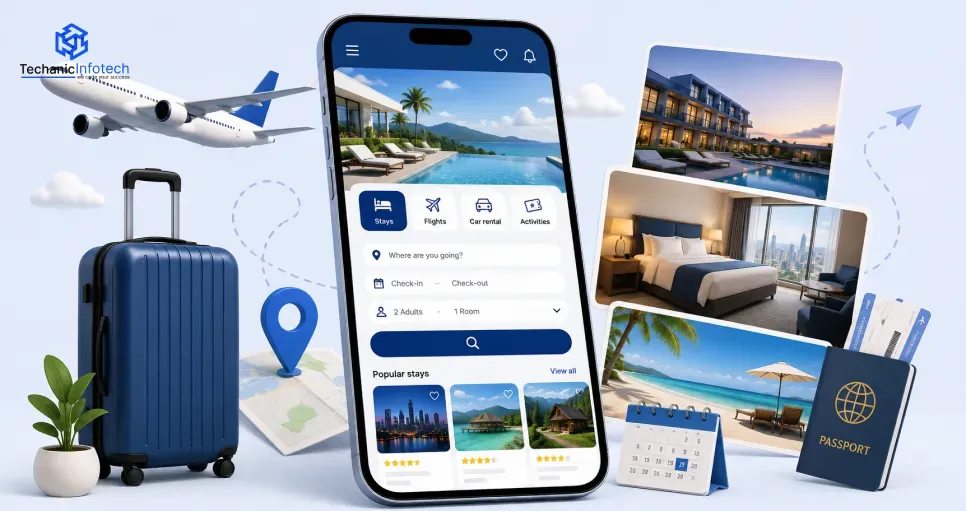
On Demand App Development
How to Build an App Like Booking.com: Features, Cost & Business Model
August 26, 2026
August 26, 2026
Key Takeaways:
Building a Booking.com-like app can cost approximately 8,000–70,000+, depending on complexity and features.
A basic MVP may take 2–3 months, while an advanced platform can require 7–10+ months.
Essential features include hotel search, filters, listings, availability, booking, payments, reviews, notifications, and hotel partner management.
Multiple revenue streams can include commissions, booking fees, premium listings, subscriptions, and advertising.
A scalable technology stack and reliable third-party integrations are essential for handling bookings and real-time availability.
Online hotel booking platforms have changed how travellers search for accommodation, compare properties, check availability, and make reservations. Platforms such as Booking.com bring hotels, travellers, and service providers together through a convenient digital marketplace.
If you want to develop an app like Booking.com, you need more than a hotel listing and reservation system. A successful platform requires a strong business model, intuitive booking experience, property management capabilities, secure payments, real-time availability, reviews, notifications, and reliable backend infrastructure.
The scope of Booking.com clone app development can also vary significantly depending on whether you are creating a basic hotel reservation platform or a large marketplace with multiple property types, advanced search, personalized recommendations, loyalty programmes, and global payment support.
This guide explains the key aspects of Booking.com-like app development, including how the platform works, business and revenue models, essential features, development process, technology requirements, estimated cost, timeline, and factors to consider when choosing a development partner.
The online accommodation booking market size was valued at USD 340.92 billion in 2025 and estimated to grow from USD 361.54 billion in 2026 to reach USD 484.95 billion by 2031, at a CAGR of 6.05% during the forecast period (2026-2031).
According to Mordor Intelligence, mobile applications held 61.45% of the online accommodation booking market share in 2025, and their share is projected to widen as the segment advances at a 12.65% CAGR through 2031.
According to Mordor Intelligence, hotels and resorts captured 49.02% of the online accommodation booking market size in 2025, while alternative lodgings are accelerating at a 14.9% CAGR during the forecast period.
The growing preference for online travel planning has created opportunities for businesses to launch platforms that simplify hotel discovery and reservations. A Booking.com-style marketplace can connect travelers with hotels and other accommodation providers through a single platform.
A digital booking platform allows hotels and property providers to reach travelers beyond their local market. Customers can search and reserve properties from different locations through a single application.
A booking marketplace can generate revenue through commissions, booking fees, advertising, premium listings, subscriptions, and partnerships with hotels or travel businesses.
Customers can search properties, compare prices, view photos and reviews, check availability, and complete reservations without contacting hotels individually.
Unlike a single-property booking application, a marketplace can onboard multiple hotels and accommodation providers. As the inventory grows, the platform can expand into additional cities, regions, or countries.
Booking data can help businesses understand customer preferences, popular destinations, booking patterns, seasonal demand, and pricing trends. These insights can support better marketing and business decisions.
Personalized recommendations, saved properties, tailored offers, smart search, and AI-powered suggestions can make the booking journey more relevant to individual users.
A well-designed booking platform can establish a direct relationship with customers instead of relying entirely on third-party travel marketplaces. This can create opportunities for loyalty programmes, repeat bookings, and direct marketing.
For businesses considering a hotel booking app development company, the key advantage is the ability to create a customized marketplace around a specific target audience, location, property category, or travel niche rather than simply copying an existing platform.
A Booking.com-style platform connects travelers with hotels and accommodation providers through a multi-sided marketplace. Each user type has different responsibilities, while the backend coordinates listings, availability, bookings, payments, and communication.
Users can create accounts, search destinations, apply filters, compare properties, view room details, check availability, make reservations, and receive booking confirmations.
Hotels can create property profiles, upload photos, add room types, set prices, manage availability, accept or update reservations, and respond to customer requests through a dedicated dashboard.
The admin panel manages users, properties, bookings, payments, commissions, reviews, promotions, disputes, and platform analytics. Administrators can also approve or remove property listings.
A typical booking journey follows these steps:
The customer enters a destination and travel dates.
The app retrieves available properties.
The customer applies filters and compares options.
The customer selects a room and reviews its details.
Availability and pricing are confirmed.
The customer completes the payment or reservation.
The hotel receives the booking information.
The customer receives a confirmation and booking details.
Notifications and reminders are sent before the stay.
When a reservation is completed, the platform can deduct its commission or applicable booking fee according to the selected business model. The remaining amount can then be settled with the hotel or property partner based on the platform's payment and payout process.
A reliable backend is essential because the platform must keep property information, room availability, pricing, bookings, and payment records synchronized. This makes hotel booking app development more complex than building a simple hotel listing application.
Choosing the right business model is important when building a platform like Booking.com because it determines how the app attracts hotels, serves travelers, and generates revenue.
The platform charges hotels or property owners a percentage of every successful booking. This is one of the most common approaches for online booking marketplaces.
Hotels pay a fixed amount to list their properties on the platform. This model can provide predictable revenue but may be less attractive to new property owners.
Hotels can pay monthly or annual subscription fees to access premium platform features, analytics, promotional tools, or higher visibility.
Property owners can pay to have their hotels displayed more prominently in search results or promotional sections. This can create an additional revenue stream without changing the standard booking process.
The platform can charge travelers a service or convenience fee when they complete a reservation. The fee can be fixed or calculated as a percentage of the booking value.
A combination of commissions, subscriptions, booking fees, advertisements, and premium listings can create multiple revenue streams. This approach can also reduce dependence on a single source of income.
The ideal model depends on the target market, property types, competition, customer acquisition strategy, and expected booking volume. A startup may initially use a commission-based approach to attract hotel partners because the platform earns revenue when properties generate bookings.
Businesses can also study competitors by comparing Airbnb and hotel booking apps to understand how different accommodation marketplaces structure their services and revenue models.
A hotel booking marketplace can generate revenue through multiple channels. Combining different monetization strategies can help the platform create sustainable income while offering value to both travelers and property partners.
The platform can earn a percentage of each completed reservation. Commission rates can vary based on property type, location, partnership terms, and booking volume.
A small service or convenience fee can be added to selected bookings. The fee should be transparent to avoid negatively affecting customer trust and conversion rates.
Hotels can pay for enhanced visibility in search results, promotional sections, or destination-specific campaigns. This gives property owners an additional way to attract potential guests.
Premium subscription packages can provide hotels with advanced analytics, promotional tools, priority support, or additional listing capabilities in exchange for recurring fees.
Hotels, travel brands, restaurants, transportation providers, and tourism businesses can advertise their services to users based on destinations and travel preferences.
The platform can earn commissions by referring users to complementary travel services such as flights, car rentals, travel insurance, activities, and airport transfers.
Depending on the platform's policies and booking terms, certain cancellation or service charges may create additional revenue opportunities.
Paid memberships can provide customers with exclusive discounts, rewards, early access to offers, or additional booking benefits. The recurring membership revenue can complement booking commissions.
The platform can collaborate with hotels and tourism businesses on seasonal campaigns, destination promotions, sponsored offers, and special packages.
A diversified monetization strategy can make Booking.com app development more commercially sustainable. However, revenue features should be designed carefully so that monetization does not compromise the customer experience or discourage hotel partners from joining the platform.
A Booking.com-style platform needs features for travelers, hotel partners, and administrators. The goal should be to make property discovery, comparison, reservation, and management simple across the entire booking journey.
User registration and secure login
Destination and hotel search
Advanced filters and sorting
Hotel and room listings
Photos, amenities, and property details
Real-time room availability
Price comparison
Booking and cancellation
Secure online payments
Booking history
Ratings and reviews
Wishlist and saved properties
Push notifications
Customer support
Maps and location services
Hotel owners and property managers can use a dedicated dashboard to:
Create and manage property listings
Add rooms and amenities
Update pricing and availability
Manage reservations
View customer information
Manage promotions and discounts
Track earnings
Respond to reviews
View booking analytics
The admin panel can provide centralized control over:
Customers and hotel partners
Property approvals
Listings and room inventory
Bookings and cancellations
Payments and commissions
Reviews and complaints
Promotions
Reports and analytics
Content management
These core Booking.com clone app features provide the foundation for a functional hotel marketplace. Businesses can initially prioritize high-value functionality and introduce more advanced capabilities as the platform gains users.
Once the core booking functionality is established, advanced features can help a platform provide a more personalized experience and compete in a crowded travel market.
AI can analyze search behavior, previous bookings, budgets, and preferences to recommend relevant hotels, rooms, destinations, and travel options.
Natural-language search can allow users to enter requests such as “budget-friendly hotels near the beach with free breakfast” and receive relevant results.
Advanced pricing systems can help hotels adjust room rates according to demand, seasonality, occupancy, local events, and other market conditions.
The platform can display customized discounts and offers based on user preferences, previous bookings, destinations, and browsing behavior.
For international users, support for multiple currencies and languages can make the platform more accessible across different markets.
Points, membership tiers, exclusive offers, and repeat-booking rewards can encourage customers to return to the platform.
360-degree images, virtual room tours, and interactive property galleries can help users make more informed booking decisions.
Secure messaging can allow travelers to communicate with hotels regarding check-in details, special requests, or other booking-related questions.
Automated monitoring can identify suspicious transactions, unusual booking behavior, duplicate accounts, and potentially fraudulent activities.
The platform can expand beyond hotel reservations by offering airport transfers, activities, car rentals, travel insurance, and other complementary services.
Choosing the right mobile app features can increase development complexity and influence the overall project cost, so businesses should introduce advanced capabilities according to customer demand and business priorities rather than adding everything at launch.
Developing a large hotel booking marketplace requires a structured approach. Breaking the project into clear stages helps control scope, budget, and development quality.
Identify your target audience, property types, geographic market, unique value proposition, and primary revenue model before starting development.
Study platforms such as Booking.com, Airbnb, Expedia, and regional booking services. Identify their strengths, gaps, pricing strategies, and customer expectations.
Separate features into essential and advanced categories. Core functionality should be prioritized for the initial launch, while AI, loyalty programmes, and other advanced capabilities can be added later.
Create user flows, wireframes, prototypes, and final UI designs for travelers, hotel partners, and administrators. The booking journey should remain simple and intuitive.
Choose suitable frontend, backend, database, cloud, API, payment, and communication technologies based on the expected scale and functionality.
Develop the customer application, hotel partner dashboard, admin panel, backend services, booking engine, payment system, and required APIs.
Connect hotel inventory APIs, payment gateways, maps, notifications, analytics, identity verification, and other required services.
Conduct functional, usability, security, performance, compatibility, and payment testing. Booking and inventory synchronization should receive particular attention.
Deploy the initial version to the relevant app stores and production infrastructure. Start with a controlled market or limited property inventory when possible.
Analyze user behavior, booking conversions, reviews, crashes, and performance after launch. Use these insights to prioritize future features and improvements.
“Businesses planning to build a mobile app like Booking.com should treat development as an ongoing product lifecycle rather than a one-time project.”
The right technology stack helps a Booking.com-like platform manage high volumes of searches, real-time availability, reservations, payments, hotel data, and user activity. The exact technologies should be selected based on the platform's scale and technical requirements.
|
Technology Layer |
Common Options |
|
Mobile Development |
Flutter, React Native, Swift, Kotlin |
|
Frontend Web |
React, Angular, Next.js |
|
Backend |
Node.js, Python, Java, .NET |
|
Database |
PostgreSQL, MySQL, MongoDB |
|
Cloud Infrastructure |
AWS, Google Cloud, Microsoft Azure |
|
Real-Time Communication |
WebSockets, Firebase |
|
Maps & Location |
Google Maps API, Mapbox |
|
Payments |
Stripe, PayPal, Braintree |
|
Notifications |
Firebase Cloud Messaging, Twilio |
|
Analytics |
Google Analytics, Mixpanel |
Choosing the right technology stack in a mobile app is not only about selecting popular frameworks. The technology architecture should support current booking requirements while allowing the platform to scale as users, properties, and transaction volumes increase.
The estimated cost to build an app like Booking.com can range from $8,000 to $70,000+, depending on the app's complexity, number of platforms, features, integrations, backend architecture, and development team.
|
App Type |
Estimated Cost |
Development Timeline |
|
Basic Booking App |
8,000–15,000 |
2–3 months |
|
Standard Booking Platform |
15,000–30,000 |
3–5 months |
|
Advanced Booking Marketplace |
30,000–50,000 |
5–7 months |
|
Enterprise Booking Platform |
50,000–70,000+ |
7–10+ months |
For businesses already familiar with hotel booking app development costs, it is important to note that a booking.com-style marketplace generally requires a larger budget because it involves multiple user roles, property partners, inventory synchronization, commissions, and more complex booking workflows.
The time required to build a Booking.com-like platform depends on the number of features, platforms, integrations, and level of customization. A simple MVP can be launched faster, while a large marketplace requires significantly more development and testing.
|
Development Stage |
Estimated Timeline |
|
Planning & Research |
1–2 weeks |
|
UI/UX Design |
2–4 weeks |
|
Frontend Development |
4–8 weeks |
|
Backend & Booking Engine |
5–10 weeks |
|
API & Payment Integrations |
2–5 weeks |
|
Testing & Quality Assurance |
2–4 weeks |
|
Deployment |
1–2 weeks |
|
Overall Timeline |
2–10+ months |
Feature Complexity: Advanced search, dynamic pricing, loyalty programmes, AI recommendations, and personalized experiences require additional development effort.
Number of Platforms: Building customer apps for both iOS and Android along with web dashboards increases the project scope.
Third-Party Integrations: Hotel APIs, payment gateways, maps, analytics, notifications, and external booking systems can require additional integration and testing.
Multi-Vendor Functionality: Supporting multiple hotels requires partner onboarding, property management, inventory control, commissions, and settlement features.
Customization: A highly customized interface, booking workflow, or backend architecture can require more design and development resources.
Scalability Requirements: A platform intended to support thousands of properties and high booking volumes needs a stronger backend and cloud infrastructure from the beginning.
A realistic mobile app development timeline should therefore be calculated after the complete feature scope and technical requirements have been finalized. Adding major features during development can increase both the timeline and the Booking.com clone app development cost.
Choosing the right development partner can directly affect the quality, scalability, and cost of your booking platform.
Look for a team with experience in hotel booking, travel, marketplaces, or reservation-based applications.
Evaluate previous projects, UI/UX quality, booking workflows, integrations, and overall technical capabilities.
The team should understand mobile development, backend architecture, APIs, payment gateways, cloud infrastructure, databases, and security.
Ask for a detailed proposal covering design, development, integrations, testing, deployment, and maintenance rather than comparing only the final price.
Choose a company that provides clear project updates, manages feedback efficiently, and offers post-launch maintenance and technical support.
If you plan to expand into multiple locations and onboard thousands of properties, ensure the team can build a scalable architecture from the beginning.
A reliable software app development company should understand both the technical and business aspects of your platform. The right partner can help you develop an app like Booking.com while keeping the project aligned with your target market, budget, and long-term goals.
Building an app like Booking.com requires careful planning across business strategy, features, technology, monetization, and development. The estimated investment can range from $8,000 to $70,000+, depending on the platform's complexity and scope.
Starting with an MVP allows businesses to launch essential booking functionality, validate demand, and gradually introduce advanced features such as AI recommendations, dynamic pricing, loyalty programmes, and personalized experiences.
A scalable architecture, secure payment system, reliable hotel integrations, and an experienced development team can provide a strong foundation for long-term growth. With the right strategy, a Booking.com-style platform can create value for both travelers and accommodation providers while generating multiple revenue opportunities.
The estimated cost is around 8,000–70,000+, depending on features, complexity, platforms, integrations, and technology requirements.
A basic MVP can take 2–3 months, while an advanced platform may require 7–10+ months.
Hotel search, filters, listings, availability, booking, payments, reviews, notifications, maps, and hotel partner management are essential features.
Common revenue streams include booking commissions, service fees, premium listings, subscriptions, advertising, and affiliate partnerships.
Yes. AI can be used for personalized recommendations, smart search, chatbots, pricing insights, fraud detection, and customer support.
Common technologies include Flutter or React Native for mobile development, Node.js or Python for backend development, PostgreSQL or MongoDB for databases, and AWS or Google Cloud for infrastructure.


Abhishek Jangid is the CEO of Techanic Infotech, with extensive experience in mobile app and web development. He specializes in helping businesses turn innovative ideas into scalable digital solutions through strategic planning and modern technology.