Real Estate App Development
Real Estate Chatbot Development: Adoption Trends & Use Cases
March 30, 2026
March 30, 2026
Key Takeaways
Real estate chatbot development helps businesses respond instantly and improve user experience.
AI chatbots automate lead generation, qualification, and customer support efficiently.
The cost of an AI chatbot for real estate can range from $8,000 to $150,000+ based on complexity.
24/7 availability ensures no potential lead is missed, even outside business hours.
Personalized property recommendations improve engagement and conversion rates.
Proper real estate chatbot implementation requires clear goals and defined use cases.
AI-powered chatbots perform better than rule-based ones due to better understanding of user intent.
Ever visited a real estate website and had questions but no one replied instantly? Or waited hours just to get basic property details? That’s exactly the gap real estate chatbot development is solving today.
With an AI chatbot for real estate, businesses can respond to users instantly, share property details, and even schedule site visits without delays. From our experience, companies investing in real estate AI chatbot development are seeing better engagement and faster lead conversion.
If it’s a real estate customer support chatbot or advanced AI-powered real estate automation, these tools are changing how property businesses operate. With the rise of conversational AI for real estate, chatbots are no longer optional, they are becoming a core part of modern real estate platforms.
A real estate chatbot is an AI-powered tool designed to interact with users on websites, apps, or messaging platforms. It helps property businesses handle customer queries, share property details, schedule site visits, and even qualify leads automatically.
With real estate chatbot development, businesses can provide instant responses without relying fully on human agents. An AI chatbot for real estate uses conversational AI to understand user queries and deliver relevant answers in real time. This improves customer experience and reduces manual workload.
From our experience, a well-built real estate customer support chatbot can handle up to 60–80% of common queries like pricing, location, and availability. This makes AI-powered real estate automation highly valuable for agencies and property platforms.
The demand for real estate AI chatbot development is growing rapidly due to changing user expectations and digital transformation.
Here are key reasons:
Instant Response is Now Expected: Around 70% of users expect immediate replies when they inquire online. Chatbots ensure 24/7 availability without delays.
Higher Lead Conversion: Businesses using chatbots have reported up to 30% increase in lead conversion rates because users get quick and relevant information.
Reduced Operational Cost: Chatbots can automate 60–80% of repetitive queries, reducing the need for large customer support teams.
Growing AI Adoption: The global chatbot market is projected to exceed $20 billion by 2029, showing rapid adoption across industries, including real estate.
Better Customer Experience: About 92% of customers report positive experiences with AI chatbots when responses are fast and accurate.
Real estate businesses deal with multiple tasks every day, handling inquiries, sharing property details, scheduling visits, and managing leads.
This is where real estate chatbot development plays a powerful role. With the help of an AI chatbot for real estate, many of these tasks can be automated, saving time and improving efficiency.
Let’s explore the most practical real estate chatbot use cases in simple terms.
One of the biggest use cases of a chatbot is capturing and qualifying leads automatically. When a user visits your website, the chatbot starts a conversation and asks relevant questions like:
Budget
Preferred location
Property type
Based on these answers, the chatbot filters serious buyers from casual visitors.
This is one of the most valuable parts of real estate AI chatbot development, as it helps sales teams focus only on high-quality leads.
Finding the right property can take time. A chatbot simplifies this process using conversational AI for real estate.
Users can type simple queries like
"I need 2BHK under $100K in a good location.”
The chatbot instantly shows matching listings based on preferences. This makes the experience faster and more user-friendly compared to traditional filters.
This is a key part of AI-powered real estate automation, improving both engagement and satisfaction.
Scheduling site visits manually can be time-consuming. Chatbots automate this entire process.
Show available time slots
Book appointments instantly
Send confirmations and reminders
This improves efficiency and reduces back-and-forth communication.
Automated scheduling is one of the most practical benefits of property chatbot development.
Not every user converts immediately. Chatbots help in sending follow-ups and keeping users engaged.
They can:
Share new property updates
Send reminders
Re-engage inactive users
This continuous interaction increases the chances of conversion over time.
With proper real estate chatbot integration, chatbots can connect with CRM systems to manage data effectively.
This allows businesses to:
Store user information
Track interactions
Analyze behavior
This makes lead management more organized and improves overall sales efficiency.
During peak times, handling multiple queries can become difficult for teams. Chatbots can manage thousands of conversations at once without delay.
This ensures:
Faster response time
No missed inquiries
Consistent communication
This scalability is one of the biggest advantages of real estate chatbot implementation.
Real estate platforms often deal with users from different regions. Chatbots can support multiple languages, making communication easier.
This helps:
Reach a wider audience
Improve user comfort
Increase engagement
Multi-language support is especially useful for large property platforms.
Chatbots act as virtual assistants, guiding users throughout their journey.
They can:
Suggest properties
Explain features
Answer common doubts
This reduces confusion and helps users make quicker decisions.
One of the biggest use cases is reducing operational cost through automation. Chatbots handle repetitive tasks like answering queries and sharing details.
This allows businesses to:
Reduce support team size
Focus on sales and strategy
Improve efficiency
This is why real estate chatbot development cost is often seen as an investment rather than an expense, especially when you partner with an experienced AI chatbot development company that can build scalable and cost-effective solutions
Chatbots allow users to explore properties without physical visits by sharing virtual tours, images, and videos instantly. They also simplify scheduling by letting users book site visits directly through the chat.
This ensures:
Quick access to property visuals
Easy appointment booking
No back-and-forth communication
This improves user convenience and speeds up the decision-making process.
With AI and NLP, chatbots understand user queries in natural language and respond intelligently. They can recommend properties, answer questions, and personalize conversations based on user needs.
This ensures:
Better understanding of user intent
Personalized property suggestions
Smooth and natural interaction
This makes conversational AI for real estate more effective and user-friendly.
The adoption of chatbots in real estate is growing rapidly as businesses shift towards automation and better customer experience. In 2026, chatbots are no longer optional, they are becoming a core part of digital property platforms.
Let’s look at the key trends shaping real estate chatbot development.
More real estate businesses are investing in chatbots than ever before. Around 58% of real estate professionals already use AI chatbots, and adoption is growing by nearly 45% every year.
At the same time, over 72% of industry leaders are planning or actively investing in chatbot solutions. This shows that real estate AI chatbot development is becoming a standard practice, not just a trend.
Businesses are moving from basic chatbots to advanced AI-powered real estate automation.
Modern chatbots can:
Understand user intent
Suggest properties
Automate workflows
The global chatbot market itself is expected to grow from $11.45 billion in 2026 to $32.45 billion by 2031, showing strong demand for AI solutions. Automation is now the main reason companies invest in chatbot technology.
Speed is becoming a major competitive factor. Real estate businesses using chatbots report
40% higher lead capture rates
50% faster response times
Chatbots respond instantly, which helps capture user interest before they move to another platform. This is why many companies prioritize AI chatbot for real estate to improve conversions.
Chatbots are evolving from simple FAQ tools to intelligent AI agents. Instead of giving fixed answers, modern systems use conversational AI for real estate to:
Understand natural language
Personalize conversations
Provide smarter recommendations
Experts suggest this shift from basic bots to AI agents is a major transformation in 2026 technology. This trend is making chatbots more human-like and effective.
Users are now directly searching for properties through chat interfaces instead of traditional browsing. AI tools are changing how people discover listings.
Real estate platforms are focusing on:
Chat-based property search
Virtual assistance
Personalized recommendations
This shift shows that chatbots are becoming a key part of real estate chatbot implementation for improving user experience and engagement.
Real estate businesses are becoming more digital, and chatbots are playing a big role in this shift. They help automate tasks, improve communication, and make the overall buying journey smoother.
Here are the key benefits explained in a simple way.
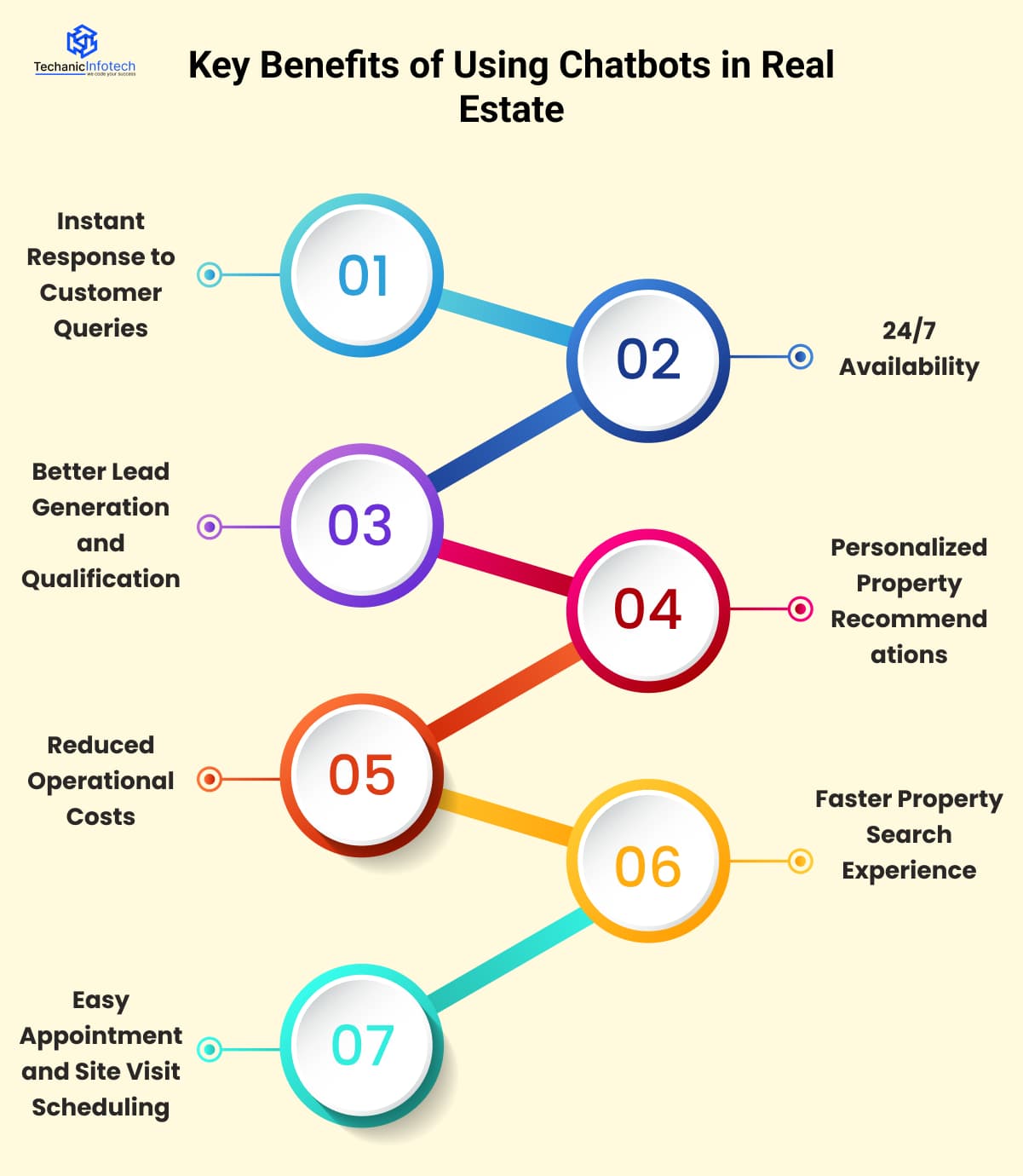
One of the biggest advantages of chatbots is speed. Instead of waiting for an agent to respond, users get instant answers to their questions. Whether it’s property details, pricing, or availability, a chatbot can handle it in seconds.
This quick response keeps users engaged and reduces the chances of losing potential buyers. From our experience, faster replies directly improve user satisfaction and increase the chances of conversion in real estate platforms.
Real estate inquiries don’t follow office hours. Many users browse properties late at night or during weekends. A chatbot ensures your business is always available.
It can answer questions, collect user details, and even guide them through listings at any time. This continuous availability helps capture more leads that might otherwise be missed. It also builds trust because users feel supported whenever they need help.
Chatbots don’t just collect leads, they qualify them. They can ask smart questions about budget, preferred location, and property type.
Based on this, they filter serious buyers from casual visitors. This saves time for sales teams and helps them focus on high-quality leads. From our experience, this improves efficiency and increases the chances of closing deals faster.
With the help of AI, chatbots can suggest properties based on user preferences. If someone is looking for a 2BHK in a specific area within a budget, the chatbot can instantly show relevant options.
This makes the search process easier and more engaging. Users don’t have to browse endlessly, which improves their overall experience and keeps them interested in your platform.
Handling customer queries manually requires a large support team. Chatbots can automate a major portion of these tasks.
They can answer common questions, share details, and guide users without human involvement. This reduces staffing needs and operational costs. Businesses can then invest more in marketing or improving their services instead of managing repetitive tasks.
Chatbots simplify the way users search for properties. Instead of using filters and navigating multiple pages, users can just type their requirements.
The chatbot understands the request and shows matching properties. This conversational approach is faster and more user-friendly. It also makes the platform feel more interactive, which increases user engagement.
Scheduling property visits can take a lot of back-and-forth communication. Chatbots automate this process by allowing users to book appointments instantly.
They can check available slots, confirm bookings, and send reminders. This saves time for both agents and customers. It also reduces the chances of missed or delayed appointments.
Adopting a chatbot is not just about adding a chat feature to your website. It requires the right planning, tools, and strategy to make it work effectively.
A well-planned real estate chatbot implementation can improve lead generation, automate tasks, and enhance customer experience.
Here’s a step-by-step guide to help you do it the right way.
Start by understanding why you need a chatbot. Do you want to generate leads, provide support, or automate tasks?
Common goals include:
Lead generation and qualification
Customer support automation
Property search assistance
From our experience, clear goals help you plan the right AI development strategy and avoid unnecessary features.
Next, decide how your chatbot will be used. Focus on high-impact areas such as:
Answering user queries
Sharing property details
Booking site visits
These are the most common real estate chatbot use cases that deliver quick results.
Start simple and expand later based on user needs.
Selecting the right technology stack is crucial. You can choose between:
Rule-based chatbots (basic)
AI-powered chatbots (advanced)
For better results, go with an AI chatbot for real estate that uses conversational AI for real estate to understand user intent and provide smarter responses. This improves user experience and makes interactions more natural.
A chatbot should feel easy and natural to use. Plan how conversations will flow:
Greeting messages
Questions to qualify users
Responses based on user input
Keep the language simple and clear. Avoid making conversations too complex.
From our experience, a well-designed flow is the key to successful real estate AI chatbot development.
For maximum impact, your chatbot should connect with your existing systems. Proper real estate chatbot integration allows you to:
Sync data with CRM
Track leads
Manage customer interactions
Integration ensures smooth operations and better data management.
Before launching, test your chatbot thoroughly. Check if it
Understands user queries correctly
Provides accurate responses
Handles different scenarios
If you are using AI, train it with real data to improve accuracy. App testing helps avoid errors and ensures a better user experience.
Once everything is ready, launch your chatbot. But the process doesn’t stop here.
Track performance using:
Response time
User engagement
Conversion rates
Continuous monitoring helps you improve your chatbot over time.
After launch, keep improving your chatbot based on user behavior and feedback.
Add new features
Improve responses
Expand use cases
This is where AI-powered real estate automation becomes more effective as your chatbot evolves.
The cost to integrate an AI chatbot for real estate depends on the complexity, mobile app features, and level of integration required. In general, the price can range from $8,000 to $150,000+ for a custom solution.
For a basic chatbot that handles FAQs and simple property queries, the cost usually falls between $8,000 and $15,000. These are suitable for small agencies or websites just starting with automation.
A mid-level AI chatbot with features like lead qualification, property suggestions, and CRM integration can cost around $20,000 to $80,000. This is the most common choice for growing real estate businesses.
For advanced AI chatbots, including conversational AI, personalization, and deep system integration, the cost can go beyond $100,000–$150,000+. These are typically used by large property platforms and enterprises.
While chatbots offer many benefits, implementing them in real estate is not always simple. Businesses often face practical challenges during real estate chatbot implementation. The key is to understand these challenges early and plan the right solutions.
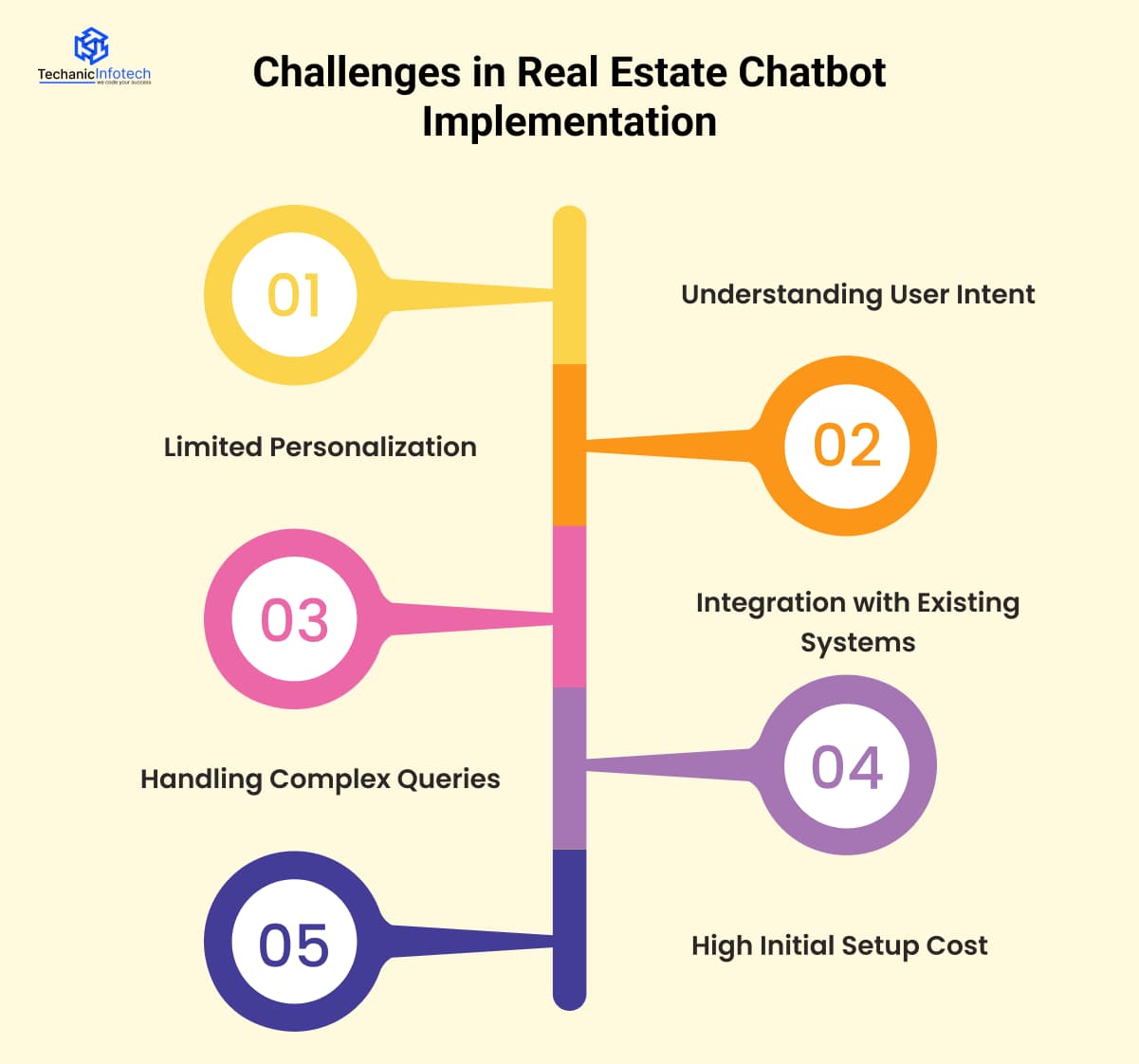
Chatbots may fail to understand what users actually mean, especially when queries are unclear or complex.
Solution: Use an advanced AI chatbot for real estate with strong NLP capabilities. Train it with real user data and common queries to improve accuracy over time.
Basic chatbots give generic responses, which can reduce user engagement.
Solution: Invest in real estate AI chatbot development that supports personalization. Use user data like location, budget, and preferences to deliver relevant suggestions.
Connecting chatbots with CRM, property databases, and other tools can be complex.
Solution: Focus on smooth real estate chatbot integration using APIs and experienced developers. This ensures data flows properly across systems.
Chatbots can struggle with detailed or unusual questions that require human judgment.
Solution: Use a hybrid approach where the chatbot handles basic queries and transfers complex ones to human agents. This balance ensures better support without losing efficiency.
The AI chatbot development cost can feel high, especially for advanced AI features.
Solution: Start with a basic version (MVP) and gradually add features. This reduces initial investment and spreads cost over time.
Real estate chatbots are quickly becoming a key part of modern property businesses. From handling inquiries to automating lead generation, they help improve efficiency and customer experience at every step.
With tze rise of AI chatbot for real estate and AI-powered real estate automation, businesses can now offer faster, smarter, and more personalized services.
From our experience, the success of real estate chatbot implementation depends on starting with clear goals and scaling gradually. When done right, it not only reduces operational effort but also increases conversions. In a competitive market, adopting chatbot technology is no longer optional, it’s a smart move for long-term growth
A real estate chatbot is an AI-powered tool that interacts with users, answers property-related queries, shares listings, and helps in lead generation automatically.
An AI chatbot for real estate automates tasks like customer support, property search, and appointment scheduling, helping businesses save time and improve conversions.
Common real estate chatbot use cases include lead qualification, property recommendations, customer support, follow-ups, and site visit scheduling.
The cost can range from $8,000 to $150,000+, depending on features, AI capabilities, and integrations.
Yes, with proper real estate chatbot integration, chatbots can connect with CRM systems to store data, track leads, and manage customer interactions.
Not really. With the right strategy and development team, real estate chatbot implementation can be smooth and scalable.
No, chatbots support agents by handling repetitive tasks. Human agents are still needed for complex discussions and closing deals.
With the rise of conversational AI for real estate and AI-powered real estate automation, chatbots will become more intelligent, personalized, and essential for business growth.


Abhishek Jangid is the CEO of Techanic Infotech, with extensive experience in mobile app and web development. He specializes in helping businesses turn innovative ideas into scalable digital solutions through strategic planning and modern technology.