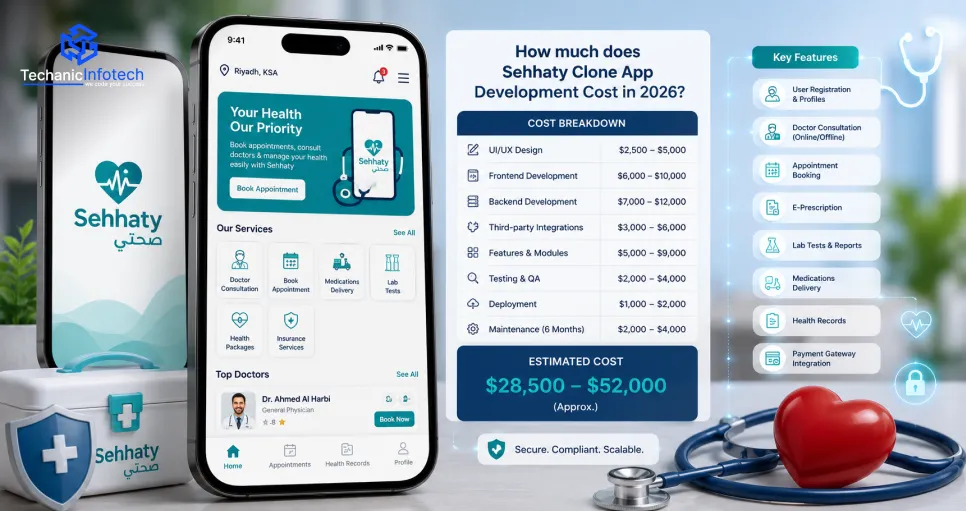
Key Takeaways
Sehhaty clone app development cost ranges from $8,000 to $90,000+, depending on scope and complexity.
An MVP costs $8,000–$20,000, while AI-powered healthcare super apps require significantly larger budgets.
Platform choice, features, compliance, security, AI, and integrations have the biggest impact on development costs.
Healthcare compliance like HIPAA, GDPR, FHIR, HL7, and SOC 2 increases cost but protects patient data.
Advanced capabilities such as AI symptom checking, remote monitoring, and wearables require additional investment.
Hidden expenses include cloud hosting, security audits, compliance renewals, API fees, and ongoing app maintenance.
Starting with an MVP and cross-platform development helps reduce costs without sacrificing future scalability.
Choosing an experienced healthcare app development company minimizes risks, speeds delivery, and improves long-term ROI.
Thinking about building the next big healthcare app? Good. The Saudi digital health market is moving fast, and everyone wants a piece of it.
But before you get excited about features and screens, there's one question that decides everything: money. Sehhaty clone app development cost isn't cheap, but it's also not as scary as it sounds once you break it down.
In this guide, we'll walk through real numbers, real features, and real decisions that shape your final bill. By the end, you'll know exactly what you're paying for and why.
Sehhaty is Saudi Arabia's official health app. It lets patients book appointments, view lab reports, and talk to doctors online, all from one place.
Businesses want a version of this because the demand is real. Here's why investors keep circling this space:
Saudi Arabia is pushing digital health hard under Vision 2030
Patients want fast, app-based access to doctors
Hospitals need one platform to manage records and bookings
The telemedicine market keeps growing every single year
Government support makes compliance and adoption easier
According to Grand View Research, the Saudi digital health market was valued at USD 2.37 billion in 2024 and is projected to reach USD 11.07 billion by 2033, growing at a CAGR of 18.79%. That kind of growth isn't happening by chance. It reflects rising demand for telehealth, AI-powered care, and mobile health apps, making this the right time for businesses to invest in a Sehhaty-like healthcare platform.
A Sehhaty clone app typically costs between $8,000 and $90,000+ in 2026. The exact number depends on your feature list, compliance needs, AI tools, and which platforms you build for.
That's a wide range, I know. But healthcare apps aren't one-size-fits-all. A basic patient portal costs way less than a full hospital management system with AI diagnostics built in.
Here's a simple breakdown to give you a starting point:
|
App Type |
Estimated Cost |
Timeline |
|
Basic MVP (booking + profile) |
$8,000 – $20,000 |
6 – 10 weeks |
|
Mid-level app (telemedicine + records) |
$20,000 – $45,000 |
3 – 5 months |
|
Full-scale super app (AI + multi-module) |
$45,000 – $90,000+ |
6 – 10 months |
These figures are estimates based on custom healthcare app projects in 2026. Your final quote will shift depending on features, compliance requirements, integrations, and where your development team is based.
Notice something? The jump from an MVP to a full super app isn't just about screens. It's about the plumbing behind them, the databases, the security layers, the stuff users never see but always need.
Health super app development cost swings based on platform choice, compliance standards, security setup, integrations, AI features, scalability, and cloud infrastructure. Each layer adds its own price tag.
Let's go through them one by one, because honestly, this is where most budgets get thrown off.
Your platform choice sets the base price. Native apps cost more because you're building twice, once for iOS and once for Android.
|
Platform |
Cost Range |
|
iOS only |
$6,000 – $30,000 |
|
Android only |
$6,000 – $28,000 |
|
Cross-platform (Flutter/React Native) |
$10,000 – $45,000 |
|
Web app (patient portal) |
$5,000 – $20,000 |
A lot of founders start with cross-platform builds. It's faster, and honestly, it works well for most patient-facing apps in the beginning.
Every module you add – appointment booking, e-prescriptions, and video calls- stacks onto your cost. Rich features mean more screens, more testing, and more backend logic working behind the scenes to keep everything smooth.
Cost: $3,000 – $25,000 depending on how many modules you pack in.
This one's non-negotiable in healthcare. You need standards like HIPAA, GDPR, FHIR, HL7, and SOC2 baked into your app from day one, not bolted on later.
Skipping this step early is a mistake I've seen kill launch timelines. If your team has to check the entire healthcare app development cost structure again just to retrofit compliance, you'll lose months, not weeks.
Cost: $4,000 – $15,000
Patient data is sensitive. Encryption, secure logins, audit trails, and breach protection all need real engineering time, not a quick plugin.
Cost: $3,000 – $12,000
Your app needs to talk to labs, pharmacies, insurance systems, and sometimes government health databases. Each connection needs its own API work and testing.
Founders who compare notes with top telemedicine app development companies usually find this step takes longer than expected, mostly because third-party systems don't always play nice together.
Cost: $2,000 – $10,000
AI symptom checkers, smart scheduling, and chatbots are becoming standard in 2026. Training models on medical data and fine-tuning accuracy takes real time and real budget.
Cost: $5,000 – $20,000
This approach is especially useful for healthcare providers planning to expand from Riyadh into cities like Jeddah, Dammam, Al Khobar, and Madinah without rebuilding the platform later.
Your architecture needs to handle that from the start. Rebuilding a weak backend later costs way more than building it right the first time.
Cost: $3,000 – $15,000
Hosting, storage, and server management run on platforms like AWS, Azure, or Google Cloud. Healthcare apps need extra redundancy because downtime with patient data isn't an option.
Cost: $2,000 – $8,000 (setup), plus ongoing monthly fees.
Where your developers sit changes your final invoice more than almost anything else.
|
Region |
Hourly Rate |
Typical Project Cost |
|
USA |
$100 – $200 |
$50,000 – $150,000+ |
|
Western Europe |
$80 – $150 |
$40,000 – $100,000 |
|
Saudi Arabia / UAE |
$40 – $90 |
$20,000 – $80,000 |
|
South Asia (India, Pakistan) |
$20 – $45 |
$8,000 – $90,000+ |
South Asian teams often deliver the same quality for a fraction of the price. That's not an opinion; it's just how the hourly math works out.
Digital health app development cost breaks down by module. Patient and doctor modules usually cost the least, while hospital dashboards and admin panels run higher because of their complex data flows.
Let's split this by role, since that's how patients, doctors, and admins actually experience the app.
Lets users book appointments, check lab results, and message doctors. It's usually the first thing users open, so the interface needs to be dead simple. Anyone comparing quotes from top healthcare app development companies will notice this module gets prioritized first in almost every proposal.
Cost: $2,000–$8,000
Gives physicians a dashboard to view patient history, write prescriptions, and manage schedules. It needs tighter security since doctors handle sensitive records daily.
Cost: $2,500–$9,000
Controls the entire backend, user permissions, reporting, and system settings. It's not flashy, but without it, nothing else runs smoothly.
Cost: $2,000–$7,000
Connects multiple departments, beds, staff, equipment, into one real-time view. This is where the real complexity lives, and it shows in the price.
Cost: $3,000–$10,000
Manages test requests, results uploads, and report sharing with patients. Integration with lab equipment software can add extra dev hours here.
Cost: $1,500–$6,000
Handles prescriptions, inventory, and sometimes medicine delivery tracking. Teams building this alongside a pharmacy app development companies partnership often save time by reusing existing e-prescription frameworks.
Cost: $2,000–$7,000
Costs above reflect standard build complexity for 2026 healthcare projects. Custom workflows or legacy system integrations can push these numbers higher.
Telemedicine app development Saudi Arabia costs rise once you add AI and remote monitoring tools. Smart features like symptom checkers and predictive health alerts are the priciest additions, but they're also what set modern apps apart.
These features aren't required for a basic launch. But if you want your app to actually compete, this is where the real value lives.
Asks patients a few questions and suggests possible conditions before they even see a doctor. Building one that's accurate takes serious medical dataset training, which is why the AI symptom checker app development cost sits on the higher end.
Cost: $5,000–$15,000
Handles basic patient questions, appointment reminders, and FAQs 24/7 without needing a human on the other end.
Cost: $2,000–$8,000
Lets users book appointments or check reports just by speaking. It's a small feature that makes a big difference for elderly patients.
Cost: $2,000–$6,000
Sync data from smartwatches and fitness bands straight into the patient's health profile in real time.
Cost: $3,000–$10,000
Tracks vitals like heart rate and blood pressure for patients managing chronic conditions from home.
Cost: $4,000–$12,000
Turns raw health data into charts and trends that doctors and admins can actually use to make decisions.
Cost: $2,000–$7,000
Uses AI models to flag early warning signs before symptoms even show up. This is genuinely where AI integration in mobile apps gets exciting, and expensive, because the models need constant retraining to stay accurate.
Cost: $6,000–$18,000
Your tech stack choice quietly shapes your entire Sehhaty clone app development budget, long before a single screen gets designed.
|
Technology |
Purpose |
Cost Impact |
|
Flutter |
Cross-platform frontend |
Lower cost, one codebase |
|
React Native |
Cross-platform frontend |
Slightly higher, large talent pool |
|
Node.js |
Backend server |
Fast development, moderate cost |
|
PostgreSQL |
Structured patient data |
Reliable, moderate cost |
|
MongoDB |
Flexible data storage |
Good for scaling fast |
|
AWS |
Cloud hosting |
Pay-as-you-grow pricing |
|
Microsoft Azure |
Cloud hosting |
Strong healthcare compliance tools |
|
Google Cloud Platform |
Cloud hosting |
Competitive pricing, solid AI tools |
Picking the right combination isn't just a technical decision, it's a budget decision too. Teams who study a proper mobile app tech stack guide before locking in vendors tend to avoid expensive rebuilds down the line.
eHealth app development cost is spread across six phases, discovery, design, development, testing, deployment, and ongoing maintenance. Development itself takes the biggest chunk of your budget.
Let's walk through the actual journey your project takes, start to finish.
This is where everything gets planned before a single line of code gets written. Your team maps out user flows, compliance needs, and technical architecture. Skip this step, and you'll pay for it later in rework and missed deadlines.
I've seen projects rush past discovery to "save time," and it almost always backfires. The requirements shift mid-build, developers scramble, and the timeline stretches way past what anyone budgeted for.
A solid discovery phase covers:
Market research and competitor analysis
User persona mapping for patients, doctors, and admins
Technical feasibility and compliance scoping
Wireframe planning before actual design begins
This phase usually runs 2 to 4 weeks and sets the tone for everything that follows.
Clean, simple screens matter more in healthcare than almost any other industry. Patients are often stressed or unwell when using the app, so confusion isn't an option.
Wireframes and clickable prototypes
Accessibility-friendly color contrast and fonts
Role-based dashboard layouts
Cost: $1,500–$6,000
This is the heart of the project, where your database schema, APIs, and app screens actually get built. Backend security, telemedicine app development logic, and remote patient monitoring pipelines all come together here.
Frontend and backend built in parallel
API integrations with labs and pharmacies
Compliance layers coded into the core, not added later
Cost: $5,000–$40,000
Bugs in a banking app are annoying. Bugs in a healthcare app can genuinely hurt someone. Testing here goes deeper than most apps.
Functional testing across every module
Security penetration testing
Load testing for peak patient traffic
Cost: $1,000–$5,000
Once testing wraps up, your app goes live on app stores and production servers. This phase also includes final compliance checks and hospital records interoperability confirmation.
App store submission and approval
Production server configuration
Go-live monitoring for early bugs
Cost: $500–$2,000
Launch day isn't the finish line. Apps need updates, bug fixes, and security patches to stay compliant and useful.
Cost: 15–20% of yearly development cost
If you're building lean, studying chronic disease management software development patterns early can help you scope your MVP without overbuilding features nobody's asking for yet.
Here's the part nobody tells you upfront. Your app doesn't stop costing money once it launches. Saudi healthcare app development comes with ongoing bills that catch a lot of founders off guard.
|
Hidden Cost |
Estimated Range |
|
Cloud Hosting & Server Infrastructure |
$50–$500/month |
|
API Licensing & Third-Party Service Fees |
$100–$1,000/month |
|
App Store Publishing & Developer Accounts |
$25–$100/year |
|
Security Audits & Penetration Testing |
$1,000–$5,000 |
|
Healthcare Compliance Renewals & Certifications |
$2,000–$8,000 |
|
Data Backup & Disaster Recovery |
$200–$1,000/year |
|
Performance Monitoring & Logging Tools |
$100–$500/month |
|
Customer Support & Helpdesk Operations |
$300–$2,000/month |
|
Analytics & Business Intelligence Tools |
$50–$500/month |
|
Future Feature Enhancements & Version Upgrades |
15–20% yearly |
Budget for these from day one. Founders who forget about renewal fees and audit costs often run into cash flow trouble six months after launch, right when they should be focused on growth instead.
You don't need a $90,000 budget to get started. Smart planning cuts costs without cutting corners on quality.
Start with an MVP Instead of a Full-Scale Product: Launch with core features, then expand based on real user feedback, not guesses.
Prioritize High-Impact Features First: Booking and telemedicine matter more early on than AI predictive tools.
Use Cross-Platform Development: One codebase for iOS and Android cuts your dev time nearly in half.
Leverage Ready-Made APIs & SDKs: Don't build video calling or payment systems from scratch when solid tools already exist.
Adopt a Modular Architecture: Build each feature as its own block so future updates don't break the whole app.
Outsource to an Experienced Development Team: The right partner avoids costly mistakes that eat your budget fast.
Plan Compliance Requirements Early: Retrofitting HIPAA or FHIR standards later costs way more than building them in from the start.
Automate Testing & CI/CD Workflows: Automated pipelines catch bugs faster and reduce manual QA hours.
Build for Scalability from Day One: A slightly higher upfront cost saves you from a painful, expensive rebuild later.
Invest in Long-Term Maintenance Planning: Budgeting for updates now prevents emergency spending down the road.
Founders exploring how to build a minimal viable product usually save 30 to 40% on their first version simply by cutting non-essential features before launch.
Patient portal app development pays off through subscriptions, consultation fees, medicine delivery, insurance partnerships, premium plans, and corporate wellness deals. Most successful apps combine two or three of these together.
Here's how each model actually works in practice.
charges users a monthly or yearly fee for unlimited access to doctors and health tracking tools. It's predictable revenue, which investors love.
Charges per video call or chat session with a doctor. Simple, transparent, and easy for patients to understand.
Adds a small margin or delivery fee on top of prescription orders shipped straight to the patient's door.
Partnerships let patients use their coverage directly inside the app, and you earn through referral or processing fees.
Unlock extra features like priority booking, specialist access, or advanced health reports for a higher price point.
Deals sell bulk healthcare access to companies who want to offer wellness benefits to their employees.
Picking the wrong dev partner can cost you more than a bad budget; it can cost you months of wasted time. Here's what actually matters when comparing vendors for healthcare app development in Saudi Arabia.
Ask to see real healthcare projects, not just generic mobile apps. A team that's built telemedicine or patient portal apps before already knows the compliance traps to avoid.
Your vendor should talk about HIPAA, GDPR, and FHIR without you bringing it up first. If compliance feels like an afterthought in their pitch, that's a red flag.
Look past the sales pitch and ask who's actually coding. A strong bench of backend, frontend, and QA engineers matters more than a slick presentation deck.
Your app needs updates and bug fixes long after launch day. Confirm what support looks like after the contract ends, not just during development.
Vague quotes lead to surprise bills. A trustworthy mobile app development company breaks down costs by phase so you know exactly where your money goes.
If your team is halfway across the world, make sure their working hours actually overlap with yours enough for real-time updates.
Before signing anything, ask these questions:
Have you built a HIPAA- or GDPR-compliant app before?
Who owns the source code after launch?
What's included in your post-launch support package?
How do you handle scope changes mid-project?
Can I speak with a past healthcare client as a reference?
If you plan to launch in Riyadh today and expand into Dubai later, choose a healthcare app development company with experience building scalable healthcare platforms for the GCC region.
Building a healthcare app isn't just about copying a feature list. It's about getting the compliance, security, and user experience right from day one.
Sehhaty clone app development cost can range from $8,000 for a lean MVP to $90,000+ for a full AI-powered super app, and where you land depends entirely on your goals.
Start small if you need to. Build for scale from the start, even if you launch simply.
The Saudi digital health market isn't slowing down anytime soon, and the businesses that plan smart today will be the ones patients trust tomorrow.
A Sehhaty clone app usually costs $8,000 to $90,000+. The final price depends on features, AI, compliance, integrations, platform, and development team location.
Core features include patient registration, appointment booking, telemedicine, e-prescriptions, lab reports, payments, notifications, and secure health records.
Platform, feature complexity, AI, security, HIPAA compliance, third-party integrations, cloud setup, and developer location all impact the total cost.
A basic MVP takes 6–10 weeks. A mid-level app needs 3–5 months, while a full healthcare super app can take 6–10 months.
HIPAA helps protect patient data, reduces legal risks, and builds trust. It is essential if your app handles sensitive healthcare information.
Yes. An MVP lets you launch faster, validate your idea, reduce development costs, and add advanced features based on user feedback.
Flutter and React Native work well for cross-platform apps, while Node.js, PostgreSQL, and AWS provide a reliable backend for healthcare solutions.
You can earn through subscriptions, consultation fees, medicine delivery, insurance partnerships, premium plans, and corporate healthcare programs.


Neha Sharma is a tech expert at heart who loves exploring new technologies and turning complex ideas into easy-to-understand content. With a passion for learning and writing, she enjoys sharing insights on emerging tech, digital products, and innovation that help businesses stay ahead.