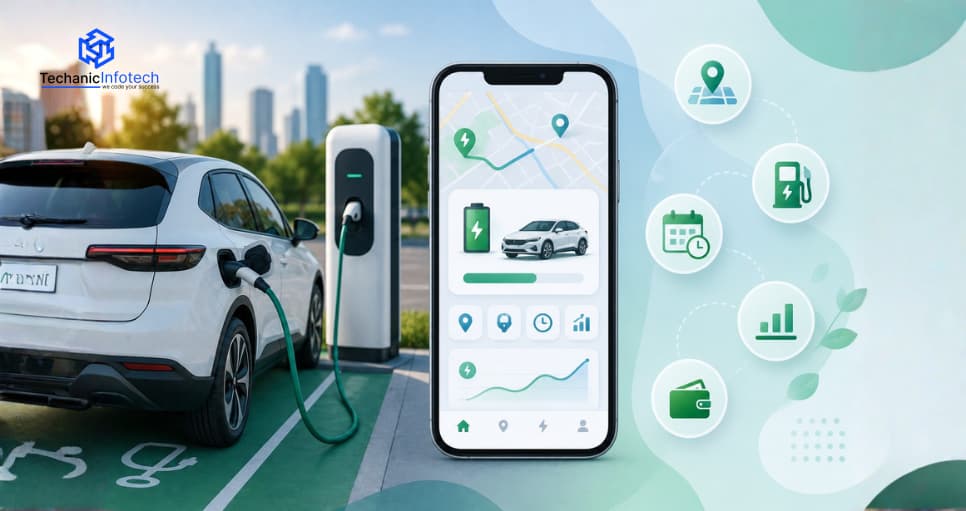
Key Takeaways
EV charging apps connect drivers, chargers, payments, and energy systems in one platform.
Smart features improve charging access, user experience, and business profitability.
EV app costs from $10,000 to $90,000+ depend on features, integrations, and platform complexity.
Real-time tracking, analytics, and automation help scale charging networks.
Choosing the right development approach supports long-term EV business growth.
EV charging is not just about plugging a car anymore… It’s becoming a full digital ecosystem. And if you’re building in this space, things can get messy fast.
An EV charging app development guide for businesses helps companies understand how software, hardware, and user experience all come together in one flow.
Think real-time station tracking, smart billing, load management, and that invisible backend work that keeps everything running without drama. I’ve seen teams underestimate this part… and then struggle later when scaling hits.
In this blog, we’ll break down how EV charging platforms work, key features, cost factors, and what actually matters when building a scalable solution for the U.S. market.
An EV charging platform is basically the digital brain behind electric vehicle charging. It connects charging stations, mobile apps, users, and the power grid into one system. Drivers use it to find chargers, start charging, pay, and track usage. At the same time, operators manage energy, pricing, and station health from a single dashboard.
According to Grand View Research's EV Charging Infrastructure Market (2026–2033), the global market is expected to grow from USD 50.3 billion in 2026 to USD 238.8 billion by 2033, driven heavily by connected charging systems and smart energy management. Another report by Fortune Business Insights,EV Charging Stations Market (FBI102058), highlights that the market could reach USD 139.93 billion by 2034, with fast-charging and smart platforms leading the shift.
It sounds technical, but the flow is actually pretty human at the core. Almost like ordering food online… just with electricity instead.
1. Station discovery through the app
A driver opens the app and finds a nearby charging station. Real-time status shows if it’s available or busy. No guessing, no driving around blindly.
2. Charging session initiation
Once the car is plugged in, the platform authenticates the user. This is where backend systems quietly talk to the charger and start the session.
3. Energy monitoring in real time
The platform tracks how much energy is being used. Users can literally watch charging speed, cost, and time left. It feels small, but it builds trust.
4. Payment processing
After charging ends, billing happens automatically. No manual steps, no confusion at the counter. Smooth, almost invisible.
5. Data + smart optimization
This is where things get interesting. The platform collects usage data, peak demand patterns, and station performance. Operators use this to improve pricing, load balancing, and station placement.
Explore key EV charging business models that improve profitability, from subscriptions to pay-per-use, with insights into EV charging network app development strategies.
This model allows businesses to provide charging access through subscriptions or usage-based payments. It helps create recurring revenue while giving EV users a simple charging experience without high upfront costs.
Users pay based on charging time, energy consumed, or sessions completed. This flexible approach works well for public charging stations and is commonly supported through EV charging software development solutions.
Customers pay a monthly fee for charging benefits, discounts, or premium access. It works well for building customer loyalty and fits with changing mobile app development trends around personalised services.
Fleet operators build dedicated charging networks for electric vehicles like delivery vans, buses, and company cars. The model focuses on reducing fuel costs, improving operations, and managing energy usage.
Charging stations become digital touchpoints where businesses can display promotions, partner offers, or brand messages. This creates an extra income stream beyond charging fees and helps improve ROI.
This model uses connected systems to optimise charging schedules, electricity costs, and station performance. It is becoming popular among SMBs’ software development projects because it supports scalable energy solutions.
Leading EV charging platforms show how technology is changing the way drivers find stations, manage payments, and access reliable charging. These examples help businesses understand what users expect from modern EV charging mobile app development solutions.
|
EV Charging Platform |
Specialization |
Key Features |
|
ChargePoint |
Public and commercial charging network management |
Real-time charger availability, station locator, payment processing, charging history, driver notifications, operator dashboard, energy usage reports, and remote station monitoring |
|
Tesla Supercharger Platform |
Integrated EV ecosystem with fast charging |
Supercharger location tracking, live stall availability, route planning, charging progress updates, automatic billing, vehicle integration, and smart charging controls |
|
Electrify America |
DC fast charging infrastructure |
Fast charger discovery, real-time station status, pricing details, trip planning, mobile payments, membership plans, and charging session tracking |
|
EVgo |
Highway and urban fast charging network |
Charger availability updates, app-based charging, payment options, membership management, station monitoring, and customer account features |
|
PlugShare |
Community-driven EV charging discovery |
Charger reviews, station ratings, compatibility filters, user check-ins, photos, trip planner, charging reports, and location-based recommendations |
|
Shell Recharge |
Energy + EV charging services |
Charging station finder, digital payments, charging history, fleet solutions, energy management, and connected charger support |
|
Blink Charging |
Commercial and workplace charging |
Mobile charging access, user accounts, pricing control, charger management dashboard, revenue analytics, and station performance tracking |
Building an EV charging app is not just about adding a charger locator. A successful EV charging network app development project needs features that make charging simple, reliable, and stress-free for drivers and operators.
Users should quickly find nearby charging points with live availability, distance, connector type, and charging speed. A smart map experience is one of the most important features in a mobile app for EV users.
A built-in payment system lets users pay through cards, wallets, or subscriptions. Safe transactions and automated billing make the charging process much easier.
Users should monitor charging time, energy usage, cost, and battery progress. These details help drivers manage their trips and understand their charging habits.
AI can analyse usage patterns and suggest better charging times, nearby stations, or cost-saving options. This shows how AI integration in mobile apps is improving EV experiences.
Drivers can save vehicle details, preferred connectors, and charging history. This creates a personalised experience instead of a one-size-fits-all app.
Operators need tools to manage chargers, pricing, users, and performance reports. Many mobile app development companies in USA focus on these backend controls while building scalable EV platforms.
Advanced analytics help businesses track energy consumption, peak hours, and revenue patterns. These insights support better station planning and long-term growth.
The app should show if a station is free, occupied, or under maintenance. Real-time updates help drivers avoid wasted trips and improve trust in the charging network.
Allow users to reserve charging slots before reaching the station. This reduces waiting time and creates a smoother experience, especially at busy locations.
Push notifications can inform users about charging completion, station availability, payment updates, and maintenance issues without making them constantly check the app.
A smooth user experience also depends on how easily drivers can access the platform after launch. Proper app publishing on the Play Store helps users download updates, security fixes, and new charging features.
Building an EV charging app is not just about adding a map and payment button. A successful electric vehicle charging app development process connects drivers, charging stations, operators, and energy systems into one smooth experience.
Before development starts, identify your target users and business goals. Study competitors' charging behaviour and pain points like station availability, payment issues, or route planning.
This phase helps decide:
Target audience (EV drivers, fleets, businesses)
Revenue model
Required charging features
Platform goals
A clear plan saves time and avoids costly changes later.
The feature list decides how useful your charging platform becomes. Drivers expect more than just finding a charger; they want a simple experience from search to payment.
Common features include:
Real-time charger availability
GPS-based station locator
Charging status updates
Digital payments
Booking and reservations
Battery and charging history
A strong feature strategy improves user trust and keeps the app practical.
The technology behind your app affects speed, security, and future growth. Choosing the right tools helps your platform handle more users and charging stations without performance issues.
A proper mobile app tech stack guide helps decide the following:
|
Technology Layer |
Recommended Options |
Purpose of the EV Charging Platform |
|
Frontend Framework |
React Native, Flutter, Swift (iOS), Kotlin (Android) |
Builds user apps with charger locator, live station status, booking, payments, and charging tracking features. |
|
Backend System |
Node.js, Python, Java, .NET |
Handles user accounts, charging sessions, pricing logic, station management, and business operations. |
|
Cloud Services |
AWS, Microsoft Azure, Google Cloud |
Supports scalable hosting, real-time data processing, security, storage, and IoT connectivity. |
|
Database |
PostgreSQL, MySQL, MongoDB, Firebase |
Stores user profiles, charger details, payment records, energy usage, and platform analytics. |
|
API Integrations |
Google Maps API, Payment APIs, OCPP, EV roaming APIs |
Connects maps, chargers, payment gateways, and external charging networks for smooth operations. |
For EV platforms, IoT connectivity and charging station management systems are important parts of the setup.
EV users usually need quick answers: “Where can I charge?” “Is the station free?” “How long will it take?”
The design should focus on:
Simple station search
Clear charging information
Easy navigation
Smooth payment flow
A clean interface reduces confusion, especially when drivers are on the road.
The backend works like the engine of the platform. It connects users with chargers, payments, energy data, and third-party services.
Development includes:
User account management
Charger communication
Payment gateway setup
Location APIs
Admin dashboard
Working with an experienced mobile app development company helps create a scalable system for growing EV networks.
Testing makes sure every part works correctly before users access the app. This stage prepares the platform for publishing an app to the App Store without major issues.
Teams test:
App performance
Payment safety
Charger connectivity
User experience
Data protection
A reliable app creates confidence for both drivers and charging operators.
Launching the app is only the beginning. User feedback and performance data show what needs improvement.
After release, focus on:
Bug fixes
Feature updates
User reviews
Charging network expansion
Budget planning also matters here because mobile app development costs depend on app complexity, integrations, and long-term maintenance needs.
As the EV market grows, apps need smarter capabilities to stay competitive. AI, analytics, and automation can improve station usage and driver experience.
Future improvements may include:
AI-based charging suggestions
Predictive maintenance
Smart energy management
Fleet monitoring
This helps businesses build a charging ecosystem that can grow with EV adoption.
The cost of electric vehicle app development in 2026 depends on what you want the app to handle. A simple MVP with basic charging station discovery costs much less than an enterprise platform with IoT integration, fleet tools, AI features, and a complete charging network system.
For most businesses, the EV charging app development cost can range from $10,000 to $90,000+ based on features, design complexity, technology stack, and development team experience.
|
App Type |
Estimated Cost |
Development Timeline |
Key Features Included |
|
MVP EV Charging App |
$10,000 – $25,000 |
3 – 5 months |
User signup, EV charger locator, GPS integration, basic station details, charging availability, simple payment integration, and charging history |
|
Standard EV Charging App |
$25,000 – $50,000 |
5 – 8 months |
Real-time charger status, booking system, digital wallet, push notifications, route planning, user reviews, admin dashboard, payment gateway |
|
Advanced EV Charging Platform |
$45,000 – $75,000 |
8 – 12 months |
IoT charger connectivity, smart charging, energy tracking, subscription plans, analytics dashboard, multi-location support, operator panel |
|
Enterprise EV Charging Solution |
$75,000 – $90,000+ |
12+ months |
Full charging network management, fleet management, AI-based recommendations, roaming support, advanced security, CRM integration, large-scale cloud infrastructure |
Explore common EV charging problems and how smart app solutions improve station access, payments, maintenance, and user experience.
Challenge: Many EV drivers still worry about finding an available charger when they need one. Poor station visibility, long waiting times, and inaccurate availability data can create frustration.
Solution: Smart EV apps solve this by offering real-time charger tracking, GPS-based station search, and live availability updates. With advanced EV charging software development, businesses can connect multiple charging points into one reliable network.
Challenge: Charging an EV takes longer than refueling a traditional vehicle. During busy hours, drivers may face queues and delays, especially at public charging stations.
Solution: Apps can add charging reservations, estimated charging time, and smart scheduling features. These tools help users plan better and reduce station congestion.
Challenge: Different charging providers often use different payment systems, making the process confusing for users. Switching between apps can feel like extra work.
Solution: A unified wallet, multiple payment options, and automated billing create a smoother experience. Businesses can start with minimal viable product development to test these payment features before scaling.
Challenge: A broken charger means lost revenue for operators and wasted time for drivers. Without proper monitoring, issues may remain unnoticed for days.
Solution: Smart platforms use remote diagnostics, maintenance alerts, and performance tracking to identify problems early. Regular updates and mobile app maintenance keep the system stable as the network grows.
Challenge: EV charging apps handle personal details, payment data, and vehicle-related information. Weak security can damage user trust.
Solution: Strong authentication, encrypted payments, secure cloud systems, and regular security checks help protect the platform and customer data.
Challenge: As EV adoption grows, charging demand can put pressure on power grids. Unmanaged charging may increase energy costs during peak hours.
Solution: Smart charging features balance energy usage by adjusting charging schedules, tracking consumption, and supporting renewable energy integration. This creates a more efficient charging ecosystem.
Challenge: Large charging businesses often handle thousands of stations, users, and transactions across different locations. Managing everything manually becomes difficult.
Solution: A connected platform combines station management, user accounts, analytics, and operator tools in one place. This approach works well for businesses planning a multi-service super app development strategy with EV services included.
The EV industry is moving fast, and businesses that understand user needs, charging infrastructure, and smart technology will have a stronger position ahead.
A well-planned EV charging app development approach connects drivers, operators, and energy systems through a simple digital experience.
From real-time charger tracking to secure payments and analytics, every part plays a role in creating a reliable charging ecosystem.
The future belongs to platforms that focus on scalability, customer experience, and smarter energy management.
An EV charging app helps drivers find chargers, check availability, start charging sessions, make payments, and track energy usage from their phones.
EV charging app development usually costs around $10,000 to $90,000+, depending on features, integrations, and platform complexity.
It connects users, charging stations, payment systems, and operators to manage charging sessions, energy data, and station performance.
Key features include charger locator, live availability, booking, digital payments, charging tracking, notifications, and admin management tools.
Yes, modern apps can integrate multiple networks, helping users access different charging providers through one platform.
A basic app may take 3–5 months, while advanced charging platforms can require 8–12+ months.
Businesses earn through charging fees, subscriptions, partnerships, advertisements, and fleet charging services.
Smart features like AI insights, analytics, and energy management improve user experience and help operators run efficient networks.


Bharat Sharma is the CTO of Techanic Infotech, bringing deep technical expertise in software architecture, mobile app development, and scalable system design. He leads the engineering team with a strong focus on innovation, performance, and security.