Mobile App Development
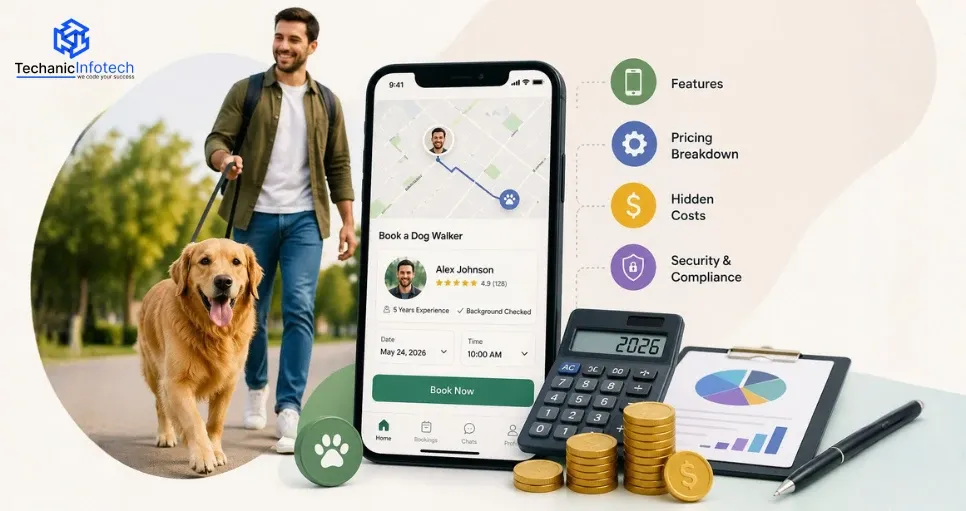
Dog Walking App Development Cost in 2026: Features, Pricing Breakdown & Hidden Costs
April 27, 2026
April 27, 2026
Dog walking app development costs typically start at $8,000 and can exceed $80,000, depending on features, scalability, and overall complexity, making early budget planning essential for success.
Core features like booking, GPS tracking, payments, and notifications play a major role in shaping both user experience and total development cost, especially as you scale the app.
Hidden costs such as licensing, security audits, cloud hosting, and customer support can significantly increase expenses if not considered during the initial planning phase.
Choosing the right tech stack, platform, and development approach helps optimise costs while ensuring performance, scalability, and long-term reliability of your app.
Starting with an MVP and gradually adding advanced features is a smart strategy to control costs, reduce risk, and build a competitive dog-walking app over time.
Thinking about building a dog walking app, but unsure how much it will cost in 2026?
With the rising demand for pet care services, understanding the dog walking app development cost is essential before getting started.
From core features like booking and GPS tracking to advanced functionalities and ongoing maintenance, several factors influence the final budget.
Costs can vary widely based on app complexity, design, and technology choices.
In this guide, we’ll break down the key features, provide a clear pricing overview, and uncover hidden costs that many businesses overlook, helping you plan smarter and build a scalable, cost-effective dog walking app.
Understanding the cost of a dog-walking app depends on multiple factors, and the cost of a pet care app development is shaped by features, technology, and market demand in 2026.
The number of features like GPS tracking, booking systems, and payments directly impacts cost. Advanced functionalities increase development time and budget, especially when building scalable and user-friendly applications.
The cost to build a dog walking app is influenced by growing demand. The market is projected to reach $13.9 billion by 2033, growing at a 16.5% CAGR.
Choosing between single-platform and cross-platform development significantly affects cost. Building for both iOS and Android increases expenses but ensures a wider audience reach and better market penetration.
Following a strong mobile app design guide helps create intuitive experiences, but custom UI/UX increases costs. High-quality design improves engagement while requiring more time, testing, and skilled resources.
The global market is expected to exceed $7.83 billion by 2033, driven by mobile-first services and scalable solutions.
The right dog-walking app features play a major role in defining your budget. Each feature adds functionality, improves user experience, and directly impacts development complexity, performance, and overall cost.
User accounts and profile management are essential, but they also affect the cost to build a dog walking app. Adding social login, verification, and personalisation features increases both development time and budget.
A smooth booking system is key, but it also raises the on-demand dog walking app cost. Features like real-time availability, recurring bookings, and calendar sync add complexity and require more development effort.
GPS tracking is a core feature in wag clone app development, allowing users to track walks in real time. Advanced mapping, route history, and accuracy features increase development time and overall cost.
Secure payment systems support multiple payment options and smooth transactions. Adding features like auto-pay, tips, and refunds improves user convenience but also increases backend complexity and maintenance costs.
Real-time alerts keep users updated on bookings and walk status. Implementing advanced notification systems can raise the dog walker app development price due to added backend logic and real-time processing.
Ratings and reviews build trust and improve service quality. Adding moderation tools, review filtering, and feedback systems requires additional development effort, impacting both time and overall budget.
An admin panel is essential for managing users, bookings, and payments. Advanced dashboards with analytics and reporting tools can increase the pet sitting app development cost due to added functionality and complexity.
Building a dog walking app in 2026 typically starts at $8,000 and can exceed $80,000, depending on features, scalability, and tech choices.
Understanding the dog walking app development cost helps you plan better, avoid hidden expenses, and allocate your budget wisely across each development stage for long-term success.
This stage defines your target audience, competitors, and business goals. The pet care app development cost often begins here, as proper planning reduces risks, avoids rework, and ensures smoother execution in later stages.
|
Element |
Estimated Cost (USD) |
Details |
|
Market Research |
$1,000 – $3,000 |
Audience and competitor analysis |
|
Business Planning |
$1,000 – $2,000 |
Strategy and roadmap |
|
Requirement Gathering |
$1,000 – $2,000 |
Feature and scope definition |
Design plays a key role in user engagement. The rover like app development cost increases with custom layouts, intuitive flows, and modern interfaces that require skilled designers and detailed prototyping.
|
Element |
Estimated Cost (USD) |
Details |
|
Wireframing |
$1,000 – $2,000 |
Basic layout and structure |
|
UI Design |
$2,000 – $4,000 |
Visual design and branding |
|
Prototyping |
$1,000 – $2,000 |
Interactive user flow |
Core features like booking, GPS tracking, and payments define the cost to build a dog walking app. Adding advanced capabilities increases complexity, development time, and overall budget significantly.
|
Element |
Estimated Cost (USD) |
Details |
|
Booking System |
$2,000 – $5,000 |
Scheduling and reservations |
|
GPS Tracking |
$2,000 – $5,000 |
Real-time location tracking |
|
Payment Integration |
$2,000 – $4,000 |
Secure transactions |
A strong backend ensures smooth operations, data handling, and scalability. The dog walker app development price increases with advanced server architecture, real-time processing, and secure data management systems.
|
Element |
Estimated Cost (USD) |
Details |
|
Server Setup |
$2,000 – $4,000 |
Infrastructure and hosting |
|
Database Management |
$2,000 – $4,000 |
Data storage and handling |
|
API Development |
$2,000 – $5,000 |
System integrations |
Frontend development focuses on user interaction and performance. Choosing the right tech stack for your app ensures responsiveness, smooth navigation, and consistent experiences across different devices and screen sizes.
|
Element |
Estimated Cost (USD) |
Details |
|
App Interface |
$3,000 – $6,000 |
User-facing development |
|
Responsive Design |
$2,000 – $4,000 |
Multi-device compatibility |
|
Performance Optimization |
$1,000 – $3,000 |
Speed and smooth interaction |
Testing ensures reliability, performance, and security. The pet-sitting app development cost increases with detailed testing processes, including bug fixes, performance checks, and security validations before launch.
|
Element |
Estimated Cost (USD) |
Details |
|
Functional Testing |
$1,000 – $2,000 |
Feature validation |
|
Performance Testing |
$1,000 – $2,000 |
Speed and load testing |
|
Security Testing |
$1,000 – $2,000 |
Data protection |
Launching the app involves publishing, configuration, and marketing strategies. The cost to develop a pet care app in the USA may increase due to platform fees, compliance, and initial promotion efforts.
|
Element |
Estimated Cost (USD) |
Details |
|
App Store Deployment |
$500 – $1,500 |
Publishing and setup |
|
Configuration |
$500 – $1,500 |
Final adjustments |
|
Launch Strategy |
$1,000 – $2,000 |
Marketing and rollout |
Post-launch updates are essential for long-term success. The timeline for your mobile app continues beyond launch, with ongoing improvements, bug fixes, and performance optimisation required regularly.
|
Element |
Estimated Cost (USD) |
Details |
|
Bug Fixes |
$1,000 – $3,000 |
Issue resolution |
|
Feature Updates |
$2,000 – $5,000 |
Enhancements |
|
Performance Monitoring |
$1,000 – $2,000 |
Ongoing optimization |
An admin dashboard helps manage users, bookings, and payments efficiently. Advanced analytics and reporting tools increase development complexity but are essential for smooth operations and business insights.
|
Element |
Estimated Cost (USD) |
Details |
|
User Management |
$2,000 – $4,000 |
Control user data |
|
Booking Management |
$2,000 – $4,000 |
Track and manage services |
|
Analytics Dashboard |
$2,000 – $5,000 |
Reports and insights |
Hidden costs in app development often go unnoticed but can significantly impact your overall dog walking app development cost. Identifying these early helps you plan smarter and avoid unexpected financial strain later.
Using premium development tools, libraries, or licensed software can add ongoing expenses. While they improve efficiency and performance, subscription fees or one-time licences increase the total development budget over time.
Ensuring your app meets data protection standards may require third-party security audits. These checks help prevent breaches and legal risks but add extra costs, especially for apps handling sensitive user information.
Improving speed, scalability, and responsiveness often requires additional resources. The cost to develop a pet care app in the USA can rise due to advanced optimisation efforts needed for high-performance, user-friendly applications.
Publishing your app involves fees, but delays in app approval on app store platforms can also add indirect costs. Revisions, compliance updates, and resubmissions may increase both time and overall expenses.
Setting up support systems like live chat, help desks, or ticketing tools requires investment. While it improves user satisfaction, maintaining customer support adds ongoing operational costs to your app business.
Building a dog walking app in 2026 requires more than just a basic budget; it demands a clear understanding of features, development stages, and hidden costs.
From planning and design to advanced functionalities and ongoing maintenance, every element contributes to the final investment.
By carefully analysing cost drivers and avoiding common pitfalls, businesses can create a scalable and user-friendly app without overspending.
Focusing on essential features first and expanding later is a smart approach to control expenses.
With the right strategy, technology, and development partner, you can build a competitive dog walking app that meets market demand, delivers value to users, and supports long-term business growth.
The dog walking app development cost typically starts from $8,000 and can go beyond $80,000, depending on features, design complexity, platform choice, and scalability requirements.
Key factors include app features, UI/UX design, development team, platform (iOS or Android), backend infrastructure, and integrations like GPS tracking, payments, and notifications.
Essential features include user registration, booking and scheduling, GPS tracking, secure payments, push notifications, ratings and reviews, and an admin dashboard for management.
The development timeline usually ranges from 2 to 6 months, depending on app complexity, features, and the development approach chosen for the project.
Maintenance costs can range from $3,000 to $10,000 annually, covering updates, bug fixes, performance improvements, and security enhancements.
Yes, hidden costs include third-party API fees, cloud hosting, app store charges, licensing tools, security audits, and marketing expenses that can increase the overall budget.
Yes, you can start with an MVP, prioritize essential features, use cross-platform development, and scale gradually to manage and optimize your budget effectively.
It depends on your target audience. iOS and Android both have large user bases, but building for both platforms increases development cost and reach.
Yes, an admin panel is essential for managing users, bookings, payments, and analytics, ensuring smooth operations and better control over your app.
With growing demand for pet care services, a well-built app can generate strong returns through bookings, subscriptions, and commissions, making it a profitable business opportunity.


Bharat Sharma is the CTO of Techanic Infotech, bringing deep technical expertise in software architecture, mobile app development, and scalable system design. He leads the engineering team with a strong focus on innovation, performance, and security.