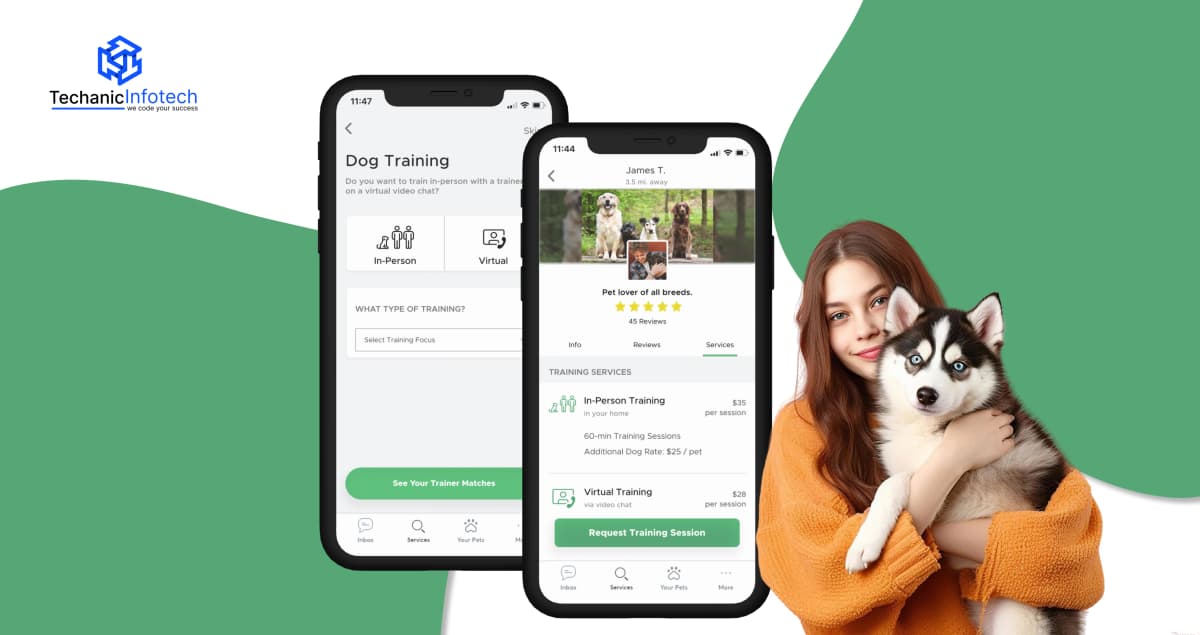
The demand for pet care apps is rising quickly as pet owners look for reliable, on-demand services. Many startups and businesses want to build a pet-sitting app like Rover, but the first thing they want to know is the budget.
In 2026, the cost to develop a dog walking app like Rover typically ranges between $15,000 and $80,000, depending on features, platform, and app complexity. The cost increases as you add real-time tracking, payments, and marketplace features.
If you are planning a basic pet care app like Rover, this guide explains the dog walking app development cost, pricing breakdown, and what drives the final budget in simple terms.
A dog walking app is a mobile or web platform that connects pet owners with professional dog walkers and pet sitters in their area, making it easy to book services on demand.
These apps like Rover, serve as digital marketplaces where users can find, schedule, and pay for dog walking, sitting, or other pet-care services without needing to call or visit multiple providers. The global dog walking service app market is estimated to be worth around USD 1.47 billion in 2026 and is expected to grow significantly in the coming years as pet ownership rises and users prefer on-demand convenience.
Digital dog walking apps are part of the broader pet sitting and walking app segment, which was valued at around USD 2.9 billion in 2025 and could reach USD 6.3 billion by 2032, reflecting strong demand and rapid growth.
Features such as GPS tracking, secure payments, real-time notifications, and subscription plans make these platforms popular with busy pet owners who want reliable, tech-enabled care for their pets.
User Registration & Profile Setup: Pet owners and dog walkers create accounts, upload profiles, and verify identities. Walkers often submit credentials, experience, and background checks to build trust.
Service Search & Booking: Users search for available dog walkers based on location, availability, and ratings. They can view profiles, read reviews, and select a walker that fits their preferences.
Scheduling & Confirmation: Once a walker is chosen, owners schedule the walk, choose the time and duration, and confirm the booking. Real-time availability and booking confirmation help keep the process seamless.
In-App GPS Tracking & Communication: During the walk, users can track the route in real time through GPS. Communication features let owners message the walker for updates or instructions.
Secure Payments: After the service is completed, payment is processed through the app using integrated payment gateways. Platforms like Rover may split the fee between the walker and the platform.
Ratings & Reviews: After each walk, owners can rate and review walkers, helping future users make informed choices and maintaining service quality.
By integrating scheduling, tracking, and payments into one platform, dog walking apps simplify the process of finding reliable pet care, making them increasingly popular with pet owners worldwide.
Rover operates as a pet service marketplace that connects pet owners with independent dog walkers and pet sitters. Instead of directly employing walkers, Rover provides the platform, tools, and trust layer that make bookings easy and safe for both sides.
This marketplace-based approach is a big reason why the Rover-like app development cost scales with features and complexity.
Rover earns money by taking a commission from each completed booking. Pet owners pay through the app, and Rover deducts its platform fee before releasing earnings to the walker. This model works well because it scales automatically as the number of bookings grows.
In addition to commissions, Rover also benefits from:
Premium placement or visibility for walkers
Extended support services
Repeat bookings and long-term customer retention
This structure is common in pet care app development like Rover and directly influences the pet service marketplace app cost, as secure payments, payouts, and commission logic must be built into the platform.
The app flow is designed to be simple and trust-focused.
First, pet owners create a profile and add details about their pets, such as size, behavior, and walking needs. This helps match them with the right dog walker.
Next, dog walkers create profiles, submit verification details, set availability, and list their services and pricing. Reviews and ratings play a major role in visibility and trust.
Pet owners then search and book walkers based on location, availability, ratings, and price. Once booked, the app manages scheduling, notifications, and communication.
During the walk, real-time updates and GPS tracking may be shared, depending on the service. After completion, payments are processed in-app, and users leave reviews.
This smooth flow is why building a similar platform impacts the cost to build a dog walking app like Rover, especially when adding trust, safety, and marketplace features.
The cost to develop a dog walking app like Rover is not fixed. It depends on several technical and business factors that directly influence development effort, timeline, and long-term maintenance.
If you’re planning a Rover-like app development, understanding these cost drivers will help you estimate a realistic budget and avoid hidden expenses later.
Below are the key factors explained in a cost-oriented, practical way.
App complexity is one of the biggest factors affecting dog walking app development cost. A simple app with basic booking and profiles costs far less than a full pet service marketplace.
Apps with multiple user roles (pet owners, dog walkers, admins), real-time tracking, secure payments, and review systems require more development time. As complexity increases, so does the custom app development cost, mainly due to added logic, testing, and backend infrastructure.
|
Level of Complexity |
Description |
Average Cost |
|
Basic |
Simple booking app with user profiles and manual scheduling |
$15,000 – $25,000 |
|
Medium |
Marketplace app with payments, reviews, and admin panel |
$25,000 – $45,000 |
|
Advanced |
Full Rover-like platform with GPS tracking, real-time updates, automation |
$45,000 – $80,000 |
Features directly shape the dog walking app cost by features. Core features in mobile app like user registration, service booking, and payments are essential.
Advanced features such as GPS tracking, in-app chat, background verification, recurring bookings, and subscription plans increase the cost to create an app like Rover.
Every new feature adds design, app development, and testing effort. Carefully prioritizing features helps control the on-demand dog walking app cost in the early phase.
|
Feature |
Description |
Average Cost |
|
User Registration & Login |
Sign-up for pet owners and walkers |
$1,000 – $2,000 |
|
Pet Profiles |
Store pet details, behavior, preferences |
$1,000 – $2,000 |
|
Walker Profiles |
Experience, availability, pricing |
$1,500 – $3,000 |
|
Search & Filters |
Location-based walker discovery |
$1,500 – $3,000 |
|
Booking & Scheduling |
On-demand and scheduled bookings |
$2,000 – $4,000 |
|
In-App Payments |
Secure payments and payouts |
$2,500 – $5,000 |
|
Commission Management |
Platform fee deduction |
$1,500 – $3,000 |
|
GPS Tracking |
Real-time walk tracking |
$3,000 – $6,000 |
|
In-App Chat |
Owner–walker communication |
$1,500 – $3,000 |
|
Push Notifications |
Booking and status updates |
$1,000 – $2,000 |
|
Reviews & Ratings |
Feedback and trust system |
$1,000 – $2,000 |
|
Admin Dashboard |
Manage users, bookings, revenue |
$3,000 – $6,000 |
|
Subscription Plans |
Recurring services |
$2,000 – $4,000 |
|
Background Verification |
Identity and trust checks |
$1,500 – $3,500 |
Whether you build for iOS, Android, or both platforms has a strong impact on the Rover clone app development cost. Native apps for both platforms usually cost more because they require separate codebases.
Cross-platform development can reduce initial costs but may still need customization for performance. Platform choice also affects long-term maintenance, which should be considered when planning the pet care app development cost.
|
Platform |
Benefits |
Average Cost |
|
iOS |
High security, premium users |
$20,000–$45,000 |
|
Android |
Larger user base, device flexibility |
$18,000–$40,000 |
|
Cross-Platform |
Faster launch, lower initial cost |
$15,000–$35,000 |
UI/UX design is more than just visuals, it directly affects user trust and engagement. Clean, simple designs are faster to build and reduce development time. However, apps like Rover rely heavily on intuitive navigation, clear service listings, and smooth booking flows.
Custom animations, complex layouts, and detailed dashboards increase the dog walker booking app development cost. Investing wisely in UI/UX helps balance usability and budget.
|
Design Element |
Description |
Average Cost |
|
User Flow Design |
Booking and service journeys |
$1,500–$3,000 |
|
Wireframes & Prototypes |
Screen layouts and interactions |
$1,500–$3,500 |
|
Visual UI Design |
Colors, typography, icons |
$2,000–$4,000 |
|
Interactive Elements |
Maps, cards, animations |
$1,500–$3,000 |
|
Usability Testing |
Improve ease of use |
$1,000–$2,500 |
The selected right mobile app tech stack plays a major role in overall cost. Using modern, scalable technologies may increase initial development cost but reduce long-term issues.
Backend frameworks, databases, hosting solutions, and security layers all influence the pet service marketplace app cost. A well-chosen tech stack ensures performance and scalability, while poor choices can lead to higher maintenance expenses later.
|
Layer |
Technologies Used |
Avg Cost Impact |
|
Frontend (Mobile) |
React Native / Flutter / Swift / Kotlin |
$6,000 – $15,000 |
|
Backend |
Node.js / Django / Laravel |
$6,000 – $18,000 |
|
Database |
PostgreSQL / MongoDB |
$2,000 – $5,000 |
|
Cloud & Hosting |
AWS / Google Cloud / Azure |
$1,500 – $4,000 |
|
Security |
SSL, encryption, auth layers |
$1,500 – $4,000 |
Your development approach significantly affects cost. Building everything from scratch increases the cost to build a dog walking app like Rover but offers full flexibility.
Using pre-built modules, APIs, or MVP-based development can reduce early expenses. Many startups begin with a limited feature set to control Rover-like app development cost, then scale gradually based on user demand.
|
Approach |
Description |
Cost Impact |
|
MVP-Based Development |
Core features only, quick launch |
Lowest initial cost |
|
Modular Development |
Features added in phases |
Controlled scaling cost |
|
Custom Development |
Fully tailored Rover-like app |
Highest flexibility, higher cost |
Deployment costs are often overlooked but still important. App store setup, server configuration, security certificates, and cloud hosting all add to the overall dog walking app pricing breakdown.
Depending on traffic expectations, hosting and infrastructure costs may increase over time. Planning deployment properly helps avoid unexpected expenses after launch.
|
Deployment Task |
Description |
Avg Cost |
|
App Store Setup |
iOS & Android store configuration |
$500 – $1,200 |
|
Server Deployment |
Backend + database setup |
$800 – $2,000 |
|
Security Configuration |
SSL, firewalls, backups |
$700 – $1,500 |
|
Monitoring Setup |
Logs, alerts, uptime tracking |
$500 – $1,000 |
Third-party integrations such as payment gateways, maps, GPS tracking, notifications, and identity verification services add functionality but also cost. Some services charge setup fees or usage-based pricing.
These integrations are essential for pet care app development like Rover, but each one increases both development and ongoing operational costs.
|
Integration |
Purpose |
Avg Cost |
|
Payment Gateway (Stripe, PayPal) |
Payments & payouts |
$2,500 – $5,000 |
|
Maps & GPS (Google Maps) |
Location & route tracking |
$2,000 – $4,000 |
|
Push Notifications |
Booking alerts & updates |
$1,000 – $2,000 |
|
Chat & Messaging |
Owner–walker communication |
$1,500 – $3,000 |
|
Identity Verification |
Trust & safety checks |
$1,500 – $3,500 |
|
Analytics Tools |
User & revenue insights |
$800 – $2,000 |
App testing ensures the app works smoothly across devices and scenarios. Functional testing, performance testing, security testing, and compatibility testing all add to the dog walking app development cost.
Skipping proper testing may reduce initial cost but leads to higher expenses later through bug fixes, poor reviews, and user churn.
|
Testing Type |
What It Covers |
Avg Cost |
|
Functional Testing |
App features & flows |
$1,500 – $3,000 |
|
Performance Testing |
Speed & load handling |
$1,500 – $3,000 |
|
Security Testing |
Vulnerability checks |
$2,000 – $4,000 |
|
Compatibility Testing |
Devices & OS versions |
$1,000 – $2,000 |
|
User Acceptance Testing |
Real user scenarios |
$1,000 – $2,500 |
Post-launch support is a long-term cost factor. Regular updates, bug fixes, security patches, and OS compatibility updates are necessary.
On average, maintenance can cost 15–25% of the initial development cost per year. Factoring this into your budget is essential when estimating the cost to develop a dog walking app like Rover.
|
Maintenance Activity |
Description |
Monthly Cost |
|
Bug Fixes |
Issue resolution |
$500–$1,200 |
|
OS Updates |
iOS & Android updates |
$600–$1,500 |
|
Security Patches |
Data and payment safety |
$700–$2,000 |
|
Performance Optimization |
Speed & scalability |
$500–$1,200 |
|
Feature Enhancements |
New improvements |
$800–$2,500 |
Building a pet care platform doesn’t have to break the bank.
With the right planning and development strategy, businesses can significantly reduce the cost to build a dog walking app like Rover while still delivering a reliable product.
Below are practical ways to optimize the dog walking app development cost without compromising quality.
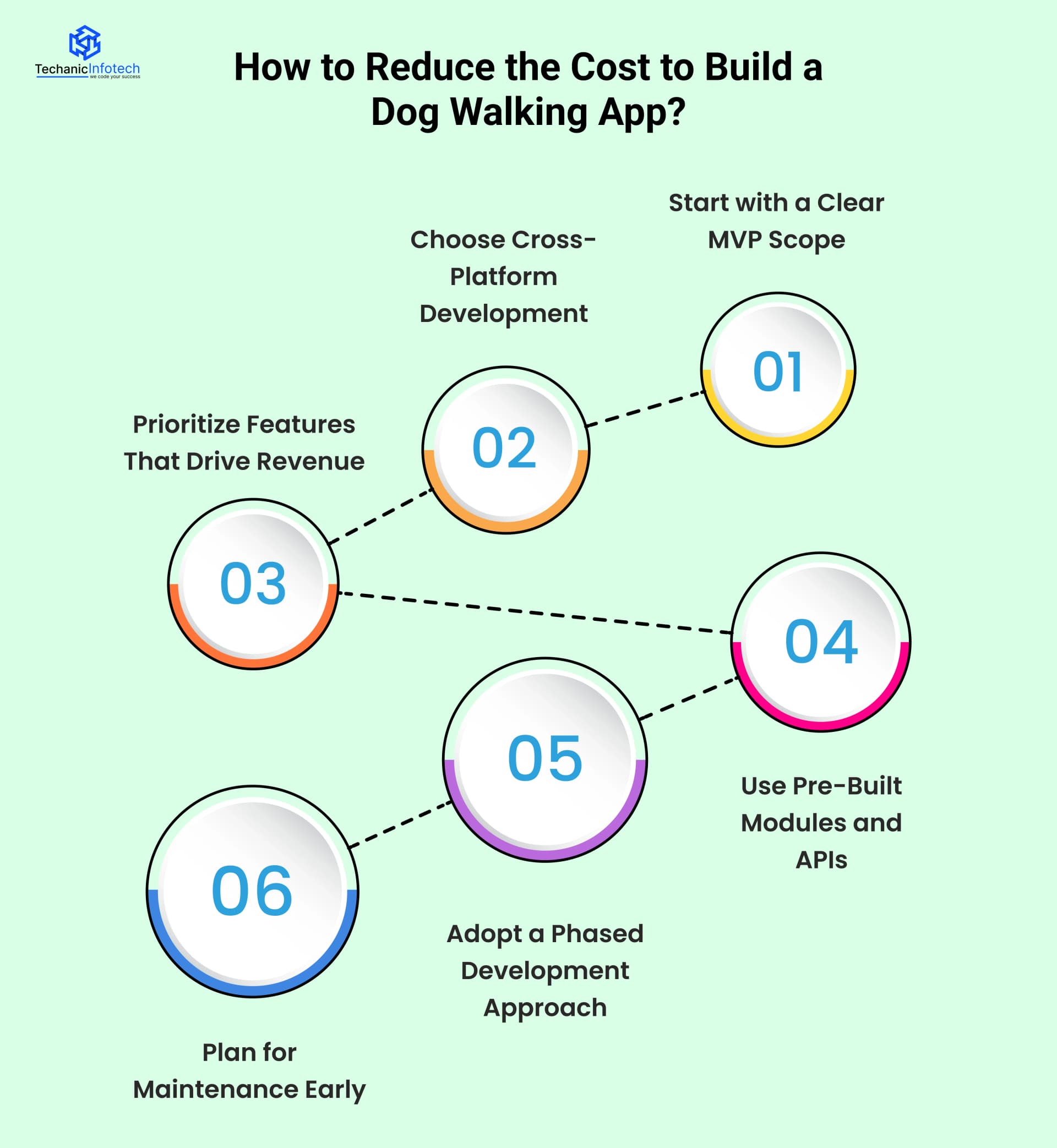
Focus only on essential features such as user registration, booking, and payments. Launching an MVP helps control the Rover-like app development cost and allows you to validate demand before investing in advanced features like GPS tracking or subscriptions.
Building a single app for both iOS and Android using cross-platform technology reduces time to develop an app and lowers the on-demand dog walking app cost compared to building two separate native apps.
Every feature adds to the dog walking app cost by features. Start with features that support bookings and payments, and delay non-essential elements like advanced analytics or loyalty programs.
Integrating ready-made solutions for payments, maps, notifications, and authentication helps reduce the cost to create an app like Rover and speeds up development.
Instead of building everything at once, release features in phases. This keeps the custom dog walking app development cost manageable and spreads investment over time.
Factoring support and updates into your budget helps avoid unexpected expenses later and keeps the overall pet care app development cost predictable.
Smart planning and phased execution can help you launch a competitive dog walking app while staying within budget.
Building a dog walking app like Rover in 2026 is a promising opportunity, but success depends on smart planning and realistic budgeting. The cost to build a dog walking app like Rover can range widely based on features, platform choice, and development approach.
By starting with an MVP, prioritizing revenue-driving features, and choosing the right technology stack, businesses can control the dog walking app development cost without sacrificing quality.
A phased development strategy and proper maintenance planning further reduce long-term expenses. With the right partner and cost-focused approach, launching a scalable and profitable Rover-like dog walking app is both achievable and sustainable.
The cost to build a dog walking app like Rover typically ranges between $15,000 and $80,000. The final cost depends on app complexity, features, platform choice, and third-party integrations.
Key factors include app complexity, feature selection, UI/UX design, technology stack, platform choice (iOS, Android, or cross-platform), and ongoing maintenance requirements.
Yes. Many businesses launch with an MVP that includes core features like booking, payments, and user profiles. This helps reduce the initial Rover-like app development cost and allows you to scale later.
On average, development takes 8 to 16 weeks, depending on feature scope and development approach.
They earn revenue through commissions on bookings, subscription plans, premium listings for walkers, and additional service fees.


Bharat Sharma is the CTO of Techanic Infotech, bringing deep technical expertise in software architecture, mobile app development, and scalable system design. He leads the engineering team with a strong focus on innovation, performance, and security.