
Key Takeaways
Hiring the right POS developers helps you build a system tailored to your business needs instead of relying on generic solutions.
A well-built POS system improves daily operations by handling billing, inventory, and customer data in one place.
Choosing POS development services allows you to integrate advanced features like multi-payment options, analytics, and cloud access.
The cost to hire POS developers varies based on experience and project complexity, but starting with a mid-level solution is often the most practical approach.
Different types of systems like retail POS system development, restaurant POS system development, and cloud POS system development serve different business needs.
Walk into any modern store today, and you’ll notice one thing, billing is faster, smoother, and smarter than ever before. That’s the power of a well-built POS system.
If you’re planning to scale your business or improve operations, choosing to hire POS developers can be a game-changing decision. A smart point-of-sale system doesn’t just handle transactions, it manages inventory, tracks sales, improves customer experience, and gives real-time insights.
From retail stores to restaurants and online businesses, companies are now investing in custom POS solutions instead of relying on outdated systems.
In this guide, we’ll break down everything you need to know, from benefits and features to cost and trends, so you can build a POS system that actually works for your business.
POS (Point of Sale) is the place where a customer completes a purchase, either in a physical store or online.
In simple terms, it’s the system used to process payments and manage sales. A modern POS system includes both hardware (like billing machines or tablets) and software that handles transactions, inventory, and customer data.
Today, POS systems are much more advanced than traditional billing tools. With proper POS system development, they can track sales in real time, manage stock, and provide useful business insights.
From our experience, a smart POS system acts as a complete solution that helps businesses run more efficiently and grow faster.
Running a business today is not just about making sales, it’s about managing operations smoothly and delivering a great customer experience.
Traditional billing systems can’t keep up with modern expectations. Businesses now need smarter tools that save app development time, reduce errors, and give better control over daily operations.
That’s where modern POS systems come in. They help businesses handle everything from transactions to inventory and customer data in one place.
Here’s why they have become essential:
Modern POS systems speed up the checkout process, reducing waiting time for customers.
Unlike traditional billing methods, they handle transactions quickly and accurately. This improves customer experience and helps businesses serve more customers in less time, especially during peak hours.
One of the biggest advantages of a modern POS system is real-time inventory tracking.
Businesses can monitor stock levels instantly, avoid overstocking or shortages, and manage products more efficiently. This is especially useful in retail POS system development, where inventory accuracy directly impacts sales.
Modern POS systems provide detailed insights into sales performance.
You can track daily sales, identify top-selling products, and understand customer buying patterns. This data helps businesses make smarter, data-driven decisions instead of relying on guesswork.
A smooth and quick checkout process creates a better experience for customers.
Many systems also store customer data, enabling personalized offers and loyalty programs. From our experience, businesses that invest in smart POS systems often see higher customer satisfaction and retention.
Today’s customers prefer different payment methods like cards, UPI, and digital wallets.
Modern POS systems support multiple payment options, making transactions more convenient and flexible. This is a key part of POS system development for modern businesses.
A modern POS system acts as a complete business management tool.
It connects sales, inventory, and customer data in one place. Whether you run a retail store or a restaurant, this centralized approach simplifies operations and reduces manual work.
With cloud POS system development, businesses can access their data from anywhere.
Owners can monitor sales, track performance, and manage operations remotely. This flexibility is especially useful for businesses with multiple locations.
When you hire POS developers, you’re bringing in experts who build and manage systems that handle your business transactions and operations. Their role goes beyond simple coding, they create complete solutions that help your business run smoothly.
Here’s what POS developers actually do:
POS developers design and develop software based on your business needs. Whether it’s retail, restaurant, or service-based, they create systems that match your workflow.
This is where custom POS development becomes important, as every business has different requirements.
A POS system should be easy to use for staff. Developers focus on creating simple and clean interfaces so employees can quickly learn and operate the system without confusion.
Handling payments is a core function. POS developers integrate multiple payment options like cards, digital wallets, and UPI to ensure smooth transactions.
This is a key part of point of sale system development.
Behind every POS system is a strong backend. Developers build databases and server-side systems to store and manage data like sales, inventory, and customer information securely.
Modern POS systems do more than billing. Developers add features like inventory tracking, sales reports, and analytics to help businesses make better decisions.
Since POS systems deal with financial data, security is critical. Developers implement encryption and secure APIs to protect transactions and customer information.
Even after the system is launched, POS developers continue to provide support. They fix bugs, update features, and improve performance over time.
Choosing to hire POS developers can make a big difference in how your business operates. Instead of using generic software, you get a system designed specifically for your needs.
Here are the key benefits:
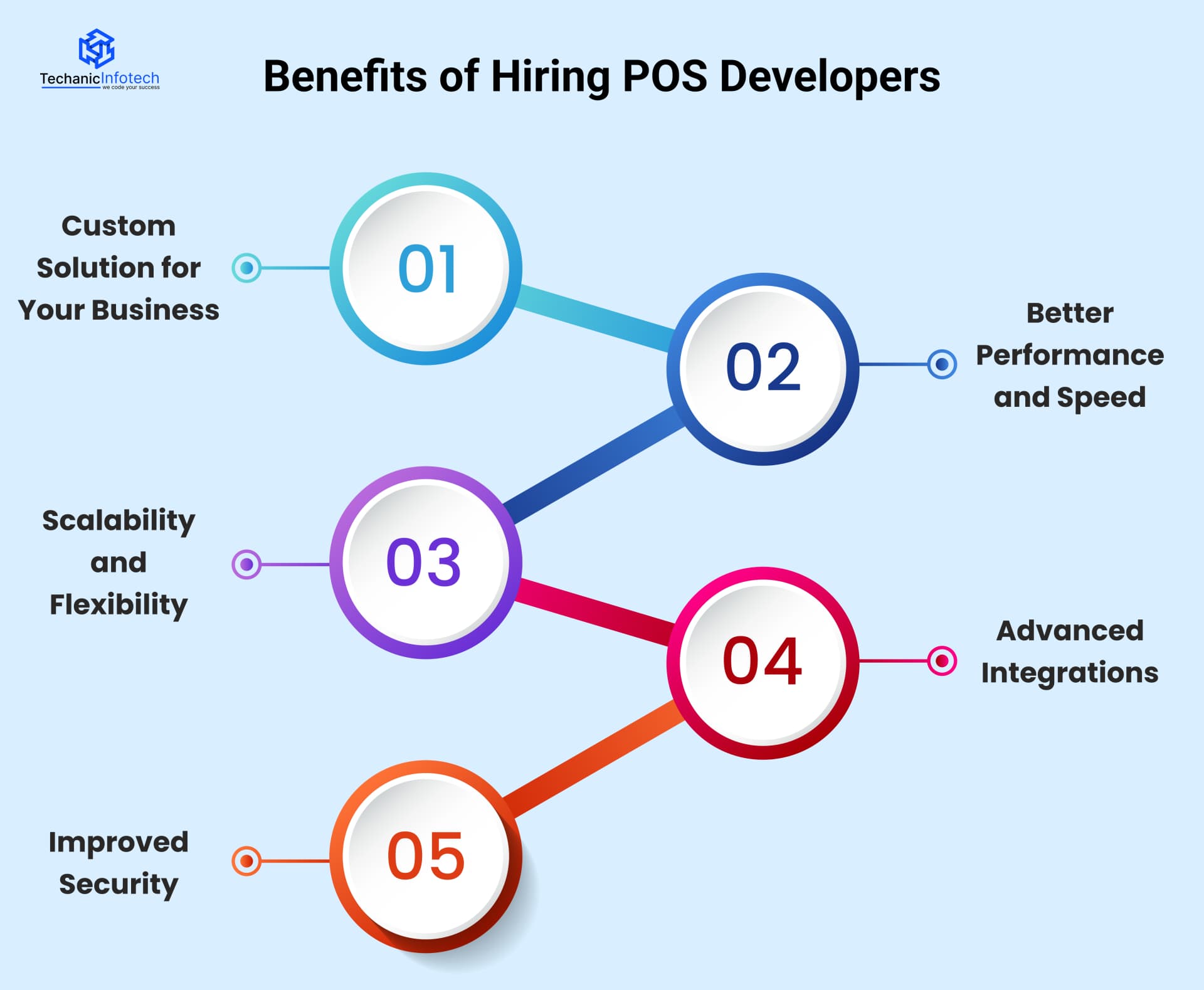
Every business works differently. A retail store, restaurant, or pharmacy all have unique workflows.
When you invest in custom POS development, developers build an e-commerce platform that fits your exact requirements. This makes daily operations smoother and more efficient compared to one-size-fits-all solutions.
Custom-built POS systems are designed with your business in mind. This means faster billing, smooth navigation, and fewer technical issues.
From our experience, businesses that use tailored systems face fewer delays and can handle customers more efficiently, especially during busy hours.
As your business grows, your POS system should grow with it.
When you hire POS software developers, they build systems that can be upgraded easily. You can add new features, expand to multiple locations, or integrate new tools without rebuilding everything from scratch.
Modern businesses rely on multiple tools to run operations.
POS developers can integrate your system with:
Payment gateways
CRM systems
Inventory management tools
Accounting software
This creates a connected ecosystem where everything works together. It reduces manual work and improves accuracy across your business processes.
POS systems handle sensitive financial and customer data, so security is critical. Developers implement strong security measures like encryption, secure APIs, and compliance standards. This ensures safe transactions and protects your business from potential risks.
A smart POS system is designed to simplify daily operations and improve overall business efficiency. It combines multiple functions into one platform, helping businesses manage sales, customers, and inventory with ease.
Sales and Billing Management: A smart POS system handles transactions quickly and accurately. It generates invoices, processes payments, and reduces manual errors, making daily operations smoother.
Real-Time Inventory Tracking: One of the most important e-commerce app features is inventory management. It helps track stock levels in real time, prevents overstocking, and ensures you never run out of important items.
Multi-Payment Integration: Modern POS systems support various payment methods like cards, digital wallets, and UPI. This flexibility improves customer convenience and speeds up the checkout process.
Customer Management: The system stores customer details, purchase history, and preferences. This helps businesses offer personalized services and build stronger customer relationships.
Reporting and Analytics: Smart POS systems provide detailed reports on sales, revenue, and performance. These insights help businesses make better decisions and improve profitability.
Cloud-Based Access: With cloud POS system development, businesses can access data from anywhere. This is useful for managing multiple locations and tracking performance remotely.
When you decide to hire POS developers, one of the first things you need to choose is the type of system you want to build. Different businesses have different needs, so selecting the right type of POS system is important for long-term success.
With the help of the right POS development services, you can build a system that fits your business perfectly.
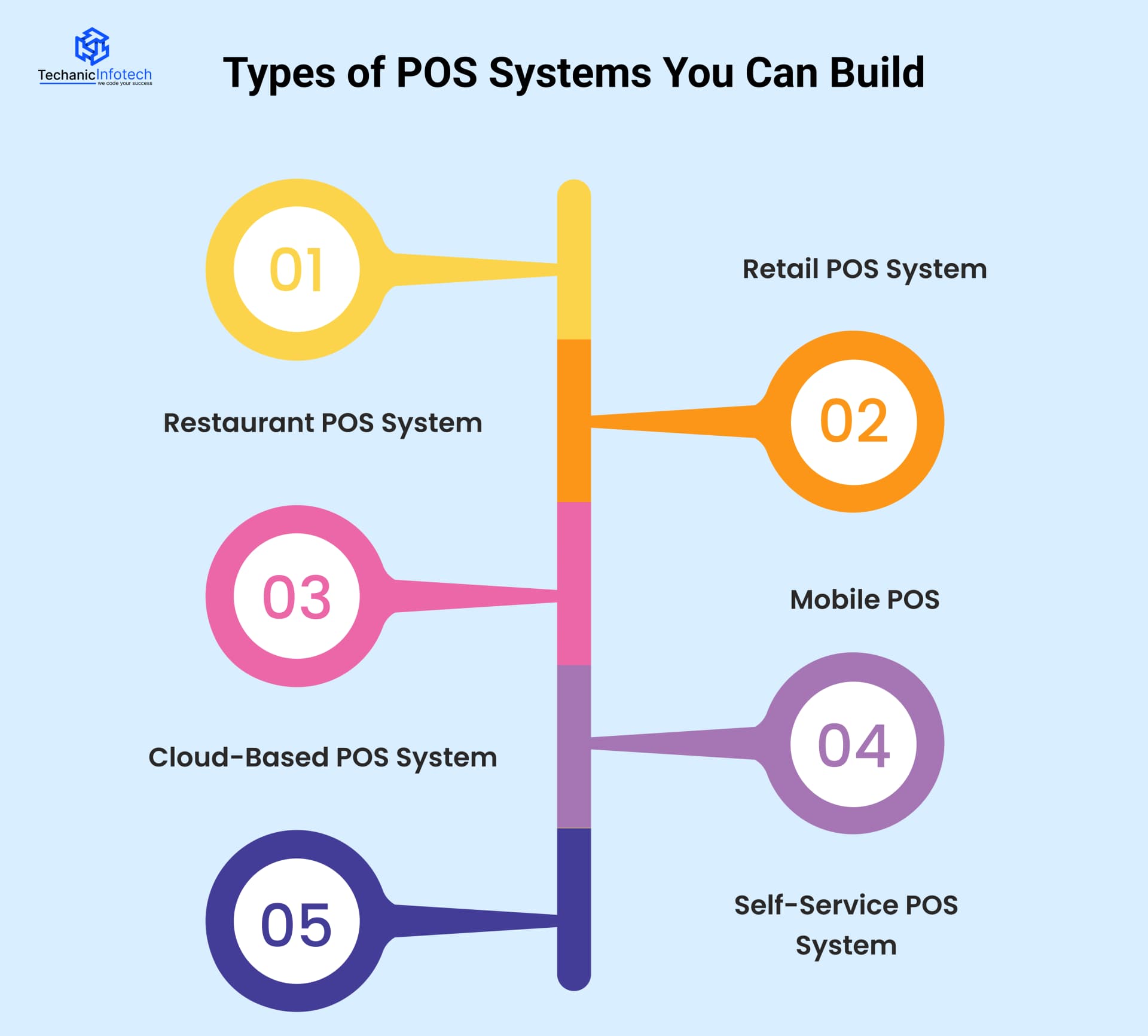
A retail POS system is designed for stores like supermarkets, clothing shops, and electronics outlets. It includes features like barcode scanning, billing, and real-time inventory tracking.
With retail POS system development, businesses can manage stock levels, track sales, and handle multiple transactions efficiently. This type of system helps store owners reduce manual work and improve accuracy in daily operations.
A restaurant POS system is built specifically for food businesses like cafes, restaurants, and cloud kitchens. It includes features such as table management, order tracking, and kitchen display integration.
With restaurant POS system development, orders can be sent directly to the kitchen, reducing errors and improving service speed. It also helps manage billing, split payments, and customer orders more effectively.
Mobile POS systems work on smartphones or tablets, making them perfect for small businesses or businesses on the move. These systems are lightweight and easy to use, allowing staff to process payments anywhere.
With POS app development, businesses can create flexible solutions that don’t require heavy hardware. This type of system is especially useful for pop-up stores, delivery services, and small retailers.
A cloud-based POS system stores data online instead of on local servers. This means business owners can access their data from anywhere at any time.
With cloud POS system development, you can manage multiple store locations, track sales remotely, and get real-time updates. It also ensures better data security and easier system updates without manual intervention.
Self-service POS systems are commonly used in kiosks where customers can place orders or make payments on their own. This reduces the need for staff and speeds up the checkout process.
These systems are popular in restaurants, cinemas, and retail stores. When you invest in point-of-sale system development, adding self-service options can improve efficiency and enhance customer convenience.
The app technology stack used plays a big role in performance and scalability.
Frontend
React Native
Flutter
Angular
Backend
Node.js
Python
Java
Database
MySQL
MongoDB
PostgreSQL
Integrations
Stripe / PayPal
Firebase
Cloud services
Choosing the right tech stack ensures your POS system is fast, secure, and scalable.
The cost to hire POS developers depends on multiple factors such as experience, location, and the complexity of your project. If you’re building a basic system or a fully customized solution, your budget will vary based on the features and scale you choose.
|
Type of Developer |
Hourly Rate |
|
Junior Developer |
$15 – $30 |
|
Mid-Level Developer |
$30 – $70 |
|
Senior Developer |
$70 – $150+ |
Junior developers are suitable for simple tasks or basic updates. Mid-level developers are ideal for most projects, offering a balance between cost and expertise. Senior developers are best for complex POS system development projects that require advanced features and scalability.
Basic POS System: $10,000 – $25,000
Mid-Level POS System: $25,000 – $60,000
Advanced POS System: $60,000 – $120,000+
A basic system includes core features like billing and inventory. A mid-level system adds integrations, reporting, and better UI. Advanced systems include features like cloud support, analytics, and multi-location management.
From our experience, most businesses benefit from starting with a mid-level solution. It offers enough functionality to run operations smoothly while keeping the cost to hire POS developers within a practical range. As your business grows, you can scale and add more advanced features over time.
Building a POS system may sound straightforward, but in reality, it comes with several technical and operational challenges.
From our experience, many businesses face issues not because of the idea but due to poor execution. This is where experienced teams you hire POS developers from make a real difference, they don’t just build, they solve problems proactively.
A POS system often needs to connect with multiple tools like payment gateways, inventory systems, CRM, and accounting software. Without proper planning, these integrations can become complex and lead to errors or data mismatches.
How Developers Solve It
Experienced POS developers design systems with API-first architecture. This ensures smooth integration with third-party tools. They also test each integration properly to avoid breakdowns during live operations.
POS systems handle sensitive customer and payment data. Weak security can lead to data breaches, financial loss, and loss of customer trust.
How Developers Solve It
When you choose the right POS software development company, they implement strong security measures like encryption, secure APIs, and compliance standards. This ensures all transactions are safe and your system stays protected from threats.
Many businesses build a POS system for current needs but forget about future growth. As the number of users or transactions increases, the system may slow down or crash.
How Developers Solve It
With proper POS system development, developers build scalable architectures from the start. They use cloud-based solutions and flexible frameworks so your system can handle growth without performance issues.
If the POS system is complicated, staff will take longer to process transactions. This can lead to delays, errors, and poor customer experience.
How Developers Solve It
Good developers focus on simple and intuitive design. A professional e-commerce app development company or POS team ensures the interface is easy to use, reducing training time and improving efficiency during daily operations.
Choosing to hire POS developers is not just a technical decision, it’s a strategic move for your business growth.
A well-built POS system can simplify operations, improve customer experience, and give you better control over sales and inventory. From retail stores to restaurants, investing in the right POS system development helps you stay competitive in a fast-moving market.
From our experience, the key is to start with the right features, choose a reliable POS software development company, and build a system that can grow with your business.
Instead of going for generic solutions, focus on custom POS development that fits your needs. In the long run, a smart POS system becomes a powerful tool that drives efficiency and success.
When you hire POS developers, you get a custom solution tailored to your business needs. Unlike ready-made software, it offers better flexibility, scalability, and performance.
The cost can range from $15 to $150+ per hour, depending on experience. The total POS system development cost can go from $10,000 to $120,000+ based on features and complexity.
POS developers design, build, and maintain point-of-sale systems. They handle everything from frontend design to backend development, integrations, and security.
Key features include billing, inventory management, sales tracking, customer management, reporting, and multi-payment support.
Yes, with custom POS development, systems can be tailored for retail, restaurants, healthcare, and other industries based on specific needs.
A basic system can take 2–3 months, while advanced systems may take 4–6 months or more.
Cloud POS system development allows you to access data from anywhere, while traditional systems store data locally and have limited flexibility.
Yes, when built by a reliable POS software development company, they include encryption, secure APIs, and compliance measures to protect transactions and data.
Yes, modern POS development services allow integration with payment gateways, CRM systems, accounting tools, and inventory management software.
Retail, restaurants, hospitality, healthcare, and eCommerce businesses benefit the most from point of sale system development.
Yes, a well-built POS system is scalable. You can add features, support more users, and expand to multiple locations over time.
Look for experience, portfolio, technology expertise, and clear communication. The right company will understand your needs and build a solution that supports long-term growth.


Abhishek Jangid is the CEO of Techanic Infotech, with extensive experience in mobile app and web development. He specializes in helping businesses turn innovative ideas into scalable digital solutions through strategic planning and modern technology.