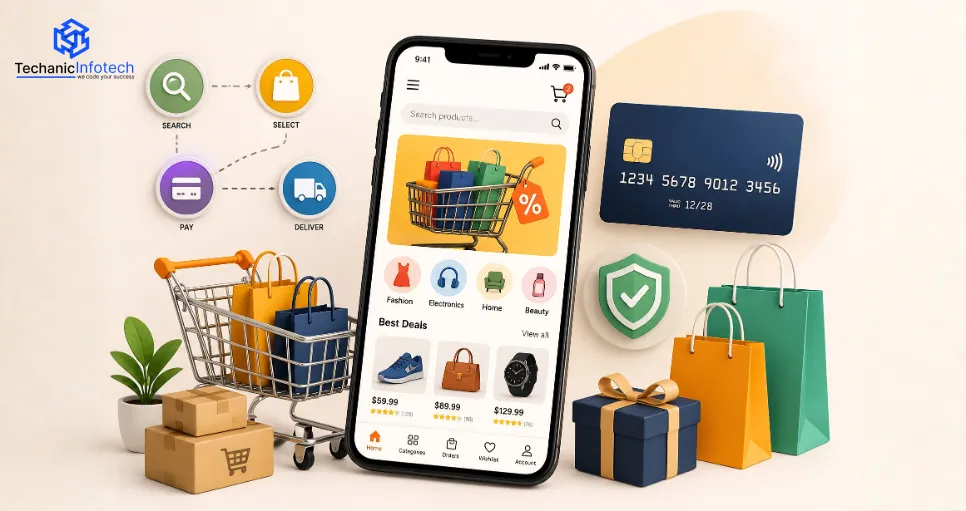
You’ve decided to create an eCommerce app, that’s amazing! But, maybe you’re wondering, where do you even begin? It sounds like a lot, right? Well, you’re not alone.
Many entrepreneurs and businesses face the same dilemma when deciding to take their store online and into the hands of customers on the go. But, don’t stress.
In this guide, we’re going to walk you through everything you need to know to create an eCommerce app that not only looks great but also functions like a wow and keeps your customers coming back for users.
Let’s break it down step-by-step.
An eCommerce app puts a store in your pocket, so you can shop whenever and wherever you want.
It is a mobile platform that lets customers browse products, pay, and keep an eye on their orders with just a few taps.
These apps give shoppers a personal experience helping businesses connect better with people who are out and about.
With easy-to-use features like smooth browsing, quick payments, and suggestions just for you, eCommerce apps are changing how we buy things. They make shopping faster, easier, and more fun than before.
It's a great tool for businesses that want to do well in today's world where mobile comes first. The convenience and ease of use have made businesses look for an expert mobile app development company and get the eCommerce app of their dreams.
We are one step closer to knowing how to create an eCommerce app, but before that, how about we get the working eCommerce app?
The use of e-commerce apps has also steadily increased in the last few years, and so does the number of app downloads.
To provide you with some insights into proper stats, we have curated this section filled with fantastic market stats.
The E-commerce App Market is projected to register a CAGR of 9.60% during the forecast period (2024-2029).
The market is filled with so many top eCommerce apps. To be successful in the market, you have to know the various types of eCommerce apps you can choose from.
Dive in to understand that along with some examples of apps already making waves in the market, let’s jump in!
B2B e-commerce apps are geared toward businesses whose services engage with other companies. Retail improves products and procurement or processes. It offers the ability to purchase large quantities and customizable catalogs for the B2B market. These platforms are crucial for the production, distribution, and logistics sectors. B2B apps primarily aim to optimize and enlarge the scale of business interactions, which is why they incorporate various functionalities.
Alibaba
1. Bulk order management
2. International shipping support
3. Customizable catalogs
ThomasNet
1. Supplier discovery tools
2. Verified vendor profiles
3. Detailed product specifications
TradeIndia
1. Business networking features
2. Secure payment systems
3. Trade fair participation
IndiaMART
1. Buyer-seller communication tools
2. RFQ (Request for Quotation) system
3. Multi-language support
Moglix
1. Industrial supply management
2. Inventory and logistics tracking
3. Vendor credit facilities
B2C apps directly involve transactions between businesses and consumers. Their main focus is on designing simple, elegant, and intuitive interfaces, providing the best user experience, and integrating seamless payment methods. They are most widely used in the eCommerce industry, where they take a convenience-based approach and offer a wide range of products, from everyday needs to luxurious items.
Amazon
1. AI-powered recommendations
2. Prime delivery services
3. Global Marketplace
Walmart
1. In-store pickup options
2. Price matching
3. Loyalty programs
Target
1. AR for virtual try-on
2. One-click payment options
3. Exclusive app discounts
Flipkart
1. Live video shopping
2. Festive sales and promotions
3. EMI and pay-later options
Sephora
1. Beauty tutorials
2. Virtual makeup try-on
3. Exclusive app-only products
C2C apps are the applications that enable direct interaction between consumers to purchase or offer products or services. They provide a link between the two persons, ensuring the safety of the transaction. Well known for used merchandise, as art wall pieces, and providing crafts, real-life platforms like features promote such retail as trade review by section. It is vital to know that enabling bidding the system direct and interaction communication between tools.
eBay
1. Auction-style listings
2. Buyer protection programs
3. Advanced search filters
Craigslist
1. Localized classifieds
2. Direct user communication
3. Free ad postings
OLX
1. Instant chat features
2. Easy ad creation
3. Location-based listings
Poshmark
1. Social shopping features
2. Closet management tools
3. Community-driven promotions
OfferUp
1. Secure in-app payments
2. Verified seller badges
3. Local delivery options
C2B apps enable people to market their goods or services directly to companies. These are common in the creative and professional industries, where companies require content creation, services, or marketing. Freelancing gives users power and businesses a way of accessing many talents.
Fiverr
1. Gig-based job listings
2. Seller performance analytics
3. Multiple service tiers
Upwork
1. Hourly and fixed-price contracts
2. Time-tracking tools
3. Feedback and rating systems
99designs
1. Design contest feature
2. Client-designer collaboration tools
3. Global design community
Toptal
1. Elite talent matching
2. Custom recruitment services
3. Exclusive client pool
TaskRabbit
1. On-demand task completion
2. Transparent pricing
3. Localized service listings
Marketplace apps are applications that bring multiple sellers and buyers into one platform. They are middlemen and thus offer various products for sale while generating revenue from commissions. These apps are available in different sectors to facilitate efficient shopping and the use of search and transaction options.
Etsy
1. Focus on handmade goods
2. Global seller community
3. Custom order requests
UberEats
1. Real-time order tracking
2. Multiple payment options
3. Personalized food recommendations
Airbnb
1. Flexible booking options
2. Host protection programs
3.Local experience offerings
Swiggy
1. Wide restaurant network
2. Quick delivery times
3. Scheduled order feature
Zomato
1. Food and restaurant reviews
2. Table booking options
3. Hyperlocal delivery services
Subscription-based e-commerce apps offer subscription-based products or services for a monthly or yearly charge. They target convenience-seeking customers who want regular deliveries or access to certain content. This model fosters customer loyalty and ensures consistent cash flow.
Netflix
1. Personalized content recommendations
2. Offline viewing options
3. Multi-device compatibility
Spotify
1. Ad-free music streaming
2. Downloadable playlists
3. Collaborative playlist creation
HelloFresh
1. Customizable meal plans
2. Fresh ingredient delivery
3. Recipe-saving features
Amazon Prime
1. Fast delivery services
2. Prime Video and Music access
3. Exclusive member deals
Hulu
1. Live TV options
2. On-demand content library
3. Add-ons for premium networks
Before you understand how to build an eCommerce app, first find out “why”.
The benefits are huge, and once you see them, you’ll definitely want to jump on board and tap into the market. Here are some key advantages:
An eCommerce app directly links the company's database, facilitating easy and efficient order processing.
This advantage stems from eliminating the intermediary role traditionally played by dealers or wholesalers, whose absence streamlines the sales process.
This direct connection also enables timely updates of products, inventory, and pricing, ensuring that the platform mirrors the current status of the physical store the enhanced efficiency in order and processing improves coupled customer satisfaction.
It is observed that conversion rates are much higher for mobile apps than for websites.
Compared to mobile, factors that fast-track conversions include push notifications, targeted offers, and a smooth checkout process, thus creating an excellent basis for making more sales.
Data such as the number of downloads, app usage rate, and users' preferences can be applied to improve marketing strategies and focus on potential customers.
This has excellent potential for increasing revenues and is a significant investor incentive.
An app is a means through which the company can get a dedicated platform to fully articulate its brand and, hence, build brand awareness.
Branding, sound design, and user engagement make the brand experience unique.
This strengthens the company's brand identity and makes customers trust it more, incurring high customer acquisition costs.
This can attract investors who see the potential of a strong brand as a valuable intangible asset.
Some ways to leverage mobile apps include integrating loyalty programs, providing customers with exclusive offers and deals, and creating interactive content to ensure that customers remain engaged.
Push notifications are also a good way of engaging inactive users and encouraging them to revisit the store.
This, in turn, increases customer engagement and retention rates, thus improving the customer lifetime value and decreasing customer acquisition costs.
This is a key metric for investors who seek long-term growth and profitability.
The following data can be obtained using information on users' behavior, preferences, and purchase history from mobile apps: User behavior, preference, and purchase history data.
This data can be applied to improve product offerings, design marketing campaigns, and enhance customer service.
It can also pinpoint growth potential, optimize marketing investments, and develop proper business strategies—such capability to utilize data for strategic planning appeals to investors, especially those interested in data-based strategy.
So, how to build an eCommerce app? Wondering the same.
Creating an eCommerce app includes several series of key steps to ensure that it is user-friendly, functional, and secure.
Let’s break down the process to make an eCommerce app that stands out in the market.
The first step to build an eCommerce app that needs to be done is to establish the business objectives, and the needs the application will fulfill. This entails understanding the target market, assessing the existing trends in the market, and outlining the main features that the app is to offer. You may want to develop a B2C application, a B2B marketplace, or a specific niche application; your development partner will assist in fine-tuning the concept. This helps to lay a good foundation for the project and reduces the chances of misunderstandings and changes in the project's scope.
Choosing a good marketplace app development company is the second stage in the process of a complete guide to create an e-commerce app. In which imperative to achieve the desired goals for the developing project. Phase search includes:
When choosing an Android or iOS app development company, remember client testimonials, the partner's experience in your industry, and their development methodologies.
Choosing the right company puts a good foundation for a smooth and effective working relationship during the development process.
The app's concept is expanded further in this phase, and wireframes, prototypes, and UI/UX design are developed. Designers work towards creating an attractive and easily understandable interface that aligns with your brand.
The design process involves user flow mapping to ensure all the features are easily accessible. This allows stakeholders to test the app's usability before it is developed. This stage is crucial as it will inform how the target audience will engage with your application. Good design increases user participation and makes your offering unique in the market.
Development is the application creation process and involves integrating the front-end and back-end processes.
The front end is all about user interfaces. The users can’t see the back-end, which deals with server-side activities, including database, user authentication, and APIs.
The development process is incorporated. It is also based on the integration agile approach.
This ensures that the application is developed in a way that accomplishes the intended purpose and meets all the needed technical standards with the input of the client and the development team.
Testing is a necessary process that helps ensure the app works as it should before it is released.
An app development company employs several types of testing: functionality testing, compatibility testing on various devices and platforms, and performance testing under different conditions.
User acceptance testing (UAT) requires the involvement of the stakeholders to check if the application is complete.
Thus, by eliminating the bugs and enhancing the usability at this stage, the application becomes strong enough to meet the challenges of the market.
After the app goes through the testing process, it is considered finished.
The development team helps submit apps to various platforms, including Google Play and Apple App Store.
It also ensures that the app gets boosts on the app store with listing using good guidelines, visuals, descriptions, and keyword platforms.
A successful launch strategy involves promoting the app to get the first users and create a buzz.
This phase is the app's start in the highly competitive e-commerce industry, and the launch is a critical factor in the app's success.
Last but not least stage to know how to make an eCommerce app.
In the post-launch stage, attention is paid to the support and maintenance of the application to sustain its usefulness in the long run.
It is, therefore, essential to ensure that the application is regularly updated, that the performance is monitored, and that bugs are fixed to keep the application relevant in the market.
It also involves ensuring that the app is well-tuned to work efficiently with the new OS versions and includes new features to make it applicable to the current market trends.
A good iOS or Android app development company provides support throughout, thus guaranteeing that the app is in line with the business objectives and the needs of its users.
To build an eCommerce app that keeps users hooked, certain features are a must.
We have brought those essential features that provide seamless user experiences and make users come back.
Let’s get to know them one by one in detail:
This feature allows admins to manage user accounts, view details, and close accounts. It also offers features like monitoring user activities to ensure the platform's proper functioning and protection.
Admins can create, delete, or modify products or group them into different categories to reflect changes in the catalog and make it more effective for customers.
To increase the system's productivity, the managers can track, accept, decline, or complete customers' orders, check the order history, and track delivery.
Admins can integrate, manage, and troubleshoot the payment gateway settings to enhance transaction security and offer users multiple payment options.
This feature enables the admin to check stock levels, receive low-stock alerts, and control product availability in real-time.
Admins can view customers' feedback, grievances, and suggestions and, where necessary, resolve them, improving the customer experience.
The admins can create, modify, and view promotional lure campaigns, customer discounts, and sales-increasing strategies.
This feature allows admins to create reports on user actions, sales performance, payment success rates, and other business metrics.
Admins can control the content, banners, and promotional messages displayed on the platform to enhance the brand's visual identity and communication.
The admins can control users' permissions, monitor for breaches, and ensure that sensitive information is not exposed through multiple levels of security.
Customers can also use the website to create an account or sign in to their existing account to enhance the shopping experience and track their orders.
This feature offers quick access to the desired results by filtering their search using price, category, and brand criteria.
Users can also select multiple products and view them in their shopping cart before checking out.
With the help of this, customers can choose a safe and secure payment method, including credit cards, digital wallets, or other payment channels.
This feature provides real-time information on their placed orders, shipment tracking, and delivery schedules.
Customers can also create lists of the products they want or would like to be recommended.
Users can easily engage with support through the live chat function to solve problems or ask questions.
With the help of this feature, customers can use the search bar to input codes and view current promotions.
It provides feedback and purchases, rates the products they bought, and even reads other customers' reviews to guide them.
Customers can engage the app to receive push notifications about deals, order status, and new products.
Vendors can get performance reports on sales, user actions, and inventory to make better decisions.
Ordering processing can view, approve, or cancel orders to meet delivery and customer service goals.
This feature gives the Vendor the authority to control stock levels, identify out-of-stock products, and set up stock alerts.
With this feature, Vendors can create new products, modify existing ones, and delete or classify products to help users quickly find their needs.
With the help of this feature, vendors can attend to customers' complaints and answer their queries accordingly.
The Vendor can organize delivery and monitor transportation to guarantee that orders are placed at the right time.
Return requests can quickly be processed, and product return or refund requests can be handled effectively by the Vendor.
It offers checks on the transactions, verifies payments, and ensures no differences in the financial statements.
This feature allows Vendors to organize and execute promotions and sales to boost conversion and attract customers.
This function can also track customer reviews and ratings to answer and resolve customer complaints.
As we all know, the demand for e-commerce app development has increased extensively. But what made it more efficient? New technology.
Some of the best eCommerce apps come every year, but last, the ones with incredible technology stack. So, the eCommerce app development guide is incomplete without knowing the eCommerce app tech stack.
| Category | Technologies |
| Frontend | React Native / Flutter / Swift / Kotlin |
| Backend | Node.js, Django, Ruby on Rails, .NET, Spring Boot |
| Database | MySQL, PostgreSQL, MongoDB, SQLite |
| Payment Gateway | Stripe, PayPal, Razorpay, Square, Braintree |
| Hosting Services | AWS, Google Cloud Platform, Azure, Heroku |
| Cloud Storage | AWS S3, Google Cloud Storage, Firebase Storage |
| Search Engine | Elasticsearch, Algolia, or Sphinx |
| Analytics Tools | Google Analytics, Mixpanel, Firebase Analytics |
| DevOps Tools | Jenkins, Docker, Kubernetes, GitHub Actions |
| Security Tools | OAuth, JWT, HTTPS, SSL |
| AI/ML Integration | TensorFlow, PyTorch, Scikit-learn, AWS AI Services |
| Real-Time Features | WebSockets, Socket.io |
| UI/UX Design Tools | Figma, Adobe XD, Sketch, InVision |
The cost to create an eCommerce application depends on several factors, including the features to be incorporated, the application's design, and the location of the developers, among others.
On average, it can cost $10,000 to $300,000, depending on the complexity of the application.
The following are the eight most important factors that affect the costs to create e-commerce applications:
The ecommerce app development cost depends on the complexity and the type of features to be incorporated. A simple app with essential functions such as product catalogs, shopping carts, and payment gateways is cheaper than a complex app with features like AI personalization, AR try-on, and multi-seller integration.
| Feature Type | Description | Cost Range (USD) |
| Basic Features | Product catalog, shopping cart, payment gateway | $10,000 - $30,000 |
| Advanced Features | AI personalization, AR try-on, multi-seller integration | $30,000 - $80,000 |
| Custom Features | Tailored features unique to your business needs | $50,000+ |
Good custom design is high-quality and expensive, and it makes an impression on customers. Put them into basic themes. Designs are cheap, but investing in professional UI/UX design is worthwhile as it will improve retention and provide a better shopping experience.
The choice of platform, such as iOS, Android, or both, impacts the ecommerce app development cost. Native apps are expensive to develop since one has to write code specific to a particular platform, while cross-platform apps are cheaper to develop. The right platform should be chosen according to your audience and financial plan.
Some integrations that can be incorporated into the system include payment gateways, CRM, analytics, and inventory management tools. These tools help enhance functionality but also increase costs. Third-party tools help manage various business processes effectively and enhance overall usability.
Hourly rate to hire dedicated developers also depends on the location. Hiring a team of professionals from high-cost areas like the United States or Europe is more expensive than outsourcing from Asia or Eastern Europe.
Finding a balance between cost and expertise is essential to achieving the best results without breaking the bank.
This is why testing is essential: to ensure the app has no flaws. The QA process is more complicated and expensive for large and complex apps. Thus, proper QA improves the app's quality and users' satisfaction.
Post-launch maintenance and updates are usually performed to maintain the application's performance. The cost of maintaining the application depends on its complexity. It is essential to update the app frequently to make it relevant in the market.
Advertise your application to acquire users and make them aware of it. Marketing costs depend on the strategies used and the campaign scale.
Hiring marketers ensures that your product reaches the right people and that the users are well-engaged.
As much as knowing how to make an eCommerce app is important, so does the cost.
With this being out of the way, we shall understand how these apps make money.
E-commerce applications have changed the face of shopping.
For businesses, they have become essential tools for increasing their revenues. Here are the primary ways e-commerce apps monetize their platforms:
This is the most apparent way e-commerce apps generate revenues. Simply put, they connect buyers and sellers and receive a commission from each sale. Depending on the platform, the commission may be a certain percentage or amount. For instance, Amazon's income comes from one of the leading direct-to-consumer e-commerce models, where companies sell large products to consumers. Amazon gets a commission from the third-party seller's sales.
E-commerce apps can make money by promoting other businesses by putting up ads for other companies. Ads can take different forms, including banner ads, sponsored product listings, and video ads. This way of advertising can be effective if ads are well placed and aimed at the right people to view them.
Furthermore, it is common for brands to collaborate with e-commerce apps for sponsored content, a form of advertising in which brands compensate the e-commerce apps to feature their products or services.
Certain e-commerce apps provide premium subscription plans that offer users various benefits. These benefits may include exclusive offers, fast delivery, or membership to certain user sections. By charging a subscription fee regularly, such apps can ensure a steady flow of revenue. For example, Amazon is one of the most prominent players in the e-commerce industry. It has implemented the subscription model with its Amazon Prime service, which includes free shipping, streaming services, and many more benefits. This subscription model has been great for Amazon.
E-commerce apps capture information such as the user's browsing history, buying patterns, and demographics. The information can be helpful to businesses, marketers, and researchers. When the data is anonymized and aggregated, the e-commerce apps can sell the insights to third parties as revenue. However, user data should be respected in some cases, and data privacy laws and regulations must be followed to build trust and avoid legal consequences.
Additional services can be integrated into the e-commerce apps to improve the satisfaction of customers and, at the same time, bring in some revenue. These services may include;
By diversifying their revenue streams and leveraging technology, e-commerce apps can continue growing in the digital age as far as possible.
Looking to build an eCommerce App? Techanic Infotech is the perfect partner to bring your vision to life.
As an experienced eCommerce app development company, Techanic Infotech is the perfect partner in building custom, user-friendly apps that offer seamless navigation, secure payments, and personalized experience.
Our expert team works closely with you to understand your needs and create an app that not only looks great but performs exceptionally well.
With Techanic Infotech, you can turn your eCommerce ideas into a powerful app that drives growth and keeps customers coming back.
To create an e-commerce app from scratch, it is crucial to consider aspects such as understanding the customer, providing a good user experience, and providing value through the features.
In this blog, we compiled a step-by-step guide to develop an eCommerce app with its cost, features, stats, and many more.
It is, therefore, important for businesses to focus on unique features to enhance mobile commerce to ensure that they can build trust with their clients.
This will offer them the advantage to develop loyalty and remain relevant in the ever-evolving global market.
At Techanic Infotech, we deliver top-notch eCommerce app development with innovative features, seamless user experiences, and scalable solutions tailored to your business. Your success is our priority!
Depending on your target audience, you should consider iOS, Android, cross-platform, or any other framework like Xamarin. iOS generates higher revenue than Android but has fewer users. Through cross-platform development technologies like Flutter or React Native, you can reach both user groups while minimizing costs and time.
The cost to create an eCommerce app from scratch depends on the complexity, the number of features required, the location of the e-commerce app development company, and the design decisions made during the process.
The timeline also depends on the complexity of the app and the features required. Developing a simple e-commerce app with basic shopping features can take about 3 to 4 months, while creating a complex app with specific features or integrations may take 6 to 12 months.
To make an app user-friendly, the main areas to concentrate on are navigation, design, and the use of payment systems. This means periodically conducting user testing to get feedback and improve the app's interface. Some of the features that should be given high priority include fast search, recommendations, and quick checkout.
A successful e-commerce app should include features like product search, filters, secure payment gateways, user accounts, order tracking, push notifications, and reviews. Advanced features like AI recommendations and chat support can further enhance user engagement.
You should evaluate a company based on its portfolio, client reviews, technical expertise, and experience in building scalable e-commerce solutions. Communication and post-launch support are also key factors to consider.
Yes, integrating secure payment gateways like credit/debit cards, UPI, wallets, and net banking is essential. Multiple payment options improve user convenience and boost conversion rates.
Yes, having a mobile app improves customer engagement, offers a better user experience, and increases retention compared to websites. Apps also allow push notifications and personalized offers.
To ensure security, implement SSL encryption, secure payment gateways, two-factor authentication, and regular security updates. Protecting user data builds trust and credibility.
Web apps are accessed via browsers, while mobile apps are installed on devices. Mobile apps offer better performance, personalization, and offline access, whereas web apps are easier to maintain.
Yes, a scalable app architecture allows you to add new features, improve performance, and update design as your business grows.
Focus on fast loading speed, simple navigation, easy checkout, attractive UI, and personalized recommendations. Reducing cart abandonment is key to increasing conversions.
Popular technologies include Flutter, React Native, Swift (iOS), Kotlin (Android), and backend technologies like Node.js or Laravel. The choice depends on your business needs and budget.
Regular maintenance ensures smooth performance, bug fixes, security updates, and compatibility with new devices. It helps keep your app competitive and user-friendly.


Abhishek Jangid is the CEO of Techanic Infotech, with extensive experience in mobile app and web development. He specializes in helping businesses turn innovative ideas into scalable digital solutions through strategic planning and modern technology.