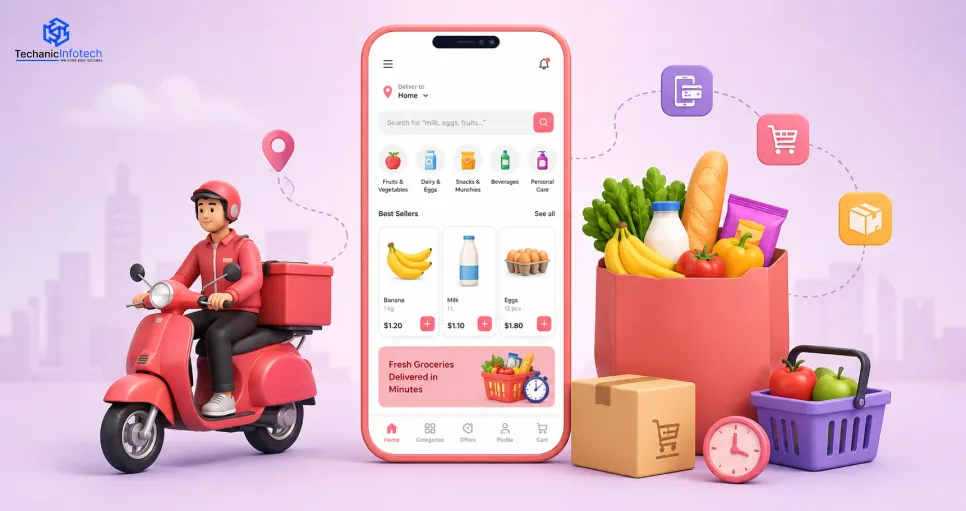
Businesses are no longer competing on product selection alone.
They compete on delivery speed, convenience, and customer experience. That is why building an app like Instashop has become a serious investment for startups, supermarket chains, retailers, and hyperlocal delivery businesses looking to capture growing on-demand demand.
During product planning, one common challenge is balancing fast market entry with a scalable platform that supports real-time order tracking, inventory management, secure payments, and last-mile delivery.
In this guide, you'll learn the development process, business models, essential features, AI capabilities, technology stack, development cost, monetization strategies, and best practices for building a successful grocery delivery app.
InstaShop is a hyperlocal grocery delivery app that connects customers with nearby supermarkets and local stores. Users can order groceries, household items, and daily essentials through a mobile app. The platform manages online ordering, secure payments, real-time order tracking, and fast last-mile delivery.
Customers explore nearby grocery stores, search products, compare prices, and add daily essentials to their shopping cart.
Customers complete checkout using secure payment options. The order is sent instantly to the selected merchant.
The merchant confirms the order, updates inventory, packs items, and assigns the order for last-mile delivery.
A delivery partner picks up the order. Customers track it in real time until it reaches their doorstep.
In real-world grocery delivery projects, one pattern appears again and again. Apps that focus only on online grocery shopping often struggle to keep users engaged. Platforms built around fast fulfillment, real-time visibility, and local store partnerships usually retain customers better.
|
Feature |
InstaShop |
Traditional Grocery Apps |
|
Delivery Model |
Built for hyperlocal delivery. Nearby stores fulfill orders for faster last-mile delivery. |
Orders often come from central warehouses. Delivery usually takes longer. |
|
Order Tracking |
Real-time order tracking keeps customers updated from checkout to doorstep. |
Basic order status. Live tracking is often limited or delayed. |
|
Inventory Management |
Inventory sync updates product availability across local merchants in real time. |
Stock updates may lag, causing canceled or unavailable orders. |
|
Customer Experience |
Fast checkout, secure payments, and quick fulfillment improve repeat purchases. |
Focus is mainly on online ordering, not instant delivery convenience. |
|
Business Scalability |
Supports multi-store marketplace growth, delivery partner management, and AI-powered route optimization. |
Scaling across multiple merchants and delivery zones is often more challenging. |
The market opportunity is growing fast. The grocery delivery software market will grow from $6.79 billion in 2026 to $14.14 billion by 2030, at a 20.3% CAGR. This creates strong demand for new delivery platforms.
Consumer behavior has changed. People now expect groceries at their door in minutes, not hours. That is why quick commerce app development is becoming a smart choice for retailers and startups.
In real-world hyperlocal commerce projects, fast delivery keeps customers coming back. Features like live order tracking, secure payments, and easy checkout improve the shopping experience.
Enterprise grocery platforms often grow faster by partnering with local stores instead of managing large warehouses. This model lowers operational costs and supports faster last-mile delivery.
The right business model shapes your launch cost, delivery speed, and future growth. In real-world grocery delivery projects, teams often discover that choosing the wrong model creates higher costs and slower expansion. Pick a model that matches your budget, target market, and long-term business goals.
Best for startups with a low to medium budget. Local stores manage inventory. During marketplace app development, this model helps launch faster. Avoid it if you want full stock control.
Choose this when you want complete control over products and pricing. It needs a higher budget for inventory and storage. Avoid it if your startup has limited capital.
A smart choice for businesses partnering with nearby stores. It supports fast last-mile delivery with a medium budget. Avoid it if local merchant coverage is weak.
Best for quick commerce brands that promise 10–30 minute delivery. It needs a high budget for warehouses and operations. Avoid it in low-demand markets.
Successful InstaShop like on demand grocery app development depends on features that improve customer experience, simplify operations, and support long-term business growth without making the platform difficult to scale.
Login, smart search, AI search, cart, checkout, live order tracking, multiple payment options, and ratings build trust. Many on demand app development services focus on these first because they improve conversions with manageable development effort.
Route optimization, earnings dashboard, live navigation, and delivery proof help drivers complete more orders. These features reduce delivery delays but require accurate GPS and real-time location updates.
Inventory, order management, pricing, and analytics help stores avoid stock issues and process orders faster. Teams often discover this panel becomes the backbone of daily business operations.
User management, commissions, promotions, reports, and notifications give full platform control. During multi service super app development, a scalable admin panel also makes future service expansion much easier.
Modern InstaShop clone multi vendor grocery app development uses AI to improve delivery speed, customer experience, and business decisions without adding unnecessary operational complexity.
AI delivers smarter search results and personalized product suggestions. AI integration in mobile apps improves conversions, but it needs quality customer data and proper model training.
AI predicts product demand and stock levels. This reduces inventory waste, avoids stockouts, and helps merchants plan purchases more accurately.
AI calculates accurate delivery times by analyzing traffic and driver location. Customers get better updates, while businesses reduce late deliveries and fuel costs.
AI adjusts prices based on demand and flags unusual payment activity. It improves revenue and security, though it requires reliable data and business rules.
AI chatbots answer order, payment, and delivery questions instantly. They reduce support workload and improve response time without increasing customer service costs.
Build a successful InstaShop like quick commerce app development solution with a clear plan. Each step reduces risk, controls cost, and creates a better user experience.
Study local demand, competitors, and buying habits before development starts. This step shapes every product decision.
Find your target users and delivery area.
Study apps like Instacart, Blinkit, and Carrefour Now.
Check delivery time, pricing, and features.
Expert Tip: Teams often skip local demand research. That leads to weak customer adoption and poor merchant interest.
Test your business model before investing in full development. Early feedback saves time and money.
Talk with grocery stores and customers.
Test pricing and delivery fees.
Confirm the revenue model.
Expert Tip: For early-stage startups, merchant validation matters more than adding extra features.
Pick only the features users need for the first release. A focused MVP launches faster and costs less.
Customer app
Delivery partner app
Merchant panel
Admin dashboard
Expert Tip: During feature planning, many founders use an Amazon clone app development strategy as a reference but remove unnecessary marketplace features.
Simple navigation helps users order groceries faster. Clean screens also reduce cart abandonment.
Easy product search
Fast checkout
Clear order tracking
Large action buttons
Expert Tip: One common challenge is adding too many screens. Keep the buying journey short.
Develop core features first. Launch early, collect feedback, then improve with real customer data.
Login
Product catalog
Cart
Payments
Live tracking
Expert Tip: Avoid building AI or loyalty programs before the MVP proves market demand.
A strong backend keeps orders, inventory, and deliveries running without delays.
Frontend: Flutter or React Native
Backend: Node.js or Laravel
Database: PostgreSQL or MongoDB
Cloud: AWS or Google Cloud
Maps: Google Maps API
Payments: Stripe, PayPal
Expert Tip: While selecting technologies, a mobile app tech stack guide helps teams choose scalable tools instead of rebuilding later.
Test every workflow before launch. Small bugs can stop orders and reduce customer trust.
Payment testing
Order flow testing
GPS testing
Load testing
Security testing
Expert Tip: In production environments, payment and location issues are the most common launch blockers.
Release the app in one city or service area first. A phased launch helps fix issues quickly.
Onboard merchants
Train delivery partners
Monitor live orders
Collect customer reviews
Expert Tip: Enterprise grocery platforms usually expand city by city instead of launching nationwide on day one.
Track app performance after launch. Customer behavior shows what should improve next.
Monitor delivery time
Track repeat orders
Review app ratings
Improve slow workflows
Expert Tip: At scale, businesses that improve the app every month keep customers longer and increase order value.
Building an app starts with the right plan. This mobile app development cost guide shows what each stage includes, the expected timeline, and the budget needed to launch and grow.
|
Development Stage |
Best For |
Estimated Cost (USD) |
Timeline |
|
MVP App |
Early-stage startups |
$8,000 – $15,000 |
6–8 Weeks |
|
Standard App |
Growing local grocery brands |
$15,000 – $35,000 |
3–4 Months |
|
Advanced App |
Regional grocery chains |
$35,000 – $60,000 |
5–6 Months |
|
Enterprise Platform |
Large retailers & quick commerce brands |
$60,000 – $90,000+ |
6–9+ Months |
The final Instacart app development cost depends on app scope, AI features, tech stack, and delivery workflows. Smart planning helps control budgets without limiting future growth.
|
Cost Factor |
How It Affects Development |
Estimated Cost Impact |
|
Business Model |
A marketplace, inventory, or hyperlocal commerce model changes workflows, merchant panels, and order management. |
+$2,000–$10,000 |
|
Platform Choice |
Android, iOS, or cross-platform apps need different development effort and testing time. |
+$3,000–$12,000 |
|
Feature Complexity |
AI search, live order tracking, wallet, subscriptions, and multi-vendor support increase development work. |
+$5,000–$20,000 |
|
UI/UX Design |
Custom grocery app design, smooth checkout, and easy navigation improve user experience but add design hours. |
+$2,000–$8,000 |
|
Backend & Cloud |
Real-time inventory sync, APIs, cloud hosting, and scalable architecture support growing grocery marketplaces. |
+$4,000–$15,000 |
|
AI Integration |
Smart search, demand forecasting, ETA prediction, and pricing automation require AI models and extra testing. |
+$5,000–$18,000 |
|
Payment & Security |
Multiple payment gateways, PCI compliance, OTP login, and data security increase implementation effort. |
+$2,000–$7,000 |
|
Third-Party Integrations |
Maps, notifications, SMS, analytics, CRM, and delivery APIs reduce build time but add integration costs. |
+$2,000–$8,000 |
|
Admin & Merchant Panel |
Advanced reports, commission rules, inventory control, and user management need additional backend modules. |
+$3,000–$10,000 |
|
Testing & Maintenance |
Performance testing, bug fixes, updates, and scaling keep the grocery delivery platform reliable after launch. |
10–20% of annual development cost |
The right revenue model helps a grocery marketplace earn from every order. Smart InstaShop app development combines multiple income streams to support long-term business growth.
The charge partner stores a fee on every order. This creates steady revenue while helping supermarkets and local grocery sellers reach more customers.
Delivery charges cover last-mile logistics costs. Fees can change by distance, order value, or delivery zone to protect profit margins.
Offer monthly plans with free delivery and special deals. Subscription members order more often and improve customer retention.
Brands and grocery stores pay for banner ads. During InstaShop app development, sponsored products increase visibility and create extra income.
Merchants pay to appear at the top of search results. Better product exposure increases sales while growing marketplace revenue.
Raise delivery fees during peak hours or bad weather. Dynamic pricing balances delivery demand and keeps operations running smoothly.
Charge extra for 15–30 minute grocery delivery. Many customers happily pay more for faster service, increasing average order value.
Avoiding these mistakes helps your grocery delivery mobile app development project launch faster, reduce costs, and improve customer experience.
Mistake: Adding every feature delays launch and increases grocery delivery app development cost.
Avoid: Start with core features. Add AI and advanced tools after real user feedback.
Mistake: Wrong stock data causes canceled orders and unhappy customers.
Avoid: Use real-time inventory sync with the merchant panel and cloud database.
Mistake: No live order tracking lowers customer trust and increases support calls.
Avoid: Add GPS tracking, ETA updates, and delivery status notifications from day one.
Mistake: Missing analytics hides customer behavior and sales trends.
Avoid: Track orders, retention, conversions, and delivery performance with dashboards.
Mistake: Choosing the wrong revenue model limits marketplace growth and profits.
Avoid: Match commissions, subscriptions, and delivery fees to your business model and target market.
Quick commerce is growing fast, but success depends on smart planning, not just fast development.
If you want to build an app like an Instashop, start with the right business model, scalable architecture, real-time inventory, AI-powered features, and reliable last-mile delivery.
Enterprise grocery platforms often grow faster because they launch with an MVP, track customer behavior, and improve using analytics.
A clear product roadmap today creates a stronger business opportunity tomorrow, while a phased launch helps reduce risk, control costs, and support long-term revenue growth.
Costs usually range from $8,000 to $90,000+, based on features, business model, AI tools, platforms, and overall project complexity.
An MVP takes about 6–8 weeks. An advanced multi-vendor grocery app usually needs 6–9 months for full development.
Startups often choose the marketplace model. Large grocery brands may prefer inventory or dark store models for better control.
Core features include smart search, cart, payments, live tracking, merchant panel, delivery app, admin dashboard, and analytics.
Yes. AI helps with smart search, demand forecasting, ETA prediction, fraud detection, and personalized product recommendations.
Popular choices include Flutter, React Native, Node.js, PostgreSQL, AWS, Google Maps API, and Stripe for secure payments.
Revenue comes from commissions, delivery fees, subscriptions, featured listings, ads, surge pricing, and express delivery services.
Launch an MVP first. It reduces cost, validates your idea, collects user feedback, and lowers business risk before scaling.


Abhishek Jangid is the CEO of Techanic Infotech, with extensive experience in mobile app and web development. He specializes in helping businesses turn innovative ideas into scalable digital solutions through strategic planning and modern technology.