Key Takeaways
The Airbnb-like app development cost typically ranges from $35,000 to $95,000, with development time around 3–6 months.
Choosing the right technologies ensures better performance, security, and long-term growth in Airbnb-style travel platform development.
Simple navigation, fast booking flow, and clean design directly improve user engagement and conversions.
Features like availability, pricing, and booking confirmations must work seamlessly to build user trust.
Revenue models such as commissions, service fees, and premium listings make the platform profitable.
Planning to develop an app like Airbnb but not sure where to start? You’re not alone.
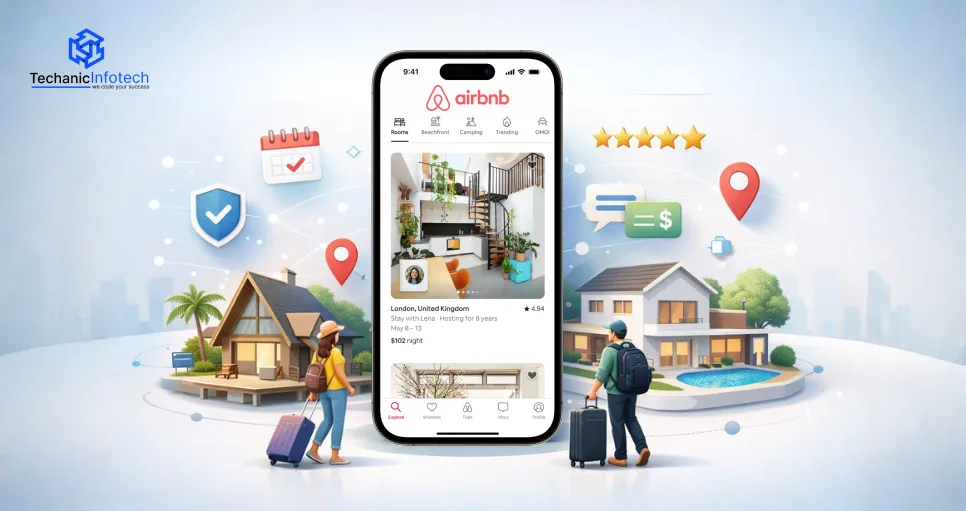
Many startups and businesses today want to build a travel app like Airbnb to enter the growing vacation rental market. With the rise of digital travel platforms, vacation rental apps have become a popular choice for companies looking to offer booking, hosting, and seamless user experiences in one place.
Understanding how to build an app like Airbnb involves more than just design; it requires the right features, technology, and development strategy. From defining the app development process to estimating its cost, every step plays an important role in building a successful platform.
In this guide, we’ll explain everything in a simple way to help you get started.
An app like Airbnb is a digital platform that connects travelers with property owners who want to rent out their spaces.
These platforms allow users to search, book, and manage short-term stays such as apartments, homes, villas, or even unique spaces like cabins. Today, many businesses are investing in Airbnb-like app development to create similar marketplaces that bring hosts and guests together in one place.
Airbnb itself is one of the most popular examples of a vacation rental platform. It allows property owners (hosts) to list their spaces, while travelers (guests) can browse listings, compare prices, and book accommodations easily.
The platform focuses on providing a seamless experience with features like reviews, secure payments, and real-time booking.
Here’s a simple step-by-step process of how these platforms operate:
User Registration: Both hosts and guests sign up on the platform by creating an account using email, phone number, or social login.
Property Listing by Hosts: Hosts can add property details such as location, price, photos, availability, and amenities to attract potential guests.
Search and Discovery: Guests can search for properties based on location, budget, dates, and preferences using filters.
Booking and Payment: Once a guest selects a property, they can book it and make secure payments directly through the app.
Confirmation and Communication: The platform confirms the booking and allows hosts and guests to communicate for further details.
Reviews and Ratings: After the stay, users can leave reviews and ratings, which help build trust and improve the platform experience.
This complete flow forms the foundation of Airbnb-style travel platform development and helps businesses create user-friendly and scalable travel applications.
The demand for travel and vacation rental platforms is growing rapidly, which is why many businesses are focusing on vacation rental app development.
Below are some key reasons supported by real industry data.
The global short-term rental market was valued at around $149 billion in 2025 and is expected to reach over $362 billion by 2033, showing strong long-term growth.
Airbnb has a massive global presence with an estimated 275 million users worldwide and continues to grow steadily. This shows the strong demand for platforms where users can book stays easily.
Airbnb has more than 8 million active listings across 220+ countries, proving how scalable this business model is. This encourages companies to build a travel app like Airbnb and build similar marketplaces.
Airbnb continues to generate billions in revenue, with quarterly revenue crossing $3–4 billion and growing year over year. This makes Airbnb clone app development a profitable opportunity for startups and enterprises.
The online travel booking market reached $641.07 billion in 2025 and is expected to cross $1 trillion by 2030.
This growth shows why businesses are investing in tour and travel app development and building platforms that offer booking, hosting, and travel experiences in one place.
To successfully develop a travel app like Airbnb, it is important to include mobile app features that make the platform easy to use for both hosts and guests. A well-designed app should focus on smooth booking, secure payments, and a great user experience.
Below are the essential Airbnb-like app features that every travel platform should include.
The app should allow users to sign up easily using email, phone number, or social media. Both hosts and guests should have profiles where they can manage their information, bookings, and preferences.
Hosts should be able to add and manage property listings with details such as photos, location, pricing, availability, and amenities. This is a core feature to make a travel app successful.
Users should be able to search properties based on location, price, dates, and preferences. Filters like property type, ratings, and amenities help users find the right stay quickly.This feature improves user experience by saving time and showing relevant results instantly.
A seamless booking system with secure payment options is essential. The app should support multiple payment methods and ensure safe transactions. It should also include features like booking confirmation, cancellation policies, and refund management.
Hosts should be able to manage their availability using a calendar, while users can see real-time booking availability before making a reservation. This helps avoid double bookings and ensures smooth scheduling for hosts.
User reviews and ratings help build trust on the platform. Guests can share their experiences, and hosts can improve their services. Positive reviews increase credibility and attract more users to the platform. This feature also helps maintain quality standards across listings.
A messaging feature allows direct communication between hosts and guests. This helps in discussing booking details and resolving queries. It also improves transparency and builds better relationships between users. Quick communication can lead to faster booking decisions.
Push notifications keep users informed about booking confirmations, updates, offers, and reminders. They also help in re-engaging users by sending personalized offers and travel suggestions. Timely notifications improve overall user engagement.
An admin panel helps manage users, listings, payments, and overall platform performance.It allows the platform owner to monitor activities, handle disputes, and ensure smooth operations. A strong admin system is important for scalability and control.
Users should be able to save properties to a wishlist or favorites section for future reference. This feature improves user engagement and makes it easier for users to compare options later. It also increases the chances of repeat visits and bookings.
Building a successful travel platform requires proper planning, the right technology, and a clear development strategy. If you are planning to develop an app like Airbnb, it is important to follow a structured approach to ensure smooth development and long-term success.
Based on our experience in tour and travel app development, a well-planned process can save both app development time and cost while improving overall app performance.
The first step in the process to create a travel app like Airbnb is understanding your target market. You need to identify your audience, study competitors, and analyze what users expect from a travel platform.
Look at existing platforms and find gaps where you can offer something better. For example, you may focus on luxury stays, budget accommodations, or niche travel experiences.
Expert Insight: In our experience, platforms that target a specific niche (like budget stays or premium villas) perform better in the early stages than trying to compete directly with global players.
Once your idea is clear, the next step is to define the core features and business model. Decide what functionalities your app will offer, such as property listings, booking systems, payments, and reviews.
You also need to choose how your platform will generate revenue. This could include commission fees, subscription plans, or premium listings.
Pro Tip:Start with only the most essential features and expand later. This helps reduce initial app development costs and speeds up time to market.
The technology stack plays a key role in Airbnb-style travel platform development. You need to select the right tools, frameworks, and programming languages to build a scalable app.
|
Technology Layer |
Tools/Technologies |
Description |
|
Frontend (Mobile) |
React Native, Flutter |
Used to build cross-platform mobile apps for iOS and Android with a single codebase. |
|
Frontend (Web) |
React.js, Angular |
Builds responsive web applications for users and admin panels. |
|
Backend |
Node.js, Django, Ruby on Rails |
Handles server logic, APIs, authentication, and data processing. |
|
Database |
MongoDB, PostgreSQL |
Stores user data, property listings, bookings, and transactions. |
|
Cloud & Hosting |
AWS, Google Cloud, Azure |
Provides scalable infrastructure, storage, and server management. |
|
Payment Integration |
Stripe, PayPal, Razorpay |
Enables secure payment processing for bookings and transactions. |
|
Maps & Location |
Google Maps API, Mapbox |
Helps users find properties and view locations on maps. |
|
Notifications |
Firebase Cloud Messaging |
Sends push notifications and alerts to users. |
|
Security |
SSL, OAuth, JWT |
Ensures secure authentication and data protection. |
Expert Insight: We always recommend choosing a scalable backend early, as changing architecture later can significantly increase development cost and complexity.
User experience is one of the most important parts of any travel app. The UI/UX design should be simple, attractive, and easy to navigate.
Designers usually create wireframes and prototypes to show how the app will look and function. A clean interface helps users quickly search properties, compare options, and complete bookings.
Expert Insight: In our projects, we’ve seen that a simple booking flow directly improves conversion rates and reduces drop-offs.
This is the core stage where developers build the application. The frontend focuses on user interaction, while the backend manages servers, data, and business logic.
During this stage, developers integrate key features such as:
User authentication
Property listings
Booking system
Payment gateways
Messaging system
Expert Insight: From our experience, real-time availability and booking logic are the most critical components in Airbnb clone app development, as they directly impact user trust.
Before launching, the app must go through thorough app testing to ensure everything works smoothly. This includes checking performance, security, and usability.
Developers test:
Booking flow
Payment processing
App performance under load
Security vulnerabilities
Expert Insight: Skipping proper testing can lead to major issues after launch, especially in payment and booking systems.
Once testing is complete, the app is ready to launch on the Apple App Store and Google Play Store.
At this stage, businesses should also focus on marketing strategies such as app store optimization, promotions, and user onboarding.
Pro Tip: Launching with a limited region or audience first helps gather feedback and improve the app before scaling.
After launch, the development process continues. Regular updates are needed to improve performance, fix bugs, and add new features.
This includes:
Performance optimization
Feature updates
Security improvements
User feedback implementation
Expert Insight: Successful platforms continuously evolve based on user behavior, which is key to long-term growth in this industry.
If you are planning to make an app like Airbnb, both cost and timeline depend on the app’s complexity, features, and platform choice.
On average, the Airbnb-like app development cost ranges between $35,000 and $95,000 or more. A basic version with core features like user registration, property listings, and booking can be built at a lower cost, while advanced apps with real-time updates, secure payments, and custom design require a higher budget.
In terms of time, it usually takes around 3 to 6 months to build a fully functional app. A simple MVP (Minimum Viable Product) can be developed faster, while a feature-rich platform may take longer.
Proper planning, choosing the right tech stack, and working with experienced developers can help reduce both cost and development time while ensuring a scalable and high-quality application.
|
Development Stage |
Avg Cost |
Time Required |
|
Research & Planning |
$2,000 – $5,000 |
1 – 2 weeks |
|
UI/UX Design |
$4,000 – $10,000 |
2 – 4 weeks |
|
Frontend Development |
$8,000 – $20,000 |
4 – 8 weeks |
|
Backend Development |
$10,000 – $25,000 |
5 – 10 weeks |
|
Feature Integration |
$5,000 – $15,000 |
3 – 6 weeks |
|
Testing & QA |
$3,000 – $8,000 |
2 – 4 weeks |
|
Deployment & Launch |
$1,000 – $3,000 |
1 week |
|
Maintenance & Updates |
$2,000 – $5,000/year |
Ongoing |
Airbnb follows a simple yet highly profitable business model that connects hosts (property owners) with guests (travelers). If you are planning to build an app like Airbnb, understanding how the platform generates revenue is very important.
Below are the main ways Airbnb makes money.
The primary source of revenue is commission on every booking. Airbnb charges both hosts and guests a service fee when a booking is made. This fee usually ranges between 10% to 20%, depending on the type of booking and location. This model ensures consistent revenue as the number of bookings increases.
Guests are charged a service fee while making a reservation. This fee covers platform usage, customer support, and secure payment processing. It is added to the total booking cost, making it a steady income stream for the platform.
Hosts also pay a percentage of their booking amount as a fee for listing their properties on the platform. In return, they get access to a global audience, booking management tools, and secure payment handling.
Airbnb allows hosts to promote their properties by paying for better visibility. Featured listings appear at the top of search results, increasing the chances of bookings. This creates an additional revenue stream.
Apart from accommodations, Airbnb offers “Experiences” such as guided tours, activities, and local events. The platform earns a commission from these bookings as well, expanding its revenue beyond just property rentals.
At our mobile app development company, we have hands-on experience working on large-scale travel platforms like Easybook, which has helped us understand the real challenges and requirements of building high-performance booking systems.
Easybook is one of the largest online booking platforms in Southeast Asia, allowing users to book bus, train, ferry, and tour tickets across multiple countries. The platform supports thousands of routes and connects users with hundreds of transport operators, making travel booking simple and accessible.
While working on this platform, we gained deep insights into how modern travel app development works at scale. We focused on building features that ensure smooth user experience, fast booking, and reliable performance.
Developed a seamless booking flow similar to top travel platforms
Integrated real-time availability and scheduling systems
Implemented secure payment processing for multiple services
Built scalable backend systems to handle high traffic and bookings
In our experience, the most critical part of any travel platform is handling real-time data such as availability, pricing, and booking confirmations without delays.
We also learned that a simple and fast booking experience directly improves user engagement and conversions.
This real-world experience allows us to build scalable solutions when businesses want to develop a tour and travel app like Airbnb, ensuring both performance and user satisfaction.
The vacation rental industry is evolving quickly, and businesses planning to create an app like Airbnb need to stay updated with the latest trends. In 2026, technology, user behavior, and market demand are shaping how travel apps are built.
Below are some key trends driving Airbnb-like app development.
Artificial intelligence is becoming a core part of travel apps. Platforms now offer personalized recommendations based on user preferences, past bookings, and behavior. AI usage in travel planning has already doubled and is expected to grow further in 2026.
The global vacation rental market is projected to reach around $99 billion in 2026, showing steady growth. This growth is pushing more businesses to invest in vacation rental app development and build scalable platforms.
Modern travel apps are using real-time data to adjust pricing, availability, and offers instantly. Platforms that use smart pricing and automation perform better and attract more users.
Travelers are now focusing more on experiences rather than just accommodation. Around 74% of people prefer spending on travel experiences, showing a major shift in user behavior.Apps are now integrating tours, activities, and local experiences along with bookings.
New travel patterns are emerging, especially among younger users. Many travelers now prefer short trips and quick getaways instead of long vacations. Apps need to support flexible booking options and last-minute deals.
Users expect apps to work smoothly across mobile, web, and other devices. Simple experiences across platforms are now a standard requirement in modern travel app development.
Users are becoming more selective and expect clear pricing, verified listings, and authentic reviews. Platforms that build trust through transparency perform better in the long run.
Building a successful travel platform requires the right strategy, technology, and understanding of user needs.
As the demand for digital booking platforms continues to grow, many businesses are choosing to develop an app like Airbnb to tap into this expanding market and create scalable business opportunities.
From understanding key features and the Airbnb app development process to estimating the Airbnb-like app development cost, every step plays an important role in building a reliable platform. A well-planned approach, combined with the right technology stack and user-focused design, can help businesses deliver smooth and engaging experiences.
As the industry evolves with new trends like AI, real-time data, and personalized travel experiences, investing in this industry can offer long-term growth. With the right execution, businesses can build powerful platforms that stand out in the competitive vacation rental market.
The cost to develop an app like Airbnb usually ranges between $35,000 and $95,000 or more, depending on features, design, and platform choice.
On average, it takes around 3 to 6 months to build a basic to mid-level app, while advanced platforms may take longer.
Essential features include user registration, property listings, search filters, booking system, payments, reviews, messaging, and admin dashboard.
The process includes market research, feature planning, UI/UX design, development, testing, launch, and ongoing maintenance.
Yes, startups can start with an MVP (Minimum Viable Product) with basic features and expand gradually based on user feedback.
Common technologies include React Native or Flutter for frontend, Node.js or Django for backend, and cloud platforms like AWS or Google Cloud.
They earn through booking commissions, service fees, premium listings, and additional services like experiences or tours.
It depends on your target audience. Many businesses prefer cross-platform development to reduce cost and reach both audiences.
You can reduce costs by starting with an MVP, prioritizing essential features, using cross-platform technologies, and planning development properly.


Bharat Sharma is the CTO of Techanic Infotech, bringing deep technical expertise in software architecture, mobile app development, and scalable system design. He leads the engineering team with a strong focus on innovation, performance, and security.