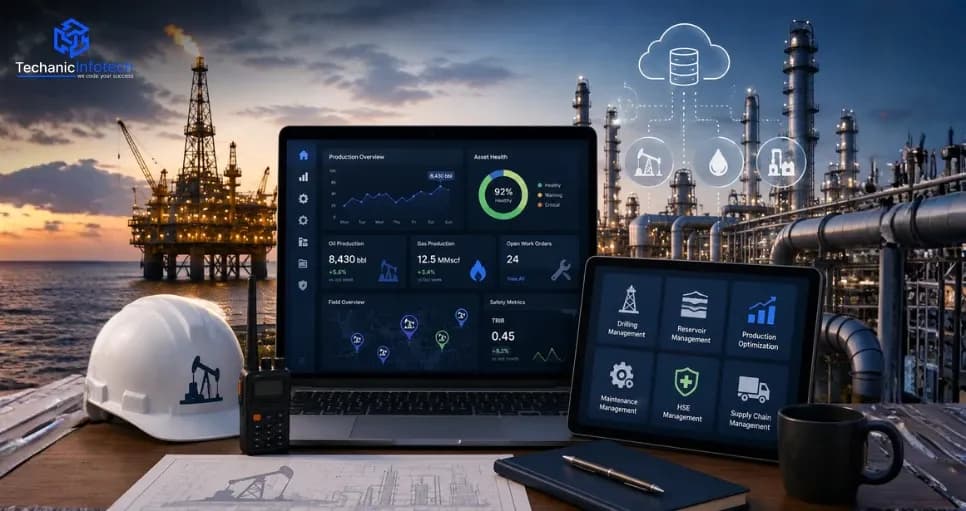
From offshore drilling platforms to complex pipeline networks and refineries, companies must manage massive infrastructure, high-value assets, strict safety regulations, and volatile market conditions.
With the integration of advanced technologies like cloud computing, artificial intelligence (AI), the Internet of Things (IoT), and big data analytics, modern oil and gas software has become a strategic asset rather than just a support tool.
This guide provides an in-depth, experience-backed overview of oil and gas software development, covering solution types, key features, development costs, step-by-step processes, technologies used, and more.
Oil and gas software solutions are typically categorized according to the operational segment they serve. Each category addresses unique challenges and workflows within the industry.
Upstream operations focus on exploration, drilling, and production activities that involve high capital investment and significant geological uncertainty.
Software solutions in this segment help companies analyze complex datasets and make informed decisions early in the production lifecycle.
Key upstream software solutions include:
Reservoir modeling and simulation software, which helps engineers evaluate subsurface characteristics and estimate recoverable reserves
Seismic data processing tools that analyze geological data to reduce exploration risks
Drilling management systems for monitoring well performance, drilling parameters, and operational efficiency
Production optimization software that improves recovery rates while minimizing operational costs
These fuel delivery app development solutions enable oil and gas companies to reduce exploration risks, enhance production efficiency, and maximize asset value.
Midstream operations involve the transportation, storage, and handling of crude oil and natural gas.
This segment requires continuous monitoring to prevent leaks, equipment failures, and environmental incidents.
Common midstream software solutions include:
Pipeline monitoring and management systems for real-time flow and pressure tracking
Leak detection and integrity management software to identify issues before they escalate
Transportation and logistics management platforms for fleet and route optimization
Terminal and storage management systems to monitor inventory and operations
By improving visibility and control, midstream software enhances safety, reduces losses, and ensures regulatory compliance.
Downstream operations focus on refining, processing, marketing, and distribution.
Software solutions in this segment aim to improve efficiency, reduce waste, and optimize supply chains.
Typical downstream solutions include:
Refinery operations management software to control production processes
Supply chain and inventory management systems to balance demand and supply
Fuel retail management software for pricing, sales, and customer data
Demand forecasting and pricing analytics tools to maximize profitability
These systems help downstream companies improve operational transparency and customer satisfaction.
Enterprise software supports cross-departmental operations and strategic planning.
Examples include:
Enterprise Resource Planning (ERP) systems for finance, procurement, and operations
Asset and Maintenance Management Software to track equipment lifecycle
Customer relationship management (CRM) platforms
Human resource and workforce management Systems
Enterprise solutions unify data across the organization, enabling better coordination and decision-making.
HSE software is critical in an industry where safety and environmental responsibility are paramount.
Key capabilities include:
Incident reporting and investigation
Risk assessment and safety audits
Environmental monitoring and compliance tracking
Regulatory reporting and documentation
HSE solutions help organizations reduce accidents, improve compliance, and protect both employees and the environment.
Oil and gas operations involve high-value assets, complex workflows, and strict regulatory oversight.
Below are the most critical features that are helpful in defining a robust and reliable oil and gas software system.
One of the most essential features of oil and gas software is the ability to collect, process, and analyze data in real time.
Sensors, operational equipment, and connected systems continuously generate data related to pressure, temperature, flow rate, equipment health, and production output.
Real-time analytics allow operators and decision-makers to:
Monitor operational performance continuously
Detect anomalies or inefficiencies immediately
Reduce response time to operational issues
Improve decision-making with live dashboards and reports
This capability is especially critical in drilling operations, pipeline monitoring, and refinery management, where delays or inaccuracies can lead to safety risks or financial losses.
Predictive maintenance is a game-changing feature enabled by artificial intelligence and machine learning. Instead of relying on fixed maintenance schedules or reactive repairs, oil and gas software analyzes historical and real-time equipment data to predict potential failures before they occur.
Key benefits include:
Reduced unplanned downtime
Lower maintenance and repair costs
Extended equipment lifespan
Improved operational safety
By identifying early warning signs such as abnormal vibrations or temperature changes, predictive maintenance helps organizations avoid costly shutdowns and equipment damage.
Oil and gas companies manage thousands of assets across multiple locations, including drilling rigs, pipelines, compressors, storage tanks, and refinery equipment.
Asset management features in the fuel delivery app provide a centralized system to track asset performance, maintenance history, inspection schedules, and lifecycle status.
This feature helps organizations:
Optimize asset utilization
Plan preventive maintenance more effectively
Reduce asset-related operational risks
Improve long-term capital planning
A well-implemented asset management system ensures that critical infrastructure remains reliable and compliant throughout its lifecycle.
The oil and gas industry is subject to strict local, national, and international regulations related to safety, environmental protection, and operational standards.
Oil and gas software simplifies compliance by automating reporting processes and maintaining detailed audit trails.
Key compliance capabilities include:
Automated regulatory reporting
Environmental impact monitoring
Safety compliance documentation
Audit readiness and record management
By reducing manual reporting efforts and human errors, compliance features help organizations avoid penalties, legal risks, and reputational damage.
Modern oil and gas software increasingly relies on cloud-based infrastructure to support scalability, flexibility, and remote operations.
Cloud integration enables organizations to scale resources as operational demands grow without investing heavily in physical infrastructure.
Cloud-based features offer:
Secure remote access to operational data
Improved collaboration across teams and locations
Faster system updates and deployments
Lower infrastructure and maintenance costs
This is particularly valuable for companies operating across geographically dispersed sites.
Given the critical nature of oil and gas infrastructure, cybersecurity is a top priority.
Software systems must protect sensitive operational, financial, and geological data from cyber threats and unauthorized access.
Key security features include:
Data encryption (at rest and in transit)
Role-based access control
Multi-factor authentication
Continuous system monitoring and threat detection
Strong cybersecurity measures ensure business continuity and protect against data breaches and operational disruptions.
Artificial intelligence and machine learning enhance oil and gas software by transforming raw data into actionable insights.
AI-driven systems support advanced forecasting, optimization, and decision-making.
These capabilities help:
Improve production forecasting accuracy
Optimize drilling and extraction processes
Identify operational inefficiencies
Support strategic planning and risk management
AI-powered insights allow organizations to move from reactive operations to proactive and predictive decision-making.
While every project is unique, most mobile app development cost breakdowns are within the $20,000 to $120,000 range, depending on the depth of functionality and customization involved.
This category is suitable for small-scale operations or organizations beginning their digital transformation journey.
These solutions typically include essential custom mobile app features such as data tracking, basic reporting, limited asset management, and simple dashboards.
They are ideal for companies seeking operational visibility without extensive customization or advanced analytics.
Mid-level solutions include multiple modules, workflow automation, role-based access control, system integrations, and enhanced analytics.
These solutions are well-suited for growing organizations that require tailored workflows, improved operational control, and better data-driven decision-making.
Advanced solutions are designed for larger operations with complex processes and higher performance demands.
These systems may incorporate real-time data processing, predictive maintenance features, cloud-based infrastructure, enhanced security measures, and integration with enterprise tools such as ERP, GIS, or SCADA systems.
Oil and gas software development requires a structured and industry-focused approach to ensure reliability, scalability, and regulatory compliance.
These solutions support mission-critical operations, manage real-time data, and operate in highly regulated environments, making a disciplined development process essential.
Mobile app development teams work closely with stakeholders to understand industry challenges, evaluate existing systems, and define clear functional and technical requirements.
This step reduces risk and ensures the software addresses real operational needs.
Architects design secure and scalable system architectures capable of handling real-time data and future growth.
In parallel, UI/UX design of a mobile app creates intuitive interfaces tailored for engineers, operators, and managers, ensuring ease of use, faster adoption, and reduced human error.
Developers build the solution using agile methodologies, allowing flexibility and continuous feedback.
Core features, automation, and security controls are implemented while integrating the software with existing systems such as ERP, GIS, or SCADA to ensure seamless data flow.
Comprehensive testing validates functionality, performance, security, and data accuracy.
The software is tested under real-world conditions to ensure reliability, stability, and compliance with industry standards before deployment.
After testing, the software is deployed on cloud, on-premise, or hybrid infrastructure.
This phase includes configuration, data migration, and user training to ensure smooth adoption and minimal operational disruption.
Post-deployment, the software is continuously monitored, updated, and optimized.
Ongoing maintenance ensures security, performance, and scalability while adapting to regulatory changes and evolving business needs.
Oil and gas software development leverages advanced digital technologies to streamline operations, enhance safety, and enable data-driven decision-making across exploration and production.
Choosing a mobile app tech stack selection is vital when considering the following list of technologies used for developing oil and gas software.
Leading cloud services such as AWS, Microsoft Azure, and Google Cloud provide highly scalable, secure, and cost-efficient environments for managing vast volumes of seismic, drilling, and production data, enabling real-time collaboration and analytics.
Example: Cloud-based seismic data processing helps geoscientists analyze large datasets faster and collaborate across offshore and onshore teams.
Advanced AI and ML algorithms drive intelligent decision-making by enabling predictive maintenance, drilling performance optimization, reservoir modeling, and early detection of operational anomalies.
Example: Machine learning models analyze sensor data from drilling equipment to predict failures in advance and reduce unplanned downtime.
IoT-enabled sensors and SCADA systems deliver continuous, real-time monitoring of oilfield assets, pipelines, and processing facilities, significantly improving operational efficiency, safety, and asset reliability.
Example: Pipeline pressure and flow sensors integrated with SCADA systems detect abnormal conditions and alert operators to potential leaks.
High-performance data platforms process complex, high-velocity datasets to generate actionable insights, improve forecasting accuracy, and support data-driven exploration and production strategies.
Example: Production and historical drilling data are analyzed to optimize output levels and improve reservoir performance forecasting.
Robust cybersecurity frameworks and compliance-driven architectures safeguard critical infrastructure, protect sensitive data, and ensure adherence to industry regulations and safety standards.
Example: Role-based access control and data encryption are implemented to secure operational data and meet regulatory audit requirements.
Techanic Infotech is the best fuel delivery app development company that specializes in delivering custom oil and gas software solutions designed to handle the industry’s complex operations, safety requirements, and data-intensive workflows.
With deep experience in upstream, midstream, and downstream software development, Techanic Infotech helps organizations modernize legacy systems and achieve digital transformation.
Their team combines domain expertise with advanced technologies such as cloud computing, AI/ML, IoT, big data analytics, and SCADA integration to build secure, scalable, and high-performance solutions.
Oil and gas software development has evolved into a strategic investment that directly impacts operational efficiency, safety, and profitability.
With increasing data volumes, strict regulations, and volatile market conditions, companies need intelligent, scalable, and secure digital solutions.
Custom oil and gas software enables real-time monitoring, predictive maintenance, regulatory compliance, and enterprise-wide integration across upstream, midstream, and downstream operations.
By partnering with an experienced development company, oil and gas organizations can future-proof their operations and successfully navigate the industry’s digital transformation journey.
Oil and gas software is a digital solution designed to manage exploration, production, transportation, refining, safety, compliance, and enterprise operations within the oil and gas industry.
Development typically takes 3 to 9 months, depending on software complexity, required features, integrations, regulatory requirements, and whether the solution is basic or enterprise-grade.
Yes, when built correctly, cloud-based solutions use encryption, access controls, monitoring, and compliance frameworks to securely protect sensitive operational and business data.
Custom oil and gas software can seamlessly integrate with ERP, GIS, SCADA, IoT platforms, and legacy systems to ensure smooth data flow and unified operations.
Costs generally range from $20,000 to $120,000, depending on features, customization level, technology stack, security requirements, and system integrations.


Shailendra is a dedicated professional known for his strong client-focused approach and clear understanding of business needs. He brings a thoughtful understanding of client needs and focuses on building long-term relationships through clear communication and quality-driven work. With a blend of strategic thinking, content expertise, and a hands-on approach, Shailendra plays a key role in shaping content that aligns with both business goals and user expectations.