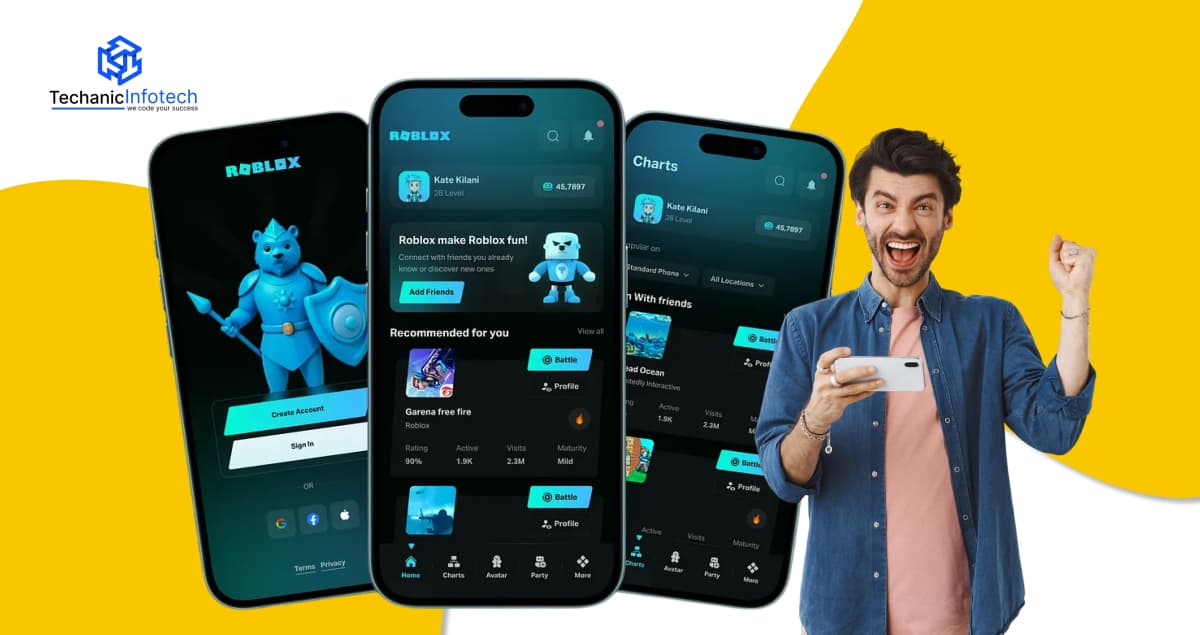
Online gaming is evolving rapidly, and platforms like Roblox have changed how people play and create games.
Instead of just playing, users can now design their own experiences and share them with millions of players. This concept of a user-generated content gaming platform has made Roblox-like app development a popular trend among startups and gaming companies.
Many businesses are now exploring how to build an app like Roblox to create immersive digital worlds where users can interact, play, and build games together.
With the rise of metaverse gaming app development, these platforms are becoming powerful ecosystems that combine gaming and social interaction into one engaging experience.
A Roblox app is an online gaming platform where users can play, create, and share games within a virtual environment.
Unlike traditional games that are developed by a single company, Roblox works as a user-generated content gaming platform where developers and players can build their own experiences using built-in tools.
Roblox has grown rapidly over the years. According to recent reports, the platform has over 144 million daily active users worldwide and more than 200 million monthly active users. Developers on the platform have also created millions of games, making it one of the largest online gaming communities.
Another key factor behind Roblox’s success is its virtual currency called Robux, which allows users to buy in-game items, upgrades, and experiences.
The success of Roblox comes from its unique platform model where users are not only players but also creators. The platform allows developers to build games, publish them, and earn money while players explore and interact in different virtual worlds.
Understanding this model is important for businesses planning Roblox-style gaming platform development.
Here is a simple step-by-step explanation of how the platform works.
The process begins when users create an account on the platform. After registration, they can set up their profile, customize avatars, and access the game marketplace. This step helps the platform build a community and track user activity.
Roblox provides a tool called Roblox Studio, which allows gaming app developers to design and build games using built-in development features. Creators can design maps, characters, and gameplay mechanics.
Once a game is created, developers can publish it on the Roblox platform. The game then becomes available for millions of users to discover and play. This publishing system supports the growth of multiplayer game app development, where users can interact with others in real time.
Players can browse different games, join multiplayer sessions, and explore virtual worlds created by developers. The platform supports social interactions, chat systems, and collaborative gameplay.
Roblox uses its own virtual currency called Robux. Players can purchase Robux to buy items, upgrades, and special game features. This monetization model plays a major role in metaverse gaming app development.
Developers earn revenue when players spend Robux in their games. Roblox shares a portion of the earnings with creators, making the platform attractive for developers and businesses exploring Roblox clone app development.
Building a successful platform requires integrating several interactive fantasy sports app features that support both players and creators.
User Registration and Profiles: Users should be able to sign up, create profiles, and customize their avatars. Personal profiles help track achievements, game activity, and social interactions within the platform.
Game Creation Tools: A Roblox-style platform needs built-in development tools that allow creators to design games, maps, and characters.
Multiplayer Gameplay: Real-time multiplayer functionality allows users to interact, compete, and collaborate in virtual worlds.
Virtual Currency System: A digital currency system allows players to purchase items, upgrades, and premium experiences.
In-App Purchases and Marketplace: Players should be able to buy skins, accessories, and game passes through an in-app marketplace.
Social and Chat Features: Messaging, friend lists, and chat systems help build community engagement.
Safety and Moderation Controls: Strong moderation tools and reporting systems ensure a safe environment for users, especially younger audiences.
Real-Time Multiplayer Servers: Scalable server infrastructure ensures smooth gameplay even when thousands of users join the same experience.
To compete with large gaming ecosystems, a platform needs more than basic gameplay features. Advanced capabilities help improve engagement, scalability, and monetization.
Businesses planning to create a gaming app like Roblox often integrate these advanced features to create a more immersive and profitable gaming ecosystem.
Artificial intelligence can analyze user behavior and recommend games based on player interests. This improves engagement and helps users discover new experiences on the platform.
A modern Roblox-style gaming platform should support multiple devices such as smartphones, tablets, PCs, and gaming consoles. Cross-platform access allows players to join the same game from different devices.
Advanced monetization features allow developers to earn revenue through in-game purchases, game passes, and premium content. This system encourages creators to contribute more games to the platform.
Platforms can integrate immersive virtual environments where users can socialize, attend events, and explore interactive spaces. This concept is becoming popular in metaverse gaming app development.
Users can personalize avatars with clothing, accessories, animations, and digital items. Customization enhances player identity within the virtual world app development ecosystem.
Providing developers with analytics tools helps them track game performance, user engagement, and monetization data. This feature is essential for improving games and managing the platform effectively.
Building a platform similar to Roblox is very different from the regular mobile app development process. Instead of creating a single game, the goal is to build a user-generated content gaming platform where developers can create games and players can explore thousands of virtual experiences.
Because of this, Roblox-like app development requires a strong platform architecture, creator tools, multiplayer infrastructure, and monetization systems.
Below is a Roblox-oriented step-by-step process to build such a platform.
The first step in Roblox-style gaming platform development is defining what type of platform you want to build. Roblox itself focuses on social gaming and user-generated worlds. Similarly, businesses must decide whether their platform will focus on:
Multiplayer mini-games
Open-world virtual experiences
Educational or simulation-based games
Metaverse-style social platforms
At this stage, the development team defines the platform structure, user roles (players and creators), monetization strategy, and core gameplay experience.
Unlike traditional games, Roblox-like platforms require a scalable backend infrastructure capable of supporting thousands of games and millions of players simultaneously.
The architecture usually includes:
Game servers for multiplayer gameplay
Cloud storage for user-generated content
Asset libraries for models, textures, and scripts
Real-time networking systems
This stage also defines how the fantasy sports app development environment will manage game instances, user data, and player interactions.
A key element of Roblox clone app development is providing creators with tools to build their own games. Roblox uses Roblox Studio, which allows developers to design worlds, objects, and gameplay logic.
To replicate this model, the platform should include:
Game editors and map-building tools
Object libraries and reusable assets
Visual scripting or programming tools
Physics and animation systems
These tools allow developers and creators to build games without needing complex game engine knowledge.
Since Roblox is primarily a multiplayer game app development platform, real-time interaction between players is essential.
This step includes building:
Real-time multiplayer networking
Game session management
Matchmaking systems
Player synchronization
The system must handle thousands of simultaneous game sessions and ensure smooth gameplay with minimal latency.
A major part of Roblox’s success comes from its digital economy powered by Robux. During this process, developers must build a similar virtual currency system.
This includes:
In-app currency management
Marketplace for digital assets
In-game purchases and upgrades
Revenue-sharing systems for creators
This system allows developers to monetize their games while the platform generates revenue through transactions.
Roblox is not just a gaming platform; it is also a social network. Players interact with friends, join multiplayer sessions, and communicate in real time.
Important social features include:
Friends and follower systems
In-game chat and messaging
Community groups
Event hosting inside virtual worlds
Since players can create and upload content, moderation is extremely important. Roblox invests heavily in safety tools to protect younger users.
A Roblox-style gaming platform must include:
AI-based content moderation
Reporting and blocking systems
Age restrictions and parental controls
Automated detection of harmful content
These systems ensure that the platform remains safe and compliant with global regulations.
Before launching the platform publicly, it is important to test it with a small group of creators and players. Early gaming app developers can build initial games and test the game creation tools.
This stage helps identify issues related to:
Multiplayer performance
Game publishing workflows
Monetization systems
Creator experience
App testing ensures the platform works smoothly before a large-scale release.
Once the system is stable, the platform can be launched to a wider audience. However, the success of a Roblox-like platform depends heavily on its creator community.
Businesses should focus on:
Attracting independent developers
Offering creator incentives and revenue sharing
Hosting virtual events and game competitions
Promoting new user-generated games
A strong creator ecosystem ensures continuous content growth within the platform.
After launch, development does not stop. Platforms like Roblox constantly add new features such as improved avatars, virtual events, and immersive experiences.
Future improvements may include:
Metaverse-style environments
AR/VR integrations
Advanced avatar customization
AI-powered game development tools
Continuous innovation ensures long-term success in development and keeps users engaged.
Building a platform similar to Roblox requires a powerful and scalable app technology stack. Because of this, developers need a combination of game engines, backend technologies, cloud infrastructure, and networking frameworks to support developing a gaming app like Roblox.
Below is a detailed overview of the technology stack commonly used in Roblox clone app development.
Popular game engines include the following:
Unity: One of the most widely used engines for multiplayer game app development. It supports cross-platform development and advanced 3D rendering.
Unreal Engine: Ideal for high-quality graphics and large open-world environments used in metaverse gaming app development.
Godot: A lightweight open-source game engine suitable for building customizable gaming platforms.
Common languages used in Roblox-like app development include:
C#: Widely used with Unity for game mechanics and gameplay scripting.
C++: Often used with Unreal Engine for performance-intensive gaming applications.
JavaScript / TypeScript: Used for web-based components, dashboards, and game marketplaces.
Python: Sometimes used for AI systems, moderation tools, and backend automation.
Common backend technologies include:
Node.js: Ideal for handling real-time multiplayer communication and APIs.
Django (Python): Used for secure backend systems and content management.
Spring Boot (Java): Suitable for enterprise-level backend architecture and large-scale gaming platforms.
Common options include:
MongoDB: A NoSQL database ideal for handling flexible game data structures.
PostgreSQL: Reliable relational database for structured data like transactions and user accounts.
Redis: Used for caching and improving real-time game performance.
Technologies commonly used include:
Photon Engine: Popular for real-time multiplayer gaming.
Mirror Networking (Unity): Supports multiplayer synchronization in Unity-based games.
WebSockets: Enables real-time communication between players and servers.
Common cloud platforms include:
Amazon Web Services (AWS): Provides scalable servers, storage, and global networking.
Google Cloud Platform (GCP): Offers high-performance infrastructure for gaming platforms.
Microsoft Azure: Often used for enterprise-level cloud hosting and gaming services.
Common payment technologies include:
Stripe
PayPal
Braintree
Technologies used include:
Machine learning frameworks like TensorFlow or PyTorch
AI-based image and text moderation tools
Automated content filtering systems
Common analytics solutions include:
Google Analytics
Firebase Analytics
Mixpanel.
Building a Roblox-style gaming platform involves multiple development stages, each requiring different fantasy sports app development costs and time.
Since the platform must support multiplayer gameplay, user-generated content, creator tools, and a virtual economy, the Roblox-like app development cost and timeline can vary depending on complexity and features.
Below is a simplified cost and timeline breakdown for the major development stages involved in Roblox clone app development.
|
Development Stage |
Avg. Cost |
Avg. Time |
|
Research & Platform Planning |
$4,000 – $8,000 |
2 – 3 Weeks |
|
UI/UX Design |
$6,000 – $12,000 |
3 – 4 Weeks |
|
Game Engine & Core Development |
$40,000 – $90,000 |
3 – 5 Months |
|
Game Creation Tools Development |
$25,000 – $60,000 |
2 – 3 Months |
|
Backend & Multiplayer Infrastructure |
$20,000 – $50,000 |
2 – 3 Months |
|
Virtual Economy & Payment Integration |
$8,000 – $18,000 |
3 – 4 Weeks |
|
Testing & Quality Assurance |
$6,000 – $15,000 |
3 – 4 Weeks |
|
Launch & Deployment |
$3,000 – $8,000 |
2 Weeks |
Estimated Total Cost: $50,000 – $250,000+Estimated Development Time: 6 – 12 Months
This app development timeline may vary depending on platform complexity, number of features, and the development team involved in the Roblox game platform development process.
A strong monetization model is one of the key reasons behind the success of platforms like Roblox. When planning to build an app like Roblox, businesses must build revenue streams that benefit both the platform owner and the game creators.
A well-designed monetization system helps maintain long-term growth while encouraging developers to create more games for the platform.
Most Roblox-style gaming platforms use a virtual currency similar to Robux. Players can purchase this currency using real money and spend it on in-game items, upgrades, or premium experiences. This model is widely used in virtual world app development because it creates a in-app economy.
Players can buy digital items such as character skins, accessories, power-ups, and exclusive game passes. These purchases enhance gameplay and provide additional revenue opportunities within multiplayer game platforms.
A creator marketplace is an important part of a user-generated content gaming platform. Game developers can monetize their games through in-game purchases, while the platform earns a percentage of each transaction.
Some platforms offer premium subscriptions that provide users with benefits such as extra virtual currency, exclusive items, or early access to games. This subscription model helps create recurring revenue.
Brands can host virtual events, promote products, or place advertisements inside games. As metaverse gaming app development continues to grow, virtual advertising is becoming an important revenue source.
By combining these strategies, businesses can build a sustainable economy that supports both the platform and its creator community while maximizing the value.
Building a platform similar to Roblox is complex because it involves multiplayer gaming, user-generated content, and a large-scale virtual ecosystem. Businesses planning Roblox-like app development often face several technical and operational challenges.
Below are some common challenges and practical solutions.
One of the biggest challenges in multiplayer game app development is supporting thousands or even millions of players interacting in real time. Poor server performance can lead to lag, crashes, and poor user experience.
Solution: Use scalable cloud infrastructure such as AWS or Google Cloud with load balancing and distributed servers to manage high traffic and maintain smooth gameplay.
It allows players to create and publish their own games. However, this can lead to inappropriate or low-quality content being uploaded.
Solution: Implement strong content moderation systems, AI-based filtering, and manual review processes to monitor games, assets, and user behavior.
Since these platforms handle user accounts, digital assets, and virtual currency, security becomes a major concern. Cyberattacks or fraud can damage the platform’s reputation.
Solution: Use advanced encryption, secure authentication systems, and regular security testing to protect user data and financial transactions.
Platforms that include virtual currency and digital marketplaces must carefully manage their economy. Poor balance in pricing or rewards can reduce engagement and monetization.
Solution: Design a balanced economy with controlled currency circulation, fair revenue sharing for creators, and regular updates to maintain value within the platform.
The success of Roblox-style gaming platform development depends heavily on active creators who continuously build new games. Without them, the platform may struggle to grow.
Solution: Provide easy-to-use game creation tools, developer incentives, and revenue-sharing programs to encourage creators to build and publish games on the platform.
Building a platform similar to Roblox requires deep expertise in gaming technologies, multiplayer infrastructure, and scalable backend systems. Techanic Infotech helps businesses turn innovative gaming ideas into powerful digital platforms through expert Roblox-like app development services.
From designing interactive game environments to developing creator tools similar to Roblox Studio, our fantasy sports app development company provides end-to-end development support.
The company also integrates advanced features such as real-time multiplayer servers, virtual currency systems, secure payment integrations, and creator monetization tools. This approach ensures that businesses can launch a fully functional user-generated content gaming platform that is engaging, scalable, and profitable.
Roblox has transformed the gaming industry by introducing a platform where players are not only gamers but also creators. This innovative model has inspired many businesses to explore Roblox-like app development and build their own interactive gaming ecosystems.
Developing a platform like Roblox requires advanced technologies, strong multiplayer infrastructure, creator tools, and a well-designed virtual economy. From game creation features to real-time social interactions, every component plays an important role in building a successful user-generated content gaming platform.
With the right development strategy and an experienced technology partner, companies can successfully build immersive gaming platforms that combine creativity, social interaction, and digital economies into one powerful experience.
The Roblox-like app development cost usually ranges between $50,000 and $250,000+, depending on features, multiplayer infrastructure, and platform complexity.
Building a Roblox-style gaming platform typically takes 6 to 12 months, depending on the number of features, creator tools, and multiplayer capabilities.
Developers commonly use Unity or Unreal Engine, along with backend technologies like Node.js, Python, or Java, and cloud platforms such as AWS or Google Cloud.
Important Roblox-like app features include game creation tools, multiplayer gameplay, virtual currency, avatar customization, social chat systems, and creator monetization tools.
Yes, most gaming platforms allow creators to earn revenue through in-game purchases, digital assets, and revenue-sharing programs.


Abhishek Jangid is the CEO of Techanic Infotech, with extensive experience in mobile app and web development. He specializes in helping businesses turn innovative ideas into scalable digital solutions through strategic planning and modern technology.