Fantasy Sports App Development
Fantasy Sports App Development: A comprehensive guide
February 19, 2026
February 19, 2026
Fantasy sports app development in 2026 is driven by real-time data, AI personalization, and secure digital payments.
Entrepreneurs are investing in feature-rich applications that offer live scoring, competitive contests, and seamless wallet integration.
With increasing smartphone penetration and digital payment adoption, fantasy sports apps present profitable opportunities across global markets.
However, success requires strategic planning, regulatory compliance, advanced technology integration, and user-centric design.
This guide explains the development process, cost estimates, monetization strategies, and the essential features needed to launch a secure, scalable fantasy sports app in 2026.
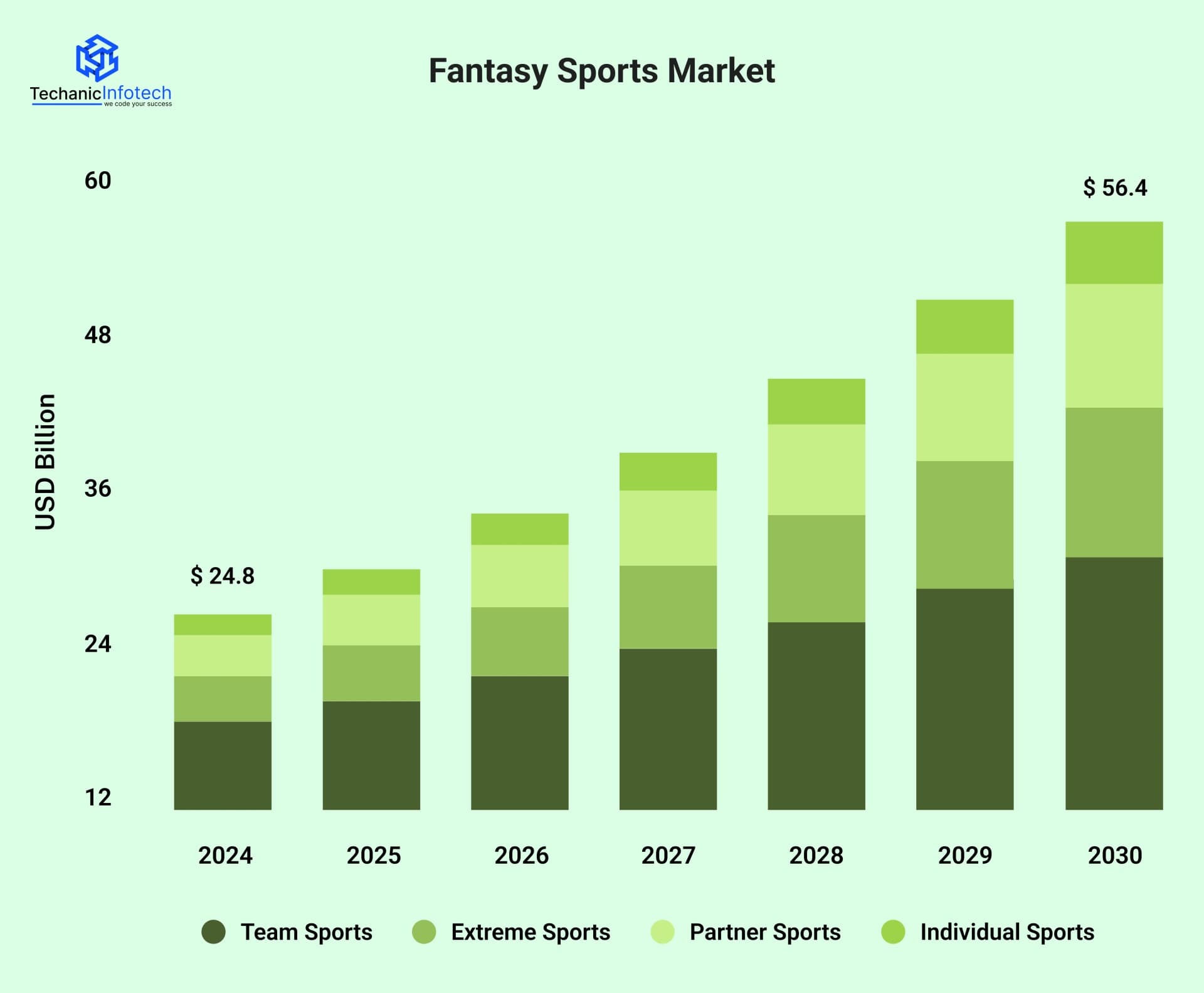
North America maintained its leading position in the global fantasy sports market in 2024, contributing more than 37% of the total revenue.
Among different sports categories, team sports emerged as the top segment, generating above 33% of the total revenue in 2024.
The global market was valued at USD 24,853.7 million in 2024, reflecting a strong foundation and widespread industry adoption.
The market is projected to reach USD 56,381.2 million by 2030, indicating substantial expansion over the forecast period.
The industry is expected to grow at a robust 15.2% CAGR from 2025 to 2030, driven by rising demand and technological advancements.
North America led the market in 2024 as the largest regional contributor, while the Asia Pacific is expected to witness the fastest growth during the forecast period due to rising participation and market development.
A successful app in 2026 depends on powerful, user-focused fantasy sports app features that enhance engagement, security, and real-time interaction.
From seamless onboarding to AI-driven insights, the right feature set determines user retention, scalability, and long-term platform profitability.
The User Panel is the heart of a fantasy sports app, offering seamless team creation, live match tracking, leaderboards, secure payments, and personalized notifications to ensure high engagement and an intuitive experience.
Provide seamless onboarding through email, mobile OTP, and social logins.
A simplified registration process reduces drop-offs, improves conversions, and ensures faster access to contests while maintaining secure authentication protocols.
Enable intuitive player selection with filters, statistics, and budget limits.
A smooth drafting interface enhances user experience, promotes strategic decision-making, and increases participation in multiple contests.
Integrate real-time APIs for instant score updates and player performance tracking.
Live data improves engagement, builds excitement, and ensures transparency in point calculations during ongoing matches.
Display dynamic leaderboards showing rankings and prize distributions.
Transparent reward systems encourage competitiveness, motivate users to participate regularly, and increase retention rates.
Incorporate encrypted wallet systems supporting multiple payment methods.
Ensure secure deposits, withdrawals, and KYC verification to comply with financial regulations and protect user funds.
Send timely notifications for match reminders, results, and promotional offers.
Personalized alerts improve engagement, boost contest participation, and enhance user retention effectively.
The Admin Panel manages users, contests, commissions, and analytics.
It provides real-time monitoring, fraud prevention, and operational control, ensuring smooth platform management, secure transactions, and data-driven decision-making for scalable growth.
Admins should manage users, monitor contests, approve withdrawals, and resolve disputes efficiently.
A centralized dashboard simplifies operational control and ensures platform stability.
Provide configurable commission settings for different contests. Automated revenue tracking ensures accurate financial reporting and profitability management.
Integrate dashboards showing user behavior, revenue insights, and engagement metrics. Data-driven decisions improve marketing strategies and operational efficiency.
Implement anti-fraud systems, device tracking, and activity monitoring. Strong security protocols protect against bots, duplicate accounts, and suspicious transactions.
Advanced mobile app features give fantasy sports platforms a strong competitive edge by improving user engagement, trust, scalability, and personalization.
Integrating innovative technologies enhances gameplay experience, boosts retention, and positions the platform for sustainable long-term growth.
Leverage machine learning models trained on historical performance, injuries, weather, and matchup data to deliver personalized player suggestions.
Ensure transparency in algorithms, explain recommendation logic, and continuously retrain models with verified datasets to maintain accuracy, trust, and long-term user engagement.
Integrate reliable sports data providers offering low-latency feeds, live scores, and player statistics.
Use scalable architecture with caching and failover systems to maintain uptime. Prioritize licensed, compliant data sources to ensure accuracy, credibility, and uninterrupted real-time gameplay experiences.
Expand reach by supporting multiple sports leagues and regional tournaments. Implement multilingual interfaces with culturally adapted content.
Use localization best practices and hreflang strategies for search indexing, improving global discoverability, accessibility, and user retention across diverse markets.
Increase engagement through reward systems, leaderboards, referral bonuses, badges, and seasonal contests.
Design transparent point mechanisms and fair play policies. Data-driven loyalty programs encourage retention while reinforcing user trust, community building, and long-term platform credibility.
Use blockchain technology for transparent prize distribution and tamper-proof transactions. Smart contracts automate payouts, reducing disputes and fraud risks.
Ensure regulatory compliance, secure wallet integrations, and audited code to build credibility, financial transparency, and user confidence.
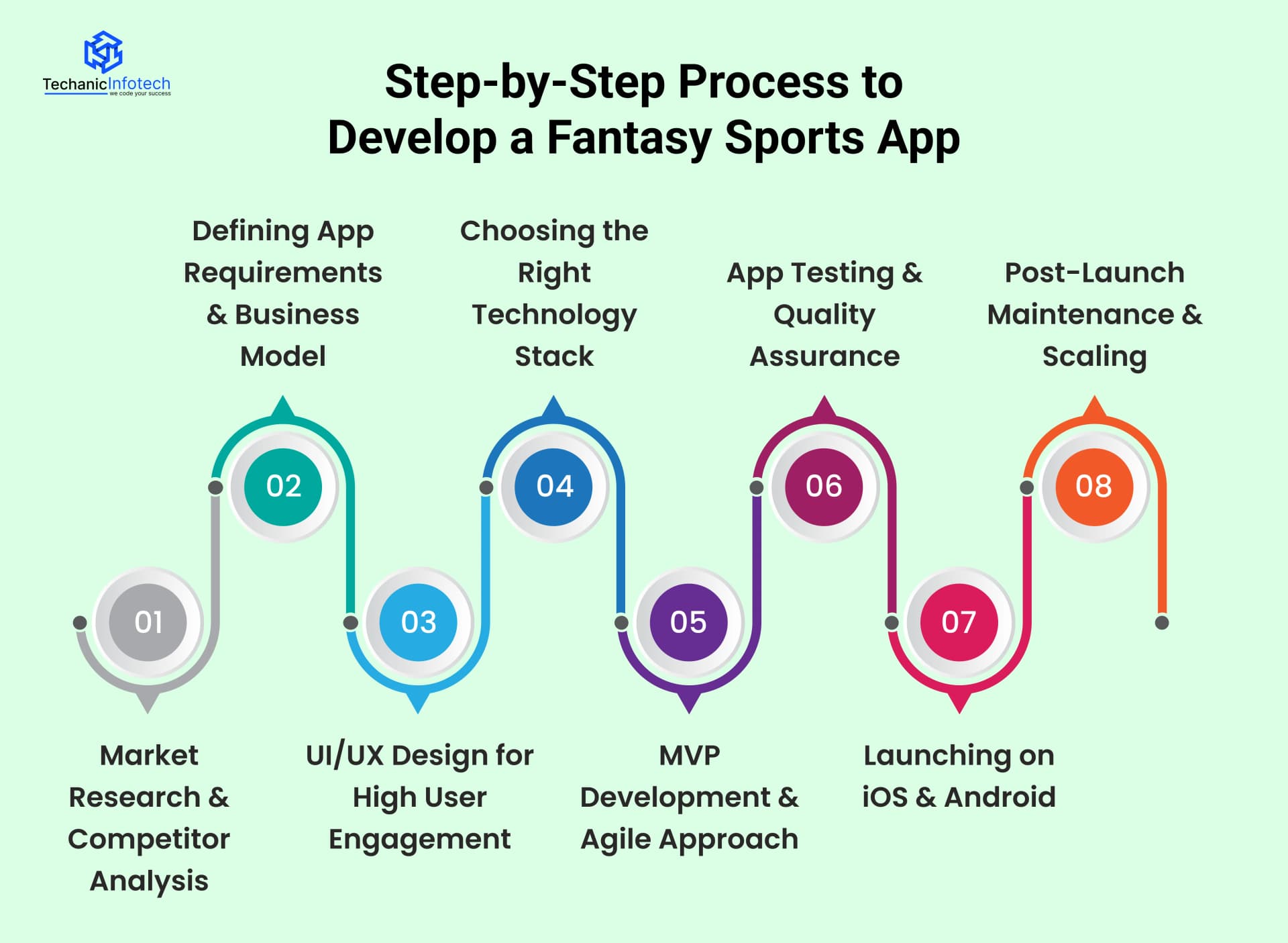
Developing a fantasy sports app requires a structured, strategic approach from research to post-launch scaling.
A step-by-step mobile app development process ensures technical stability, regulatory compliance, user engagement, and long-term business growth in a competitive digital sports market.
Analyze industry leaders, user behavior, trends, and regulatory landscapes. Conduct keyword research and user surveys to identify gaps.
Evaluate monetization strategies and compliance requirements. Evidence-based insights ensure strategic positioning, sustainable growth, and alignment with evolving market demand.
Document functional requirements, user journeys, revenue streams, and compliance needs. Choose monetization models such as entry fees, subscriptions, or ads.
Clear product roadmaps, transparent policies, and legal alignment enhance investor confidence and operational scalability.
Design intuitive navigation, fast-loading dashboards, and accessible interfaces. Apply mobile-first principles, clear CTAs, and micro-interactions to boost retention.
Conduct usability testing and heatmap analysis to refine user experience based on real behavioral data.
Select scalable backend frameworks, secure databases, and cross-platform development tools. Prioritize cloud infrastructure for elasticity and high availability.
Ensure strong cybersecurity protocols, API scalability, and modular architecture to support future feature expansion.
Build a minimum viable product focusing on core features like team creation and live scoring.
Use agile sprints, iterative releases, and stakeholder feedback loops. Continuous validation reduces risk, accelerates time-to-market, and ensures product-market fit.
Conduct functional, performance, security, and regression testing. Simulate high traffic loads to ensure stability during live matches.
Use automated testing frameworks and manual audits to maintain reliability, data integrity, and user trust.
Prepare store-optimized listings with keyword-rich descriptions, screenshots, and compliance documentation.
Follow platform guidelines for approvals. Implement analytics tracking from day one to measure installs, engagement, and conversion performance effectively.
Monitor user behavior, server performance, and security vulnerabilities continuously. Roll out feature updates based on analytics insights and user feedback.
Invest in scalable cloud infrastructure and compliance audits to ensure long-term growth, reliability, and brand authority.
Choosing the right mobile app tech stack ensures a fantasy sports app is scalable, secure, and high-performing.
Combining robust frontend, backend, database, real-time APIs, cloud hosting, and payment solutions enables seamless user experiences and growth.
Use cross-platform frameworks like Flutter and React Native to build high-performance iOS and Android apps from a single codebase.
They enable faster minimal viable product development, consistent UI, hot-reload features, and cost efficiency while maintaining near-native performance and scalability.
Choose scalable backend frameworks such as Node.js, Python, or .NET to manage APIs, authentication, and real-time data processing.
These technologies support microservices architecture, high concurrency, robust security, and seamless integration with third-party sports data providers.
Implement flexible and high-performance databases like MongoDB for unstructured data and PostgreSQL for complex queries and transactional consistency.
Combining NoSQL and relational databases ensures scalability, data integrity, and efficient handling of user statistics and contest records.
Integrate licensed sports data APIs offering live scores, player statistics, and match updates with minimal latency. Ensure webhook support, caching mechanisms, and failover systems.
Reliable data providers enhance credibility, gameplay accuracy, and user trust during high-traffic live sporting events.
Deploy infrastructure on scalable cloud platforms like Amazon Web Services, Microsoft Azure, or Google Cloud.
These providers offer auto-scaling, managed databases, security compliance, global CDN support, and disaster recovery capabilities for uninterrupted performance.
Integrate secure payment gateways supporting cards, wallets, and regional payment methods. Ensure PCI-DSS compliance, tokenization, and fraud detection systems.
Seamless payment processing builds user confidence, enables smooth contest entry fees, and supports subscription-based monetization models globally.
The cost to develop a Fantasy sports app varies from $10,000 to $90,000, depending on features, complexity, integrations, and scalability.
Budgeting aligns development scope with user engagement and business goals.
|
Feature |
Short Description |
Cost Estimation (2026) |
|
Basic MVP Development |
Core features include registration, team creation, scoring, and an admin panel for quick market validation. |
$10,000 – $20,000 |
|
Standard App with Core Features |
Adds live APIs, payments, push notifications, and improved UI/UX for regional growth. |
$20,000 – $40,000 |
|
Advanced Features Integration |
Includes AI recommendations, analytics, multi-sport support, and stronger security. |
$40,000 – $60,000 |
|
Enterprise-Grade Application |
Custom APIs, gamification, loyalty programs, scalable cloud, and fraud detection. |
$60,000 – $75,000 |
|
Blockchain & Smart Contract Integration |
Blockchain-based payouts, smart contracts, and secure wallet integration. |
$75,000 – $90,000+ |
A minimum viable product with user registration, team creation, basic scoring, and an admin panel typically costs between $10,000 and $20,000.
This option suits startups validating ideas quickly with limited integrations, simple UI, and a faster mobile app development timeline.
An application including live score APIs, payment gateway integration, push notifications, and enhanced UI/UX generally costs around $20,000 to $40,000.
This mobile app development cost supports stable performance, improved user engagement, and readiness for regional market expansion.
Adding AI-driven recommendations, analytics dashboards, multi-sport functionality, and enhanced security increases development costs to approximately $40,000 to $60,000.
This investment enables better personalization, higher retention, and competitive differentiation in saturated markets.
A scalable solution with custom APIs, gamification systems, loyalty programs, and robust cloud infrastructure typically requires $60,000 to $75,000.
It supports high traffic volumes, regulatory compliance, and advanced fraud detection mechanisms for large-scale operations.
Integrating blockchain for transparent transactions, automated prize distribution, and secure wallet systems can raise total development costs to $75,000 to $90,000.
This model enhances trust, transparency, and financial security for global fantasy sports platforms.
Techanic Infotech is an end-to-end mobile app development company tailored to startups and enterprises.
The company supports clients from market research and requirement analysis to UI/UX design, MVP development, and full-scale deployment.
Their team builds scalable architectures with real-time sports data integration, secure payment gateways, and cloud hosting solutions.
They focus on compliance, data security, and performance optimization to ensure reliable gameplay during peak traffic events.
Techanic Infotech also offers post-launch maintenance, feature enhancements, and technical support, helping businesses scale efficiently while maintaining high user engagement, platform stability, and long-term digital growth.
Developing a fantasy sports app in 2026 requires strategic planning, the right technology stack, and a scalable business model.
Costs can range from $10,000 for a basic MVP to $90,000 for an enterprise-grade platform with blockchain integration.
Success depends on integrating real-time sports data, ensuring regulatory compliance, maintaining strong cybersecurity standards, and delivering seamless user experiences.
Additionally, incorporating AI-driven personalization and gamification features can significantly improve user retention and engagement.
Businesses must focus on transparent operations, secure payment systems, and continuous post-launch optimization to remain competitive.
Fantasy sports app development cost in 2026 ranges from $10,000 for an MVP to $90,000+ for enterprise platforms with AI, blockchain, real-time APIs, and advanced security integrations.
The fantasy sports app development timeline typically ranges from 3 to 6 months, depending on features, integrations, testing complexity, compliance requirements, and overall project scope.
Essential fantasy sports app features include user registration, team creation, live score updates, secure wallet integration, leaderboards, push notifications, admin dashboard, analytics, and fraud detection systems.
Real-money fantasy sports app development requires secure payment gateways, KYC verification, encrypted wallets, regulatory compliance, anti-fraud systems, and scalable cloud infrastructure to ensure transparent and safe transactions.
A strong fantasy sports app tech stack includes Flutter or React Native for frontend, Node.js or Python for backend, MongoDB/PostgreSQL databases, licensed sports APIs, and AWS or Azure cloud hosting.


Abhishek Jangid is the CEO of Techanic Infotech, with extensive experience in mobile app and web development. He specializes in helping businesses turn innovative ideas into scalable digital solutions through strategic planning and modern technology.