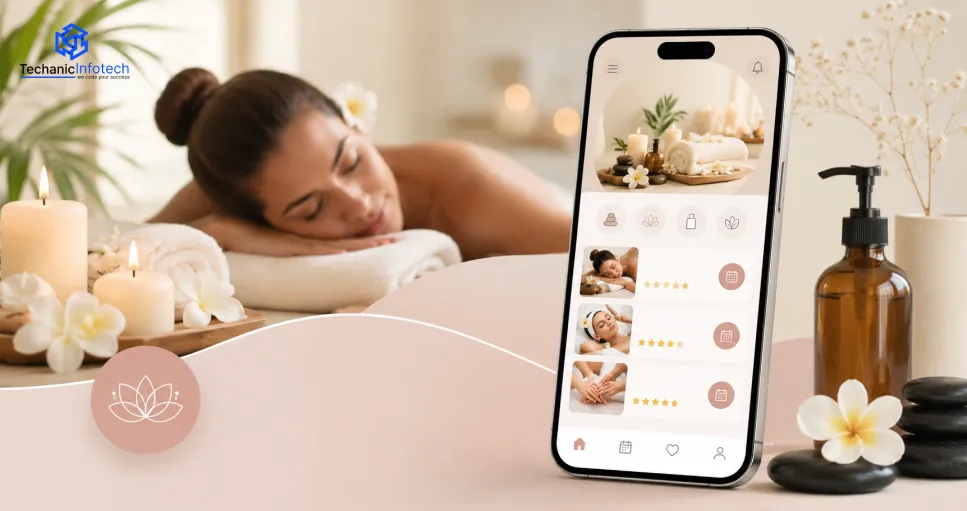
Salon App Development
Spa Booking App Development: Features, Cost, Technology & Development Process
August 20, 2026
August 20, 2026
Key Takeaways:
Spa booking app development can help businesses automate appointments, manage staff schedules, process payments, and improve customer engagement.
Essential spa booking app features include service listings, therapist profiles, real-time availability, appointment scheduling, payments, notifications, reviews, memberships, and analytics.
A basic spa booking app can cost around $8,000–$20,000, while an advanced or enterprise solution can reach $90,000+.
AI can support personalized treatment recommendations, intelligent scheduling, chatbots, customer analysis, and demand forecasting.
The development timeline can range from 2–3 months for an MVP to 8–12+ months for an enterprise platform.
Businesses should prioritize essential features initially and expand the platform with AI, CRM, multi-location management, and home-service capabilities as demand grows.
The spa and wellness industry is increasingly adopting digital platforms to simplify appointment scheduling, improve customer engagement, and streamline daily operations. A dedicated spa booking app development solution can connect customers with spas, therapists, and wellness professionals through a convenient mobile experience.
Instead of relying on phone calls or manual bookings, customers can browse services, check availability, select therapists, book appointments, make payments, and receive reminders from a single platform.
For spa businesses, a spa appointment booking app can help manage schedules, reduce booking conflicts, maintain customer records, and improve operational efficiency. Advanced solutions can also incorporate AI, CRM integrations, personalized recommendations, and automated marketing.
The overall spa booking app development cost depends on factors such as features, platforms, design complexity, integrations, technology choices, and the level of customization required. This guide covers the essential features, technology stack, development process, timeline, cost, and key considerations for building a successful spa booking platform.
The global spa services market size was valued at USD 102.3 billion in 2025 and is projected to grow from USD 108.9 billion in 2026 to USD 194.0 billion by 2033, at a CAGR of 8.6% from 2026 to 2033.
According to Grand View Research, the market in Europe is dominated, with a revenue share of 25.9% in 2025. The industry has experienced significant growth due to an increasing awareness of the importance of wellness and self-care.
According to the 2025 survey by the American Massage Therapy Association (AMTA), 91% of individuals consider massage beneficial to their overall health.
A dedicated booking app can help spas move beyond traditional phone-based scheduling and provide customers with a faster, more convenient way to manage appointments.
Customers can browse available services, select preferred dates and times, choose therapists, and confirm appointments without calling the spa.
A mobile app allows customers to book or reschedule appointments from anywhere. Push notifications can also remind them about upcoming sessions.
Real-time availability and automated scheduling can help prevent double bookings and make therapist and room management easier.
Spas can maintain customer profiles containing booking history, preferences, selected services, and other relevant information. Integration with CRM development services can further improve customer relationship management.
Payment gateway integration allows customers to pay for appointments, packages, memberships, or additional services directly through the app.
Personalized offers, loyalty programmes, reminders, reviews, and targeted notifications can encourage customers to return regularly.
Spas can promote premium treatments, memberships, packages, gift cards, and add-on services through the application.
A scalable booking platform can support multiple branches, therapists, service categories, and customer accounts as the business expands. Businesses familiar with Salon app development can also apply similar scheduling and customer-management concepts to spa operations.
Overall, a dedicated booking app can create a more convenient experience for customers while giving spa businesses better control over appointments and daily operations.
A spa booking app connects customers, spa staff, therapists, and administrators through a centralized digital platform. The booking journey can be kept simple while the backend manages availability, payments, schedules, and customer information.
Users create an account using email, phone number, or social login and provide basic profile information.
Customers can explore available treatments such as massages, facials, body treatments, wellness therapies, and spa packages. Each service can include pricing, duration, description, and therapist availability.
The app displays available slots based on therapist schedules, treatment duration, and room availability. Customers can then choose their preferred appointment.
Customers review their booking details and pay through an integrated payment gateway. The system automatically updates the appointment status.
Push notifications, SMS, or email reminders can inform customers about booking confirmations, upcoming appointments, cancellations, and schedule changes.
Staff can manage appointments, therapist schedules, services, customer records, payments, and cancellations through an admin dashboard.
After the appointment, customers can provide ratings and reviews. The spa can also send personalized offers, loyalty rewards, or recommendations.
A well-designed appointment booking app development strategy should focus on real-time availability, simple navigation, secure payments, and smooth communication between customers and spa staff.
A successful spa booking platform should provide convenient booking tools for customers while giving spa owners and staff effective control over schedules, services, payments, and customer relationships.
|
Feature |
Purpose |
|
User Registration & Profiles |
Allows customers to create and manage their accounts. |
|
Service Catalog |
Displays treatments, packages, prices, and durations. |
|
Therapist Profiles |
Shows therapist expertise, availability, and ratings. |
|
Real-Time Availability |
Displays available appointment slots and prevents double bookings. |
|
Appointment Booking |
Allows customers to schedule, reschedule, or cancel appointments. |
|
Online Payments |
Supports secure payment for services, packages, and memberships. |
|
Push Notifications |
Sends booking confirmations, reminders, and updates. |
|
Reviews & Ratings |
Helps customers share their experience and evaluate services. |
|
Memberships & Packages |
Supports recurring memberships, prepaid packages, and special offers. |
|
Loyalty Programs |
Rewards returning customers and encourages repeat bookings. |
|
Offers & Discounts |
Helps spas promote seasonal deals and personalized promotions. |
|
Customer Management |
Stores booking history, preferences, and customer information. |
|
Calendar Management |
Helps staff manage therapists, rooms, and appointment schedules. |
|
Admin Dashboard |
Provides centralized control over users, services, bookings, and payments. |
|
Analytics & Reports |
Tracks revenue, bookings, popular services, and customer trends. |
For spa businesses with multiple locations, the application can allow customers to select a preferred branch while administrators manage individual locations, staff, services, and schedules from one dashboard.
Spas offering at-home treatments can add location selection, service-area management, therapist assignment, and real-time status tracking. This makes home service app development capabilities useful for businesses expanding beyond physical spa locations.
AI can analyze customer preferences and booking history to recommend relevant treatments, packages, or appointment times. Businesses working with an AI development company can implement more advanced recommendation and personalization features.
Integrating customer data with a CRM system can help spas track interactions, booking history, preferences, campaigns, and loyalty activity. CRM development services can be used when a business requires a customized customer-management system.
AI can make a spa booking platform more personalized and efficient by analyzing customer preferences, booking patterns, and service interactions.
AI can analyze previous bookings and preferences to suggest relevant treatments, packages, or wellness services.
The system can recommend suitable appointment slots based on customer preferences, therapist availability, and booking history.
An AI-powered chatbot can answer common questions about services, pricing, availability, cancellation policies, and bookings without requiring staff intervention.
AI can identify booking patterns and customer segments, helping spas create targeted offers and personalized marketing campaigns.
AI can analyze customer reviews to identify common complaints, positive feedback, and areas where service quality can be improved.
AI can analyze historical booking data to help predict busy periods, allowing spa managers to plan staff schedules and resources more effectively.
Businesses that want advanced AI functionality can work with an AI development company to build customized recommendation engines, chatbots, predictive analytics, and automation features.
The technology stack should support smooth appointment scheduling, secure payments, real-time availability, notifications, customer management, and future scalability.
|
Technology Layer |
Recommended Technologies |
Estimated Cost Contribution |
|
Mobile App |
Flutter, React Native, Swift, Kotlin |
$4,000–$12,000 |
|
UI/UX Design |
Figma, Adobe XD |
$1,500–$4,000 |
|
Backend |
Node.js, Python, Laravel, Django |
$4,000–$10,000 |
|
Database |
PostgreSQL, MySQL, MongoDB |
$1,500–$4,000 |
|
Cloud & Hosting |
AWS, Google Cloud, Azure |
$1,500–$6,000 |
|
Payment Integration |
Stripe, PayPal, regional gateways |
$800–$3,000 |
|
Maps & Location |
Google Maps API, Mapbox |
$500–$2,500 |
|
Notifications |
Firebase Cloud Messaging, Twilio, APNs |
$500–$2,000 |
|
AI/Personalization |
Python, TensorFlow, OpenAI APIs |
$2,000–$10,000+ |
|
Security |
OAuth, JWT, encryption, RBAC |
$1,000–$4,000 |
|
Admin Dashboard |
React, Angular, Vue.js |
$2,000–$7,000 |
A structured spa booking app development process helps ensure that the platform is easy to use, scalable, secure, and aligned with business requirements.
Identify the target customers, spa services, booking model, payment requirements, locations, staff workflows, and business goals.
Start with essential features such as registration, service listings, therapist profiles, availability, appointment booking, payments, notifications, and an admin dashboard.
Create wireframes and prototypes for the customer app and administrative interface. The booking process should require minimal steps.
Build APIs and databases for users, services, therapists, schedules, appointments, payments, reviews, and notifications.
Build the customer-facing application for iOS and Android using the selected technology stack. Staff functionality can also be included where required.
Integrate payment gateways, maps, push notifications, calendars, CRM systems, and other required services.
AI can be introduced to provide personalized service recommendations, support customer segmentation, automate support, and optimize appointments.
Test booking flows, payment processing, notifications, availability synchronization, security, performance, and compatibility across devices.
Deploy the application to the App Store and Google Play, configure cloud infrastructure, and set up analytics and monitoring.
Monitor performance and user feedback after launch. Regular updates can improve security, introduce new features, and support evolving operating system requirements.
Working with a software development company experienced in booking platforms can help businesses manage integrations, scalability, and long-term maintenance more efficiently.
The spa booking app development timeline depends on the number of platforms, booking complexity, integrations, AI features, and customization requirements.
|
Development Level |
Estimated Timeline |
Typical Features |
|
Basic |
2–3 months |
Profiles, services, booking, payments, notifications, admin panel |
|
Mid-Level |
3–5 months |
Therapist scheduling, reviews, packages, loyalty, CRM, analytics |
|
Advanced |
5–8+ months |
AI recommendations, multi-location support, home services, advanced CRM, complex integrations |
Number of platforms: iOS, Android, and web development increase the workload.
Booking complexity: Real-time therapist, room, and service availability requires additional backend logic.
Third-party integrations: Payment gateways, maps, CRM, calendars, and notification services add development time.
AI features: Personalized recommendations and AI automation require additional development and testing.
Custom design: Highly customized UI/UX and animations can extend the design phase.
Testing: Payment, scheduling, notifications, and real-time availability require thorough testing.
A focused MVP can typically be launched within 2–3 months, while a highly customized platform may take 5–8+ months. Working with an experienced mobile app development company can help keep the project timeline organized and reduce unnecessary development delays.
The spa booking app development cost typically ranges from $8,000 to $90,000+, depending on features, platforms, integrations, customization, and overall complexity.
|
App Type |
Estimated Cost |
Timeline |
Key Features |
|
Basic |
$8,000–$20,000 |
2–3 months |
Profiles, services, booking, payments, notifications |
|
Mid-Level |
$20,000–$40,000 |
3–5 months |
Therapist scheduling, reviews, packages, loyalty, analytics |
|
Advanced |
$40,000–$65,000 |
5–8 months |
AI recommendations, CRM, multi-location, advanced booking |
|
Enterprise |
$65,000–$90,000+ |
8–12+ months |
AI automation, multi-branch management, home services, complex integrations |
The final cost can change based on the following:
Number of platforms
UI/UX customization
Booking and scheduling complexity
Payment gateway integration
CRM integration
AI features
Multi-location support
Home-service functionality
Third-party APIs
Security requirements
Post-launch maintenance
A simple MVP can start around $8,000, while a comprehensive spa platform with AI, CRM, multi-location management, and advanced integrations can exceed $90,000.
For businesses looking to build a spa-booking app, defining the MVP first can help control the initial investment and allow advanced features to be introduced gradually.
Several factors determine the final spa booking app development cost. Understanding these elements helps businesses set a realistic budget before development begins.
|
Cost Factor |
Impact on Cost |
|
Feature Complexity |
Advanced booking, loyalty, memberships, and analytics require more development effort. |
|
Number of Platforms |
Developing for iOS, Android, and web increases development and testing requirements. |
|
UI/UX Customization |
Unique designs, animations, and personalized customer journeys increase design costs. |
|
Payment Integration |
Multiple payment gateways, refunds, subscriptions, and transaction handling add complexity. |
|
CRM Integration |
Connecting customer data, booking history, and marketing workflows requires additional APIs and development. |
|
AI Features |
Recommendations, AI assistants, personalization, and automation can significantly increase development costs. |
|
Multi-Branch Support |
Managing multiple locations, staff, services, and schedules requires more complex architecture. |
|
Home-Service Features |
Location tracking, therapist assignment, service zones, and route management add development effort. |
|
Third-Party Integrations |
Maps, calendars, notifications, payment services, and other APIs increase implementation work. |
|
Security Requirements |
Secure authentication, payment protection, encryption, and access controls add development effort. |
|
Maintenance & Scaling |
Updates, bug fixes, server management, and scaling create ongoing costs after launch. |
A basic appointment booking application costs considerably less than a platform with memberships, packages, loyalty programs, AI recommendations, CRM integration, and multi-location management.
The location and expertise of the development team can also influence pricing. Businesses working with a spa booking app development company should evaluate technical expertise, previous booking-platform experience, integration capabilities, and post-launch support.Careful scope planning helps businesses avoid unnecessary features in the first release while leaving room for future expansion.
A well-designed spa booking app can simplify appointment management while creating a more convenient and personalized experience for customers. Features such as real-time scheduling, online payments, therapist management, reminders, memberships, and customer profiles can help spas streamline their daily operations.
The spa booking app development cost can range from $8,000 to $90,000+, depending on the application's features, platforms, integrations, AI capabilities, and level of customization. Businesses should also account for ongoing expenses such as cloud infrastructure, third-party APIs, maintenance, and updates.Starting with a focused MVP allows spa businesses to validate demand and control their initial investment. As the platform grows, advanced capabilities such as AI personalization, CRM integration, multi-location management, and home-service booking can be added to support long-term growth.
The spa booking app development cost typically ranges from $8,000 to $90,000+. The final cost depends on features, platforms, integrations, customization, and AI capabilities.
A basic spa booking app can take around 2–3 months, while a feature-rich or enterprise platform may require 8–12+ months.
Important features include service listings, therapist profiles, real-time availability, appointment scheduling, online payments, notifications, reviews, memberships, loyalty programs, and analytics.
Yes. AI can provide personalized treatment recommendations, intelligent appointment suggestions, customer-support chatbots, demand forecasting, and customer behaviour analysis.
Yes. A scalable platform can allow businesses to manage multiple branches, therapists, services, schedules, pricing, and bookings from a centralized dashboard.
Yes. Home-service functionality can support location selection, service-area management, therapist assignment, appointment tracking, and notifications.
Common monetization options include booking commissions, subscriptions, premium memberships, service fees, promotional listings, packages, and in-app purchases.
Common technologies include Flutter or React Native for mobile development, Node.js or Python for the backend, PostgreSQL or MongoDB for databases, and AWS, Azure, or Google Cloud for hosting.


Neha Sharma is a tech expert at heart who loves exploring new technologies and turning complex ideas into easy-to-understand content. With a passion for learning and writing, she enjoys sharing insights on emerging tech, digital products, and innovation that help businesses stay ahead.