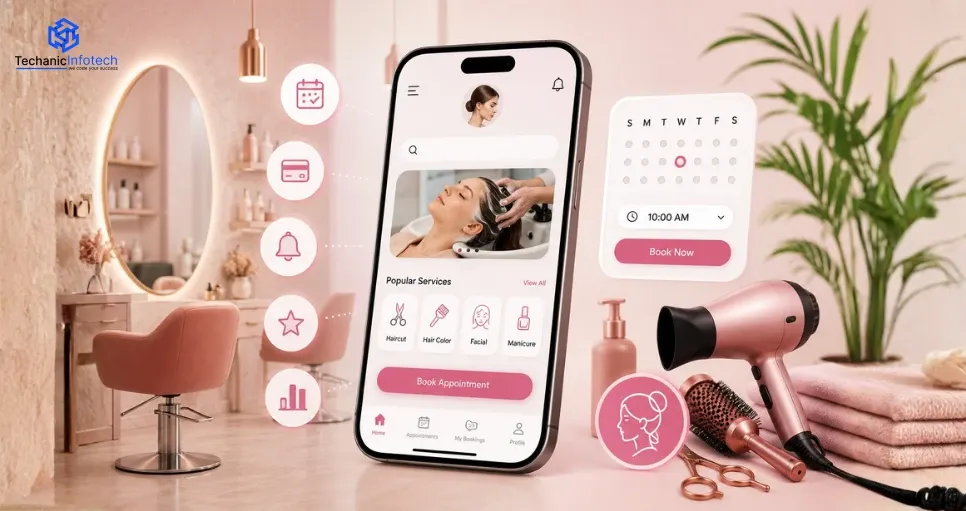
Key Takeaways
The salon app industry is growing rapidly because customers increasingly prefer online appointment booking and digital beauty services.
Essential salon app features include appointment booking, personalized profiles, secure payments, loyalty programs, push notifications, and stylist management.
Advanced technologies such as AI-powered recommendations, AR try-on features, and smart scheduling systems improve customer engagement and user experience.
The salon app development cost generally ranges between $10,000 and $80,000+ depending on app complexity, features, and backend infrastructure.
Cross-platform technologies like Flutter and React Native help businesses reduce development costs and accelerate launch timelines.
Partnering with an experienced salon app development company helps businesses build scalable, feature-rich, and user-friendly salon applications efficiently.
Technology has completely transformed the way customers interact with salon and beauty businesses.
Today, users prefer booking salon appointments online instead of making calls or visiting salons physically. From scheduling appointments to choosing stylists and making online payments, everything can now be managed directly through mobile applications.
Because of this growing digital convenience, salon businesses are increasingly investing in mobile applications to improve customer experience, automate operations, and increase bookings.
If you are also planning to create a salon application, understanding the development process, features, technologies, and costs becomes extremely important before starting the project.
Modern beauty businesses now partner with an experienced salon app development company to build scalable and feature-rich salon booking applications that improve customer engagement and operational efficiency.
In this blog, we’ll explore how to develop a salon app, essential features, advanced functionalities, development steps, technology stack, app development cost, and the latest salon industry trends.
The salon and beauty app industry is growing rapidly due to increasing smartphone usage and digital booking adoption.
According to market reports, the global salon software market is projected to grow from USD 0.82 billion in 2023 to USD 1.69 billion by 2030, showing strong opportunities for beauty and wellness businesses.
The market is also expected to grow at a CAGR of approximately 15.3% over the coming years due to increasing demand for appointment booking automation, personalized beauty services, and digital customer engagement systems.
The Asia-Pacific region is expected to witness the fastest growth because of rising mobile adoption and increasing digital transformation among salon businesses.
These statistics clearly show that investing in salon app development can create strong business growth opportunities for startups and beauty enterprises.
Businesses researching scalable beauty platforms also explore modern on-demand app ideas before planning feature-rich salon booking solutions.
Developing a salon app offers multiple benefits for both salon businesses and customers.
It improves customer convenience, increases operational efficiency, and helps businesses generate more bookings and revenue.
Convenience is one of the biggest reasons why businesses invest in salon applications.
Customers can book appointments anytime and from anywhere without needing to call or visit the salon physically.
They can also:
Reschedule appointments
Cancel bookings
Choose preferred stylists
Access service details instantly
This flexibility improves customer satisfaction while reducing front desk workload significantly.
Salon applications help businesses capture bookings even outside business hours.
A user-friendly booking system encourages users to schedule appointments more frequently, increasing overall revenue opportunities.
Businesses planning scalable digital platforms often analyze mobile app development between 5000 to 10000 budgeting strategies before starting app development projects.
Salon applications help businesses automate multiple operations including:
Appointment scheduling
Staff management
Customer information
Notifications
Payment tracking
This reduces manual workload while improving overall operational efficiency.
Modern salon apps provide personalized customer experiences through:
Customized recommendations
Loyalty rewards
Booking history
Preferred stylist suggestions
Businesses can also integrate video consultations and AI-based beauty recommendations to improve customer engagement.
A salon app also works as a direct marketing channel for beauty businesses.
Businesses can send:
Push notifications
Promotional offers
Discounts
Product launches
Beauty tips
This helps businesses improve customer retention and increase repeat bookings.
Features are the foundation of every successful salon application.
A feature-rich app improves customer engagement, retention, and overall user experience.
Quick onboarding is one of the most important features of a salon application.
If users face complicated registration systems, they may leave the app and move to competitors.
The app should support:
Gmail sign-up
Mobile number registration
Social media login
This helps users start using the platform quickly and conveniently.
Smooth appointment booking functionality is extremely important for salon applications.
Users should be able to:
Browse services
Select stylists
Choose time slots
Confirm bookings instantly
Businesses often analyze scalable appointment booking app development systems before integrating advanced scheduling functionalities.
Personalized profiles help businesses deliver better customer experiences.
The app should store:
Appointment history
Preferences
Contact information
Favorite services
This helps businesses provide personalized recommendations and targeted promotions.
Integrated payment systems improve convenience for users and businesses.
The app should support:
UPI payments
Wallets
Cards
Online banking
Secure payment systems simplify checkout experiences and improve transaction transparency.
Loyalty programs encourage users to book appointments repeatedly.
Businesses can offer:
Reward points
Discounts
Referral bonuses
Exclusive offers
These systems improve customer retention and long-term engagement.
Push notifications help businesses stay connected with users.
Notifications can be used for:
Appointment reminders
Promotional offers
Product launches
Beauty tips
This improves engagement and repeat visits significantly.
A visual gallery helps businesses showcase:
Hairstyles
Beauty transformations
Makeup work
Styling portfolios
This increases customer confidence and encourages bookings.
Staff profiles allow customers to learn about stylists and choose professionals according to expertise and reviews.
This improves transparency and helps users make informed decisions.
Social media integration helps users share experiences directly from the application.
Businesses can improve visibility through:
Customer reviews
Before-after photos
Social sharing
This also supports organic marketing and brand growth.
Advanced functionalities help businesses differentiate themselves in the competitive salon industry.
These features improve customer experience and increase app engagement.
AI-powered recommendation systems analyze user preferences, facial features, and appointment history to suggest suitable stylists and beauty services.
Businesses increasingly explore AI-based personalization to improve customer satisfaction and booking accuracy.
Smart scheduling systems use machine learning to optimize appointment management and reduce scheduling conflicts.
These systems improve staff productivity and booking efficiency.
AR technology allows users to virtually try:
Hairstyles
Hair colors
Makeup looks
before booking appointments.
This improves user confidence and helps customers make informed decisions.
Video consultation features allow users to connect with beauty professionals remotely before booking services.
This improves trust, personalization, and customer engagement.
Community forums allow users to:
Share beauty tips
Discuss trends
Ask questions
Interact with professionals
This helps businesses build stronger customer communities and improve engagement.
Businesses planning scalable beauty platforms also explore modern wearable app development and AI-powered personalization trends before integrating advanced salon technologies.
Developing a salon app involves multiple stages from market research to launch and maintenance.
Market research helps businesses understand:
Customer behavior
Competitor strategies
Industry gaps
User expectations
Proper research helps businesses build more competitive and user-friendly applications.
After research, businesses should prioritize core features based on user needs and business goals.
It’s always recommended to launch with essential features first and add advanced functionalities later.
A clean and easy-to-use design improves user engagement significantly.
Businesses should focus on:
Simple navigation
Fast booking flow
Attractive visual design
Smooth user experience
This stage involves frontend and backend development.
Developers build:
User interfaces
Databases
APIs
Payment systems
Booking systems
Businesses often compare scalable hybrid app development cost before selecting the right development approach.
Testing ensures the app remains bug-free and performs efficiently across multiple devices and operating systems.
The testing process includes:
Functional testing
Security testing
Performance testing
Device compatibility testing
After testing, the app is launched on:
Google Play Store
Apple App Store
Businesses also start marketing campaigns during the launch stage to increase visibility and downloads.
Regular updates are essential for:
Bug fixes
Security improvements
Feature upgrades
Performance optimization
Long-term maintenance improves app stability and user retention.
Choosing the right technology stack is extremely important for scalability, performance, and long-term maintenance.
|
Layer |
Recommended Technologies |
|
Frontend |
Flutter, React Native, Swift, Kotlin |
|
Backend |
Node.js, Python, PHP |
|
Database |
MongoDB, Firebase, MySQL |
|
Cloud Platform |
AWS, Azure, Google Cloud |
|
Development Tools |
GitHub, Jira, Xcode |
|
Additional Tools |
Firebase Notifications, Stripe |
Businesses exploring scalable digital infrastructure often compare modern strategies for hiring a dedicated software development team before starting large-scale app projects.
One of the most common questions businesses ask is: how much does it cost to develop a salon app?
The salon app development cost generally ranges between $10,000 and $80,000+ depending on app complexity, features, backend infrastructure, integrations, and design quality.
Here’s a quick cost breakdown:
|
Feature |
Cost Range |
|
App Development |
$10,000 – $40,000 |
|
UI/UX Design |
$2,000 – $10,000 |
|
Backend & Database |
$1,000 – $5,000 |
|
Project Management |
$1,000 – $5,000 |
|
App Store Submission |
$100 – $200 |
|
Maintenance & Updates |
$1,000 – $5,000+ |
Businesses researching scalable service applications also analyze modern cost to build an app like Yuka and marketplace development strategies before planning advanced beauty platforms.
The salon industry is rapidly moving toward digital transformation, making salon applications one of the most valuable investments for beauty businesses in 2026.
A well-developed salon app helps businesses improve appointment management, increase customer convenience, automate operations, and generate higher revenue opportunities.
Features such as online booking, personalized profiles, AI-powered recommendations, secure payments, loyalty programs, and push notifications play a major role in improving customer engagement and retention.
With the right development strategy, scalable technologies, advanced features, and experienced development support, businesses can successfully build high-performing salon applications that stand out in the competitive beauty and wellness market
The salon app development cost generally ranges between $10,000 and $80,000+ depending on app complexity, features, integrations, and design requirements.
Important features include appointment booking, push notifications, personalized profiles, online payments, loyalty programs, staff profiles, and customer reviews.
A salon app may take around 3 to 6 months depending on feature complexity, app design, integrations, and platform requirements.
AI helps improve stylist recommendations, personalized beauty suggestions, smart scheduling, and customer engagement through intelligent automation systems.
Technologies like Flutter, React Native, Node.js, Firebase, MongoDB, AWS, and Stripe are commonly used for salon app development.
Salon apps improve customer convenience, automate appointment management, increase bookings, enhance customer retention, and support long-term business growth.


Neha Sharma is a tech expert at heart who loves exploring new technologies and turning complex ideas into easy-to-understand content. With a passion for learning and writing, she enjoys sharing insights on emerging tech, digital products, and innovation that help businesses stay ahead.