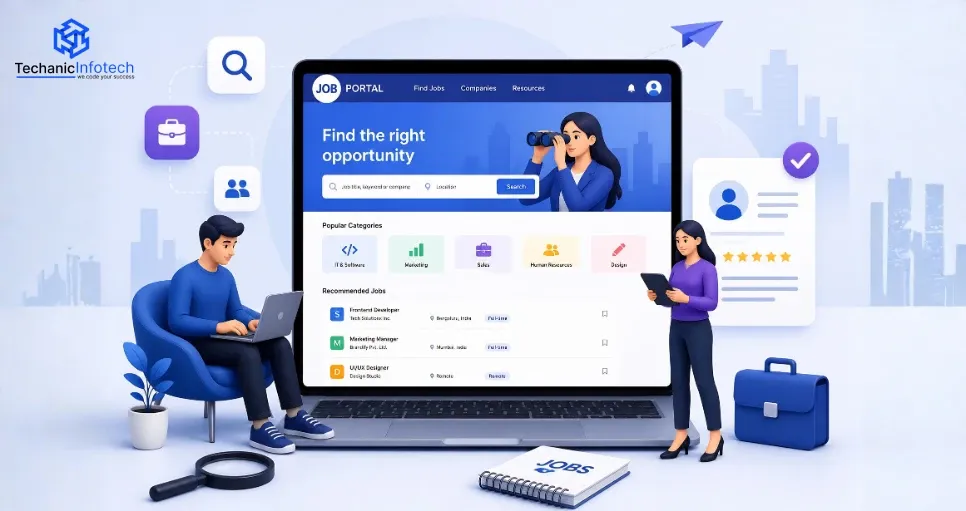
Job Portal App Development
A Complete Job Portal Development Guide: Features, Cost, and Trends for 2026
May 5, 2026
May 5, 2026
Finding the right job or the right talent has never been easier, thanks to digital hiring platforms.
Today, businesses and job seekers prefer online portals that simplify the entire recruitment process, from posting openings to scheduling interviews. If you have ever wondered how to create a job portal or launch your own hiring platform, this guide will walk you through it step by step.
Building a reliable job portal requires the right mix of planning, technology, and user experience. To develop a job portal website or build a niche platform for specific industries, understanding the process is the key to success.
In this job portal development guide, we’ll cover everything, from how job portals work and what features make them successful to the cost, tech stack, and current trends shaping the market. By the end, you’ll have a clear roadmap to turn your idea into a fully functional, revenue-generating platform.
A job portal is an online platform, either a website or a mobile app, that connects employers with potential candidates.
It acts as a digital meeting point where companies can post open positions and professionals can apply for jobs that match their skills and interests. In simple terms, it’s like a virtual marketplace for hiring and job searching.
From big names like Indeed, Glassdoor, and ZipRecruiter to niche platforms focusing on specific industries, job portals make the recruitment process faster, easier, and more transparent.
Many modern portals now use AI-based matching, resume scoring, and smart filters to help users find the most relevant results. If you’re a startup planning to develop a job portal or a business looking to automate your hiring, understanding how these portals function is key.
Here’s a quick breakdown of how a typical job portal works:
User Registration: Both employers and job seekers create profiles. Employers share details about their company, while job seekers upload their resumes and career information.
Job Posting: Employers list open positions, adding details like job title, description, skills required, location, and salary range.
Job Search and Filters: Job seekers can browse through listings or use filters such as role, location, pay range, or experience level to find suitable openings.
Application Process: Once a user finds the right fit, they can apply directly through the portal by submitting their resume and cover letter.
Matching and Recommendations: Smart portals use AI algorithms to match candidates with jobs that align with their profiles, increasing the chances of success on both ends.
In short, a job portal simplifies hiring by saving time and connecting the right people at the right time, making it a win-win for both employers and job seekers.
Let’s move on to the next to know what market stats are saying about the growth of the job portal industry.
The demand for online job portals has grown rapidly over the past few years, driven by digital hiring, remote work, and AI-powered recruitment tools. As more companies move away from traditional hiring methods, the global job portal industry continues to expand and evolve.
Here are some key statistics that highlight this growth:
Over the past five years, industry revenue has expanded at a CAGR of 6.2%, reaching an expected $18.8 billion by 2025.
The global online recruitment market was valued at $34.0 billion in 2023 and is projected to grow to around USD 58.0 billion by 2032, at a CAGR of 6.4%.
The Job Search Engines segment is estimated at USD 13.5 billion in 2024 globally, with projections rising to USD 28.56 billion by 2032. This reflects a CAGR of about 9.2%.
In 2023, North America held over 35% of the global online recruitment market, with revenues of USD 11.9 billion in that region.
Now that we have an overview of what job portals are, how they work, and how much revenue they generate, let’s dive deeper into the key statistics shaping this industry.
Job portals vary widely depending on the target audience, industry, and hiring needs. Understanding these types is essential for anyone planning to develop a job portal website or app.
Here’s a detailed look at the main types:
These platforms are broad-based and cater to all industries, job levels, and professional roles. They allow employers to post jobs and reach a large audience while giving job seekers access to a wide variety of opportunities. General portals are ideal for mass hiring and career exploration.
Examples: Indeed, Glassdoor, ZipRecruiter, Monster.
These portals focus on a specific industry or profession, connecting specialized talent with employers who need highly targeted skills. Niche portals are especially useful for companies looking to hire for roles that require expertise in a particular field.
Examples: Dice (IT & tech jobs), Mediabistro (media & communications), Hcareers (hospitality)
Freelance portals cater to professionals seeking short-term projects or gig-based work. They provide a platform for freelancers to showcase portfolios, bid on projects, and communicate directly with clients. For companies, these portals make it easy to find temporary talent for specific tasks without long-term commitments.
Examples: Upwork, Fiverr, Freelancer
Remote job portals specialize in work-from-home opportunities. They cater to professionals who prefer flexible work locations, helping U.S.-based companies tap into a wider talent pool while offering workers more autonomy.
Examples: We Work Remotely, FlexJobs, Remote.co
These platforms connect professionals with startup companies or fast-growing ventures. They often emphasize innovation, entrepreneurial spirit, and growth potential, appealing to individuals who want dynamic roles rather than traditional corporate positions.
Examples: AngelList, Wellfound
Recruitment agency portals are managed by professional staffing and recruiting firms. They allow agencies to post multiple job openings across industries and streamline candidate matching, applications, and tracking.
Examples: Robert Half, Adecco, ManpowerGroup
On-demand portals focus on immediate or short-term hiring needs. They often integrate mobile apps that allow workers to accept shifts or tasks in real time, making them ideal for hourly, part-time, or temporary roles.
Examples: Wonolo, Snagajob
Understanding all these types will help you to pick out which one will work best for your dream job portal. The next section is a complete guide to job portal development to help you walk through the dynamics of the whole process.
Creating a job portal may seem complicated at first, but if you break it down step by step, the process becomes manageable.
This job portal development guide will walk you through everything from planning to launch, making it easier to understand what works effectively for both employers and job seekers.
If you want to create a job platform, following these steps ensures a smooth journey.
The first step in learning how to develop a job portal is to clearly define the purpose of your platform. Ask yourself:
Do you want to target a specific industry, like tech or healthcare, or go broad?
Are you creating a full-time job portal, freelance marketplace, or an on-demand platform for temporary work?
Understanding your audience helps you decide the type of portal to build a job portal website or app for. For example, U.S.-based professionals may prefer detailed filters for location, salary, and remote work options. Defining your goals early also guides your design, features, and monetization strategies.
Before you develop a job portal, it’s important to analyze the competition. Look at successful portals like Indeed, Glassdoor, and ZipRecruiter to understand:
Features that work well for users
User interface and design elements
Pricing and subscription models for employers
This research helps you identify gaps in the market where your portal can stand out. For instance, if you want to create a job portal app for niche industries or remote work, understanding competitors allows you to offer unique value.
Once you know your audience, decide the type of portal to make a job platform for:
General job portals for broad hiring needs
Niche portals for specific industries
Freelance or gig portals for temporary jobs
Remote job portals for professionals working from home
On-demand portals for instant staffing needs
This choice will determine the features you need, the tech stack, and your overall website development approach.
To create a job portal website that truly works, make a list of must-have features:
User registration and profiles for job seekers and employers
Job posting and management for employers
Advanced search and filtering for candidates
Application tracking system (ATS)
Notifications and alerts for new jobs or applications
AI-based resume matching for faster recruitment
Mobile-friendly design for easy access on smartphones
To build a successful job portal, prioritize features that improve usability and engagement. For job portal app development, make sure navigation is smooth and all key features are accessible on a small screen.
Next, decide the technology that will power your portal. Choosing the right tech stack is crucial for both development and performance. Common options include:
|
Category |
Technologies / Tools |
Description / Purpose |
|
Frontend (User Interface) |
React.js, Angular, Vue.js |
Used to build a fast, responsive, and user-friendly interface for both web and mobile versions. |
|
Backend (Server-Side Development) |
Node.js, Python (Django), PHP (Laravel), Ruby on Rails |
Handles the logic, APIs, and communication between the user interface and database. |
|
Database |
MySQL, PostgreSQL, MongoDB |
Stores user data, resumes, job listings, and company profiles securely and efficiently. |
|
Mobile App Development |
Flutter, React Native, Swift (iOS), Kotlin (Android) |
Used to create a job portal app that works smoothly on iOS and Android devices. |
|
Cloud Hosting & Deployment |
AWS, Google Cloud, Microsoft Azure |
Provides secure, scalable hosting for your portal with data backups and high availability. |
|
Search & Matching Engine |
Elasticsearch, Apache Solr |
Powers fast and accurate job searches and resume matching features. |
|
Authentication & Security |
OAuth, JWT, SSL, Firebase Auth |
Ensures secure login, user verification, and data protection across the platform. |
|
Payment Integration |
Stripe, PayPal, Razorpay |
Enables subscription payments, premium job listings, or featured employer services. |
|
Notifications & Communication |
Firebase Cloud Messaging, Twilio, SendGrid |
Sends real-time job alerts, application updates, and email/SMS notifications. |
|
Analytics & Monitoring |
Google Analytics, Mixpanel, New Relic |
Tracks user behavior, portal performance, and engagement metrics to improve user experience. |
|
Content Management System (Optional) |
WordPress, Strapi, Contentful |
Helps manage blogs, SEO content, and static pages easily without coding. |
A well-chosen tech stack ensures your platform is scalable, fast, and secure, essential for a professional audience.
A portal’s success depends heavily on its design. When you develop a job portal, focus on:
Clean layouts with intuitive navigation
Easy-to-use dashboards for employers and job seekers
Responsive design for mobile and tablet use
Quick-loading pages and minimal clutter
A great UI/UX keeps users engaged and encourages repeat visits.
Now it’s time to actually develop a job platform. Development is usually divided into:
Frontend development: The part users interact with
Backend development: Server, database, and APIs
Integration: Payment gateways, notification systems, and ATS
Once development is done, thorough testing is essential:
Functional testing for all features
Mobile responsiveness and compatibility checks
Security testing to protect sensitive user data
A well-tested portal ensures a smooth experience for both employers and job seekers.
After testing, you’re ready to create a job portal for your audience. But launching isn’t the end, you need marketing to attract users:
Use social media and email campaigns to target professionals
Run Google Ads for relevant search terms like “job portal” or “job-finding app.”
Collaborate with companies and educational institutions to post jobs
Effective marketing ensures your portal reaches the right audience and gains traction quickly.
Post-launch, continuous monitoring is key to keeping your portal relevant:
Track user behavior and feedback to improve features
Regularly update the platform for security and performance
Add new functionalities based on industry trends and user needs
If you are focusing on mobile app development, regular upgrades help retain users and maintain a competitive edge.
With careful planning, the right features, and continuous improvement, your job portal can become a trusted platform that connects the right talent with the right opportunities in the job market.
Now that you understand the detailed steps to build a job portal, it’s important to know the costs involved in bringing your platform to life, whether it’s a website, a mobile app, or both.
The cost to create a job portal can vary widely depending on the features, design, and technology you choose. Building a simple platform might cost less, but if you’re aiming for something advanced with AI-based search, mobile integration, and scalability, the cost increases.
Below, we’ll break down the estimated expenses for both a job portal website and a job portal app.
If you plan to develop a job portal website, your costs will depend on design complexity, functionality, and technology stack.
Here’s a rough cost breakdown (based on U.S. development standards):
|
Component |
Estimated Cost (USD) |
Details |
|
UI/UX Design |
$2,000 – $5,000 |
Designing a clean, user-friendly interface for job seekers and employers. |
|
Frontend Development |
$4,000 – $6,000 |
Building the user-facing part of the website with a responsive design. |
|
Backend Development |
$5,000 – $10,000 |
Creating databases, APIs, and logic for job listings, profiles, and applications. |
|
Job Search & Matching Algorithm |
$2,000 – $6,000 |
Adding AI or keyword-based job matching and search filters. |
|
Admin Dashboard |
$2,000 – $4,000 |
Managing job posts, users, analytics, and payments. |
|
Payment Integration |
$1,000 – $2,500 |
Integrating Stripe or PayPal for paid listings or employer subscriptions. |
|
Testing & QA |
$1,500 – $3,000 |
Ensuring performance, security, and responsiveness. |
|
Hosting & Maintenance (Yearly) |
$1,000 – $3,000 |
Ongoing server and performance management. |
Average cost to develop a job portal platform: $10,000 – $25,000 (USD)
If you hire offshore developers (like from India or Eastern Europe), costs can drop to $8,000 – $20,000, depending on scope and complexity.
If your goal is to create a job portal app, the cost is typically higher than a website due to mobile-specific design and performance optimization.
Here’s an estimated breakdown:
|
Component |
Estimated Cost (USD) |
Details |
|
UI/UX Design |
$3,000 – $6,000 |
Designing an engaging app interface for both Android and iOS. |
|
Frontend Development (Mobile) |
$6,000 – $12,000 |
Building the app in React Native, Flutter, or native languages. |
|
Backend Development & API Integration |
$5,000 – $10,000 |
Syncing the app with a server, database, and web version. |
|
Job Feed & Matching Engine |
$2,500 – $5,000 |
Intelligent search and job recommendations for users. |
|
Push Notifications & Messaging |
$1,000 – $2,000 |
Real-time updates and communication features. |
|
In-App Purchases & Payments |
$1,500 – $3,000 |
Integrating secure payment gateways for premium job listings. |
|
Testing (Across Devices) |
$2,000 – $4,000 |
Ensuring compatibility and smooth performance on iOS and Android. |
|
App Store Deployment & Maintenance |
$1,000 – $3,000 |
Publishing, updates, and yearly maintenance. |
Average cost to develop a job portal app: $15,000 – $30,000 (USD)
Again, if you outsource to skilled teams in countries like India, you can expect the cost to be between $10,000 – $20,000 for a high-quality cross-platform app.
Now, let’s move forward to the next section, where we will explore some of the best job portals you can take inspiration from for your own platform.
|
Job Portal |
Availability |
Top Features |
|
Indeed |
Website & Mobile App |
Advanced job search, company reviews, salary insights |
|
|
Website & Mobile App |
Professional networking, job recommendations, easy application |
|
Glassdoor |
Website & Mobile App |
Company reviews, salary information, interview tips |
|
ZipRecruiter |
Website & Mobile App |
AI job matching, one-click apply, employer dashboard |
|
Monster |
Website & Mobile App |
Resume posting, job alerts, career resources |
|
Dice |
Website & Mobile App |
Tech-focused job listings, resume database, skill-based search |
|
FlexJobs |
Website & Mobile App |
Remote and flexible job listings, scam-free jobs, career coaching |
|
We Work Remotely |
Website |
Remote jobs only, email alerts, curated listings |
|
AngelList |
Website & Mobile App |
Startup job listings, direct founder contact, equity options |
|
Snagajob |
Website & Mobile App |
Hourly and part-time jobs, easy scheduling, employer messaging |
These are some of the best job portals with a massive user base. If you still have any doubts about investing in this industry, the next section will clear them up by explaining the key benefits of developing an on-demand job portal.
Developing a custom job portal can transform the way businesses hire and candidates search for jobs. If you want to build a job platform, a customized solution gives you more control, flexibility, and growth opportunities.
Here are some key benefits:
A custom portal allows you to design the platform exactly for your target audience.
You can add features like advanced search filters, personalized job recommendations, and easy-to-use dashboards for both employers and job seekers.
This ensures that your users have a seamless experience, whether they access your portal on desktop or mobile.
By creating your own portal, you build a brand that users can trust. Unlike generic platforms, a custom solution reflects your company’s values and vision.
Professionals are more likely to engage with a portal that is intuitive, reliable, and designed with their needs in mind.
A custom job portal gives you the flexibility to add new features as your platform grows.
You can start with basic functionalities and later expand to include AI-powered matching, video interviews, or on-demand hiring. If you want to develop a job app, scalability ensures your solution evolves with market trends.
Having a unique job portal helps you stand out in a crowded market. You can offer specialized features tailored to industries, remote work, or freelance opportunities.
This makes it easier to attract high-quality candidates and retain employers who are looking for efficient hiring solutions.
Custom portals provide multiple monetization options. You can charge employers for premium listings, subscriptions, or success-based fees. Additionally, you can integrate ads, partnerships, or training programs to generate additional income.
With a custom solution, you control all the data, ensuring privacy and compliance with regulations like GDPR or data protection laws. This builds confidence among users and reduces the risk of data breaches.
In short, a custom job portal lets you build a job portal that is fully aligned with your business goals.
One big question still remains: how do job portals actually make money? Jump into the next section to discover the most effective revenue-generating strategies used by top job portals.
Once you create a job portal, the next big question is, how do you make money from it? A well-designed monetization plan ensures your platform stays profitable while delivering value to both job seekers and employers.
In this section of our job portal development guide, we’ll explore the most effective revenue models you can use in your powerful job portal.
This is the most common way to earn revenue. Employers pay to post their job openings or highlight certain listings at the top of search results. For example, platforms like Indeed and ZipRecruiter use this strategy successfully.
If you develop a job portal, offering a “featured post” option helps employers get more visibility and better-quality applicants. You can charge a flat rate per post or offer premium plans for recurring listings.
You can introduce tiered subscription models where employers pay monthly or yearly fees for added benefits. These benefits may include unlimited job postings, access to candidate databases, and advanced filters.
When you create a job portal website, providing multiple pricing tiers (Basic, Standard, Premium) lets you serve both small startups and large enterprises. Subscription models also ensure recurring revenue for your business.
If you make a job portal, another profitable model is selling access to your candidate database. Employers can pay to browse resumes, contact candidates directly, or view verified profiles.
Top job search siteslike Monster and Glassdoor use this approach to connect recruiters with top talent instantly. For companies, this feature saves time and improves hiring efficiency.
Running targeted ads is another strong source of income. You can partner with training institutes, certification platforms, or even brands targeting professionals.
When you develop a job portal website, offering banner ads or sponsored content like “Top Career Tips” or “Employer Spotlight” can bring in steady ad revenue without affecting user experience.
Some portals charge employers only when they successfully hire a candidate. This “success-based” model builds trust, as companies pay for real results.
It’s especially useful if you create an on-demand job portal where temporary or gig-based roles are common. You can set a commission percentage per successful hire.
Adding paid add-ons for job seekers can open another income stream. For instance:
Resume writing or design services
Paid skill tests and certifications
Premium placement in recruiter searches
These microtransactions are common in modern job search sites that target ambitious professionals looking to stand out.
Once you build a job portal website, you can also license your technology to companies or staffing agencies that want their own job portal. This white-label model allows you to earn from your existing framework without rebuilding from scratch.
Now that you know how to make your job portal profitable, it’s time to look ahead. The job market is evolving rapidly, and staying updated with the latest trends is key to keeping your platform relevant and competitive.
The hiring world is changing fast, and modern job portals are evolving to match the new way people find work. If you are planning to build a job-finding platorm, staying ahead of these trends is key to long-term success.
Here are the top trends currently shaping the global and job portal industry.
Artificial intelligence (AI) is now at the core of job portal website development. Modern platforms use AI to match candidates with the most suitable roles based on skills, experience, and preferences.
For example, when you make a job portal, integrating AI tools can help employers save time and help candidates get personalized job suggestions instantly.
In today’s world, most job seekers apply for positions on their phones. That’s why companies increasingly create job search sites to improve user engagement.
A mobile-friendly interface, push notifications, and instant job alerts make it easier for users to apply anytime, anywhere.
As remote hiring grows, video resumes and virtual interviews are becoming standard.
When you develop a job portal, integrating video-based features helps employers assess communication and personality before scheduling live interviews.
Many platforms now offer built-in skill tests, training modules, or links to learning platforms. This helps job seekers upskill while improving their visibility to employers.
It’s a smart trend to include when you develop a job app to create a more engaging experience.
Rather than targeting everyone, newer portals focus on niche industries, like healthcare, tech, or freelancing. If you create a custom job portal, catering to a specific audience can help you stand out and build stronger user loyalty.
While new trends open exciting opportunities, they also bring new challenges for platform owners and developers.
In the next section, let’s uncover some common hurdles faced during job portal development and practical solutions to overcome them.
Building a job portal may sound straightforward, but it comes with its share of technical and strategic hurdles. For a smooth development process, knowing these challenges and how to solve them can save time, money, and effort.
A job portal handles thousands of job listings, resumes, and user profiles daily. Without proper data management, it can slow down performance.
Solution:Use scalable cloud platforms like AWS or Google Cloud and databases such as PostgreSQL or MongoDB. They can easily handle growing user data without affecting speed or stability.
Poorly matched job recommendations can frustrate users and lead to low engagement.
Solution:Integrate AI-driven algorithms and smart filters during job portal development. This helps match candidates with roles based on skills, experience, and preferences, improving satisfaction for both employers and job seekers.
A job portal stores sensitive user data, making it a prime target for cyberattacks.
Solution:Use SSL encryption, secure login systems like OAuth or JWT, and follow GDPR or CCPA guidelines. This ensures user trust and protects all personal information.
With so many portals already out there, it’s tough to attract users.
Solution:To make a job portal stand out, focus on niche markets, like remote jobs, gig workers, or tech roles. Personalized features, community tools, and user-friendly design can also help your platform gain traction.
Job seekers often leave once they find employment, reducing repeat visits.
Solution:Include features like skill training, career advice blogs, and networking options. When you create a job portal website, these add-ons encourage long-term engagement even after users find a job.
By addressing these challenges early in your job portal development guide, you can create a more stable, secure, and successful platform that delivers real value to users and businesses alike.
Once you know the challenges and how to handle them, the next step is finding the right development partner who can bring your vision to life. That’s where Techanic Infotech steps in.
At Techanic Infotech, we don’t just build job portals, we craft powerful platforms that connect talent with opportunity. As a trusted job portal development company, our team blends creativity, advanced technology, and deep industry insight to help you build a scalable job portal that stands out in a crowded market.
From intuitive design and AI-based job matching to secure cloud infrastructure, we handle every step with precision. Whether you want to create a job portal or a full-fledged recruitment website, our end-to-end development approach ensures performance, flexibility, and growth.
Partner with Techanic Infotech where your idea transforms into a feature-rich, future-ready hiring platform.
Building a successful job portal takes more than just coding, it requires strategy, the right tech stack, and a deep understanding of what job seekers and employers need.
From learning how to create a job portal to exploring monetization and trends, this step-by-step guide to job portal development covered everything you need to get started.
To make your job platform successful, focus on features that deliver value and scalability. With the right partner, turning your idea into a thriving platform becomes seamless. The future of hiring is digital, and your portal could be the next big name in it.
To create a job portal, you need to plan your features, choose the right tech stack, design user-friendly pages, and connect job seekers with employers through smart filters and AI-based matching. You can also hire a job portal development company like Techanic Infotech to handle the full process for you.
The cost depends on your design, features, and platform choice. A basic website may start around $10,000–$20,000, while a feature-rich job portal app can go up to $50,000 or more.
Job portals earn through premium job postings, subscriptions, featured employer listings, and ads. Some also charge companies for resume access or skill test tools.
A good job portal should include easy registration, advanced search filters, resume uploads, job alerts, and a smooth application process. For employers, features like applicant tracking and candidate management are essential.
On average, it takes about 3 to 6 months to develop a job portal website or app, depending on complexity, design, and custom features.
Popular technologies for job portal development include React or Angular for frontend, Node.js or Laravel for backend, and databases like MongoDB or MySQL. You can also use AI-based tools for smart job recommendations and matching systems.
Yes, you can create a niche job portal targeting specific industries like IT, healthcare, or remote jobs. Niche platforms often perform better because they provide more relevant job listings and attract a targeted audience.
You can attract users through SEO, social media marketing, paid ads, and partnerships with companies. Offering valuable features like job alerts, resume tips, and career guidance can also increase engagement.
Having a mobile app improves accessibility and user engagement. Many users prefer applying for jobs via mobile apps, making it a valuable addition alongside a web platform.
Hiring an experienced company like Techanic Infotech ensures high-quality development, scalability, and proper integration of advanced features. It also saves time and helps you launch your platform faster.


Bharat Sharma is the CTO of Techanic Infotech, bringing deep technical expertise in software architecture, mobile app development, and scalable system design. He leads the engineering team with a strong focus on innovation, performance, and security.