Software Development
AI Drug Discovery Software Development: Cost, Process, and Features
July 22, 2026
July 22, 2026
Key Takeaways
AI is transforming pharmaceutical research by accelerating drug discovery and improving prediction accuracy.
Intelligent platforms combine machine learning, bioinformatics, and cloud computing to streamline scientific workflows.
Secure, scalable software architecture is essential for managing complex biomedical research data.
AI-driven automation reduces research time, operational costs, and manual effort throughout the discovery process.
Development costs typically range from $10,000 to $100,000+, depending on platform capabilities and research requirements.
Developing a new drug has traditionally been one of the most expensive and time-consuming processes in the healthcare industry. Pharmaceutical companies often spend years screening millions of compounds, conducting laboratory experiments, and performing clinical trials before a single drug reaches the market. Despite these efforts, many promising candidates fail during development, resulting in significant financial and research losses.
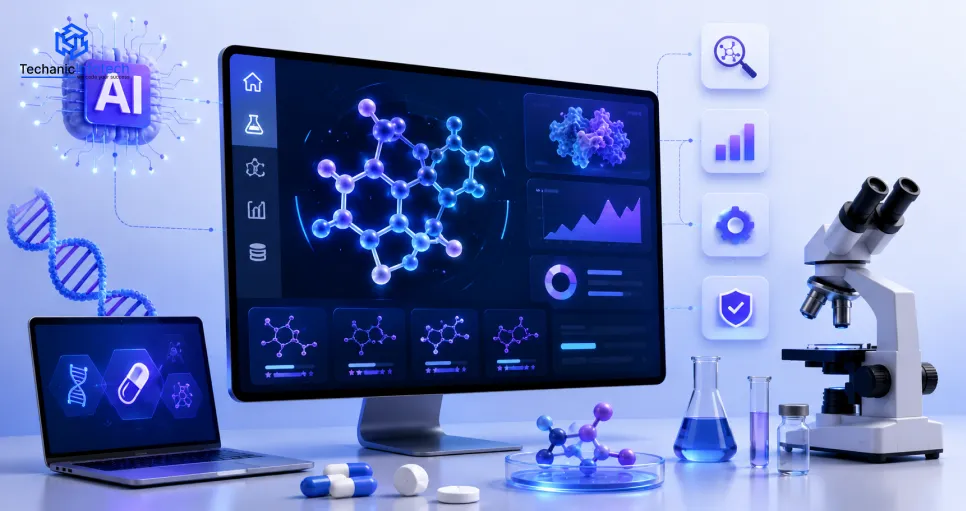
Today, AI drug discovery software development is transforming this process by enabling researchers to analyse massive biological datasets, predict molecular interactions, identify promising drug candidates, and accelerate research using artificial intelligence. Modern healthcare AI software development combines machine learning, bioinformatics, cloud computing, and predictive analytics to support faster and more efficient pharmaceutical research.
Whether developing platforms for pharmaceutical companies, biotechnology firms, or research institutions, investing in intelligent drug discovery software helps reduce development timelines, improve research accuracy, and increase the likelihood of successful drug development.
Artificial intelligence is changing the pharmaceutical industry by automating complex research activities that previously required years of manual effort. Instead of relying solely on traditional laboratory experimentation, researchers can now analyse enormous datasets, identify hidden biological patterns, and predict potential drug candidates with significantly greater speed and accuracy.
Traditional drug discovery requires scientists to examine thousands or even millions of chemical compounds before identifying potential candidates. AI in drug discovery significantly accelerates this process by analysing molecular structures, predicting biological activity, and prioritising compounds with the highest probability of success.
Machine learning algorithms continuously learn from historical research data, scientific literature, genomic databases, and clinical studies. This data-driven approach reduces human error while improving prediction accuracy throughout the drug discovery process.
Early identification of ineffective compounds reduces unnecessary laboratory testing and clinical research expenses. By minimising failed experiments, pharmaceutical organisations can allocate research budgets more efficiently and accelerate innovation.
AI enables researchers to analyse patient genetics, biomarkers, and disease characteristics to develop more personalised treatment strategies. This supports precision medicine by helping identify therapies that are more likely to be effective for specific patient populations.
The growing adoption of AI in pharmaceutical research complements innovations in digital therapeutics app development, creating opportunities for more personalised and data-driven healthcare solutions. Together, these technologies are reshaping how diseases are prevented, managed, and treated through intelligent digital ecosystems.
By processing complex biomedical information in hours rather than months, AI enables researchers to explore new therapeutic targets, discover novel compounds, and bring innovative treatments to patients much faster than traditional research methods.
Modern Drug Discovery Software development combines artificial intelligence, biological research, and advanced data analytics to accelerate every stage of pharmaceutical innovation. Instead of replacing researchers, AI assists scientists by processing enormous datasets, identifying promising drug candidates, and supporting faster scientific decision-making.
The first stage focuses on identifying biological targets associated with specific diseases. AI analyses genomic data, scientific publications, protein interactions, and clinical research to uncover potential targets that may respond to new therapeutic compounds.
Once a target is identified, AI rapidly evaluates millions of chemical compounds to determine which molecules have the highest probability of interacting effectively with the target. This significantly reduces the time required for initial compound screening.
One of the most valuable applications of machine learning in drug discovery is predicting molecular behaviour before laboratory testing begins. AI models estimate drug efficacy, toxicity, bioavailability, and potential side effects, allowing researchers to eliminate low-potential candidates early in the discovery process.
After identifying promising compounds, researchers refine their chemical structures to improve effectiveness while minimising toxicity. AI simulations help evaluate different molecular modifications, reducing the number of costly laboratory experiments required during optimisation.
Before entering clinical trials, AI analyses laboratory findings, biological responses, and experimental results to assess whether a drug candidate is suitable for further development. This data-driven evaluation improves research efficiency while supporting better scientific decisions.
AI continues to provide value during clinical development by assisting with patient recruitment, monitoring trial outcomes, identifying biomarkers, and analysing treatment effectiveness using real-time clinical data.
Successful AI drug discovery platform development requires much more than predictive algorithms. Modern pharmaceutical platforms integrate artificial intelligence, scientific databases, cloud computing, and advanced analytics to support researchers throughout the entire drug discovery lifecycle.
The platform should securely organise chemical libraries, genomic datasets, protein structures, laboratory records, and research documentation, allowing scientists to access and analyse information efficiently.
Modern AI-powered drug discovery solutions automatically evaluate chemical compounds, identify promising candidates, predict biological interactions, and prioritise molecules for laboratory validation.
Comprehensive bioinformatics software development enables researchers to analyse DNA sequences, protein structures, molecular pathways, and genomic information within a unified research environment. These capabilities accelerate scientific discovery while improving research accuracy.
Drug discovery involves multidisciplinary teams working across multiple locations. Built-in collaboration tools, shared workspaces, secure document management, and version control improve communication between researchers, pharmaceutical companies, and research institutions.
Interactive dashboards transform complex scientific data into easy-to-understand visualisations, helping researchers monitor project progress, compare compound performance, and generate evidence-based reports.
Many organisations are also exploring AI symptom checker app development alongside pharmaceutical AI research to create connected healthcare ecosystems where clinical insights, patient data, and drug discovery research can complement one another and support future healthcare innovations.
Developing enterprise-grade pharmaceutical research software requires more than integrating artificial intelligence models. A successful platform must combine secure cloud infrastructure, scalable computing resources, scientific databases, compliance standards, and intelligent analytics to support continuous innovation. Modern pharmaceutical AI software development focuses on building reliable systems that accelerate research while maintaining data accuracy and regulatory compliance.
Drug discovery platforms process enormous volumes of genomic sequences, molecular structures, clinical datasets, and research publications. A cloud-native architecture with distributed computing enables researchers to analyse large datasets efficiently while supporting future scalability.
Machine learning, deep learning, and predictive analytics help researchers identify drug candidates, forecast molecular interactions, optimise compounds, and improve clinical decision-making. Businesses planning healthcare AI initiatives often begin with an AI app development guide to better understand AI implementation strategies, model selection, and deployment best practices.
Pharmaceutical organisations manage highly sensitive research data that must comply with international regulations and industry standards. Implementing encryption, role-based access control, audit trails, secure APIs, and continuous monitoring helps protect intellectual property and confidential research information.
Modern research teams often work across laboratories, universities, pharmaceutical companies, and healthcare institutions. Secure collaboration portals, centralised document management, and real-time data sharing improve communication while accelerating scientific discoveries.
Building intelligent pharmaceutical platforms requires expertise in artificial intelligence, cloud computing, healthcare regulations, and enterprise software architecture. Partnering with an experienced mobile app development company enables organisations to build scalable healthcare solutions while reducing technical complexity and accelerating product delivery. Businesses can also leverage mobile app development services for end-to-end products. development, from system architecture and UI/UX design to deployment and ongoing maintenance.
Pharmaceutical startups and research organisations should develop flexible software architectures that can evolve alongside scientific advancements. Investing in Software Development for SMBs allows smaller biotech companies to adopt scalable AI technologies without the high infrastructure costs typically associated with enterprise research platforms.
The AI drug discovery software cost typically ranges from $10,000 to $100,000+, depending on the platform's complexity, AI models, bioinformatics capabilities, cloud infrastructure, regulatory requirements, third-party integrations, and computing resources. A basic research platform requires a lower investment, while enterprise-grade AI drug discovery systems with advanced predictive analytics, genomic data processing, and high-performance computing demand a significantly larger budget.
AI Research MVP:
Best For: Startups, universities, and research laboratories
Investment: $10,000–$20,000
Timeline: 2–3 Months
Includes: Basic compound screening, user management, research dashboard, cloud deployment, and core AI functionality.
Standard Pharmaceutical AI Platform:
Best For: Biotech companies and growing pharmaceutical organizations
Investment: $20,000–$45,000
Timeline: 3–5 Months
Includes: Molecular analysis, predictive AI models, bioinformatics integrations, reporting dashboards, and collaboration tools.
Advanced AI Drug Discovery Platform:
Best For: Mid-sized pharmaceutical companies
Investment: $45,000–$75,000
Timeline: 5–7 Months
Includes: Machine learning models, genomic data analysis, molecular simulations, advanced analytics, workflow automation, and high-performance cloud infrastructure.
Enterprise AI Drug Discovery Ecosystem:
Best For: Global pharmaceutical enterprises and large research institutions
Investment: $75,000–$100,000+
Timeline: 7–10 Months
Includes: Enterprise-grade AI, multi-cloud deployment, laboratory integrations, advanced bioinformatics, compliance management, predictive analytics, and large-scale research collaboration.
A biotechnology company sought to accelerate the identification of promising drug candidates for rare disease research. Its traditional discovery process relied heavily on manual analysis of scientific literature, laboratory testing, and molecular screening, resulting in lengthy research cycles and high operational costs.
The organisation implemented an AI-powered drug discovery platform capable of analysing genomic datasets, predicting molecular interactions, and ranking potential compounds based on their likelihood of therapeutic success. Researchers also gained access to centralised dashboards for monitoring experiments and collaborating across multiple research teams.
Within the first year of deployment, the company achieved:
Faster identification of promising drug candidates.
Reduced time spent on initial compound screening.
Improved prediction accuracy for molecular interactions.
More efficient collaboration between research teams.
Lower research costs through AI-assisted decision-making.
Artificial intelligence is redefining the future of pharmaceutical research by enabling faster discoveries, smarter scientific analysis, and more efficient drug development processes. As AI technologies continue to evolve, organisations investing in intelligent research platforms will be better positioned to accelerate innovation, reduce development timelines, and improve healthcare outcomes.
Building scalable and secure AI drug discovery software today creates a strong foundation for future advancements in precision medicine, personalized therapies, and next-generation pharmaceutical research
AI drug discovery software development involves creating intelligent platforms that use artificial intelligence, machine learning, and data analytics to accelerate pharmaceutical research and identify potential drug candidates.
Development costs typically range from $10,000 to $100,000+, depending on AI capabilities, bioinformatics integrations, platform complexity, and infrastructure requirements.
AI analyses large biomedical datasets, predicts molecular interactions, identifies promising compounds, and reduces the time required for pharmaceutical research.
Common technologies include machine learning, deep learning, cloud computing, bioinformatics, predictive analytics, natural language processing, and high-performance computing.
No. AI supports researchers by automating data analysis and generating insights, while scientists continue to make critical research and clinical decisions.
Pharmaceutical companies, biotechnology firms, research institutions, healthcare organisations, and academic laboratories all benefit from AI-driven drug discovery platforms.
Development generally takes 2 to 10 months, depending on the platform's complexity, AI capabilities, scientific integrations, and compliance requirements.


Abhishek Jangid is the CEO of Techanic Infotech, with extensive experience in mobile app and web development. He specializes in helping businesses turn innovative ideas into scalable digital solutions through strategic planning and modern technology.