Mobile App Development
Cost Build a Game Like Block Blast: Everything You Need to Know!
April 18, 2026
April 18, 2026
Developing a puzzle game like Block Blast requires careful planning, technical expertise, and budget alignment.
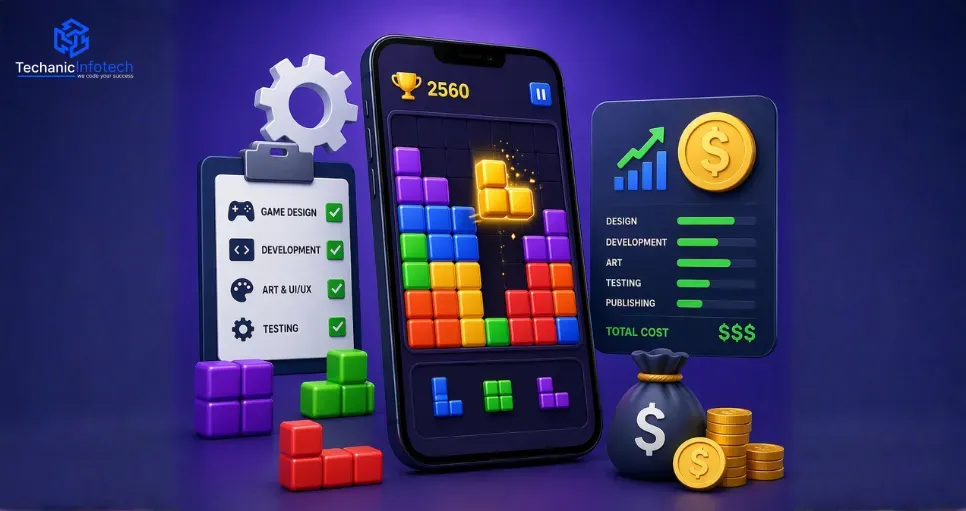
The overall cost can range from $8,000 to $70,000+, depending on features, design complexity, platforms, and development team location.
A basic version with minimal UI and simple mechanics sits on the lower end, while advanced versions with animations, multiplayer features, and monetization systems increase the cost significantly.
Understanding these cost components helps businesses and startups make informed decisions, optimize resources, and ensure a smooth development process while delivering an engaging and scalable gaming experience to users.
Mobile app development cost depends on multiple variables, including features, complexity, team expertise, and technology stack. Understanding these factors ensures better budget planning and efficient project execution.
Simple apps cost less due to fewer features, while complex apps with real-time functionality, AI, or multiplayer systems require higher investment.
Complexity affects development time, testing efforts, and infrastructure, making it a primary cost determinant for any mobile or web application.
Choosing between Android, iOS, or cross-platform development significantly impacts costs.
Native apps require separate development efforts, increasing expenses, whereas cross-platform frameworks reduce costs but may limit performance or customization in certain advanced applications.
A visually appealing and intuitive interface requires skilled designers, increasing costs.
Custom animations, interactive elements, and user-friendly layouts demand additional time and expertise, making mobile app design a crucial factor in enhancing user engagement and retention.
Hiring developers from regions like North America costs more compared to Asia or Eastern Europe.
Rates vary based on expertise and market demand, making location a significant factor in determining the overall app's minimum viable product development budget.
Apps requiring servers, databases, and APIs incur higher costs.
Scalable backend systems, cloud integration, and real-time data processing demand advanced development, increasing both initial investment and ongoing maintenance expenses.
Game development costs are driven by design quality, gameplay mechanics, technology stack, and feature integration.
These factors collectively determine the investment required for a successful puzzle game.
Developing engaging gameplay mechanics requires research, prototyping, and testing.
Puzzle balancing, level progression, and smooth interactions demand time and expertise, significantly contributing to overall development costs.
High-quality visuals and animations enhance user experience but increase costs.
Custom assets, transitions, and effects require skilled designers and tools, making this a major cost driver in the game mobile app development process.
Integrating ads, in-app purchases, and reward systems adds complexity.
These features require backend integration, analytics, and compliance with app store guidelines, increasing development time and cost.
Choosing the right engine (like Unity) and programming tools impacts cost.
Advanced technologies improve performance but require experienced developers, leading to higher expenses during development.
Extensive mobile app testing ensures bug-free performance across devices.
Quality assurance involves multiple iterations, device compatibility checks, and performance optimization, which contribute significantly to development costs.
Building an app similar to Block Blast, especially one that combines gameplay with mobile app features like barcode scanning and health insight.
It can vary significantly in cost depending on complexity, design, and technology choices. Below is a structured breakdown of development costs based on app sophistication.
A basic version typically includes barcode scanning functionality, a limited product database, and a straightforward, minimalistic interface.
Development for this level usually costs between $8,000 and $15,000, making it ideal for startups or individuals aiming to launch quickly and test their concept in the market.
However, this version comes with limitations such as restricted scalability, basic backend support, and minimal performance optimization.
A mid-tier application contains features often include user registration, personalized recommendations, saved favorites, and a more polished interface with smoother navigation.
The cost for developing a mid-level app generally ranges from $15,000 to $35,000. This investment allows for better performance, increased reliability, and the ability to support a growing user base.
It is well-suited for businesses looking to enhance user engagement and gradually scale their platform.
An advanced version typically incorporates AI-driven recommendations, detailed health or nutritional insights, real-time product data updates, and a robust cloud-based infrastructure.
Development costs at this stage usually fall between $35,000 and $70,000+, depending on customization, integrations, and the chosen technology stack.
This level also includes advanced analytics, machine learning capabilities, and seamless cross-platform performance for a premium user experience.
Integrating third-party services significantly enhances app functionality. These may include external nutrition databases, secure payment gateways, analytics tools, and authentication systems.
While valuable, these integrations can increase overall development costs due to API complexity, licensing requirements, and additional development time.
Post-launch mobile app maintenance is essential to ensure the app remains functional, secure, and competitive.
This includes bug fixes, security updates, performance improvements, and ongoing feature enhancements.
Regular updates also ensure compatibility with evolving operating systems and help maintain user trust.
Typically, maintenance costs range from 15% to 25% of the initial development cost annually.
Several development companies provide cost-effective solutions for building puzzle games like Block Blast, offering flexible pricing based on project complexity, features, and customization requirements.
Techanic Infotech provides cost-effective app and game development services, with pricing starting at approximately $8,000 for basic applications and reaching up to $40,000 for more advanced solutions.
The mobile app development company emphasizes affordability without compromising essential functionality, making it a strong option for startups and small businesses.
Their approach focuses on efficient project delivery, streamlined development processes, and building scalable applications that can grow alongside business needs while maintaining budget constraints.
Apptunix offers scalable and high-performance game development services, with costs typically ranging from $15,000 to $60,000 or more, depending on project complexity and features.
The company is recognized for delivering feature-rich applications with modern UI/UX designs and reliable backend systems.
Their development approach ensures flexibility, allowing businesses to scale their applications as user demand increases, while maintaining strong performance, security, and an engaging user experience.
AppInventiv is a premium development firm that delivers enterprise-grade applications, with pricing generally ranging from $25,000 to $70,000 or higher.
They specialize in building highly scalable, secure, and feature-rich solutions using cutting-edge technologies.
Their expertise includes advanced integrations, data-driven features, and seamless performance optimization.
TechAhead provides mid to high-range app and game development services, with pricing between $20,000 and $65,000 depending on the scope and requirements.
The company focuses on performance optimization, intuitive interface design, and robust backend infrastructure.
Their solutions are designed to ensure smooth functionality and scalability, making them suitable for businesses that want reliable, high-quality applications capable of handling growing user bases and delivering consistent user experiences.
Suffescom Solutions offers flexible and customized development services, with costs ranging from $10,000 to $50,000 based on project complexity and feature requirements.
The company is known for delivering tailored gaming solutions that balance affordability with quality.
Their development process emphasizes client collaboration, efficient execution, and scalable architecture, ensuring that businesses receive reliable applications that meet their specific needs while remaining within budget limits.
Developing a game like Block Blast involves multiple stages, each directly impacting overall cost, mobile app development timeline, and complexity.
From planning to post-launch support, every phase requires resources, expertise, and careful execution.
This initial stage defines the game idea, mechanics, target audience, and monetization strategy. It involves market research, competitor analysis, and feature planning.
Although relatively low in cost, poor planning can lead to expensive changes later, increasing overall development expenses and delays significantly.
Designing intuitive interfaces and engaging user experiences is crucial for puzzle games like Block Blast. This stage includes wireframes, prototypes, and visual assets.
Costs increase with design complexity, animations, and custom graphics, as polished visuals directly influence user retention and overall game appeal.
This is the most resource-intensive phase, where developers build core mechanics, logic, and features. Costs depend on game complexity, platform choice, and mobile app tech stack.
Advanced features like multiplayer modes or AI elements significantly increase development time, effort, and overall budget requirements.
Testing ensures the game runs smoothly across devices and is free from bugs or glitches. This stage involves functional, performance, and usability testing.
Higher testing standards and broader device compatibility increase costs but are essential for delivering a stable and enjoyable user experience.
Launching the game on platforms like app stores involves final optimization, compliance checks, and submission processes.
Costs include developer accounts, marketing preparation, and initial promotion.
A well-planned launch strategy can improve visibility but may require additional investment in marketing efforts.
Post-launch support includes bug fixes, performance improvements, and adding new levels or features. This stage requires ongoing investment, often monthly or yearly.
Regular updates keep users engaged, improve retention, and ensure the game remains competitive in an evolving market environment.
Building a game like Block Blast involves multiple cost factors, from design and development to testing and maintenance.
With an estimated budget ranging from $8,000 to $70,000+, businesses can choose between basic, mid-level, or advanced solutions depending on their goals.
Additionally, selecting the right development company plays a crucial role in balancing cost and quality.
Whether you're a startup or an established business, investing strategically in game development ensures a scalable, engaging, and profitable product in the competitive mobile gaming market.
The cost typically ranges from $8,000 to $70,000+, depending on features, design quality, platform selection, and the expertise of the development team.
Key factors include game complexity, UI/UX design, platform choice, backend requirements, monetization features, and the location and experience of the development team.
Development usually takes around 2 to 6 months, depending on the complexity of features, level design, testing requirements, and overall project scope.
Yes, a basic version with core gameplay and minimal design can be built within a budget of $8,000 to $15,000 for initial market validation.
Game engines like Unity and programming languages like C# are widely used due to their flexibility, performance, and cross-platform development capabilities.
Basic versions may not require a backend, but advanced features like leaderboards, cloud sync, and real-time updates require robust backend systems.
They typically earn through in-app advertisements, in-app purchases, reward-based ads, and premium features that enhance gameplay experience.
Maintenance, updates, bug fixes, and server costs usually require 15–20% of the initial development cost annually to ensure performance and scalability.
Launching on both Android and iOS is ideal, but cross-platform development helps reduce costs while reaching a wider audience efficiently.
Evaluate their portfolio, client reviews, pricing structure, technical expertise, and ability to deliver scalable, high-quality gaming solutions within your budget.


Bharat Sharma is the CTO of Techanic Infotech, bringing deep technical expertise in software architecture, mobile app development, and scalable system design. He leads the engineering team with a strong focus on innovation, performance, and security.