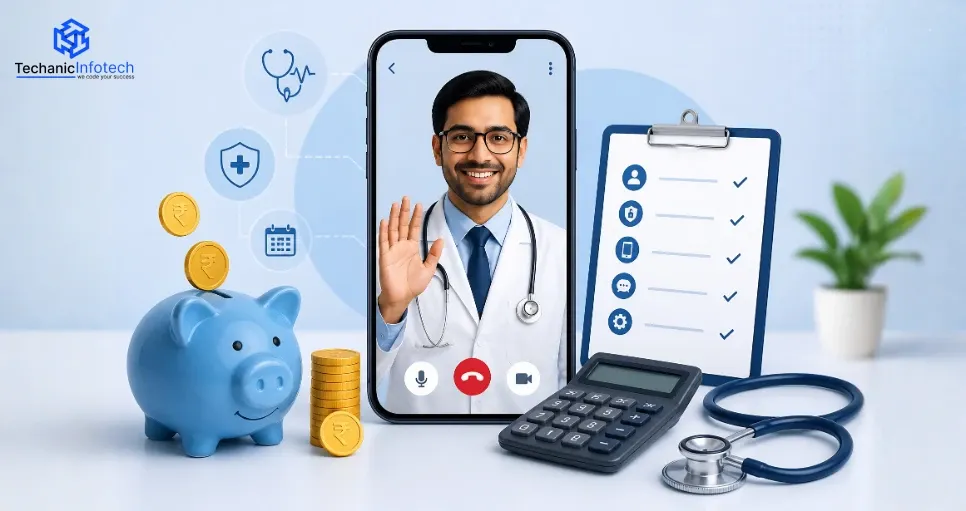
From the 21st century onwards, the demand for healthcare solutions surged, particularly on-demand services connecting patients with healthcare providers.
A doctor-on-demand app has appeared as a huge shift in the healthcare industry that allows users to access medical help via their smartphones.
However, many entrepreneurs and business owners face a crucial question: what is the actual cost to develop a doctor on-demand app?
Well, cost is a variable factor. So, the doctor on-demand app development cost can be somewhere between $20,000 to $100,000. But this range can change depending on the growing requirement of the project.
In this blog, we will break down the key factors influencing the cost of a doctor on-demand app, offering insights and statistics to help you make informed decisions.
Whether you’re a startup founder or an established business looking to enhance your healthcare offerings, this guide will equip you with the needed knowledge.
We will learn more, but first, what is a doctor on-demand app?
Doctor on-demand services are a huge leap in how the health sector happens. Patients are provided instant access to medical professionals through some app or site by clicking a few buttons from the comfort of their own homes.
The platform allows users for a consultation virtually, receive diagnoses, and order medications from licensed health professionals without leaving their houses.
Typical features of such apps include video consultation, scheduling appointments, and secure payment options.
One of the most effective ways these services work is by establishing a gateway to healthcare, eliminating the long wait times of doctors, travel times, and geographical restrictions on patients.
This new approach is beneficial, especially for people who are otherwise in need of instant care or who live in less-developed areas.
So, are you thinking of developing a doctor-on-demand app? Excellent choice!
These apps are modernizing how people access healthcare. Having the best functionalities makes all the difference.
Let’s look at the must-have features that will make your application user-friendly and effective.
First things first: you need a seamless user registration process.
Both the patient and doctor should be able to set up secure accounts with ease. Keeping sign-up simple will get you many more users on your platform.
Social media login options will ease the journey further. An effortless progression into the app will create a good impression from the start.
Once users enter, they should be able to easily manage their profile and their doctors.
Patients can be able to add personal health records, preferences, and other information they deem suitable.
It gives control over information so that users feel empowered.
You might also want to include document and prescription upload options because after all such convenience and integration enhance user experience!
First, you need to ensure appointments can take place without any hassle for the user. Second, this requires an intuitive appointment scheduling feature.
Let users choose in their effortlessness among time slots while running through their busy lives. Thus, automate reminder notifications to reduce no-shows and keep everyone on track.
Say goodbye to long waiting times and welcome improved satisfaction ratings among users!
Let’s face it, today’s healthcare thrives on convenience.
Video and audio consultations mean that patients can easily connect with doctors right from their homes.
This means time-saving and increased accessibility to complex healthcare. Establish an easy-to-use interface to encourage its utilization.
It is as though the doctor is in your pocket, yawning their way into helping you!
Patients are passionate about simplicity, and we all want to make prescription management digital.
In such a way, doctors can send prescriptions directly to users with this feature.
It saves time while eliminating the chance of losing notes. Consider integrating a pharmacy locator for the convenience of picking them up.
It keeps them coming back for more!
Make things as easy as pie for your users when it comes to making their payments.
When various payment options are integrated with credit cards, PayPal, and mobile wallets-it helps with security and convenience for the user.
Make sure you provide transparent pricing to avoid confusion and build trust with your customers.
A smooth payment process means more satisfied users!
Quick questions can pop up anytime, so be prepared!
Chat features allow the patients to reach out to doctors regarding follow-up. There is no need to set up another appointment, hence saving time for all.
Consider adding chatbots for common inquiries to enhance efficiency. This personal touch can greatly enhance the overall healthcare experience.
Help users make informed choices with a reviews and ratings system. This feature provides an open forum for patients to share their opinions on doctors.
The more information is available, the more trust is built, and, thus, high-quality service is encouraged. Consider highlighting the top doctors to guide the new users.
This feedback helps you determine what areas require improvement!
Life can be unpredictable; a user should be able to access emergency services as soon as possible. After all, an emergency services feature gives immediate care to its users.
This could be direct links with nearby hospitals or urgent care centres. Provide clear instructions on what to do in an emergency.
The layer of peace of mind for your users!
Last but not least, consider attaching health-tracking capabilities to your app. This convenient feature lets users follow their vital signs and symptoms over time.
Thus, health progress can be seen by the doctor and patient alike. You may also incorporate reminders for medications or appointments.
Being proactive about health will improve the outcomes!
As you understand the features needed to create a doctor-on-demand app, it’s time to talk about the investment required to build your app.
So, you are excited to build your doctor on demand app. But before you start working on it, let's discuss how much it costs to create a doctor-on-demand app.
Knowing how much financial investment will be required helps you plan better. The general doctor on-demand app cost estimation is within the range of $20,000 to $100,000.
This ranges based on several factors, including features, design, and the location of the development team.
Let's break this down further. Here is a simple table of the probable cost of the doctor demand app:
| Feature | Cost |
|
Basic App |
$20,000 - $30,000 |
|
Advanced App |
$30,000 - $50,000 |
|
Enterprise-level App |
$50,000 - $100,000 |
Prices can vary as per your project requirements, so make sure to consult with your mobile app development company.
If you want to make a better decision, it’s time to know about the factors that influence the Doctor Appointment App development cost.
Understanding the various components that contribute to the overall cost is essential. So, here are the primary factors:
There are must-haves for any doctor on-demand app. Think of user registration, appointment scheduling, and video consultations.
Including these core features generally can be from $2,000 to $5,000 for a basic app. However, they are fundamental, let’s say they are only just the foundation.
Now let's take a look at those advanced functionalities that can raise the game.
Features like prescription management, chat features, and health tracking add up to do quite a lot for the user experience.
But then, of course, you should factor in that every one of these features will send your total cost to develop a doctor-on-demand app up by anywhere from $5,000 to $10,000 or more.
The more elaborately full-featured your version is, the greater your budget will need to be!
Platform selection is one of the most crucial decisions when you are building your doctor on-demand app.
You can opt for Android or iOS app development services or both, which is a highly significant factor in deciding the cost to develop a doctor's appointment app and the reach of your development process.
Now, let's discuss why platform selection is one of the top features and how it impacts the success of your app.
Android vs. iOS: What's Your Understanding?
Android is the most widely used mobile operating system worldwide.
By opting for Android app development services, it might enable you to reach a wider audience, especially in cosmopolitan markets.
However, development might be much more diverged depending on the number of devices and different screen resolutions.
You should expect the cost to build a doctor-on-demand app to range from $15,000 to $ 50,000 in terms of development, depending on what you want.
iOS, on the other hand, attracts a different kind of user.
If you opt for iOS application development then your target will be a richer customer base, especially in North America and Western Europe.
iOS applications tend to fetch more revenues from in-app purchases and subscriptions, whereas its user base is smaller.
The cost of iOS application development varies between $20,000 to $50,000 depending upon the scale of complexity.
If you want to reach out to maximum people without spending double the money, the best thing is cross-platform development.
You will be able to create an app that can run on both Android and iOS using frameworks like React Native or Flutter. However, with this option being less time and money-consuming, it has some performance and user-experience limits.
A cross-platform app that is well-built will cost you about $20,000 to $40,000.
Let us now speak of the design. We all know that first impressions count.
A clean, organized design could distinguish your app.
The catch, however, is that the more features you wish to incorporate; the more design is becoming that much complicated.
As a solution, directly consider the intentions of the color patterns, layout, and user navigation.
Such a polished design may also provide a great user experience and, in turn, contribute to engagement and retention.
Good designs might increase your average Doctor-on-demand app development cost in the beginning, but they'll pay off later on.
Next is the location of your development team. The location of your team can affect your Doctor on Demand App Development Cost.
For example, developers from North America may charge more than developers from Eastern Europe or Asia.
Do not be taken in by price alone.
Consider the quality and experience of the developers, too. You want a team that understands not only the technical aspect but also your vision.
The right balance between cost and expertise is essential. Here is a table showing the hourly rates of developers:
| Region | Estimated Hourly Rate |
|
North America (USA, Canada) |
$100-$150 |
|
Western Europe (UK, Germany, France) |
$80-$120 |
|
Australia |
$80-$120 |
|
Eastern Europe (Ukraine, Poland, Romania) |
$30-$60 |
|
Asia (India, Philippines, Vietnam) |
$20-$50 |
Now, it is time to talk about a biggie-regulatory compliance and security. With healthcare apps, compliance is not an option, it’s a necessity.
If you plan to enter the U.S., you'll need to comply with a regulation such as HIPAA. This means your app needs to have strong security measures protecting the sensitive data of the patient.
While you'd be adding doctor appointment app development cost, it is critical for the trust you'd garner from the users.
Investing in compliance is about much more than just preventing fines. It is creating a safe space where your patients can be.
A central task in developing a doctor on-demand app is added integrations with a variety of external systems like electronic health records (EHR), payment gateways, and scheduling tools themselves.
It would be fair to say these integrations will enhance the efficiency and working of the app; however, they could very well sound like extra overhead when it comes to the cost of the doctor demand app.
The applications programming interfaces (APIs) play a very crucial role concerning the more complex ecosystems that demand more time and development skills.
Let it therefore be conscious of setting aside resources to meet the security provisions to comply with the healthcare rules and regulations.
All this goes to say that proper attention should be given to budgeting analysis here while offering an admirable plan for app development.
| Integration | Complexity | Development Time | Licensing/Subscription Fees | Potential Costs |
| Payment Gateways (Stripe, PayPal) | Low | Moderate | Subscription fees | Moderate |
| Mapping APIs (Google Maps) | Moderate | Moderate | Usage-based fees | Moderate |
| Electronic Health Records (EHRs) | High | High | Licensing fees | High |
| Telemedicine Platforms | High | High | Licensing fees | High |
| Real-time Data Feeds (Weather, Traffic) | Moderate | Moderate | Subscription fees | Moderate |
| Social Media APIs (Facebook, Twitter) | Moderate | Moderate | Free or usage-based | Moderate |
| Chatbots and AI Services | High | High | Subscription fees | High |
| Cloud Storage (AWS, Google Cloud) | Moderate | Moderate | Usage-based fees | Moderate |
Application testing is a must if you are serious about the working and reliability of your on-demand doctor app.
It should include functional testing, unit testing, integration testing, user acceptance testing (UAT), and security testing, all aimed at ensuring that the application works well and satisfies regulatory norms.
This whole cycle of testing may lengthen your development time, leading to increased doctor-on-demand app development costs, especially where bugs are discovered later in the cycle.
Understanding all these is a part of getting a better app within budget. With that being said, let’s understand the time taken to make a doctor-on-demand app.
Doctor on-demand app development cost is going to take 6 to 9 months.
The first step is planning or research in which you outline features and understand your target audience.
This would take a few weeks and then comes design, which focuses on developing an attractive and easy interface that is four to eight weeks approx.
This is where the actual coding happens, and in total, this stage may last between two and four months.
Afterward, a rigorous testing process will be in place to ensure everything works as it should. This will add yet another month to the timeline.
And guess what? Launching your app is only the first step, but actual support and updates will keep it relevant and user-friendly!
| App Complexity | Development Time |
| Basic App (Core features: user registration, appointment scheduling, video/audio consultations) |
2-4 months |
| Advanced App (Additional features: prescription management, health tracking, chat functionality) |
3-6 months |
| Enterprise-Level App (Complex integrations, customization, advanced analytics) |
8-9 months |
So, you're diving headfirst into this telehealth world with your doctor-on-demand app. How cool is that?
Time to cut to the chase: how are you going to monetize it?
Let's get into some monetization strategies that will help you translate passion into profit.
One of the most common ways of monetizing an app like yours is through subscription models. You can offer several tiers of service. For example, a basic plan can grant access to consultation services in limited numbers per month.
However, the premium plan can avail unlimited consultations, speedy responses, and even health content that no one else gets. That also brings you an uninterrupted flow of revenue and user loyalty enforced on the users. The more value you deliver the better your chances of keeping them around.
If subscriptions are not really what you want to pursue then you can very well go with pay-per-consultation. This enables users to pay only when they need to speak with a doctor.
You could charge a flat fee per visit, which is always quite attractive to people who do not want to commit long-term. And, for that matter, it's easy enough for users to understand. They will appreciate being able to attain healthcare without the headache of bills that follow them month after month.
Another spin is through corporate partnerships. Partner with companies as part of the employee benefits deal.
Companies always look for ways to help their employees' well-being. By providing your application, you're enabling them to achieve this.
Win-Win: You are getting a reliable source of users and employees can get to healthcare in a jiffy.
Don't forget about those in-app purchases!
You can provide more options, such as personalized wellness plans, healthy materials, or even access to extra content.
Users like options, and these can really make the overall experience richer.
Just think of it as adding value to your application - making it even more inviting to the potential user.
If you have a healthy enough users' base, advertising is also an option. Now, consider partnering with health-focused brands or local clinics to insert their ads into your application.
Be cautious though. Ensuring that the ads are relevant and not annoying, you'll build a superior user experience but make some money.
Lastly, consider selling telehealth products outright through your application. This could be health supplements or any kind of medical device.
If your users are trusting of your platform, they're probably going to buy any merchandise that you recommend. It is a good way to add further value while building your income stream.
With the right approach, you’ll not only help people access healthcare but also build a sustainable business.
Now, we believe an idea of all this, so it’s time to take a look at a market-leading company that can help you launch your app and make profits.
Ready to turn your idea into reality?
Then, take the help of Techanic Infotech, the best doctor on-demand app development company that will help you to understand your goals.
As the market is growing at a tremendous rate, now is the time to take steps ahead and get yourself a doctor-on-demand within your budget that is convenient for both patients and providers.
With continuing support, we are always right there for you.
In conclusion, the cost of developing a doctor-on-demand app is a dynamic factor influenced by various elements.
While the average range falls between $20,000 and $100,000, it can vary significantly based on features, platform choice, design, development team location, regulatory compliance, and integrations.
By carefully considering these factors and understanding the cost breakdown, you can make informed decisions about your project.
Investing in a well-developed doctor-on-demand app can revolutionize healthcare access, offering convenience, efficiency, and improved patient outcomes.
The essential features of a successful doctor on-demand app are as follows: user registration, profile management, appointment scheduling, video/audio consultations, prescription management, payment integration, chat functionality, reviews and ratings, emergency services, and health tracking.
The development timeline can vary from 3 to 6 months, depending on the complexity of the app and the chosen features.
Yes, most doctor-on-demand app development companies can integrate your EHR system to provide a seamless patient experience.
Compliance with regulations like HIPAA (in the US) is crucial to ensure patient data security and privacy.
Techanic Infotech offers comprehensive app development services, including understanding your project goals, designing a user-friendly interface, ensuring regulatory compliance, and providing ongoing support.
The cost depends on factors like features, app complexity, platform (iOS/Android), and development team location. A basic app may cost less, while advanced apps with AI and integrations can be more expensive.
Technologies like Flutter, React Native, Swift, Kotlin, and backend frameworks such as Node.js are commonly used. The choice depends on scalability and performance needs.
Yes, AI can be integrated for features like symptom checking, chatbots, personalized recommendations, and predictive analysis to enhance user experience.
You can ensure security by implementing encryption, secure APIs, multi-factor authentication, and compliance with healthcare regulations to protect patient data.
Yes, a doctor-on-demand app can be designed to support multiple doctors, departments, and specialties, allowing users to choose based on their needs.


Neha Sharma is a tech expert at heart who loves exploring new technologies and turning complex ideas into easy-to-understand content. With a passion for learning and writing, she enjoys sharing insights on emerging tech, digital products, and innovation that help businesses stay ahead.