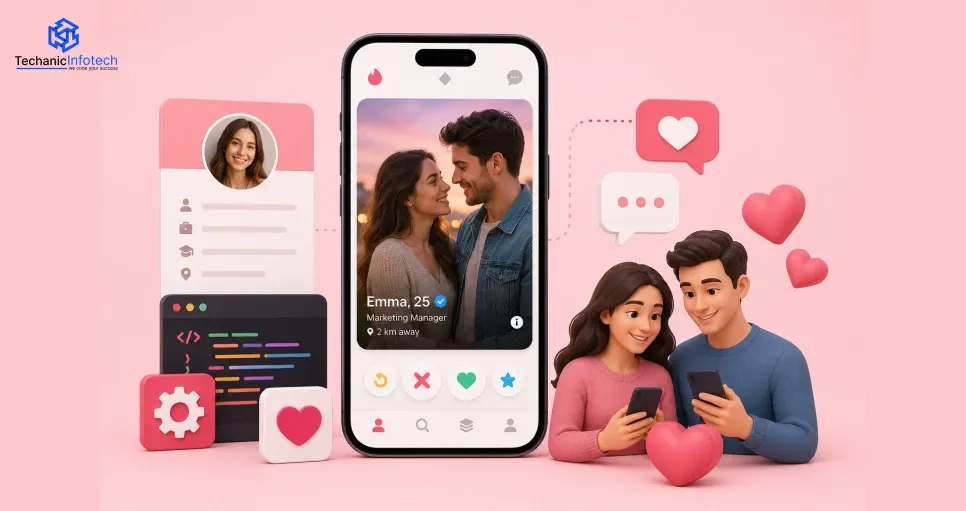
Key Takeaways
The dating app industry is growing rapidly, creating strong opportunities for startups and businesses to launch innovative platforms.
Essential features like matching algorithms, chat systems, geolocation, and security play a major role in dating app success.
Advanced technologies such as AI matching, AR/VR experiences, and gamification can improve user engagement and retention.
The cost to create a dating app usually ranges between $10,000 to $90,000 depending on features, app complexity, and development approach.
Choosing the right development strategy, tech stack, and experienced development partner helps build a scalable and user-friendly dating app.
The online dating industry has transformed how people connect, communicate, and build relationships. From casual conversations to serious relationships, dating apps have become one of the most popular mobile app categories worldwide.
Today, millions of users actively use dating platforms to find meaningful connections based on interests, compatibility, location, and lifestyle preferences. As the demand for digital matchmaking platforms continues to grow, startups and businesses are investing heavily in dating app development.
However, building a successful dating app requires more than just swipe features and messaging systems. Businesses need the right development strategy, engaging features, strong security, AI-powered matching, and scalable infrastructure to compete in this growing industry.
If you are planning to launch your own dating platform, this guide will help you understand how to create a dating app, essential features, development process, monetization strategies, technology stack, and dating app development cost.
A dating app is a mobile platform that helps users discover and connect with compatible people through profile matching, messaging, and real-time interactions.
These applications allow users to:
Create personal profiles
Upload photos and interests
Set dating preferences
Match with compatible users
Chat and interact in real time
Build relationships digitally
Modern dating apps are no longer limited to traditional matchmaking. Today’s platforms support:
Casual dating
Serious relationships
LGBTQ+ communities
Friendship networking
Video dating
Community-based interactions
Popular platforms like Tinder, Bumble, Hinge, and OkCupid have completely changed the online dating ecosystem with personalized matchmaking and engaging user experiences.
The online dating industry is growing rapidly as more users prefer digital platforms for building relationships and social connections.
Here are some important dating app market statistics businesses should know before investing in dating app development:
The global online dating market is expected to surpass $23 billion by 2032.
Millions of users actively use dating apps every day worldwide.
The United States remains one of the largest online dating markets globally.
Subscription-based dating apps generate billions in annual revenue every year.
AI-powered matchmaking and video dating features are becoming major industry trends.
Niche dating apps for communities, interests, and lifestyles are growing faster than traditional platforms.
User engagement on dating apps continues to increase because of personalized recommendations and gamification features.
Video-first dating platforms are becoming increasingly popular among Gen Z and younger audiences.
These statistics clearly show that investing in dating app development can create strong long-term business opportunities for startups and enterprises.
Dating applications continue to attract startups and investors because of their high engagement rates and recurring revenue opportunities.
Millions of users rely on online dating platforms daily to build relationships and connect with like-minded people.
Dating apps generate revenue through subscriptions, premium memberships, virtual gifts, advertisements, and in-app purchases.
Artificial intelligence improves compatibility matching, user recommendations, and engagement personalization.
Businesses can also explore advanced matchmaking systems inspired by AI-powered profile matching vs traditional algorithms.
Niche-based platforms for communities, religion, hobbies, and lifestyle preferences are becoming increasingly popular.
Features are one of the most important elements of successful dating app development.
Here are the essential features every modern dating app should include.
Users should be able to create profiles using:
Photos
Bio descriptions
Interests
Gender preferences
Age preferences
Relationship goals
Detailed profiles improve user trust and matchmaking quality.
Matching algorithms analyze:
Interests
User behavior
Preferences
Swipe patterns
Activity history
Modern dating apps use AI-based recommendations for improved compatibility matching.
Businesses can also learn from how dating app algorithms work to build smarter recommendation systems.
Swipe-based interactions make dating apps engaging and easy to use.
Users can swipe:
Right to like
Left to skip
This feature improves user engagement and simplifies matchmaking.
Communication tools help users interact directly inside the platform.
Important communication features include:
Instant messaging
Voice calling
Video calling
Media sharing
Read receipts
Push notifications help improve retention by alerting users about:
New matches
Likes
Messages
Profile views
Promotions
GPS integration allows users to find nearby matches and location-based recommendations.
Dating apps must prioritize user safety and data protection.
Important security features include:
Two-factor authentication
Profile verification
User reporting
User blocking
End-to-end encryption
Users should be able to filter matches based on:
Age
Distance
Interests
Religion
Lifestyle preferences
Relationship goals
Video calling and virtual dating experiences are becoming increasingly popular in modern dating apps.
Businesses planning video-first platforms can explore insights from how to create a video dating app.
Gamification increases user engagement through:
Badges
Rewards
Quizzes
Daily challenges
Interactive activities
Platforms implementing gamification in dating apps often experience higher user retention.
Advanced technologies can help your dating platform stand out in the competitive market.
AI-powered assistants improve onboarding and user interactions.
Many businesses are integrating AI chatbot in dating apps to improve user engagement.
AR and VR technologies create immersive dating experiences and virtual meetups.
Apps inspired by AR VR in dating app development are becoming increasingly popular.
Live streaming allows creators and users to interact in real time.
Psychology and behavior-based compatibility systems improve matchmaking accuracy.
Social account integration simplifies onboarding and improves profile authenticity.
Building a successful dating app involves multiple development stages.
Here’s the complete dating app development process.
Market research helps businesses understand:
Target audience
Competitor platforms
User expectations
Industry trends
Monetization opportunities
Research also helps identify gaps in the market and unique business opportunities.
Choosing the right niche helps your app stand out in a crowded market.
Popular niches include:
LGBTQ dating
Muslim dating
Astrology-based dating
Casual dating
Elite dating
Video dating
Businesses can explore niche opportunities inspired by dating app ideas.
Create a detailed roadmap covering:
Core features
Navigation flow
Monetization model
User journey
Security systems
Clear planning reduces development complications later.
Businesses can choose between:
Native Android development
Native iOS development
Cross-platform development
Cross-platform frameworks like Flutter and React Native help reduce development costs and speed up deployment.
Professional mobile app development services can help businesses choose the right development strategy.
A visually attractive and intuitive design improves engagement and user retention.
Modern dating apps focus on:
Easy navigation
Interactive layouts
Fast onboarding
Minimalistic interfaces
You can also gain design insights from dating app design guide strategies.
During development, developers build:
Frontend systems
Backend infrastructure
APIs
Databases
Matching algorithms
Security systems
This stage transforms the app idea into a working product.
Testing ensures the app works smoothly across devices and operating systems.
Testing processes include:
Performance testing
Security testing
Functional testing
Compatibility testing
Proper QA reduces post-launch issues.
After testing, the app is submitted to:
Google Play Store
Apple App Store
Businesses should also focus on App Store Optimization (ASO) to improve visibility.
Dating app development is an ongoing process.
Post-launch maintenance includes:
Bug fixes
Feature updates
Security patches
Performance optimization
Businesses can also follow strategies from dating app maintenance cost and strategy to improve long-term scalability.
Choosing the right technology stack is essential for performance and scalability.
|
Component |
Technologies |
|
Frontend |
Flutter, React Native, Swift, Kotlin |
|
Backend |
Node.js, Python, Laravel |
|
Database |
PostgreSQL, Firebase, MongoDB |
|
Cloud Storage |
AWS, Google Cloud |
|
Push Notifications |
Firebase Cloud Messaging |
|
Video Calling |
WebRTC, Agora |
|
Payment Integration |
Stripe, PayPal |
One of the most common questions businesses ask is:
“How much does it cost to create a dating app?”
The dating app development cost usually ranges between $10,000 to $90,000+ depending on app complexity, features, technologies, and development approach.
Here’s a quick breakdown:
|
App Type |
Estimated Cost |
|
Basic Dating App |
$10,000 – $25,000 |
|
Medium Complexity App |
$25,000 – $50,000 |
|
Advanced Dating Platform |
$50,000 – $90,000+ |
Several factors affect the final development budget, including:
App complexity
Matching algorithm
UI/UX design quality
Platform selection
AI integrations
Security systems
Backend infrastructure
Development team location
Businesses planning scalable platforms often consult a professional dating app development company for accurate project estimation.
Building a successful dating app involves several technical, security, and user engagement challenges. Understanding these challenges early helps businesses create a secure, scalable, and user-friendly platform.
Here are the major dating app development challenges along with their solutions.
Dating apps handle sensitive user information including photos, messages, location data, and payment details. Poor security systems can lead to data leaks and loss of user trust.
Solution:
Implement strong encryption, secure APIs, two-factor authentication, profile verification, and regular security audits to protect user information and improve platform credibility.
Fake profiles, bots, and spam users can negatively impact the user experience and reduce platform trust. This is one of the biggest challenges faced by dating applications.
Solution:
Use AI-based moderation tools, phone/email verification, selfie verification, and user reporting systems to identify and remove fake accounts quickly.
Many users uninstall dating apps because of poor matching quality, repetitive experiences, or lack of engagement features. Retaining users becomes difficult without continuous innovation.
Solution:
Add gamification, AI-powered recommendations, personalized notifications, video dating, and interactive features to improve engagement and increase user retention.
Poor matchmaking systems can result in irrelevant profile recommendations and reduced user satisfaction. Users expect highly personalized and compatible matches.
Solution:
Use AI-powered matching algorithms that analyze user behavior, preferences, interests, and interactions to deliver smarter and more accurate recommendations.
As the number of users grows, dating apps may experience server crashes, slow loading speeds, and real-time communication issues if the infrastructure is weak.
Solution:
Use scalable cloud infrastructure like AWS or Google Cloud with CDN integration, load balancing, and optimized backend architecture for better performance.
Real-time messaging and video calling require strong backend systems and low-latency communication. Poor performance can affect user experience significantly.
Solution:
Integrate reliable technologies like WebRTC, Agora, or Twilio with optimized backend servers to ensure smooth communication features.
The online dating market is highly competitive with established platforms like Tinder, Bumble, and Hinge dominating the industry. New apps often struggle to gain visibility.
Solution:
Focus on a niche audience, unique features, personalized experiences, and strong branding strategies to differentiate your dating app from competitors.
Many dating apps struggle to balance monetization with user experience. Excessive ads or aggressive premium models can reduce engagement.
Solution:
Use a balanced monetization strategy that combines subscriptions, freemium models, in-app purchases, and limited advertisements without affecting usability.
Ensuring smooth performance across Android, iOS, tablets, and different screen sizes can increase development complexity and testing efforts.
Solution:
Use cross-platform frameworks like Flutter or React Native along with comprehensive testing to maintain consistent performance across devices.
Dating apps require regular updates, bug fixes, security patches, and new features to stay competitive and maintain user engagement over time.
Solution:
Create a long-term maintenance strategy that includes continuous monitoring, feature enhancements, performance optimization, and regular app updates
Creating a dating app is no longer just about adding swipe features and chat options. Today’s users expect secure platforms, AI-powered matchmaking, real-time communication, personalized recommendations, and engaging user experiences. From selecting the right niche and features to choosing scalable technologies and monetization strategies, every step plays a major role in building a successful dating platform.
As the online dating industry continues to grow globally, businesses have strong opportunities to launch innovative and profitable apps. With proper planning, modern technologies, and the right development strategy, you can create a dating app that attracts users, improves engagement, and stands out in the competitive digital dating market.
The cost to create a dating app usually ranges between $10,000 to $90,000+ depending on app complexity, features, platform selection, UI/UX design, and backend infrastructure requirements.
A dating app typically takes around 4 to 9 months to develop based on features, app complexity, development approach, and testing requirements.
Important dating app features include profile creation, smart matching algorithms, swipe functionality, real-time chat, video calling, geolocation, push notifications, and security systems.
Popular technologies for dating app development include Flutter, React Native, Node.js, Firebase, MongoDB, AWS, and WebRTC for scalable and high-performance applications.
Dating apps generate revenue through subscription plans, premium memberships, in-app purchases, virtual gifts, advertisements, and affiliate partnerships.
AI improves user experience by offering personalized matchmaking, profile recommendations, fake profile detection, smart chat suggestions, and advanced compatibility analysis.
Cross-platform development is more cost-effective and faster for startups, while native development offers better performance, scalability, and advanced customization options.
Dating apps can improve user safety through profile verification, encrypted messaging, two-factor authentication, user reporting systems, AI moderation, and secure data protection measures.


Abhishek Jangid is the CEO of Techanic Infotech, with extensive experience in mobile app and web development. He specializes in helping businesses turn innovative ideas into scalable digital solutions through strategic planning and modern technology.