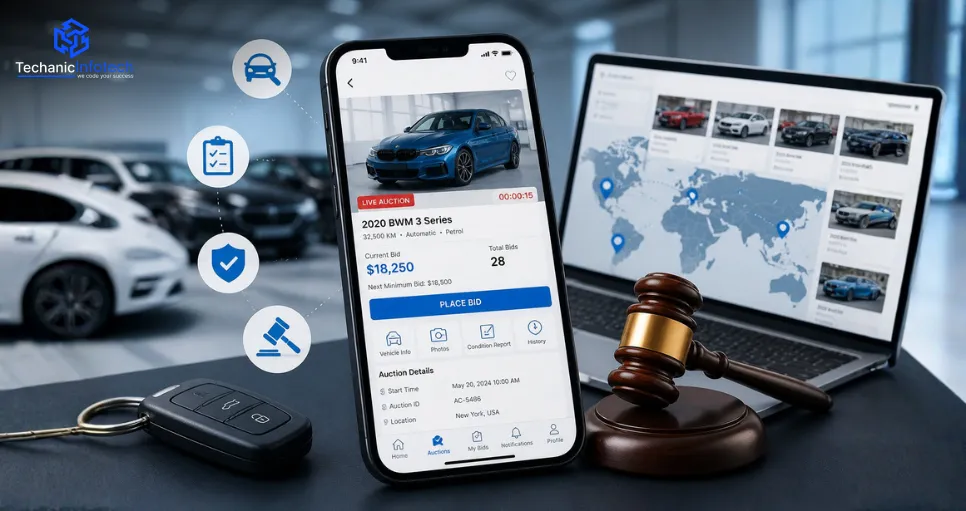
Car auctions have moved from jam-packed lots to handheld screens, and it's transforming the way cars are being purchased and sold.
These days, buyers can purchase a hard-to-find vintage Mustang or a barely used SUV without stepping inside an auction room. Convenience, speed, and exposure to a larger market are fuelling the online car auction boom.
If you’re wondering how to create a car auction app or looking to develop a car auction app that can compete with giants like Copart, AutoBidMaster, or Bring a Trailer, now is the time.
These platforms prove there’s a massive appetite for digital bidding and plenty of room for innovative newcomers who can offer a better experience, more transparency, and smarter features.
The worldwide web-based car auction market is picking up pace, worth more than $3 billion in 2024 and showing steady growth as buyers and sellers increasingly turn digital.
North America is leading the way, but growth markets in Asia-Pacific and the Middle East are experiencing double-digit growth due to mobile uptake and increasing auto trade.
Market leaders such as Copart, Manheim, and Bring a Trailer thrive because they marinate a gigantic vehicle pool with silky-smooth bidding experiences, trust-enhancing verification, and rolled-in logistics.
The audience is diverse:
The actual potential is in serving these niches, whether it's providing live HD auction viewing for exotic car owners, AI-condition evaluations for salvage purchasers, or customized suggestions for collectors.
If you’re planning to develop a car auction app, it’s important to understand how these platforms actually work.
Think of it as a virtual auction house, only faster, more accessible, and open to the world.
A user signs up, browses vehicles, checks details (photos, videos, VIN history), and places bids in real-time. The highest bidder when the timer hits zero wins the car.
For sellers, the process is just as simple: list the car, set a reserve price, and watch the bids roll in. Payments, verification, and even shipping can all be handled inside the app.
The goal? Remove the hassle of physical auctions and make buying and selling cars as easy as tapping your screen.
Before we get into flashy bells and whistles, you require the basics. A seamless, reliable experience is the building block of car auction app development.
Without it, your app won't capture user trust, and without trust, there's no business.
The following are eight essential features every successful car auction app requires:
It is easy for users to sign in with email, phone number, or social logins. Implement two-factor authentication to secure accounts. The sooner they're signed in, the sooner they begin bidding.
Allow users to filter vehicles by make, model, year, mileage, price, and location. Include special filters for accident-damaged, classic, or luxury cars to assist them in finding precisely what they seek.
Bidding has to be immediate. Display live updates, countdown timers, and ongoing highest bids without page reloads. Real-time updates keep the heart pumping and the bids rising.
Provide buyers with all they need to make informed decisions high-resolution photos, videos, VIN information, service history, and inspection reports. More info = less uncertainty.
Allow users to bookmark their favourite cars and receive instant alerts for price reduction or auction closing time. This makes them return.
Combine reputable payment processors with escrow facilities. Buyers are assured in the knowledge that their money is only paid out when the car is confirmed.
Give sellers an easy way to list cars, track bids, and communicate with buyers. The smoother it is for sellers, the more cars get listed.
Your control centre. Manage users, approve listings, handle disputes, and track performance all in one place. Without this, you’re flying blind.
After you've mastered the fundamentals, you can implement higher-end features that distinguish your app from others. These are the gimmicks that create devoted follower. So, take help of an experienced mobile app development company to seamlessly add these features.
Apply AI to recommend competitive opening bids or estimate a vehicle's market worth. It is time-saving for sellers and reassuring to buyers.
Let shoppers view the car all around with interactive 360° photos or AR-based viewing. Ideal for customers who can't physically see the car.
Embed applications that scan the VIN and retrieve the incident history, mileage, and ownership instantly. This earns trust quickly.
Enable buyers and sellers to communicate directly for quick clarifications or discreet offers. It makes the transaction more personal and relationship-building.
When you want to reach the world, simplify payment for users in their local currency and enable them to use the app in their native language.
Live stream auctions with commentary. It's entertaining, thrilling, and makes your app experience feel like visiting a high-end auction house.
Keep scammers away with AI that identifies suspicious patterns of bidding, fictitious listings, or scams before they damage your reputation.
These are features, and now to integrate them effortlessly into the following:
If you want to know how to develop a car auction app that is truly effective in today's competitive environment, the answer is not "hire developers and code". A good car auction app takes planning, astute execution, and continuous optimisation.
Whether you want to enter the rapidly growing online car auction market or surpass what currently exists, the development process you use will be crucial.
Here's our tried-and-tested eight-step approach to car auction app development that converts ideas into successful, user-cherished platforms.
You have to know the market you're getting into before you write a single line of code. This isn't about browsing a couple of articles, it's about in-depth, actionable research.
We begin by defining existing market size, growth patterns, and user activity. For instance, the world's online automobile auction market is expanding very quickly because of wider smartphone use and consumer desire for convenience in vehicle purchases.
Competitor research is just as crucial. Research titans like Copart, AutoBidMaster, and Bring a Trailer to understand what you're doing well and what you could improve on. Perhaps their bidding process isn't optimized for mobile, or maybe they don't offer niche support for luxury or salvage vehicles.
This research allows you to identify opportunities and specifically outline how to create a car auction app that fills in the gaps rather than merely being another clone.
Now that the research is in, it's time to refine your concept. Here, you determine the "why" of your app.
Do you want to specialize in live streaming auctions for luxury cars? Provide AI-powered price forecasting for sellers? Offer secure escrow payments for international sales?
We create a wishlist of features all the things you'd want to have and then narrow it down to an MVP (Minimum Viable Product) iteration. The MVP consists of the things you absolutely must include to create a car auction app and get it out there quickly.
By bringing the minimum viable product to market first, you can test user response, prove the concept, and grow smart without wasting your money too early.
With an idea of what you're creating, it's now time to visually chart it out. Wireframing provides a rough outline of your app's layout and flow, illustrating how people will transition from looking at cars to bidding.
The objective is simplicity. Car auctions are complicated at times, so the interface has to be intuitive; there are no learning curves here. It's like designing a showroom: the less complicated it is to find your way around, the longer they'll hang around.
UI design makes the wireframe come alive with colours, typography, and branding. This is an important stage in car auction app development because bad design will drive away potential users even if your features are great.
Here's where the magic begins your app begins to take form.
The frontend is what the users get to see and use. We usually employ React Native or Flutter to provide a seamless, cross-platform experience on iOS and Android.
The backend is the powerhouse that drives everything handling user accounts, processing bids, storing vehicle info, and handling payments. Common choices here are Node.js, Laravel, or Django.
Security is not negotiable. Auction apps deal with sensitive user information and significant transactions, so your backend needs to be tight. While building a car auction app, a secure, scalable backend is your best investment.
Why invent the wheel when you can integrate existing solutions?
Payment gateways such as Stripe or PayPal enable secure transactions. Vehicle history APIs retrieve VIN information, accident history, and ownership records in seconds.
AI services can scan images to identify damage or forecast car prices. These integrations don't only save time they enhance your app's power and ease of use. The correct APIs can be the difference between a good app and one that's truly great when you're building a car auction app.
Imagine launching your app and the bidding timer freezes at the last second. Or a payment fails in the middle of a transaction. That’s a surefire way to lose users and your reputation.
We conduct rigorous testing on every feature across different devices, network speeds, and user scenarios. This includes functional testing, security testing, and even stress testing to see how the app performs during peak auction times.
Quality assurance is not where you scrimp. Actually, some of our most successful projects spent as much time in QA as they did in initial development, and that's how they successfully launched.
The launch is your moment of glory, but it's also where most apps go wrong.
ASO is the app store world's equivalent of SEO. We keyword optimize your app's title, description, and screenshots with keywords such as "car auction app" and "online vehicle bidding." This increases your app's visibility in app store searches and allows it to be seen by more people.
We also arrange pre-launch promotion, beta testing, and influencer campaigns so that the app has a built-in fanbase on day one. When you execute your launch methodically, all the sweat of how to make a car auction app truly pays off.
Creation of the app is only the first step. The challenge is making it continue to be relevant.
We monitor user activity, study feedback, and deploy changes that refine performance and introduce new capabilities. This may involve enhancing the bidding process, adding new payment options, or moving into new markets.
Regular updates make your app more competitive and demonstrate to users that you're dedicated to enhancing their experience, an essential ingredient in long-term success when creating a car auction app.
As soon as we are done with this, time to know about the tech stack for car auction app development.
You require a stack that supports real-time bidding, high-media loads, secure transactions, and fast scale. Consider mobile-first UX, low-latency APIs, and bulletproof security.
Correct decisions enable you to ship quickly, maintain predictable costs, and increment features without rewrites.
Below is an actionable tech stack that you can ship with confidence and iterate as traction increases.
React Native or Flutter for cross-platform performance with native camera, push, and secure storage modules. On the web, React with Vite for quick builds.
Adopt component libraries and a design system for repeatable UI. Utilize WebSockets for live auctions and timers.
Optimize video previews and images to save bandwidth without reducing listings to mid-range device standards.
Node.js with NestJS or Python with Django/DRF for clean, modular APIs. Event-driven architecture (Kafka or RabbitMQ) manages bursts at auction endings.
Caching bids and leaderboards in Redis. Rate limiting, JWT-based auth, and role permissions.
A service split for auctions, payments, users, and listings keeps codebases small and deployments secure.
PostgreSQL for transactional integrity across bids, orders, and escrow status. Include read replicas for scaling.
Employ Elasticsearch or OpenSearch for speedy, typo-insensitive car searches and make, model, year, mileage, and damage type filters.
Save big media and inspection PDFs to object storage, and access them through signed URLs instead of inflating the DB.
Host on AWS, GCP, or Azure with containers (ECS/EKS or GKE). Terraform or Pulumi for IaC so environments align. CI/CD with blue-green or canary releases to safeguard live auctions.
CloudFront or Cloudflare for CDN. Auto-scaling groups mitigate traffic surges close to auction close. Backups and disaster recovery exercises are not negotiable.
WebSockets or Socket. IO for real-time bidding, countdowns, and outbid notifications. Implement server time as the truth source to avoid last-second arguments.
Transcode video with AWS Elastic Transcoder or Cloudinary. Create 360° spins through stitched image sets. Precompute thumbnails and poster frames so lists are instant and detail pages are responsive.
Stripe or Adyen for card, bank transfer, and escrow transactions. KYC/AML through Onfido or Veriff to maintain marketplaces free of bad actors. VIN and history reports through Carfax/AutoCheck APIs.
Encrypt PII in transit and at rest, rotate keys, and log access. Comply with PCI-DSS limits, include GDPR/CCPA tooling for exports and deletes, and map data flows.
Fraud detection using Sift or custom anomaly models for shill bidding and duplicate accounts. Content moderation on images and text using AWS Recognition or Hive.
Centralized logs in OpenTelemetry, metrics in Prometheus, and dashboards in Grafana or Datadog. Product analytics using Mixpanel or Amplitude to monitor funnel drop-offs and feature ROI.
Quick Reference Stack:
Car auction apps generate revenue through multiple channels designed to support both buyers and sellers. These monetization models help platforms stay profitable while offering smooth digital vehicle trading. Here’s how most car auction apps make money:
Listing Fees: Apps charge sellers a small fee to list vehicles on the platform. This covers posting images, car history details, inspection reports, and auction visibility.
Buyer & Seller Commissions: A percentage-based commission is applied when a sale is completed.
This ensures revenue from every successful transaction.
Membership & Subscription Plans: Users can upgrade to premium plans for added benefits like:
This creates consistent recurring revenue.
Featured / Sponsored Listings: Sellers can pay extra to highlight their listings at the top of auction results. This increases visibility and helps sellers attract more bids.
Vehicle History & Inspection Reports: Buyers can purchase detailed reports for verification. Apps either sell their own reports or partner with third-party inspection services and earn commission.
In-App Advertising: Auto brands, insurance companies, financing services, and car care providers pay to advertise. This becomes an ongoing revenue stream as app traffic grows.
Secure Payment Gateway Fees: By integrating payment services, the app can collect small processing fees on each transaction. These fees are typically included in buyer or seller charges.
Financing & Insurance Partnerships: Apps partner with loan providers and insurers to offer additional services inside the platform. For every policy or loan booked, the app earns affiliate or referral commission.
Logistics & Delivery Charges: If the app offers transport or delivery support, users pay service charges based on location, vehicle type, and delivery method.
The cost to develop a car auction app can vary greatly based on its complexity, features, and target audience.
On average, the cost to create a car auction app begins at $25,000 for a simple MVP and goes up to over $150,000 for a feature-rich platform with deep AI capabilities, real-time bidding, and multi-platform support. To arrive at an accurate estimate, you must analyze each aspect from tech stack and design to compliance and marketing.
Below, we dissect the key factors that influence the cost to develop a car auction app so you can make an effective budget plan.
|
Factor |
Impact on Cost |
|
App Complexity & Features |
Advanced features like AI-powered price prediction, live streaming, and 360° vehicle views significantly raise the cost to develop a car auction app compared to a basic MVP. |
|
Design & User Experience |
Custom, high-quality UI/UX design that improves usability and engagement adds to the cost to create a car auction app, but it’s crucial for attracting and retaining users. |
|
Technology Stack |
The choice of programming languages, frameworks, and real-time systems impacts performance and scalability influencing the overall cost to build a car auction app. |
|
Platform Choice |
Developing for iOS, Android, and web together increases costs. A cross-platform framework can reduce the cost to develop a car auction app without sacrificing quality. |
|
Compliance & Security |
Implementing PCI-DSS compliance, KYC verification, and data encryption increases thecost to create a car auction app, but ensures trust and legal safety. |
|
Team Location & Expertise |
Hiring developers in high-cost regions can make the cost to build a car auction app 2–3x higher than outsourcing to skilled teams in cost-effective regions. |
|
Post-Launch Maintenance |
Ongoing updates, bug fixes, and scalability improvements usually cost 15–20% of the initial cost to develop a car auction app per year. |
Compliance & Legal Considerations for Car Auction App Development
Compliance is not a mere formality when you develop a car auction app; it's what makes your platform stay legal, trustworthy, and competitive.
A sound compliance programme can avoid the financial costs of legal headaches, establish user trust, and even accelerate app store approval.
Whether you’re starting fresh or scaling globally, these are the must-follow rules in car auction app development that will protect your business and your users.
If you develop a car auction app that sells vehicles across different states or countries, you must follow each region’s auction and vehicle sale laws.
This involves proper transfer of title, auction licensing, and tax regulations. Compliancy ensures all sales are legitimate and accepted by the law.
Fraud can destroy a car auction platform's reputation in one night. That is why KYC verification is an integral aspect of secure car auction app development.
Implementing solution Compliance Veriff or Onfido enables you to authenticate IDs and biometrics and allows only genuine buyers and sellers on your platform.
If you build a car auction application that gathers user information, you need to comply with international privacy legislation such as GDPR in Europe and CCPA in California.
This entails obtaining explicit user consent, enabling deletion of profiles, and encrypting data securely. Compliance in these areas isn't a choice, but a necessity.
High-value payments require high-level security.
Implementing PCI-DSS-compliant payment gateways at the time of car auction app development prevents payment information from being exposed and transmitted securely.
This safeguards your users as well as your reputation and addresses international payment security requirements.
When you create an auto auction app, you need to safeguard your own brand assets and prevent sellers from uploading unauthorized content.
Enforcing IP rights avoids legal disputes related to stolen photos, spurious listings, or copyright materials.
Trust is a currency of the auction. Having transparent refund policies, listing rules, and in-app dispute resolution procedures not only establishes credibility but also makes your app compliant with consumer protection regulations across the globe.
If you’re wondering how to market your car auction app effectively, the answer is to combine strategic branding, targeted campaigns, and ongoing optimization.
A well-executed marketing plan not only boosts downloads but also builds long-term trust with buyers and sellers. To successfully market your car auction app, focus on strategies that reach your ideal audience and make your platform stand out.
Utilize social media websites such as Instagram, Facebook, and YouTube to display live auctions, promote unique listings, and report successful stories. Partner with car influencers who can generate credibility and engagement for car enthusiasts.
A good app store presence is vital. Employ targeted keywords, compelling screenshots, and concise descriptions to rank higher in search and gain organic installs.
Post blogs, videos, and guides on car auctions, bidding tips, and market trends. This makes your platform a go-to destination and enhances search engine ranking.
Drive targeted Google Ads, Facebook Ads, and Instagram Ads to reach individuals actively looking for car auctions or car buying. Employ remarketing to re-target users who landed on your app or website but failed to convert.
Incentivize users to invite their friends with rewards such as free listing credits or reduced buyer fees. Not only does this grow your user base, but it also improves retention.
Make partnerships with local dealerships, car clubs, and auto expos to get your app in front of active buyers and sellers already active in the auto community.
When you choose to build a car auction app, the concept is promising: an online showroom where bids come pouring in, and dream cars get new owners.
But the path to success isn't a straight road. While building a car auction app, you'll encounter speed bumps that challenge your tech, your imagination, and your business plan.
The silver lining? With the proper strategy, you can create a car auction app that not only thrives with these challenges but also uses them as competitive strengths.
A five-second lag can seem like an eternity in auctions. When bidding updates stall, users quickly lose interest.
The solution? Utilize WebSocket-based real-time systems and load-test them to compensate for traffic surges, particularly at those heart-pounding final seconds.
If you create an auto auction app, it must be shielded from scammers trying to get a quick buck.
Use KYC verification software such as Veriff and AI-based fraud detection solutions to prevent impostor accounts from joining the bidding in the first place.
The closing minutes are mayhem, bids are soaring, and hearts are pounding. If you create a car auction app with an inflexible architecture, it may grind under stress.
Cloud auto-scaling and load balancing keep the motor purring even during the most hectic auctions.
Would you pay thousands for a car via an app you just discovered? Trust is paramount.
Secure payments, escrow services, and open dispute resolution allow buyers and sellers to feel comfortable moving forward.
When you develop an auto auction app, you will soon realize that cars are not just pictures, there is VIN information, maintenance history, and condition reports.
Adding VIN lookup APIs and automated inspections creates buyer trust and decreases disputes.
The market is full, but that doesn't mean you have to fit in.
If you create a car auction app that caters to a niche, antique cars, wrecks, or high-end exotics and fill it with innovative features, you can own that slice of the market.
We don't only develop a car auction app at Techanic Infotech; we design scalable, secure, and high-performance platforms that reign supreme in their domain.
As a leading taxi app development company for over 10 years, we use our proven experience to build real-time apps that handle high traffic and secure transactions smoothly.
Our experts take care of everything from market research and UI/UX design to backend architecture, payment integrations, and AI-driven features.
Whatever you desire, an MVP or a global-ready solution, we make sure your app is fast, user-friendly, and fully compliant with regulations. Join hands with Techanic Infotech to convert your auction idea into a revenue-generating reality.
Creating a successful car auction app requires more than excellent code; it takes market knowledge, frictionless user experiences, high-strength security, and a clear vision for growth.
With each step, from brainstorming through post-launch tuning, the stakes are high in the race to differentiate and succeed. Whether you want to race classic car collectors, classic car dealers, or mass-market buyers, the ideal development partner can be the difference maker.
At Techanic Infotech, we blend industry expertise, leading-edge technology, and a love for innovation to create platforms users trust and adore.
The outcome? A car auction app that inspires engagement, trust, and sustainable success.
The schedule varies with complexity and features. A simple MVP will be ready within 3–4 months, but a complete platform with AI, real-time bidding, and international support might be ready in 6–9 months.
The price to create a car auction app begins at $25,000 for a basic app and can go up to more than $150,000 for a premium, feature-rich solution. Final pricing is subject to features, platforms, and integrations.
Integrate PCI-DSS-compliant payment gateways, KYC verification, data encryption, and AI-based fraud detection to secure user data and transactions.
Yes. We can integrate live HD streaming with real-time bidding updates, allowing users to participate as if they were at a physical auction.
Key features include real-time bidding, user registration, vehicle listings, push notifications, secure payments, and admin dashboard.
It depends on your audience. Most businesses choose both iOS and Android or use cross-platform frameworks for wider reach.
Real-time bidding allows users to place instant bids with live updates, countdown timers, and automatic bid increments.
You can earn through listing fees, commission per sale, featured listings, premium memberships, and in-app advertisements.
Yes, you must follow local regulations, user data protection laws, and payment compliance to ensure safe and legal operations.
Use digital marketing, SEO, social media ads, referral programs, and partnerships with dealers to grow your user base.
Techanic Infotech provides end-to-end services, from development and design to marketing and compliance. Having experience in developing high-performance apps such as marketplaces and taxi booking apps guarantees your car auction app is scalable, fast, and reliable.


Bharat Sharma is the CTO of Techanic Infotech, bringing deep technical expertise in software architecture, mobile app development, and scalable system design. He leads the engineering team with a strong focus on innovation, performance, and security.