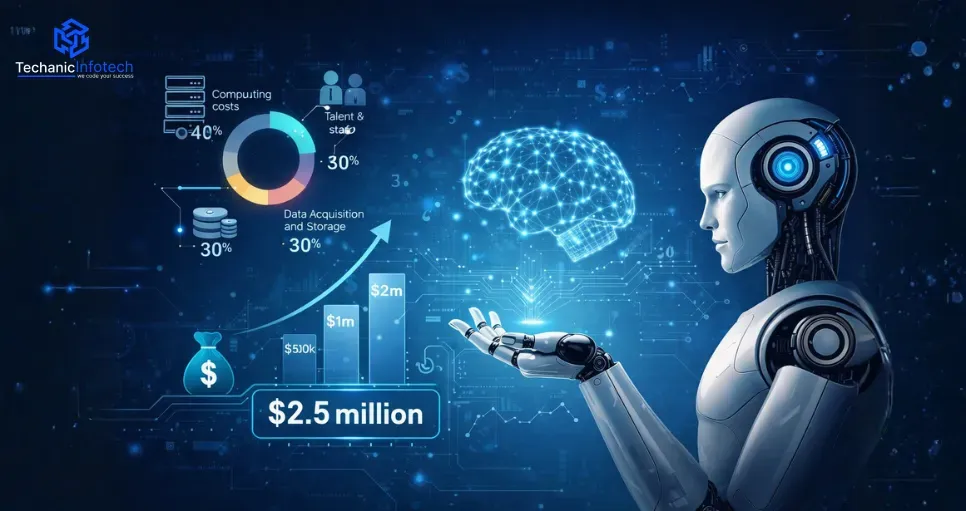
As of 2026, Artificial Intelligence has transitioned from an experimental technology to a standardized component of modern software architecture. For organizations planning a digital roadmap, understanding the financial requirements is no longer about a single "price tag," but about understanding how different technical complexities influence the overall budget.
The budget for an AI project is primarily dictated by the "Intelligence Level" required for the specific use case.
This tier involves leveraging existing Large Language Models (LLMs) via API calls.
At this level, a pre-existing model is "re-trained" on a specific, private dataset. This allows the AI to understand specialized business logic or niche industry data.
These are complex systems designed to perform multi-step tasks independently across various software environments.
To understand how specific technical challenges influence a project's budget, we can examine a real-world case study involving the pet-focused social platform, BuddyPaws.
During the development of the BuddyPaws platform, the engineering team identified a significant issue with Image Quality Variance. Users were uploading photos from a wide variety of mobile devices. Many images were appearing blurry, pixelated, or poorly lit, which negatively impacted the visual integrity of the user interface.
To solve this without relying on expensive third-party monthly subscriptions, a custom AI Image Processing Software layer was built.
Noise Reduction: A convolutional neural network was implemented to strip digital "noise" from photos taken in low-light environments.
Super-Resolution (Upscaling): An AI model was trained to predict and fill in missing pixels, effectively "upgrading" a low-resolution upload into a high-definition image.
Local Server Integration: This was integrated directly into the backend so that processing happens instantly upon upload.
While building custom software for image enhancement increased the initial development budget, it eliminated the need for long-term monthly fees to external image-processing providers. This decision moved the cost from an ongoing "operating expense" to a one-time "capital investment."
Data is the foundational layer of AI. If the data is unstructured (scattered emails, PDFs, or unorganized images), it must be organized and cleaned before the AI can use it. The more "messy" the data, the higher the labor cost.
"Inference" is the cost of the AI "thinking" every time a user asks it a question or uploads a file.
AI rarely functions in isolation. It must connect to existing databases, mobile apps, and third-party tools. Connecting AI to a "legacy" (old) system often takes more engineering hours than connecting it to a modern cloud-native system.
| Factor | In-House Engineering Team | Project-Based Partnership |
| Setup Time | 4-6 Months (Recruitment) | 1-2 Weeks (Kickoff) |
| Fixed Costs | Salaries, Benefits, Equipment | None (Milestone-based) |
| Talent Access | Limited to current hires | Access to niche AI specialists |
| Scalability | Hard to reduce staff quickly | Scale up or down as needed |
The cost of AI development in 2026 is a balance between initial engineering investment and long-term operational efficiency. By identifying specific technical challenges early such as the image quality issues highlighted in the BuddyPaws case organizations can make more informed decisions about whether to build custom software or utilize existing tools. Strategic budgeting allows for a more sustainable and high-performing digital ecosystem.
AI models require consistent, accurate examples to learn. If the data is inconsistent, the model will produce unreliable results. Cleaning ensures the AI's output remains high-quality.
This is the cost of electricity and server usage required every time the AI processes an image or answers a question. It is an ongoing cost that grows with your user base.
Yes. Using models like Llama 3 can remove licensing fees, though they often require more specialized engineering skill to set up compared to "plug-and-play" APIs.
Over time, AI models can become less accurate as the real world changes. Budgeting for periodic "retraining" ensures the system stays relevant and accurate.
A basic integration can take 4 to 6 weeks, while a custom solution (like the BuddyPaws image enhancement software) typically takes 3 to 4 months.


Bharat Sharma is the CTO of Techanic Infotech, bringing deep technical expertise in software architecture, mobile app development, and scalable system design. He leads the engineering team with a strong focus on innovation, performance, and security.