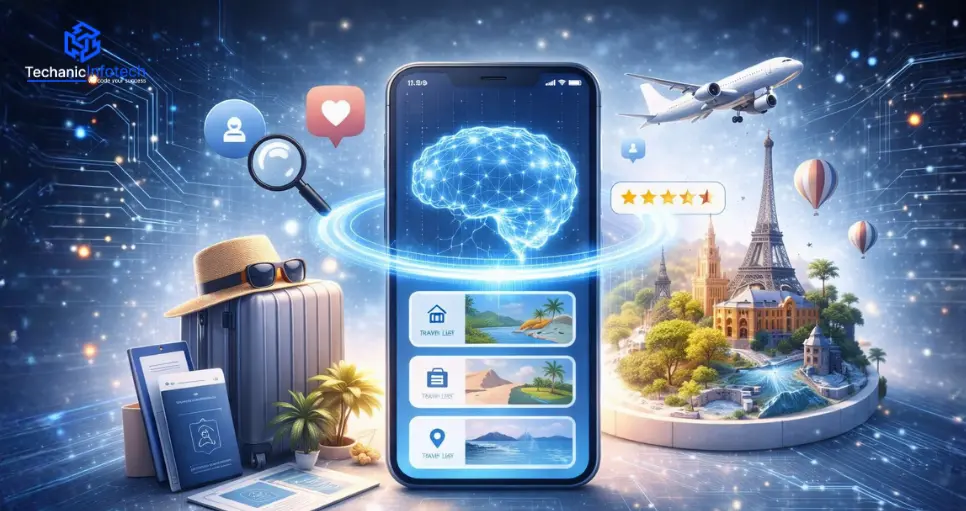
What if your travel app could plan your entire trip exactly the way you like it without you spending hours searching?
This is where AI in travel apps is making a real difference. From suggesting destinations to creating personalized itineraries, AI-powered travel apps are transforming how people explore and plan their journeys. Today, travelers expect smarter, faster, and more relevant experiences, and that’s exactly what AI delivers.
With the rise of AI in the travel industry, businesses are now focusing on AI travel app development to build intelligent platforms that understand user preferences and behavior.
In this blog, we’ll explore how AI is making travel apps smarter and more personalized.
AI is no longer an optional feature in travel apps; it has become a necessity. As user expectations grow, businesses are using AI in travel apps to deliver faster, smarter, and more personalized experiences.
Here are the key reasons why AI is becoming essential.
Today’s users expect apps to understand their preferences. Personalized travel apps use AI to suggest destinations, hotels, and activities based on past behavior. This level of customization improves user satisfaction and engagement.
With AI trip planning, users no longer need to spend hours researching. AI can instantly suggest itineraries, routes, and travel options. This makes travel planning quicker and more efficient.
AI analyzes user data to provide accurate suggestions. From hotels to restaurants, AI travel recommendations help users make better decisions without confusion.
AI-powered travel apps offer features like real-time updates, voice search, and smart suggestions. These features make apps easier to use and more interactive.
AI automates tasks such as booking confirmations, reminders, and customer support. This reduces manual work and improves overall efficiency for both users and businesses.
In a competitive market, AI app development companies investing in the travel industry can offer better services than traditional apps. This helps them attract and retain more users.
With machine learning in travel apps, businesses can analyze user behavior and improve their services. This leads to better features, pricing strategies, and user experiences.
AI helps users plan trips within their budget by comparing prices for flights, hotels, and activities. It can also suggest cost-saving options, making travel more affordable and efficient.
Modern travel apps are becoming smarter and more efficient with the use of artificial intelligence. These mobile app features not only improve user experience but also make travel planning faster and more personalized.
Below are some of the key AI features used in today’s AI-powered travel apps.
AI-Based Travel Recommendations: AI analyzes user behavior, preferences, and past searches to suggest destinations, hotels, and activities. These AI travel recommendations help users make better decisions quickly.
Smart Itinerary Planning: With AI trip planning, apps can create complete travel itineraries based on user interests, budget, and time. This reduces the effort required to plan a trip manually.
AI Chatbots for Customer Support: AI chatbots in travel apps help users with instant support, booking queries, and travel assistance. These chatbots are available 24/7 and improve overall user satisfaction.
Personalized User Experience: Travel app personalization allows apps to show customized content, offers, and suggestions based on individual user behavior. This makes the app more engaging and relevant.
Price Prediction and Dynamic Pricing: Using machine learning in travel apps, AI can predict price changes for flights and hotels. This helps users book at the right time and save money.
Voice Search and Virtual Assistants: Many apps now include voice-enabled features where users can search or plan trips using voice commands. An AI travel assistant app makes the process faster and more convenient.
Fraud Detection and Security: AI helps detect unusual activities and prevents fraud in transactions. This improves trust and security in travel platforms.
Real-Time Alerts and Updates: AI provides real-time notifications about flight delays, weather changes, or booking updates. This ensures users stay informed throughout their journey.
These features are making intelligent travel apps more advanced and user-friendly. Businesses investing in these technologies can deliver better experiences and stay competitive in the evolving travel industry.
AI may look complex from the outside, but inside a travel app, it works through a structured flow of data, algorithms, and user interactions. When businesses invest in AI travel app development, they focus on building systems that can understand user behavior and deliver smart results in real time.
Here’s a simple step-by-step breakdown of how AI in travel apps actually works.
The process starts when a user interacts with the app. This includes:
Search queries (destinations, hotels, flights)
Preferences (budget, travel dates, interests)
Past bookings and browsing behavior
This data is the foundation of all AI-based travel solutions. The more data the app collects, the better it understands user needs.
Once the data is collected, the system processes it using algorithms and models. This is where machine learning in travel apps comes into play.
Data is cleaned and organized
Patterns and trends are identified
User behavior is analyzed
This step helps the app predict what the user is likely to search or book next.
AI creates a profile for each user based on their behavior and preferences.
For example:
Budget traveler
Luxury traveler
Adventure seeker
This segmentation helps in building personalized travel apps that offer relevant suggestions to each user.
This is one of the most important parts of AI in travel apps. The recommendation engine uses processed data to suggest the following:
Destinations
Hotels
Activities
Travel packages
These AI travel recommendations are tailored to each user, making the experience more relevant and engaging.
With AI trip planning, the app creates complete travel itineraries automatically.
Suggests day-wise plans
Recommends places to visit
Optimizes travel routes
This is how smart travel planning apps reduce manual effort and save time for users.
Travel apps constantly receive real-time data, such as
Flight schedules
Weather updates
Traffic conditions
AI processes this data instantly and updates recommendations accordingly. This makes AI-powered travel apps more dynamic and reliable.
Many apps include an AI chatbot in travel apps to assist users.
Answer queries instantly
Help with bookings
Suggest options
This improves user engagement and provides 24/7 support.
AI systems keep learning from user interactions. Every time a user:
Clicks on a recommendation
Books a service
Ignores suggestions
The system updates its models using machine learning in travel apps to improve future recommendations.
Finally, all the processed data is used to deliver a personalized experience.
Customized home screens
Relevant offers
Tailored recommendations
This is where travel app personalization plays a key role in improving user satisfaction.
AI doesn’t just improve the user experience; it also helps businesses make smarter decisions.
The app collects and analyzes large amounts of data to generate useful insights.
Tracks user behavior and booking patterns
Identifies popular destinations and trends
Optimizes pricing and offers
Improves marketing strategies
These insights help businesses offering travel app development with AI to continuously improve their platform, increase conversions, and deliver better services.
AI is transforming how travel apps function, making them smarter, faster, and more user-friendly. Businesses investing in AI travel app development are able to deliver better experiences while improving efficiency and growth. Below are some key benefits of using AI in travel apps.
One of the biggest advantages of AI is personalization. Personalized travel apps can understand user preferences, past bookings, and behavior to suggest relevant destinations, hotels, and activities. This makes the experience more engaging and increases user satisfaction.
With AI trip planning, users can create complete travel itineraries within seconds. AI removes the need for manual research by suggesting the best routes, places, and schedules. This makes travel planning easier and more efficient.
AI analyzes large amounts of data to provide accurate AI travel recommendations. Whether it’s finding the best hotel deals or suggesting popular attractions, users can make better decisions without confusion.
AI automates many tasks such as customer support, booking confirmations, and notifications. Features like AI chatbots in travel apps reduce the need for manual support, helping businesses save time and operational costs.
AI-powered travel apps provide real-time updates related to flights, weather, and bookings. This ensures that users are always informed and can adjust their plans easily, improving the overall travel experience.
Using machine learning in travel apps, AI systems keep improving over time. The more users interact with the app, the better it understands their needs. This leads to smarter features, better personalization, and improved performance.
AI is not just a concept, it is already being used by leading travel platforms to improve user experience and make trip planning smarter. Below are some real-world examples that show how AI in travel apps is working in practice.
Google Travel uses AI to help users plan trips quickly and efficiently. It analyzes search behavior and provides suggestions for destinations, hotels, and things to do.
Recommends travel plans based on user interests
Shows price trends for flights and hotels
Organizes bookings automatically
This is a great example of AI trip planning, where users get a complete overview without manual effort.
Expedia uses AI to offer personalized travel suggestions. It studies user preferences, past bookings, and browsing patterns to recommend hotels, flights, and packages.
Customized recommendations for each user
AI-driven search results
Dynamic pricing suggestions
These AI travel recommendations improve user engagement and increase booking conversions.
Hopper uses advanced machine learning to predict flight and hotel prices. It tells users the best time to book to save money.
Predicts price changes with high accuracy
Sends alerts for price drops
Suggests when to book or wait
This shows how machine learning in travel apps helps users make smarter financial decisions.
Skyscanner uses AI to simplify travel searches and provide flexible options.
Suggests cheapest travel dates
Offers “Everywhere” search for destination discovery
Personalized recommendations
This is an example of intelligent travel apps improving the discovery process.
Kayak uses AI chatbots to assist users with travel planning and queries.
Helps users search flights and hotels
Answers travel-related questions
Provides quick booking support
The AI chatbot in travel apps improves user experience by offering instant assistance.
Airbnb uses AI to recommend stays and experiences based on user behavior.
Suggests properties based on preferences
Personalized search results
Smart pricing and recommendations
This highlights how travel app personalization improves engagement and user satisfaction.
Booking.com uses AI to enhance both search and customer support.
Personalized hotel recommendations
AI-powered customer support
Real-time booking suggestions
This is another strong example of AI-powered travel apps improving both user experience and business performance.
While AI brings many benefits, integrating it into travel apps is not always simple. Businesses working on AI travel app development often face technical, operational, and user-related challenges. However, with the right approach, these challenges can be managed effectively.
Below are some common issues along with practical solutions.
Building AI features like recommendation engines or chatbots requires skilled developers, data infrastructure, and advanced tools. This can increase the initial cost.
Solution: Start with basic AI features such as chatbots or simple recommendation systems. Gradually scale to advanced features as your platform grows. This helps manage budget while still benefiting from AI in travel apps.
AI depends heavily on data. If the data is incomplete, outdated, or inaccurate, it can lead to poor recommendations and user dissatisfaction.
Solution: Focus on collecting clean and relevant data from the beginning. Use analytics tools to monitor data quality and continuously improve it. High-quality data leads to better AI travel recommendations and improved user experience.
Travel apps collect sensitive user data such as location, preferences, and payment details. Mismanagement of this data can lead to privacy issues.
Solution: Implement strong security measures like encryption, secure APIs, and compliance with data protection regulations. Transparency about data usage also builds user trust in AI-powered travel apps.
Integrating AI into existing travel platforms can be technically challenging, especially when dealing with legacy systems.
Solution: Use modular architecture and APIs to integrate AI features smoothly. This approach allows businesses to add AI capabilities without disrupting the entire system.
AI development requires expertise in machine learning, data science, and cloud infrastructure, which may not be available in every team.
Solution: Partner with experienced teams or companies specializing in travel app development with AI. This ensures proper implementation and reduces the risk of errors.
Too much automation can make the app feel less personal, especially in areas like customer support.
Solution: Maintain a balance between AI and human interaction. Use AI for routine tasks while keeping human support available for complex issues.
AI systems require regular updates and monitoring to stay accurate and effective. This adds to long-term maintenance efforts.
Solution: Plan for ongoing optimization and updates from the beginning. Continuous learning and improvement ensure that intelligent travel apps remain relevant and efficient.
The cost of integrating AI into travel apps depends on the type of features, complexity, and level of personalization you want to offer. There is no fixed price, but businesses can estimate the budget based on their requirements.
For basic AI features like chatbots or simple recommendation systems, the cost can range
between $5,000 to $15,000. These features are easier to implement and are a good starting point for businesses entering AI travel app development.
For more advanced features such as personalized travel suggestions, smart itinerary planning, and predictive analytics, the cost can go up to $15,000 to $40,000 or more. These require better data processing, machine learning models, and deeper integration within the app.
If you are planning a fully advanced solution with real-time data processing, voice assistants, and highly customized user experiences, the cost may exceed $50,000, depending on the scale and technology used.
The final cost also depends on factors like
Data availability and quality
Technology stack and tools
Integration with third-party APIs
Development team location and expertise
From our experience, it is always better to start with essential AI features and scale gradually. This approach helps manage app development costs while still delivering value through AI-powered travel apps.
AI plays a major role in creating highly personalized travel apps by understanding user behavior and preferences. It analyzes past searches, bookings, and interactions to offer tailored suggestions such as destinations, hotels, and activities.
With travel app personalization, users get recommendations that match their interests, budget, and travel style, making the overall experience more relevant and engaging.
From our experience working on AI travel app development, personalization is not just about data, it’s about delivering the right experience at the right time. Our developers believe that AI should feel natural and helpful, not overwhelming. The key is to balance automation with user control, so users still feel in charge of their decisions.
When implemented correctly, AI helps build smarter, more intuitive apps that improve user satisfaction and long-term engagement.
AI is transforming how travel apps function, making them smarter, faster, and more personalized. From improving trip planning to delivering tailored recommendations, AI in travel apps is helping users save time and make better decisions. Businesses investing in AI travel app development can create more engaging and efficient platforms that meet modern user expectations.
As technology continues to evolve, the role of AI will only grow stronger in the travel industry. Companies that adopt AI early and implement it strategically will be better positioned to build scalable, user-friendly, and future-ready travel applications.
AI in travel apps refers to the use of artificial intelligence to automate processes, provide recommendations, and improve user experience through smart features like chatbots and personalized suggestions.
AI helps with AI trip planning by suggesting destinations, creating itineraries, and optimizing routes based on user preferences, saving time and effort.
Common features include AI travel recommendations, chatbots, personalized suggestions, price prediction, and real-time updates.
The cost varies based on features, but basic AI integration can start from $5,000, while advanced solutions may go beyond $50,000.
Yes, most AI-powered travel apps use encryption and secure systems to protect user data, but proper security implementation is essential.
An AI chatbot in travel apps provides instant support, answers queries, assists with bookings, and improves user engagement.
Yes, AI analyzes user behavior and preferences to offer customized suggestions, making personalized travel apps more effective and user-friendly.
AI will continue to evolve with features like voice assistants, predictive analytics, and immersive experiences, making travel apps more intelligent and efficient.


Bharat Sharma is the CTO of Techanic Infotech, bringing deep technical expertise in software architecture, mobile app development, and scalable system design. He leads the engineering team with a strong focus on innovation, performance, and security.