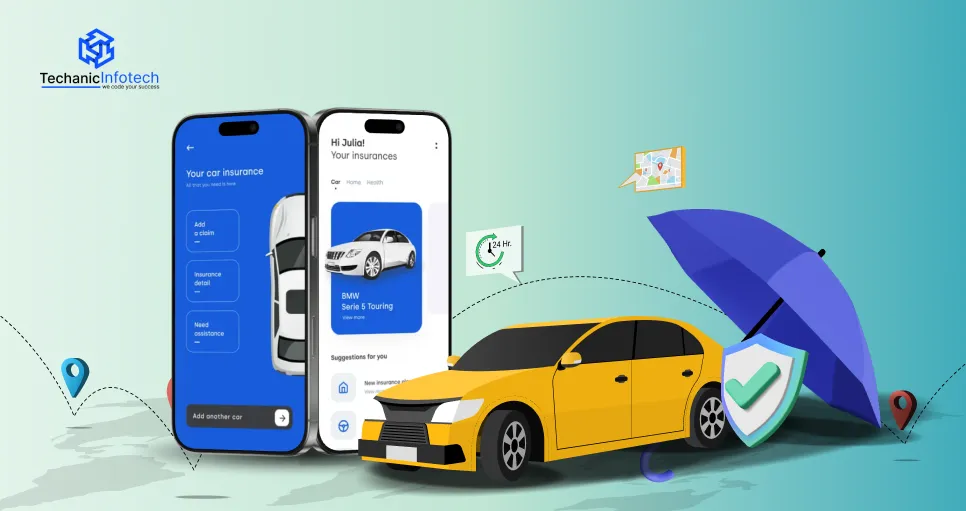
Insurance App Development
Car Insurance App Development: Features, Cost And Process in 2026
February 11, 2026
February 11, 2026
Car insurance app development is transforming how insurers and customers interact in a digital-first world.
With increasing smartphone penetration and demand for instant services, mobile insurance apps provide seamless policy management, quick claims processing, and real-time assistance.
These apps help insurers reduce operational costs while delivering personalized experiences to users.
From AI-driven risk assessment to automated claims settlement, modern car insurance apps leverage advanced technologies to improve efficiency, transparency, and trust.
As competition in the insurtech market grows, investing in a scalable and secure car insurance mobile application is no longer optional; it’s a strategic necessity.
Businesses that adopt mobile solutions gain better customer engagement, faster decision-making, and long-term brand credibility.
Wise Guy Reports estimates the global automobile insurance apps market at USD 4.64 billion in 2024.
The development process is projected to reach USD 12 billion by 2035, reflecting strong long-term digital insurance growth.
The insurance market is expected to grow at about 9.1% CAGR from 2025 to 2035, driven by smartphone adoption, AI integration, and mobile-first insurance services globally.
North America is the leading region due to advanced digital insurance ecosystems, high smartphone penetration, and strong insurer investment in mobile apps.
Wise Guy Reports identifies claims management, policy management, and premium calculation.
Roadside assistance is a core application segment, with insurers prioritizing seamless user experience, faster claims processing, and real-time policy access.
A car insurance app simplifies how users buy, manage, and claim insurance by offering digital convenience, real-time access, and personalized features all from a single, user-friendly platform.
The following is the list of key mobile app features of the car insurance apps.
Enables secure user sign-up and profile management, including personal details, vehicle information, and driving history.
Supports personalized insurance recommendations, faster onboarding, and compliance with data privacy and security standards for safe handling of sensitive user information.
Allows users to easily view, renew, upgrade, or cancel insurance policies.
Provides instant access to coverage details, digital policy documents, and renewal alerts, enhancing convenience, transparency, and overall customer experience throughout the policy lifecycle.
Helps users compare insurance quotes from multiple providers based on premium, coverage, and benefits.
Promotes transparency, empowers informed decision-making, and increases conversion rates by presenting competitive options clearly in one unified platform.
Estimates insurance premiums using factors like vehicle type, location, driving behavior, and coverage preferences.
Enhances pricing transparency, helps users understand cost drivers, and supports the selection of insurance plans that best match their needs.
Enables secure uploading, storage, and access to insurance policies, vehicle documents, and claim files.
Cloud-based storage ensures easy retrieval, better organization, and reduced reliance on physical paperwork while maintaining strong data security.
Supports secure and seamless premium payments through cards, UPI, wallets, and net banking.
Ensures fast transactions, improves payment reliability, enhances user trust, and delivers a smooth, hassle-free checkout experience for insurance customers.
The following are the advanced features that help insurers deliver smarter services while enabling users to manage policies and much more.
AI algorithms evaluate driving patterns, vehicle data, and user behavior to accurately assess risk.
This enables personalized premium pricing, improves underwriting accuracy, reduces manual errors, and helps insurers align coverage with individual risk profiles effectively.
Telematics technology monitors real-time driving behavior, including speed, mileage, braking, and acceleration.
It supports pay-as-you-drive insurance models, rewards safe driving habits, encourages responsible behavior, and allows insurers to price policies more fairly.
Smart claims processing uses AI and image recognition to assess vehicle damage automatically.
It speeds up claim verification, reduces settlement time, minimizes fraud, lowers operational costs, and significantly improves customer satisfaction through faster, transparent claim approvals.
AI-powered fraud detection analyzes claim patterns, behavioral anomalies, and historical data to identify suspicious activities.
This helps insurers prevent fraudulent claims, reduce financial losses, strengthen trust, and maintain compliance with regulatory and operational standards.
Predictive analytics leverages historical and real-time data to forecast customer behavior, claim frequency, and emerging risk trends.
It supports proactive decision-making, optimized pricing strategies, better customer retention, and improved long-term business planning.
An AI chatbot offers round-the-clock customer support by answering questions, assisting with policy selection, and guiding users through claims.
It improves response times, reduces support costs, and enhances overall user engagement and satisfaction.
Developing a car insurance app provides convenience, faster claims, streamlined operations, better engagement, and many more benefits.
Following are the list of benefits of developing car insurance apps.
A mobile application enables customers to manage insurance policies, payments, and claims anytime, anywhere.
It reduces reliance on agents, improves accessibility, streamlines interactions, and enhances overall customer satisfaction through self-service and instant access.
Automated workflows, AI-based damage assessment, and digital document submission accelerate claims handling.
This reduces processing time from weeks to hours, improves transparency, builds customer trust, and delivers a smoother, faster claim settlement experience
Digital insurance apps reduce paperwork, manual operations, and dependency on intermediaries.
Lower administrative costs, fewer errors, and reduced agent commissions help insurers optimize operations, improve efficiency, and increase overall profitability and scalability.
Personalized alerts, policy reminders, tailored offers, and real-time support keep users actively engaged.
Continuous interaction improves customer experience, increases retention rates, strengthens loyalty, and encourages long-term relationships with insurance providers.
Mobile apps capture real-time customer behavior, usage patterns, and risk data.
This enables insurers to perform accurate risk analysis, optimize pricing models, detect mobile app development trends, and make faster, data-driven strategic business decisions.
A secure, feature-rich insurance app enhances brand image and credibility.
Advanced digital capabilities differentiate insurers from competitors, attract tech-savvy customers, and build long-term trust through transparency, reliability, and seamless user experiences.
The car insurance app development process enables secure, efficient digital platforms for managing policies, claims, and customer interactions through intuitive mobile solutions.
The following is the step-by-step guide to develop the car insurance app, where one should follow every single step for making mobile app development process smoother.
This phase focuses on understanding business objectives, target users, competitor offerings, and regulatory constraints.
It helps define core features, validate market demand, reduce risks, and ensure the app aligns with customer expectations and industry requirements.
Mobile app design experts create intuitive interfaces and smooth user journeys that prioritize usability and accessibility.
Well-designed layouts, clear navigation, and engaging visuals improve user satisfaction, reduce friction, and encourage consistent app usage and engagement.
Developers build the frontend, backend, and database using scalable and secure technologies.
This phase ensures high performance, data protection, system reliability, and compliance with insurance regulations while supporting future feature expansion and growth.
APIs and third-party services such as payment gateways, telematics, analytics, and CRM systems are integrated.
These integrations enable seamless data exchange, automate processes, and enhance the overall functionality and efficiency of the insurance application.
Comprehensive testing checks functionality, performance, security, and compatibility across devices and platforms.
Quality assurance ensures the app is bug-free, reliable, and delivers a consistent user experience before public release.
The application is deployed to App Stores and configured for scalability and performance.
Monitoring tools are implemented to track stability, ensuring a smooth launch, minimal downtime, and a positive first impression for users.
Ongoing mobile app maintenance includes performance monitoring, security updates, bug fixes, and feature enhancements.
Regular updates ensure the app remains secure, efficient, and aligned with evolving user expectations and technological advancements.
A strong mobile app tech stack enables secure, scalable, and user-friendly car insurance apps with efficient policy management, claims processing, and real-time integrations.
The following are the best technology stack components, clearly explained to ensure optimal performance, security, and scalability.
React Native or Flutter support cross-platform mobile development with a single codebase.
They deliver consistent user interfaces, faster development cycles, reduced costs, and smooth performance across both iOS and Android insurance applications.
Node.js, Python, or Java power scalable and secure backend systems.
They manage user authentication, policy logic, claims processing, and data handling efficiently while supporting high traffic, reliability, and compliance with insurance industry standards.
MongoDB or PostgreSQL securely stores user profiles, policies, claims, and transaction records.
These databases support scalability, fast query performance, data integrity, and reliable access to structured and unstructured insurance data.
AWS, Microsoft Azure, or Google Cloud provide secure hosting, automated backups, scalability, and high availability.
Cloud platforms help insurers meet regulatory compliance, handle traffic spikes, and reduce infrastructure management overhead.
AI tools like TensorFlow and machine learning frameworks analyze data for risk assessment, fraud detection, and predictive insights.
Analytics platforms help insurers make smarter decisions, optimize pricing, and improve customer experience.
Encryption, OAuth authentication, and multi-factor authentication protect sensitive insurance data.
These technologies ensure regulatory compliance, safeguard user privacy, prevent unauthorized access, and strengthen defense against cyber threats.
The cost of developing a car insurance mobile app varies by features and complexity, ranging from $10,000 to $90,000+.
The following are the mobile app development cost breakdown lists and tables showing overall development prices, complexity levels, maintenance, and more.
Basic app features form the foundation of a car insurance mobile application.
This stage focuses on delivering essential functionality such as account creation, policy visibility, and simple premium calculations.
It helps insurers launch a minimum viable product quickly while offering customers convenient digital access to their insurance information.
The following table shows the breakdown of the cost for developing basic applications for car insurance.
|
Feature |
Description |
Price Range |
|
User Registration |
Secure sign-up and login functionality |
$2,000–$4,000 |
|
Policy Overview |
Displays active policies and coverage |
$2,000–$5,000 |
|
Premium Calculator |
Estimates insurance costs |
$3,000–$6,000 |
|
Customer Support |
Call and email support access |
$1,500–$3,000 |
|
Total Cost |
$10,000–$25,000 |
Medium-level development enhances usability and automation by introducing interactive and customer-centric features.
This level supports document uploads, real-time pricing, claim tracking, and notifications, significantly improving user engagement while streamlining insurance operations and reducing manual workload for insurers.
|
Feature |
Description |
Price Range |
|
Real-Time Quotes |
Instant dynamic pricing |
$6,000–$10,000 |
|
Document Upload |
Digital document submission |
$4,000–$7,000 |
|
Claims Tracking |
Track claim status online |
$6,000–$10,000 |
|
Push Notifications |
Alerts for renewals and updates |
$3,000–$5,000 |
|
Total Cost |
$25,000–$50,000 |
Advanced development focuses on intelligent, data-driven insurance solutions.
It includes telematics, usage-based pricing, AI-driven analytics, and high-end integrations.
These features enable personalized insurance plans, better risk assessment, and competitive differentiation but require higher technical complexity and investment.
|
Feature |
Description |
Price Range |
|
GPS Tracking |
Real-time driving data |
$7,000–$9,000 |
|
Driving Behavior Analysis |
Speed and braking insights |
$8,000–$10,000 |
|
Usage-Based Pricing |
Behavior-based premiums |
$10,000–$12,000 |
|
Push Notifications |
Alerts for renewals and updates |
$9,000–$12,000 |
|
Total Cost |
$50,000–$90,000+ |
A robust backend supports policy management, scalability, and secure data processing.
This layer ensures encrypted storage, API connectivity, and compliance with regulations such as GDPR and PCI-DSS, protecting sensitive customer information and ensuring reliable system performance.
|
Feature |
Description |
Price Range |
|
Secure Databases |
Encrypted data storage |
$6,000–$10,000 |
|
API Management |
System integration |
$7,000–$12,000 |
|
Role-Based Access |
Permission control |
$5,000–$8,000 |
|
Compliance Security |
Regulatory standards |
$8,000–$15,000 |
|
Total Cost |
$30,000–$60,000 |
Third-party integrations improve automation, analytics, and customer support.
Connecting payment gateways, CRM platforms, analytics tools, and AI chatbots enhances operational efficiency and user experience, but adds complexity, development effort, and ongoing maintenance requirements.
|
Feature |
Description |
Price Range |
|
Payment Gateway |
Online transactions |
$5,000–$8,000 |
|
CRM Integration |
Customer data sync |
$6,000–$10,000 |
|
Analytics Tools |
Performance tracking |
$4,000–$7,000 |
|
AI Chatbot |
Automated support |
$5,000–$10,000 |
|
Total Cost |
$10,000–$20,000+ |
Testing and launch ensure the application is stable, secure, and ready for users.
This phase includes functional testing, performance optimization, bug fixing, and app store deployment to deliver a reliable, high-quality product and minimize post-launch issues.
|
Feature |
Description |
Price Range |
|
Functional Testing |
Feature validation |
$3,000–$6,000 |
|
Performance Testing |
Load testing |
$2,500–$5,000 |
|
Bug Fixing |
Issue resolution |
$2,000–$6,000 |
|
App Store Deployment |
Publishing setup |
$2,000–$5,000 |
|
Total Cost |
$10,000–$15,000+ |
Developing a car insurance app involves challenges related to data security, regulatory compliance, system integrations, scalability, and delivering a seamless user experience.
Following is a list of key challenges involved in car insurance app development.
Insurance apps handle highly sensitive customer data, requiring strict adherence to regulatory standards.
Strong cybersecurity measures, encryption, and access controls are essential to protect data privacy, prevent breaches, and maintain user trust.
Connecting legacy systems with modern APIs and third-party services is technically complex.
It often requires custom development, careful data mapping, and extensive testing to ensure seamless communication without disrupting existing insurance operations.
Building reliable fraud detection systems demands advanced analytics, quality data, and continuous model training.
Fraud patterns evolve, requiring regular updates to AI models to maintain accuracy and reduce false positives.
Encouraging traditional users to shift to digital platforms requires intuitive interfaces and clear value benefits.
Easy onboarding, education, and reliable support help overcome resistance and improve acceptance of insurance mobile applications.
Insurance apps must efficiently manage growing user bases and increasing data volumes.
Poor scalability can impact performance, so robust architecture and cloud infrastructure are essential to maintain speed, stability, and reliability.
Insurance regulations frequently evolve, requiring ongoing app updates.
Continuous monitoring of compliance requirements and flexible system design are necessary to implement changes quickly without disrupting existing services.
Techanic Infotech is a trusted car insurance app development company with proven expertise in building secure, scalable car insurance applications.
Our team combines industry knowledge, advanced technologies, and user-centric design to deliver high-performance insurance solutions.
We follow best practices aligned with Google’s E-E-A-T and helpful content standards, ensuring reliability and long-term success. From AI-powered features to seamless integrations,
Techanic Infotech provides end-to-end development, transparent pricing, and dedicated support.
Our agile approach ensures faster time-to-market while maintaining compliance, security, and quality, making us the ideal technology partner for insurance businesses.
Car insurance app development is reshaping the insurance industry by delivering faster services, improved transparency, and personalized experiences.
With features like AI-driven risk assessment, smart claims processing, and real-time analytics, insurers can optimize operations while enhancing customer satisfaction.
Although development involves challenges such as compliance and security, partnering with an experienced development company ensures successful implementation.
Investing in a robust car insurance mobile app not only reduces costs but also strengthens brand trust and competitiveness in the growing insurtech market.
As digital adoption continues to rise, a well-designed insurance app becomes a powerful tool for long-term business growth and customer loyalty.
Developing a car insurance app typically takes 3 to 6 months, depending on feature complexity, integrations, security requirements, and whether the app includes advanced capabilities like AI or telematics.
Yes, car insurance apps are secure when built with encryption, secure authentication, compliance standards, and regular security testing to protect sensitive user data and financial information.
The average cost ranges from $10,000 to $90,000+, based on app complexity, features, platform choice, backend infrastructure, and integration of technologies like AI or IoT.
Yes, AI improves insurance apps by enabling fraud detection, personalized pricing, automated claims processing, chatbots for support, and data-driven insights for better decision-making.
A professional app development company ensures high-quality design, strong security, regulatory compliance, scalability, and timely delivery while reducing risks and long-term maintenance costs.


Bharat Sharma is the CTO of Techanic Infotech, bringing deep technical expertise in software architecture, mobile app development, and scalable system design. He leads the engineering team with a strong focus on innovation, performance, and security.