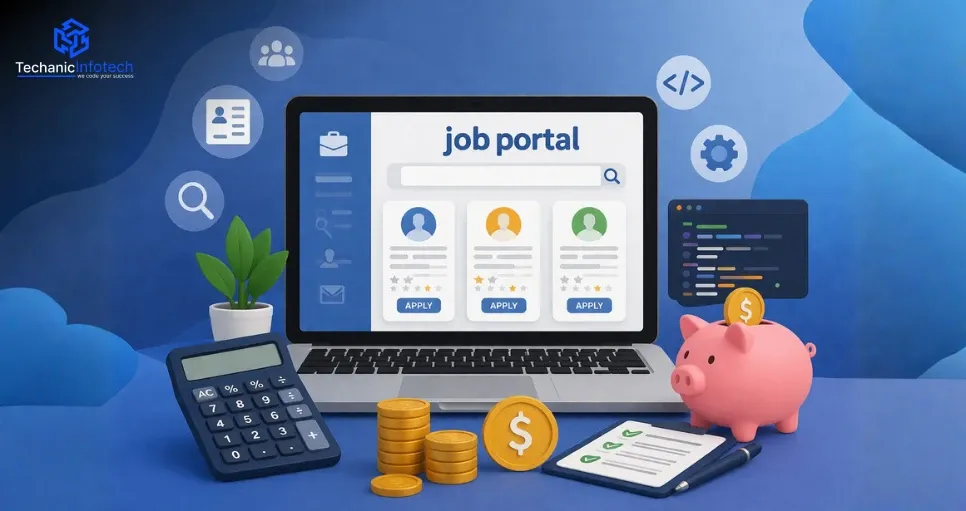
Job Portal App Development
Cost to Build a Job Portal App: Complete Pricing Guide for 2026
April 6, 2026
April 6, 2026
Key Takeaways
The job portal app development cost typically ranges between $10,000 to $80,000+, depending on features, design, and overall complexity
Starting with an MVP (Minimum Viable Product) helps reduce initial investment and allows faster market entry
Essential features like job search, profiles, resume upload, and application tracking are the foundation of any successful job portal app
Advanced features such as AI-based recommendations, ATS, and real-time chat can significantly increase development cost but improve user experience
UI/UX design plays a critical role in user engagement, retention, and overall app success
Building a job portal app has become a powerful digital opportunity as businesses shift toward online hiring and candidates increasingly depend on mobile platforms to find jobs quickly and easily.
If you’re planning to launch your own platform, one of the first questions that comes to mind is how much does it cost to build a job portal app?
On average, the job portal app development cost ranges between $10,000 to $80,000+, depending on multiple factors such as features, app complexity, design quality, technology stack, and whether you choose native or cross-platform development.
However, if you plan to include advanced functionalities like AI-based job recommendations,
real-time notifications, resume parsing, and application tracking systems, the cost can increase significantly.
In this guide, we will break down the complete cost structure, key factors that influence pricing, and how you can build a high-quality job portal app without exceeding your budget.
Job portal apps are digital platforms that connect employers and job seekers in one place, making hiring faster and more efficient. Instead of relying on traditional methods, companies can post jobs, manage applications, and streamline recruitment directly through the app.
At the same time, job seekers can search for jobs, upload resumes, apply instantly, and track their application status. Popular job portals also include advanced features like AI-based recommendations, resume screening, and real-time notifications.
These platforms simplify the entire hiring journey by bringing everything into a single, user-friendly system. With the rise of remote work and online hiring, job portal apps have become essential for both businesses and candidates.
User Registration: Job seekers and employers create accounts. Candidates add profiles and resumes, while employers set up company details.
Job Posting and Search: Employers post jobs, and users search using filters like location, salary, or job type.
Matching & Recommendations: AI-based systems suggest relevant jobs and candidates based on preferences and skills.
Applying and Screening: Candidates apply directly, and employers screen profiles using tools like ATS.
Communication & Interviews: Messaging, scheduling, and video interviews happen within the app.
Shortlisting & Hiring: Employers finalize candidates, and users track application progress in real time.
The cost to develop a job portal app is determined by features, design complexity, technology, and whether you're targeting Android, iOS, or both.
A simple job portal focuses on key elements such as job posting, search filters, profiles, and application tracking. In comparison, a sophisticated platform may incorporate AI-based suggestions, resume parsing, chat systems, employer dashboards, subscription plans, and talent tests.
For an MVP version, the job portal app development cost ranges between $10,000 and $70,000 on average. A fully featured, enterprise-level job portal can cost $70,000 to $120,000 or more, depending on bespoke modules, backend complexity, and scalability requirements.
The estimated mobile app development cost is also determined by whether you pick native development (iOS and Android separately) or cross-platform development (Flutter or React Native). Cross-platform development often results in cost savings of 30-40%.
Understanding what factors contribute to the cost to create a job portal application allows you to manage your budget more strategically.
Every feature, tech option, and development decision has an influence on the overall cost of developing a job portal app.
The most essential criteria are shown here, along with detailed explanations.
The intricacy of your app is one of the most significant factors influencing the entire cost of developing a job portal app.
A basic job portal with login, job listings, and resume submission is far less expensive than a complex app with AI suggestions, ATS (Applicant Tracking System), real-time chat, and video interviews. Advanced features need increased backend logic, databases, APIs, and development hours. As complexity rises, so do development time and costs.
This is why the estimated development cost of a job portal app varies greatly depending on the features you want to include.
|
Complexity Level |
Features Included |
Estimated Cost |
|
Basic |
Login, job listings, search |
$10,000–$35,000 |
|
Moderate |
ATS, filters, chat |
$35,000–$50,000 |
|
Advanced |
AI, video interviews, automation |
$50,000–$70,000 |
The cost to build a job portal app increases as more features are added. Simple services like job posting and resume submission take little development.
However, additional job portal app features such as candidate screening, recruiter dashboards, algorithmic matching, stored searches, subscription plans, and competence evaluations considerably raise the cost of job portal app development.
Each feature necessitates UI design, backend logic, API connections, and testing, all of which contribute to the timetable and budget. Prioritize critical features initially and grow gradually when establishing the cost to create a job-seeking site.
|
Feature |
Description |
Avg Cost (USD) |
|
User Registration & Profiles |
Easy sign-up via email, phone, or social login with detailed user and recruiter profiles, including resumes and company info. |
$800 – $2,000 |
|
Advanced Job Search & Filters |
Allows users to search jobs based on location, salary, experience, and job type with precise filtering options. |
$1,000 – $2,500 |
|
Resume Upload & Builder |
Enables users to upload resumes or create professional resumes directly within the app. |
$1,000 – $3,000 |
|
Smart Matching & Recommendations |
AI-based system that suggests relevant jobs to candidates and suitable profiles to recruiters. |
$2,000 – $6,000 |
|
Job Posting & Management |
Recruiters can post, edit, and manage job listings along with applicant tracking tools. |
$1,500 – $4,000 |
|
In-App Messaging |
Real-time chat system for seamless communication between job seekers and employers. |
$1,500 – $3,500 |
|
Application Tracking System (ATS) |
Helps users track application status while recruiters manage candidates efficiently. |
$2,000 – $5,000 |
|
Notifications & Alerts |
Push notifications for job updates, application status, and interview reminders. |
$800 – $2,000 |
|
Subscription Plans & Payments |
Monetization through premium features like job boosts, featured listings, and advanced search access. |
$1,500 – $4,000 |
A clean, intuitive job portal UI/UX design enhances user experience while also affecting cost.
Simple panels with basic layouts are less expensive to build a job portal app; however, specific user flows, animations, dynamic dashboards, and premium designs enhance the cost.
Wireframes, prototypes, interactive demonstrations, and graphic elements are all part of the design process. Both recruiters and job searchers place a high value on usability; therefore, a decent user interface is not a choice but a need.
|
UI/UX Element |
Description |
Avg Cost (USD) |
|
Wireframing |
Basic layout structure that defines app flow and screen hierarchy before design begins. |
$500 – $1,500 |
|
Prototyping |
Interactive mockups that simulate real user experience and navigation. |
$800 – $2,000 |
|
User Interface (UI) Design |
Visual design including colors, typography, icons, and overall look of the app. |
$1,500 – $4,000 |
|
User Experience (UX) Design |
Focuses on usability, smooth navigation, and seamless user journeys. |
$1,500 – $3,500 |
|
Animations & Microinteractions |
Adds transitions, hover effects, and interactive elements to improve engagement. |
$1,000 – $3,000 |
|
Dashboard Design (User & Recruiter Panels) |
Custom dashboards for job seekers and employers with data visualization. |
$1,500 – $4,000 |
|
Responsive Design |
Ensures app works smoothly across different devices and screen sizes. |
$800 – $2,000 |
|
Design Testing & Iterations |
Usability testing and multiple revisions to refine design quality. |
$500 – $1,500 |
The platform you pick has a big influence on the overall cost of building an app.
Building a job portal app for iOS and Android requires two separate codebases, tripling the effort and raising the cost. Cross-platform frameworks, such as Flutter or React Native, allow developers to build once and distribute across several platforms, decreasing the cost of creating a job portal app by up to 40%.
If your target audience uses both Android and iOS, cross-platform is the most cost-effective choice. Platform selection influences both maintenance costs and long-term scalability.
|
Platform |
Estimated Cost |
|
Android Only |
$15,000–$30,000 |
|
iOS Only |
$18,000–$35,000 |
|
Cross-Platform |
$25,000–$45,000 |
A job portal requires a robust backend to hold thousands of resumes, profiles, job postings, and application data.
The more dynamic your backend, the higher the job portal development cost. AI-powered matching, filtering, multi-role access, employer analytics, and automatic notifications necessitate a robust server infrastructure.
The cost to create a job platform includes cloud hosting, APIs, scalable databases, and microservices architecture. A solid backend provides speed, stability, and performance but demands more investment throughout mobile app development.
|
Component |
Description |
Avg Cost (USD) |
|
Cloud Hosting (AWS, GCP, Azure) |
Scalable hosting to manage user data, traffic, and app performance. |
$1,000 – $5,000 (setup + initial usage) |
|
Database Setup (SQL/NoSQL) |
Stores user profiles, resumes, job listings, and application data securely. |
$1,500 – $4,000 |
|
API Development |
Backend APIs to connect frontend with server and enable app functionality. |
$2,000 – $6,000 |
|
Microservices Architecture |
Breaks app into smaller services for better scalability and performance. |
$3,000 – $8,000 |
|
Admin Panel & Role Management |
Multi-role access for admins, recruiters, and job seekers. |
$1,500 – $4,000 |
|
Real-Time Features (Notifications, Updates) |
Enables instant alerts, updates, and activity tracking. |
$1,000 – $3,000 |
Job sites frequently rely on external APIs for email verification, SMS OTP, Google sign-in, resume processing, job feeds, maps, and payment gateways.
Each integration increases the cost to make a job portal app by adding more app development time and subscription costs. Resume parsing APIs (such as Sovren or Hireability) and job feed APIs are very costly.
These expenses must be factored into your anticipated development cost for a job portal app, especially if your platform relies significantly on automation.
|
Integration Type |
Description |
Avg Cost (USD) |
|
Authentication APIs (Google, LinkedIn) |
Enables quick login/signup via social accounts. |
$500 – $1,500 |
|
SMS & Email APIs (OTP Verification) |
Used for user verification and notifications. |
$500 – $2,000 |
|
Resume Parsing APIs |
Extracts structured data from uploaded resumes automatically. |
$1,500 – $5,000 |
|
Payment Gateway Integration |
Enables subscription plans and in-app payments. |
$1,000 – $3,000 |
|
Job Feed APIs |
Pulls job listings from external platforms to increase content. |
$1,500 – $4,000 |
|
Maps & Location APIs |
Helps users find location-based jobs. |
$500 – $2,000 |
To distinguish themselves, modern job portals require advanced features, which have a big cost impact.
AI-based job portal development includes AI job matching, applicant scoring, chat systems, candidate screening, and automated tracking, all of which require complicated logic and machine learning models.
These raise the job portal development cost, but they make your app more competitive. Employers enjoy modern ATS systems because they save time, but job seekers want tailored recommendations. If you want a high-quality product, these features are well worth the investment.
|
Feature |
Description |
Avg Cost (USD) |
|
AI-Based Job Matching |
Recommends jobs to users based on skills, behavior, and preferences. |
$3,000 – $10,000 |
|
Applicant Scoring System |
Ranks candidates based on qualifications and relevance. |
$2,000 – $6,000 |
|
Real-Time Chat System |
Enables direct communication between recruiters and candidates. |
$1,500 – $4,000 |
|
Application Tracking System (ATS) |
Helps manage applications, shortlist candidates, and track hiring stages. |
$2,500 – $7,000 |
|
Automated Screening Tools |
Filters candidates based on predefined criteria and AI logic. |
$2,000 – $6,000 |
|
Analytics & Reporting Dashboard |
Provides insights on hiring trends, user behavior, and performance. |
$1,500 – $4,000 |
The location and experience of your job portal development company have a significant impact on the cost to build a job portal app.
Outsourcing to an expert firm reduces the cost to develop a job portal app while maintaining quality. It's also important to have a project manager, designers, developers, QA engineers, and backend specialists.
|
Team Type / Location |
Description |
Avg Cost (USD) |
|
Freelancers |
Individual developers suitable for small projects or MVPs with limited scope. |
$5,000 – $15,000 |
|
In-House Team |
Dedicated internal team offering full control but higher long-term costs. |
$20,000 – $60,000+ |
|
App Development Agency (India) |
Cost-effective option with skilled developers and good quality output. |
$10,000 – $40,000 |
|
App Development Agency (US/Europe) |
Premium services with higher hourly rates and advanced expertise. |
$40,000 – $100,000+ |
|
Hybrid/Outsourcing Model |
Combination of in-house + outsourced team for flexibility and cost balance. |
$15,000 – $50,000 |
Thorough app testing is necessary and influences the cost of developing a job portal app. Functional tests, performance/load testing, security scanning, cross-device checks, and regression testing following upgrades are all part of quality assurance.
Complex features need additional automated and human testing cycles. Skipping thorough QA increases the likelihood of errors, crashes, low reviews, and lost users, all of which reduce ROI.
Budgeting for QA often adds 10-20% to the cost, ensuring that the job portal development pricing you budgeted yields a solid, dependable product.
|
QA Component |
Description |
Avg Cost (USD) |
|
Manual Testing |
Basic testing to identify bugs and usability issues across features. |
$1,000 – $3,000 |
|
Automated Testing |
Uses tools/scripts to test app performance and functionality at scale. |
$2,000 – $5,000 |
|
Performance Testing |
Ensures app stability under high traffic and heavy usage. |
$1,500 – $4,000 |
|
Security Testing |
Identifies vulnerabilities and ensures data protection. |
$1,500 – $4,000 |
|
Cross-Platform Testing |
Tests app compatibility across devices, OS versions, and screen sizes. |
$1,000 – $3,000 |
|
Bug Fixing & Iterations |
Continuous improvements based on testing results. |
$1,000 – $3,000 |
The cost to build a job portal app includes post-launch app maintenance and support costs as continuing expenses.
Maintenance typically costs between 15 and 25% of the initial development cost each year.
Early consideration of maintenance allows you to more accurately estimate the development cost of a job portal app while also keeping the platform safe, up to date, and ready to scale.
|
Maintenance Component |
Description |
Avg Cost (USD / Year) |
|
Bug Fixes & Updates |
Regular updates to fix bugs and improve performance. |
$1,000 – $5,000 |
|
Server & Hosting Maintenance |
Ongoing cloud hosting and infrastructure management. |
$1,500 – $6,000 |
|
Feature Enhancements |
Adding new features based on user feedback and trends. |
$2,000 – $10,000 |
|
Security Updates |
Regular patches to ensure data safety and compliance. |
$1,000 – $4,000 |
|
Technical Support |
Ongoing developer support for issue resolution and monitoring. |
$1,000 – $3,000 |
Even after estimating the cost to build a job portal, there are several ongoing expenses that businesses often overlook. These costs play a crucial role in maintaining performance, security, and long-term scalability.
Understanding these hidden costs helps you plan better and avoid unexpected expenses later.
Once your app goes live, hosting becomes a recurring expense.
A job portal handles large volumes of data like resumes, job listings, and user activity, which requires scalable cloud infrastructure. Platforms like AWS or Google Cloud typically cost $50 to $500+ per month, depending on traffic and usage.
To publish your app, you’ll need to pay platform fees. Google Play charges a one-time $25 fee, while Apple requires $99/year.Though small, these are essential costs in job portal app development.
Since job portals deal with sensitive user data, investing in security is non-negotiable.Costs include SSL certificates, data encryption, secure login systems, and compliance (GDPR, etc.). These are ongoing and critical for user trust.
To ensure smooth performance, you’ll need CI/CD pipelines, monitoring tools, and regular updates.Maintenance includes bug fixes, performance improvements, and feature updates, which can cost 15–20% of total development cost annually.
No matter how good your app is, you’ll need marketing to attract users.This includes SEO, ASO, paid ads, and social media campaigns. Marketing can become a major part of your total job portal app cost, especially during launch.
Features like chat, notifications, analytics, and resume parsing rely on third-party tools (Firebase, Twilio, etc.).These tools charge based on usage and add to your monthly operational cost.
After launch, you’ll need continuous design updates based on user behavior.Improving navigation, adding filters, and optimizing user flows help increase engagement but also add to long-term costs.
As your platform grows, you’ll need load balancers, CDNs, and better servers to maintain speed and performance.Scaling is essential but gradually increases your overall job portal development cost.
Building a powerful platform doesn’t always mean spending more. At Techanic Infotech, our developers follow a smart, step-by-step approach to reduce the job portal app development cost while still delivering a scalable and high-quality product.
Here’s how we make it happen:
Our team begins with a minimum viable product development that includes only essential features like job listings, search filters, resume upload, and application tracking.This helps reduce the initial cost to create a job portal app and allows you to test your idea in the real market before scaling.
Instead of building separate apps, our developers use technologies like Flutter and React Native to create a single app for both Android and iOS.This approach can reduce the job portal app development cost by up to 30–40%.
We speed up development by using high-quality UI kits and reusable components.This minimizes design time and helps control the overall cost of building a job portal app without compromising user experience.
Our experts focus only on must-have features in the initial phase. Advanced features like AI-based matching or video interviews are added later based on user demand.This keeps the development cost of a job portal app under control in the early stages.
Being based in India, we provide high-quality development at competitive pricing.This allows businesses to significantly reduce the cost to make a job portal app compared to hiring teams in the US or Europe.
Our developers use modular and scalable backend architecture, making it easier to upgrade features in the future without rebuilding the entire system.This reduces both development and long-term maintenance costs.
We use automated testing tools to quickly identify bugs and performance issues. This reduces QA time and helps optimize the overall job portal development cost.
Our team carefully configures cloud services like AWS and Firebase to match your current needs. We avoid unnecessary server costs and scale resources only when your user base grows.
We integrate analytics tools to understand how users interact with your app.This helps avoid investing in features that users don’t need, keeping the job portal app development cost optimized.
We always plan maintenance from day one. Regular updates, monitoring, and performance improvements prevent costly fixes later and ensure long-term stability.
A job portal app can become a highly profitable business if the right monetization strategies are implemented.
Modern job platforms earn revenue through multiple income streams, some targeted at job seekers, others at employers, and many through partnerships.
Below are the most effective ways the best job portals make money, explained in simple terms.
Paid Job Postings: Companies pay to publish job listings on the platform. Premium listings may appear at the top of search results, increasing visibility. This is one of the most common revenue models.
Featured Employer Profiles: Recruiters or companies can pay to highlight their profiles, boost credibility, and attract more applicants. These sponsored profiles receive higher exposure on the platform.
Subscription Plans for Employers: Many job portals offer monthly or yearly plans that provide unlimited job posts, advanced search filters, applicant tracking features, and messaging tools. Subscription revenue is stable and predictable.
Candidate Database Access: Recruiters can pay to access a large database of resumes. This gives them the ability to search, filter, and contact suitable candidates directly—making it a strong revenue channel.
Premium Services for Job Seekers: Job portals can charge job seekers for value-added services like resume writing, featured profiles, skill assessments, career counseling, or interview preparation sessions.
Advertising & Sponsored Placements: Job portals earn money by showing targeted ads, from training institutes, universities, resume services, or employers. Sponsored job listings and banners bring additional revenue.
Skill Assessment Tests: Employers may pay for verified skill test results or pre-screening tools that help filter the best candidates. Job seekers may also pay to take premium tests.
Partnerships & Affiliate Marketing: Job portals can partner with online course platforms, HR tools, background verification companies, or financial services. Every sign-up generates commission revenue.
Recruitment Process Outsourcing (RPO): Some platforms offer end-to-end hiring services for companies, screening candidates, conducting interviews, and shortlisting talent, earning additional fees.
Building a job portal app is one of the most potential digital enterprises today, especially as online hiring expands internationally.
Understanding the cost of developing a job portal app, the features required, and the factors that impact price allows you to design your platform effectively and prevent unforeseen costs. You can create a successful job portal that links talent with opportunities while remaining within your budget if you have the correct strategy, technology, and development team.
We work with you to build a high-quality, scalable, and cost-effective job portal app that adds genuine value to your users and positions you for long-term prosperity.
The cost to develop a job portal app typically ranges between $10,000 to $80,000+, depending on features, complexity, design, and the development team you choose.
On average, it takes 3 to 6 months to build a job portal app. The timeline depends on features, app complexity, and development approach.
Essential features include job search, user profiles, resume upload, job posting, application tracking, notifications, and messaging for smooth communication between employers and job seekers.
Yes, starting with an MVP (Minimum Viable Product) helps reduce initial costs. You can launch with basic features and add advanced functionalities later
Cross-platform development using Flutter or React Native is ideal as it saves cost and allows you to launch on both Android and iOS simultaneously.
Common technologies include React Native or Flutter for frontend, Node.js for backend, and cloud platforms like AWS or Firebase for hosting and real-time features.
They earn through subscription plans, featured job postings, ads, premium listings, and recruiter access fees for advanced hiring tools.
Yes, with the rise of online hiring and remote work, job portal apps offer strong revenue potential when combined with the right monetization strategy.
Cost depends on features, UI/UX design, backend complexity, third-party integrations, development team location, and maintenance requirements.
Hiring a professional mobile app development company ensures better quality, scalability, security, and faster delivery compared to freelancers or in-house beginners.
UI/UX plays a critical role in user engagement. A simple, intuitive design improves user retention, reduces bounce rate, and increases application conversions.
Ongoing costs include hosting, maintenance, updates, marketing, third-party tools, and scaling infrastructure as your user base grows.


Bharat Sharma is the CTO of Techanic Infotech, bringing deep technical expertise in software architecture, mobile app development, and scalable system design. He leads the engineering team with a strong focus on innovation, performance, and security.