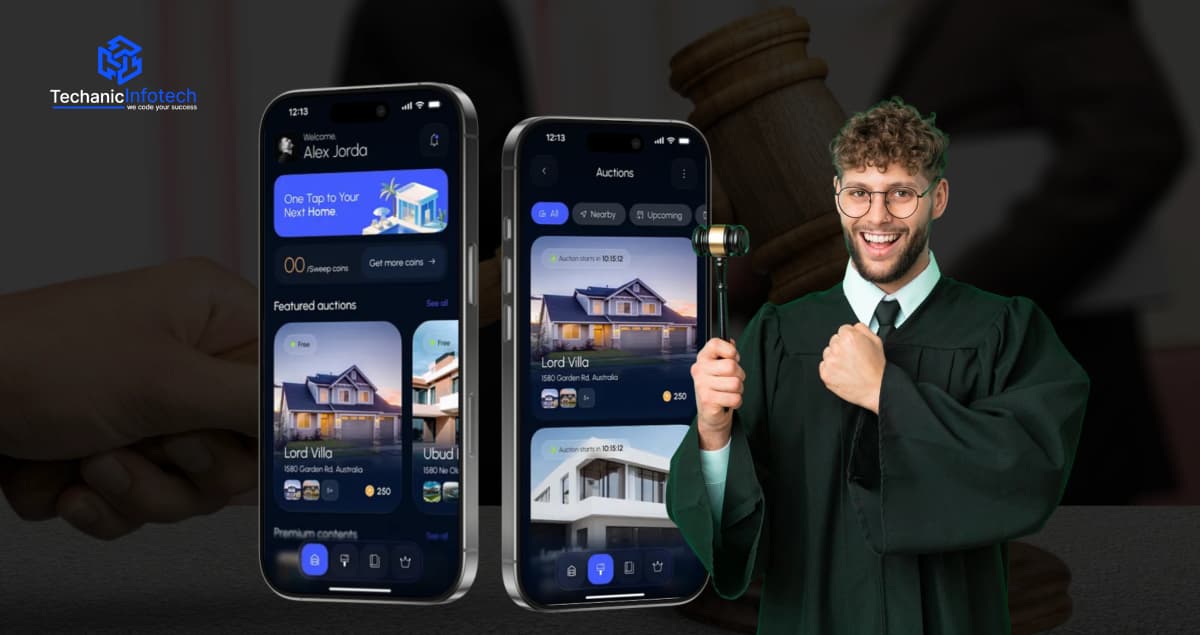
Imagine this: you have a solid idea for an auction app. You can already picture users placing bids in real time, watching prices rise, and winning items with just a tap. But before any of that becomes real, one important question comes up, how much does it actually cost to build an auction app?
In most cases, the overall cost to create an auction app ranges between $15,000 and $100,000. The exact number depends on how simple or advanced your app needs to be. A basic bidding platform sits on the lower end, while a feature-rich solution with live auctions, secure payments, and admin controls increases the cost.
The cost to develop an auction app is shaped by features, platforms, design choices, and scalability. In this blog, we’ll break down the auction app development cost clearly, so you can plan your budget with confidence.
Auction apps are gaining popularity as more users shift from traditional bidding to digital platforms. With growing mobile usage and online transactions, auction apps offer strong revenue potential and long-term scalability.

Below are key reasons why investing in auction app development makes business sense today.
The online auction market is growing steadily, projected to rise from over $2.1B in 2022 to $5.7B by 2030 at about a 13% CAGR, showing strong demand for digital bidding platforms.
Mobile auction apps are expanding fast, with the mobile auction apps market expected to reach around $21 billion by 2025 as more people use smartphones for bidding.
Online auctions are replacing traditional formats, with the market forecasted to add nearly $3.98B by 2029 at a 14% CAGR, driven by convenience and accessibility.
Auction apps earn from listing fees, transaction commissions, featured placements, subscriptions, and ads, giving businesses multiple revenue streams.
Innovative features like real-time bidding, AI search, and secure payments attract and retain users, helping your platform stand out in crowded digital markets.
An auction app is a digital platform where users can buy or sell products and services through a bidding process. Instead of fixed prices, sellers list items and buyers compete by placing bids within a set time frame.
The highest bidder usually wins once the auction ends.
These apps are commonly used for eCommerce products, collectibles, real estate, vehicles, and even services.
Modern auction apps make the entire process fast and convenient by offering real-time bidding, secure payments, and notifications.
For businesses, an auction app creates a competitive environment that can increase engagement and maximize item value.
For users, it offers excitement, transparency, and the chance to get good deals through live bidding.

Users create an account using email, phone number, or social login. This helps maintain trust and track bidding activity securely.
Sellers add items for auction by uploading images, descriptions, starting prices, bid increments, and auction duration.
Buyers explore active auctions using categories, search, and filters to find items they are interested in.
Interested users place bids on items. Each new bid must be higher than the previous one, following set rules.
Users receive live updates when someone outbids them or when an auction is about to end, keeping engagement high.
When the auction timer ends, the highest bidder is declared the winner automatically by the system.
The winning bidder completes payment using integrated payment gateways, ensuring secure transactions.
After payment, sellers deliver the item, and both parties can leave ratings or feedback.

The average cost to build an auction app usually falls between $15,000 and $100,000, depending on the app’s complexity, features, and platform choice.
A basic auction app with essential bidding features costs much less than a fully customized solution with real-time bidding, advanced security, and admin controls.
If you’re building a simple auction platform, the budget mainly goes toward design, basic development, and testing.
On the other hand, a feature-rich auction app with live bidding, payment integration, notifications, and analytics requires more development time and higher investment. Platform selection, scalability, and third-party integrations also influence the final cost.
Below is a breakdown of the key mobile app development stages and their average cost contribution.
|
Development Stage |
Description |
Average Cost (USD) |
|
Planning & Requirement Analysis |
Defining app features, user flow, and technical scope |
$2,000 – $5,000 |
|
UI/UX Design |
Designing user-friendly screens and navigation |
$3,000 – $10,000 |
|
Frontend Development |
Building the user-facing app interface |
$4,000 – $20,000 |
|
Backend Development |
Creating servers, databases, and bidding logic |
$5,000 – $30,000 |
|
Payment Integration |
Secure payment gateway and transaction setup |
$2,000 – $8,000 |
|
Admin Panel Development |
Tools for managing users, auctions, and reports |
$3,000 – $12,000 |
|
Testing & Quality Assurance |
Bug testing, performance, and security checks |
$2,000 – $7,000 |
|
Deployment & Launch |
App release, server setup, and configurations |
$1,000 – $3,000 |
When planning an auction app, one of the most common questions is why the pricing varies so much. The truth is, the expense depends on several technical and business factors. From features to platform choice, every decision affects the final budget.
Let’s break these factors down in detail so you can better estimate the cost to build an auction app.
Features play the biggest role in deciding the cost to create an auction app. A basic auction app with user registration, item listings, and manual bidding requires less development time. This type of app usually falls on the lower end of the budget.
However, as you add advanced features like live bidding, auto-bidding, push notifications, real-time updates, analytics dashboards, and dispute resolution, the cost increases. These mobile app features require more coding, testing, and backend logic.
Simply put, the more complex your app is, the higher the auction app development cost will be.
|
Feature |
Description |
Avg Cost (USD) |
|
User Registration & Login |
Email, phone, or social login with authentication |
$1,000 – $3,000 |
|
User Profiles |
Manage personal details, bidding history |
$1,000 – $2,500 |
|
Item Listing |
Sellers upload items with images, details, pricing |
$2,000 – $5,000 |
|
Category Management |
Organize items into categories and subcategories |
$1,000 – $2,500 |
|
Search & Filters |
Search by keyword, price, category, time |
$1,500 – $4,000 |
|
Manual Bidding |
Users place bids manually on items |
$2,000 – $5,000 |
|
Auto-Bidding |
Automatic bidding based on user-defined limits |
$3,000 – $7,000 |
|
Real-Time Bid Updates |
Live bid refresh without page reload |
$4,000 – $10,000 |
|
Auction Timer |
Countdown timers for active auctions |
$1,000 – $3,000 |
|
Notifications |
Bid alerts, outbid alerts, auction ending |
$1,500 – $4,000 |
|
Payment Gateway |
Secure payment and transaction handling |
$2,000 – $8,000 |
|
Order Management |
Track orders, payments, and status |
$2,000 – $5,000 |
|
Reviews & Ratings |
Buyer and seller feedback system |
$1,000 – $3,000 |
|
Dispute Management |
Handle complaints and conflicts |
$2,500 – $6,000 |
|
Admin Panel |
Manage users, listings, reports |
$3,000 – $12,000 |
The platform you choose has a direct impact on the budget. Developing an app for a single platform, such as Android, iOS, or web, is more affordable. But if you want your app to be available across all platforms, the budget increases.
Cross-platform development can help reduce the cost, but it still requires additional testing and optimization. If your goal is to reach a wider audience, multi-platform development is worth the investment, even though it raises the cost of auction app development.
Design is more than just how the app looks, it’s about how users interact with it. Simple and standard UI designs are more budget-friendly. However, auction apps often need clean layouts, easy navigation, and real-time bidding indicators.
Custom UI/UX with animations, dynamic bidding screens, and smooth transitions increases the cost. While good mobile app design adds to the budget, it also improves user engagement and retention, which is critical for auction platforms.
|
Platform Type |
Description |
Avg Cost (USD) |
|
iOS App |
Native iOS auction app development |
$10,000 – $30,000 |
|
Android App |
Native Android auction app development |
$8,000 – $28,000 |
|
Cross-Platform App |
Single codebase for iOS & Android |
$15,000 – $45,000 |
Auction apps rely heavily on backend systems to manage bids, users, listings, and payments. A basic backend supports limited users and auctions, keeping the cost to build an auction app lower.
However, if you expect high traffic or multiple auctions running simultaneously, you’ll need a scalable backend. This includes optimized databases, cloud infrastructure, and load handling. While scalability increases the estimated development cost of an auction app, it ensures smooth performance as your platform grows.
|
UI/UX Element |
Description |
Avg Cost (USD) |
|
Wireframing |
Basic structure and screen flow |
$1,000 – $3,000 |
|
User Journey Mapping |
Define buyer & seller experience |
$1,000 – $2,500 |
|
Visual Design |
Colors, typography, branding |
$2,000 – $6,000 |
|
Interactive Prototypes |
Clickable app mockups |
$2,000 – $5,000 |
|
Real-Time UI Elements |
Live bid indicators, animations |
$2,500 – $6,000 |
|
Responsive Design |
Works across devices and screen sizes |
$1,500 – $4,000 |
|
Usability Testing |
Improve navigation and ease of use |
$1,000 – $3,000 |
Real-time bidding is one of the most complex parts of an auction app. Every bid must be updated instantly for all users without delays. This requires real-time data synchronization, sockets, and low-latency systems.
Implementing real-time bidding correctly adds significant complexity and increases the cost to make an auction app. However, without this feature, the app may fail to deliver the competitive experience users expect.
|
Component |
Description |
Avg Cost (USD) |
|
Live Bid Synchronization |
Real-time update of bids across all users |
$4,000 – $10,000 |
|
WebSocket / Real-Time APIs |
Enables instant bid communication |
$3,000 – $8,000 |
|
Low-Latency Infrastructure |
Reduces delay during live bidding |
$2,500 – $7,000 |
|
Bid Validation Logic |
Prevents invalid or duplicate bids |
$1,500 – $4,000 |
|
Auto-Bid Engine |
Automatically places bids up to set limits |
$3,000 – $7,000 |
|
Failover & Recovery |
Handles connection drops during bidding |
$2,000 – $5,000 |
Secure payment handling is essential for any auction app. Integrating payment gateways, managing refunds, and handling transaction failures add to the cost.
If your app supports multiple payment methods or international transactions, the cost to build an auction app increases further. Payment-related features also require extensive testing to ensure reliability and user trust, which adds to mobile app development time and budget.
|
Component |
Description |
Avg Cost (USD) |
|
Payment Gateway Setup |
Integrating gateways like Stripe or PayPal |
$2,000 – $6,000 |
|
Multiple Payment Methods |
Cards, wallets, bank transfers |
$1,500 – $4,000 |
|
Transaction Handling |
Secure processing and status updates |
$2,000 – $5,000 |
|
Refund & Cancellation Logic |
Manage failed or canceled transactions |
$1,500 – $4,000 |
|
Payment History & Reports |
Transaction records for users and admins |
$1,000 – $3,000 |
|
Payment Testing & Compliance |
Ensures reliable and secure payments |
$1,500 – $3,500 |
Auction apps deal with sensitive user data, bidding activity, and payments. Features like data encryption, secure login, fraud detection, and compliance with regulations are not optional.
Strong security measures increase the cost to build an auction app, but they are necessary to protect users and avoid legal risks. The higher the security standards, the higher the mobile application development cost, but this investment pays off in long-term trust and stability.
|
Security Element |
Description |
Avg Cost (USD) |
|
Secure Authentication |
Login security, password protection |
$1,500 – $4,000 |
|
Data Encryption |
Protect user and payment data |
$2,000 – $6,000 |
|
Fraud Detection |
Identify suspicious bidding activity |
$3,000 – $8,000 |
|
Role-Based Access |
Control user and admin permissions |
$1,500 – $3,500 |
|
Compliance Standards |
GDPR, PCI-DSS, and data protection |
$3,000 – $10,000 |
|
Security Testing & Audits |
Vulnerability and penetration testing |
$2,000 – $6,000 |
The admin panel is the control center of an auction app. It allows admins to manage users, approve listings, monitor bids, handle disputes, and generate reports.
A basic admin panel keeps the cost lower, while advanced dashboards, analytics, and custom controls increase the cost of auction app development. A well-built admin panel reduces manual work and improves platform efficiency over time.
|
Admin Feature |
Description |
Avg Cost (USD) |
|
Admin Dashboard |
Central view of users, auctions, and activity |
$2,000 – $5,000 |
|
User Management |
View, verify, suspend, or ban users |
$1,500 – $4,000 |
|
Listing Moderation |
Approve, reject, or remove auction listings |
$2,000 – $5,000 |
|
Auction Management |
Create, edit, pause, or end auctions |
$2,000 – $6,000 |
|
Bid Monitoring |
Track live bids and bidding history |
$2,500 – $6,000 |
|
Payment Oversight |
Monitor transactions, payouts, and refunds |
$2,000 – $5,000 |
|
Dispute Handling |
Manage complaints and resolve conflicts |
$2,500 – $6,000 |
|
Reports & Analytics |
View performance, revenue, and user reports |
$3,000 – $8,000 |
|
Role & Permission Control |
Set access levels for admin staff |
$1,500 – $3,500 |
|
Content Management |
Manage policies, banners, and notifications |
$1,000 – $3,000 |
Auction apps use multiple revenue streams to generate income while keeping the platform attractive for buyers and sellers. Instead of relying on a single source, most successful auction platforms combine several monetization models.
Below are the most common ways auction apps make money.

Many auction apps charge sellers a fee to list items on the platform. This can be a one-time fee per listing or a package-based pricing model. Listing fees ensure that sellers are serious and help reduce spam or low-quality listings. This revenue model works well for platforms with high seller activity.
A common revenue model is charging a percentage commission on every successful auction. Once an item is sold and payment is completed, the platform keeps a small portion of the transaction value. This model aligns platform earnings with seller success, making it fair and scalable.
Auction apps often offer paid promotions to sellers who want more visibility. Featured listings appear at the top of search results or category pages. This option helps sellers reach more buyers while providing an additional income stream for the platform.
Some auction apps offer monthly or yearly subscription plans for frequent sellers or businesses. These plans may include benefits such as lower commission fees, priority listings, or advanced analytics. Subscriptions provide predictable and recurring revenue.
Auction platforms can display third-party ads or sponsored content. This includes banner ads, promoted products, or brand partnerships. Advertising works best for apps with high user traffic and engagement.
Auction apps may charge small service or processing fees during checkout. These fees cover payment handling, security, and platform maintenance. While small per transaction, they add up significantly at scale.

Techanic Infotech helps businesses build secure, scalable, and revenue-ready auction applications tailored to modern market needs. With experience in developing transaction-based platforms, the team understands the technical challenges of real-time bidding, payment security, and performance scalability.
Our auction app development company offers end-to-end services, from planning and UI/UX design to backend development and post-launch support. By following a transparent and structured development process, the company helps businesses control costs while delivering reliable auction apps built for long-term growth and user engagement.
Building an auction app can be a great business opportunity when planned the right way. The cost to develop an auction app mainly depends on features, platform choice, design quality, and security needs.
A simple app can be built with a lower budget, while a feature-rich and scalable auction platform requires a higher investment. Understanding the development cost, key features, and monetization options helps you make better decisions from the start.
With the right development partner and a clear plan, you can control costs, avoid common mistakes, and build an auction app that delivers value to users and grows successfully over time.
The cost to develop an auction app usually ranges between $15,000 and $100,000. The final cost depends on features, platforms, design complexity, and security requirements.
On average, an auction app takes 3 to 6 months to develop. Advanced features like real-time bidding and payment integration may increase the timeline.
Yes, many businesses start with a basic version and add advanced features later. This approach helps manage initial costs and reduces development risk.
You can choose Android, iOS, web, or cross-platform based on your target audience. Cross-platform apps are often more cost-effective for reaching wider users.
For most auction apps, real-time bidding is essential to ensure fairness and engagement. It improves user experience but also increases development cost.
Auction apps earn money through listing fees, commissions on sales, featured listings, subscriptions, ads, and service fees.
Yes, auction apps handle sensitive user and payment data. Strong security features are essential to protect users and build trust.


Bharat Sharma is the CTO of Techanic Infotech, bringing deep technical expertise in software architecture, mobile app development, and scalable system design. He leads the engineering team with a strong focus on innovation, performance, and security.