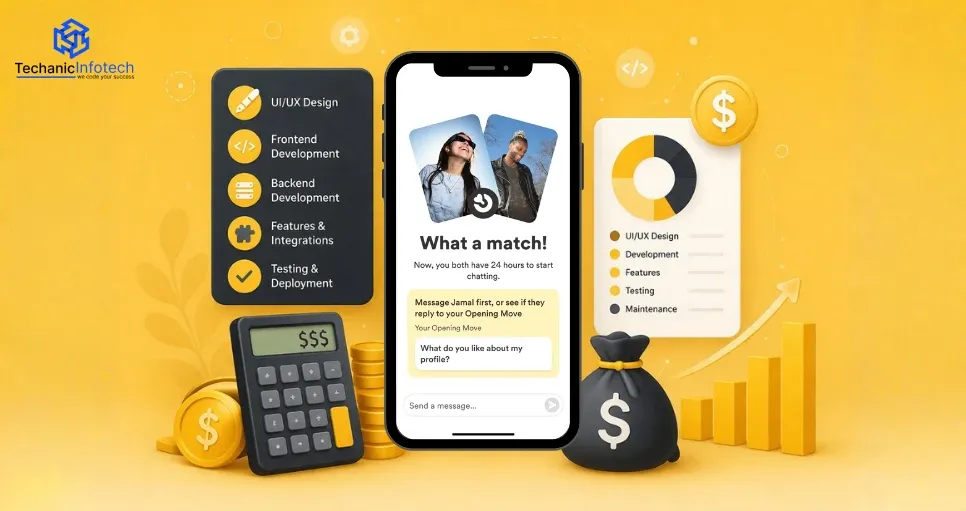
Dating App Development
Cost to Develop an App Like Bumble: Complete Pricing Guide for 2026
April 8, 2026
April 8, 2026
Key Takeaways
Creating a dating app like Bumble costs $8,000–$70,000+, depending on features, AI integration, platform choice, and team location.
Core features are affordable, while advanced functionalities like AI matchmaking, video calls, and smart recommendations can increase development costs by 40% or more.
Developing for iOS, Android, or both affects costs; custom UI/UX and animations further add 10–20% to the total budget.
North American developers charge more, while outsourcing to Eastern Europe or Asia reduces costs, affecting up to 30% of overall expenses.
Maintenance, cloud hosting, app store fees, API subscriptions, security, and customer support add recurring expenses beyond initial development.
AI enhances personalization, matching, and moderation, but increases costs by 20–30%, requiring advanced algorithms, data processing, and ongoing training for optimal performance.
Developing a dating app like Bumble requires careful planning, feature selection, and the right tech stack.
The total cost typically ranges from $8,000 to $70,000+, depending on complexity, platform choice, and development team location.
In contrast, advanced apps with AI matching, video calls, and premium features significantly increase costs.
Understanding these cost factors helps startups and enterprises plan budgets effectively and build scalable, competitive dating applications in today’s fast-growing digital market.
Several key factors influence the overall cost of developing a Bumble-like app, including best dating app features, technology, team location, and scalability requirements, all of which directly impact your final development budget significantly.
The number and complexity of features like swipe matching, chat, video calls, and AI recommendations significantly affect costs.
Basic apps are cheaper, while advanced functionality can increase development expenses by up to 40%.
Developing for iOS, Android, or both platforms affects the cost. Native apps cost more, while cross-platform frameworks reduce expenses.
Supporting multiple platforms can increase overall development costs by around 20%.
A visually appealing and intuitive mobile app design enhances user engagement but adds to development costs.
Custom animations and interactive designs increase expenses, often contributing up to 20% of the total app budget.
The cost to hire dating app developers from regions like North America is higher compared to Asia or Eastern Europe.
Location-based pricing differences can impact the budget by as much as 30%, making outsourcing a cost-effective option.
Robust backend systems for data storage, user management, and real-time interactions are essential.
More scalable and secure backend solutions increase costs, contributing around 20% to the overall development budget.
Integrations such as payment gateways, geolocation, and social logins add convenience but increase costs.
Each integration adds licensing and development expenses, impacting around 10–15% of the total cost.
The cost of developing a Bumble-like app varies based on development stages, feature levels, and ongoing expenses like dating app maintenance, scaling, and updates required for long-term performance and growth.
A basic application focuses on core functionalities such as user registration, profile creation, and simple matching algorithms.
This level is ideal for MVPs (Minimum Viable Products) and startups aiming to validate their concept quickly.
While the feature set is minimal, it allows for cost-effective development and faster market entry.
Mid-tier apps introduce advanced features like real-time chat, push notifications, and improved dating app design.
These enhancements significantly boost user engagement and retention.
The added complexity requires more development time and expertise, leading to moderately higher costs.
Advanced applications offer premium functionalities such as AI-driven matchmaking, video calling, smart recommendations, and subscription-based features.
These apps demand sophisticated architecture, high-end design, and robust backend systems, resulting in higher development investment but delivering a competitive, feature-rich product.
Post-launch maintenance is essential for long-term success. This includes regular updates, performance optimization, bug fixes, and security enhancements.
Businesses should allocate approximately 15–20% of the initial development cost annually to ensure smooth operation and continuous improvement.
As the user base expands, the need for scalable cloud infrastructure and server capacity grows.
Monthly expenses can range from $1,000 to $5,000 or more, depending on traffic, data storage, and real-time processing requirements.
A strong marketing strategy is crucial for successful app adoption.
Expenses may include digital advertising, influencer collaborations, social media campaigns, and app store optimization (ASO).
Effective marketing significantly influences user acquisition and overall growth.
While developing an app with a reliable dating app development company, hidden costs also impact your budget, including compliance, maintenance, and third-party services.
Publishing your application on platforms like the Apple App Store or Google Play Store involves mandatory annual developer fees.
Although relatively small, these recurring charges are essential for app distribution and must be considered as part of your long-term operational and budget planning strategy.
Integrating third-party services such as payment gateways, geolocation tracking, and messaging APIs often comes with subscription or usage-based fees.
Over time, these recurring costs can grow significantly, impacting your overall budget and increasing the total cost of maintaining your application.
Ensuring robust data protection and compliance with regulations like GDPR requires investment in advanced security measures, encryption technologies, and regular audits.
These essential efforts safeguard user information, build trust, and prevent legal complications, but they also introduce additional ongoing costs.
After launching your app, continuous updates and bug fixes are necessary to maintain performance, compatibility, and user satisfaction.
Regular improvements help address technical issues and evolving user needs, making it essential to allocate a dedicated budget for ongoing development and maintenance.
Cloud hosting services are required to store data, manage servers, and handle user traffic efficiently.
As your app grows and attracts more users, these costs can increase significantly, making cloud infrastructure one of the most important and scalable recurring expenses in your budget.
Providing reliable customer support through chat systems, email, or dedicated teams is crucial for resolving user issues and maintaining satisfaction.
These services require consistent investment in tools and personnel, representing an often underestimated but vital operational cost for long-term success.
Artificial intelligence enhances user experience in dating apps but significantly impacts app development costs due to advanced algorithms, data processing, and integration complexity required for smart matchmaking features.
AI-powered matchmaking systems significantly improve user engagement by analyzing behavior, preferences, and interactions.
However, developing and implementing these complex algorithms requires advanced expertise, extensive data modeling, and testing, increasing overall development costs by approximately 20% to 30% compared to basic matching systems.
AI-driven chatbots enhance user engagement by providing instant responses, onboarding assistance, and automated support.
While they improve efficiency and user satisfaction, they require additional development, training, and integration, leading to an estimated 10% to 15% increase in overall application development costs.
AI-based image recognition technologies enable profile verification, fake account detection, and content moderation.
These features improve platform safety but demand advanced machine learning models, high-quality datasets, and processing power, contributing to a 15% to 25% increase in development expenses.
AI systems rely heavily on large-scale data processing and storage to deliver accurate, real-time recommendations.
Managing this data requires scalable infrastructure and efficient processing systems, increasing backend complexity and adding approximately 10% to 20% to the total development and operational costs.
AI-driven personalization enhances user experience by tailoring match suggestions based on behavior, preferences, and activity patterns.
While highly effective for engagement, implementing these intelligent systems increases development complexity, requiring additional resources and contributing to a 15% to 25% rise in overall costs.
AI models require continuous monitoring, retraining, and optimization to remain accurate and relevant.
This ongoing process involves data updates, performance tuning, and infrastructure support, resulting in an additional annual cost of approximately 10% to 15% of the initial AI development investment.
Mobile app development costs for Bumble-like apps vary widely by region due to differences in developer rates, expertise, and market demand, making location a crucial factor in overall budgeting decisions.
Developers in the United States and Canada typically charge between $80 and $150 per hour due to high demand and advanced expertise.
While costs are premium, businesses benefit from high-quality development, innovation, and reliable project execution throughout the process.
Western European developers usually charge around $60 to $120 per hour, offering a balance between cost and quality.
Businesses can access skilled professionals and strong technical expertise while keeping development expenses slightly lower than those in North American markets.
In Eastern Europe, developers charge approximately $40 to $80 per hour, making it a cost-effective choice.
Companies can reduce overall development costs while still benefiting from skilled professionals, solid technical backgrounds, and reliable project delivery standards.
Asian countries like India offer highly competitive rates ranging from $20 to $50 per hour.
This affordability allows businesses to significantly cut development costs while still building scalable and efficient applications with the help of a large talent pool.
Developers in Australia charge between $70 and $130 per hour, reflecting high demand and expertise.
Although costs are relatively high, businesses gain access to experienced professionals who ensure quality development, smooth communication, and dependable long-term results.
Freelancers generally charge lower rates, helping reduce costs, while agencies may increase total expenses by 10% to 30%.
However, agencies provide structured workflows, dedicated teams, and end-to-end services, ensuring better reliability, scalability, and overall project management.
Bumble, a popular dating app, generates revenue through multiple strategies by offering free access while monetizing premium features, partnerships, and user engagement opportunities.
Bumble operates on a freemium model, allowing users to access basic features for free while offering premium subscriptions.
Paid tiers unlock benefits like unlimited swipes, advanced filters, and visibility boosts, encouraging users to upgrade for a better dating experience.
In-app purchases provide users with optional features such as profile boosts, SuperSwipes, and Spotlight.
These microtransactions enhance visibility and interaction chances, making them appealing for users seeking quicker or more meaningful matches within the app.
Bumble integrates advertisements in a subtle, user-friendly manner.
Brands can promote products or services through native ads, ensuring they blend with the app’s interface, thereby generating revenue without significantly disrupting the user experience.
Bumble hosts both online and offline events like meetups and networking sessions.
These events are often sponsored by brands, allowing companies to reach targeted audiences while Bumble earns revenue through partnerships and promotional collaborations.
Through affiliate marketing, Bumble partners with third-party services and promotes them within the app.
When users engage with or purchase from these partners, Bumble earns a commission, creating an additional revenue stream beyond subscriptions and ads.
Developing an app like Bumble involves a wide range of costs influenced by features, complexity, technology, and team location.
With estimates ranging from $8,000 to $70,000+, businesses must carefully plan their budgets to align with their goals and target audience.
While basic apps are affordable, advanced features like AI matching, video calls, and premium subscriptions significantly increase costs.
Additionally, hidden expenses such as maintenance, cloud hosting, and marketing play a crucial role in long-term success.
Choosing the right development strategy, such as starting with an MVP and scaling gradually, can help optimize costs.
Ultimately, investing wisely in design, functionality, and user experience ensures a competitive and scalable dating app in today’s digital landscape.
The cost typically ranges from $8,000 to $70,000+, depending on features, platform, and development complexity involved in building the application.
A basic dating app MVP can be developed with a minimum budget of around $8,000 to $15,000 with essential features only.
Development usually takes 3 to 9 months, depending on app complexity, features, and the development team’s expertise and resources.
Advanced features, AI integration, backend complexity, and cross-platform development are the major factors that significantly increase overall app development costs.
Building for a single platform is cheaper, while developing for both Android and iOS increases cost by around 20–30%.
Maintenance typically costs 15–20% of the initial development cost annually, covering updates, bug fixes, and performance improvements.
AI is not mandatory, but it improves user experience through better matchmaking and personalization, increasing engagement and retention rates significantly.
Ongoing costs include hosting, maintenance, updates, marketing, and customer support, which are essential for long-term app success.
Yes, by building an MVP first, using cross-platform frameworks, and outsourcing development to cost-effective regions, you can reduce expenses.
They generate revenue through subscriptions, in-app purchases, and advertisements, making monetization a key part of the business model.


Abhishek Jangid is the CEO of Techanic Infotech, with extensive experience in mobile app and web development. He specializes in helping businesses turn innovative ideas into scalable digital solutions through strategic planning and modern technology.