Designing a dating app is not just about creating profiles and swiping; it’s about building a smooth and exciting user experience that helps people connect.
If you’re planning to create your own dating platform, you probably have questions about the budget, must-have features, and the full development flow.
This blog is a complete dating app design guide, where we break down everything simply and clearly.
From how much it costs to design a dating app to the features users love the most and the step-by-step design process, we’ll cover it all.
By the end of this guide, you’ll understand exactly what it takes to build a dating app that people enjoy using and return to again and again.
A dating app is a mobile platform where people can meet, chat, and build connections online. It helps users find someone with similar interests, values, and lifestyles without needing to meet in person first.
From casual friendships to serious relationships, dating apps give people a space to explore and connect in a comfortable way
In this dating app design guide, understanding how a dating app functions is the first step toward building a successful one.
Users sign up and create a profile with details like photos, bio, and interests.
The app suggests matches based on preferences, location, or behavior.
Users swipe, like, or send requests to show interest.
When both users like each other, a match is created.
They can start chatting and decide to meet or continue online.
Good design is the heart of every successful dating app. When people download a new dating platform, they expect a smooth, simple, and enjoyable experience.
If the app feels confusing or slow, users leave within minutes. That’s why good design matters; it makes users stay, explore, and connect.
Whether you want to design a dating app from scratch or upgrade an existing one, design choices directly influence user satisfaction and business success.
The moment a user opens the app, the design sets the tone. A clean interface, easy navigation, and fast loading create a positive start.
On the other hand, messy layouts or complicated actions instantly reduce trust and interest. In designing a dating app, visual appeal, colors, icons, and screen flow help users feel comfortable and confident.
When the app layout is simple and features are easy to find, users interact more. They swipe more profiles, send more matches, and start more conversations.
Smooth profile setup, clear call-to-action buttons, and attractive UX increase engagement naturally. This means users enjoy the platform and spend more time on it.
Dating involves personal information, so safety must be reflected in the design.
A professional look, transparent security options, and clear reporting or blocking features make users feel protected. When people feel safe, they interact freely and return often.
In short, good design isn’t just about pretty screens. It helps users understand the app, explore it with confidence, and build real connections.
If you want your app to stand out in the crowded market, focus on a user-friendly, intuitive, and emotionally comfortable design.
Strong design creates trust, engagement, and long-term success, the three pillars of a winning dating app.
In the dating app design guide, the first step toward building a platform users love is choosing the right dating app features. A dating app isn’t just a place to swipe; it should feel comfortable, smooth, and engaging from start to finish.
Every feature should help users discover someone new, connect easily, and feel safe while using the app.
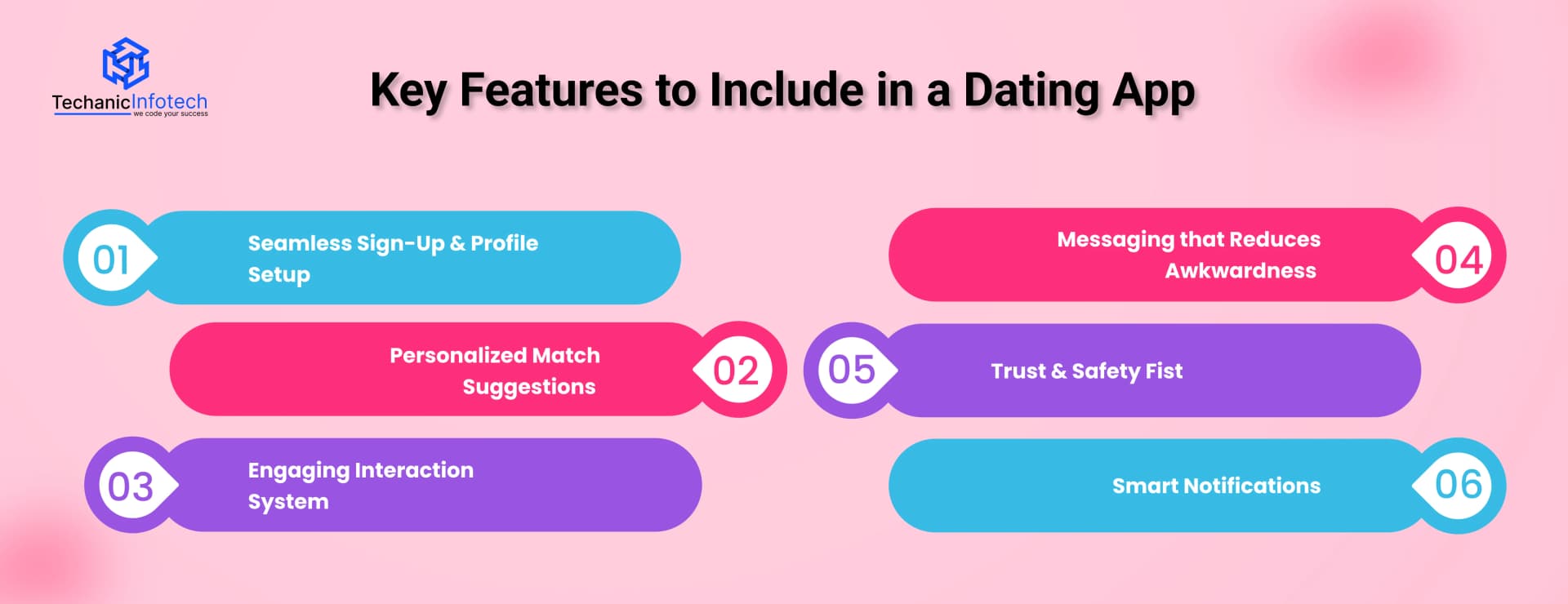
In any strong dating app design, users shouldn’t struggle to get started. A quick sign-up using phone or social login, plus easy photo upload and interest selection, sets the tone for an enjoyable experience.
Good dating app design focuses on helping users meet relevant people, not random profiles. A matching system based on preferences, location, and shared interests increases the chance of real connections.
Whether it’s swiping, liking, waving, or sending a “crush” request, interaction should feel playful. This element of dating app design keeps users active and emotionally invested while exploring profiles.
A great match needs a great chat experience. Voice notes, GIFs, prompts, and fun icebreakers help conversations without pressure and make messaging more enjoyable.
Features like profile verification, secure photo sharing, blocking/reporting options, and panic buttons give users confidence. When people feel safe, they are more likely to interact freely.
Notifications should remind users of new messages, new matches, and profile visits without becoming overwhelming. The goal is to increase engagement while respecting user comfort.
Designing a dating app is more than adding profiles and swipe buttons; it’s about building a smooth, safe, and enjoyable digital experience where people can connect confidently.
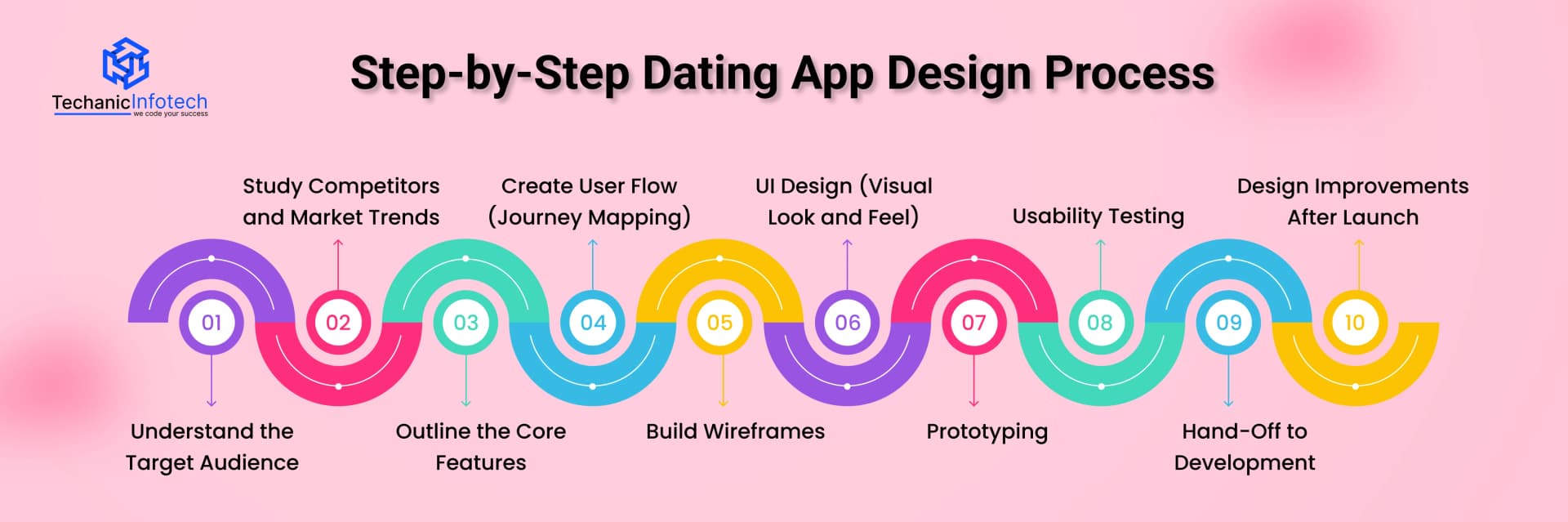
In this Dating App Design Process, every step shapes how users feel inside the app from their first signup to their first conversation.
A strong design journey ensures the app looks appealing, works flawlessly, and supports emotional comfort.
Every dating app has a different purpose because every audience has different expectations.
Before designing, it’s important to understand who the app is for: students, professionals, seniors, pet lovers, or people seeking long-term relationships.
This research decides the interface style, tone, and key features. For example, an app for professionals may follow a clean and formal UI, while an app for Gen-Z may use bold colors and playful visuals.
Competitor research helps avoid mistakes and adopt ideas that already work. In this step, designers explore popular platforms to learn where users feel happy and where they feel frustrated.
This isn’t copying, it’s learning how to design a dating app that is different and better. Designers look at sign-up flow, match suggestions, chat experience, and safety options to identify what users value the most.
After the research stage, the next step is listing all essential app features.
This includes onboarding, user profiles, discovery screen, match screen, chat, filters, notifications, and safety features.
Extra features like video dating, interest badges, and compatibility scores can also be planned at this stage. Finalizing features early keeps the design process structured.
User flow shows the step-by-step actions users take in the app. It covers everything from signing up to chatting with a match.
The goal is to make the entire experience smooth and effortless. Every action should feel natural, not confusing.
If a user wants to update a profile, check likes, or explore matches, it should never take more than a couple of steps.
Wireframes are basic layout sketches that define where everything will be placed on the screen: photos, buttons, text, icons, and navigation.
This step helps refine ideas before applying colors or graphics. Wireframes make sure the structure is clean and easy to follow. They are the foundation of every future design decision.
Once wireframes are approved, UI elements like colors, fonts, shapes, and animations are added to make the app visually appealing.
At this stage, designers aim to create a dating app that feels emotionally comfortable for users.
The visual tone should match the audience's warm and friendly, bold and energetic, or minimal and professional.
Every detail matters, including how chat bubbles look, how buttons look, and how the match success screen feels emotionally.
A prototyping simulates a functioning app without actual coding; users and internal teams can click, swipe, navigate tabs, and test the flow.
This makes it easier to identify issues early. If something feels confusing or slow, changes can be made before development, which saves time and cost.
In this step, real users or selected testers try the prototype and share honest feedback. They may highlight problems like hard-to-find icons, complicated filters, or slow onboarding screens.
Designers then refine the layout, labels, and navigation. Usability testing ensures the app is not just beautiful but also practical and effortless to use.
After finalizing the design, all assets, screens, fonts, animations, color guides, and spacing rules are shared with developers.
Clear communication is important so the live app looks and functions exactly like the prototype. Designers often continue assisting during development to maintain accuracy.
The work doesn’t stop after publishing the app. Real usage analytics and feedback reveal what people love and what they ignore.
Continuous enhancement of the dating app interface design helps boost engagement.
Examples include improving button placements, adding better filters, refining chat layout, or changing match animations based on user behavior.
Designing a dating app involves more than just attractive screens; it requires planning, research, creativity, and testing.
In this guide, we break down the major cost areas so you can understand the cost to develop a dating app from a design perspective.
$8,000 – $20,000, the final pricing depends on the number of screens, the complexity of visuals, animations, and the feature set.
A clear budget helps teams stay focused and invest in what truly matters for user satisfaction.
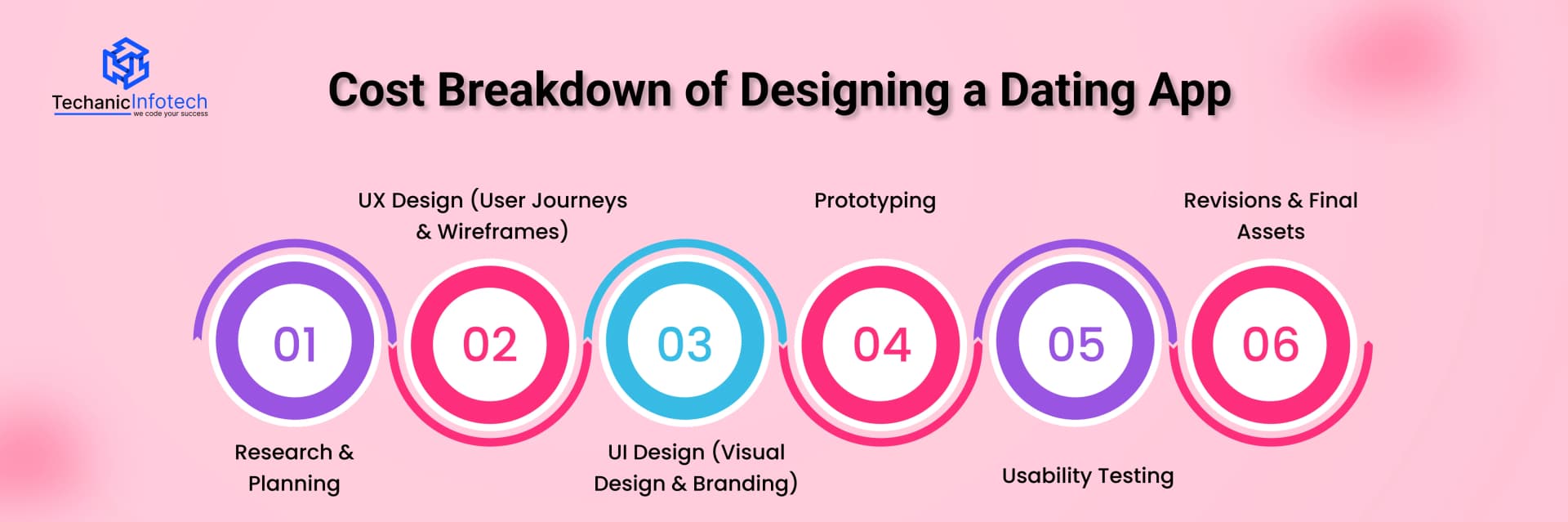
Before any visual work begins, the team studies the target audience, competitor apps, and expected features. This step builds a strong foundation and typically costs $2,000 – $6,000, depending on the research depth.
UX design defines how smoothly users move inside the app, signing up, exploring profiles, matching, and chatting. This includes journey mapping and wireframes, and usually costs $4,000 – $10,000.
This stage brings screens to life using colors, layouts, icons, animations, and branding. The design of a dating app can vary in cost depending on visual style.
Clean and minimal designs are cost-friendly, while detailed illustrations, animations, and custom components increase pricing. UI design generally ranges between $6,000 – $15,000.
A clickable prototype is built to simulate how the app functions. It helps test the flow, remove confusion, and identify needed improvements before development begins. This phase usually costs $3,000 – $8,000.
Real users or testers interact with the prototype and share feedback on what feels confusing or difficult. Designers fix button placements, page structure, and navigation based on feedback. This step costs around $2,500 – $7,000.
After improvements, the final designs and style guides are handed over to developers. This includes exporting icons, preparing spacing rules, documentation, and pixel-perfect layouts.
At this stage, the focus is on delivering a polished dating app UI design, costing around $2,000 – $5,000.
The cost of designing a dating app depends on multiple technical and creative elements, and the most important starting point is exploring the right dating app design ideas that align with your audience, platform, and revenue model.
Once the vision is clear, the design budget becomes much easier to estimate and control.
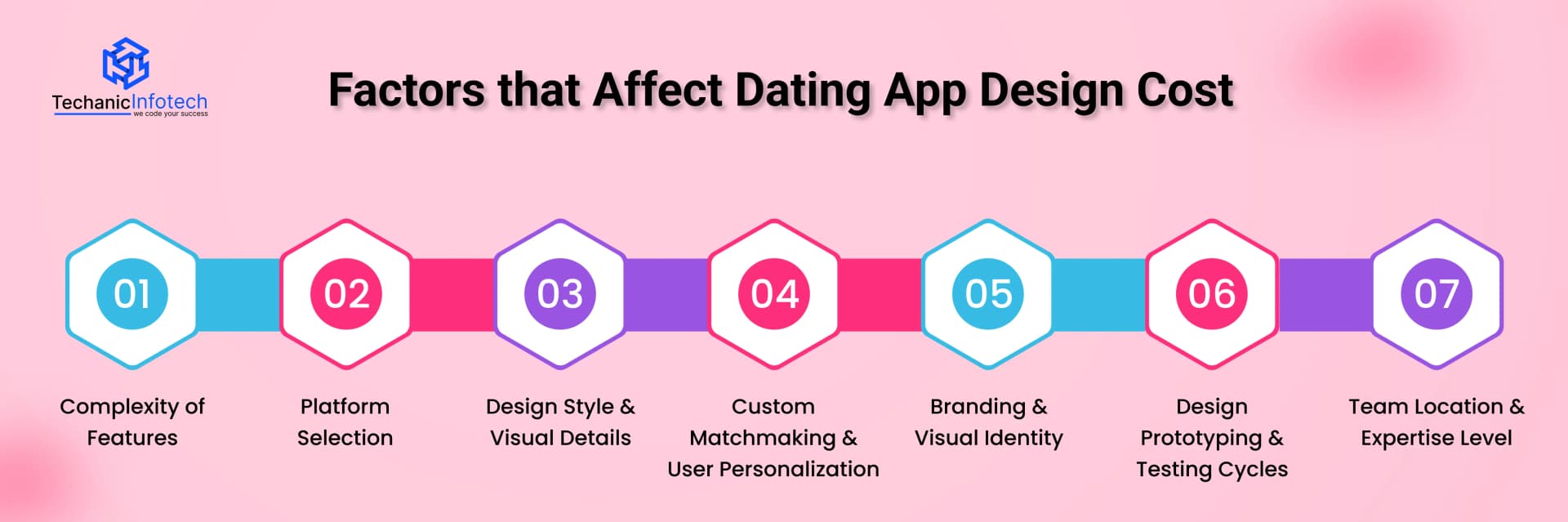
Apps with basic swiping, chat, and profile creation cost less to design. But if you add AI-based matchmaking, video calling, live streams, interest-based communities, and user safety dashboards, the design effort and the cost increase significantly.
Designing for a single platform (Android or iOS) requires fewer screens and assets compared to launching for both. If you choose cross-platform UI consistency, additional adaptations and component design will be needed.
The dating app design approach plays a major role in defining the cost. Minimalistic layouts are quicker and cheaper to design, while ultra-modern interactions like 3D avatars, motion transitions, illustrations, and micro-animations require more work and therefore more investment.
Whether you plan to include interests, hobbies, preferences, personality types, or astrological compatibility, each layer of personalization adds more UI screens and states to be designed.
Custom brand guidelines (color psychology for dating, iconography, typography, and UI elements) increase the time and expertise needed. A fully branded aesthetic costs more than using common libraries and generic UI kits.
The process of creating multiple versions and testing user journeys has a major effect on the budget. Full prototype-based development that considers dating app UI/UX design ensures higher product quality but requires more effort and iteration.
UI/UX designers in the U.S., UK, or Europe charge more compared to Asia-based teams. Additionally, senior designers and agencies cost more than freelance designers but usually deliver a more scalable and user-centric design.
When you create a dating app, you are not just building screens; you are creating a space where people meet, connect, and trust each other.
That’s why design mistakes can directly affect user engagement, retention, and safety.
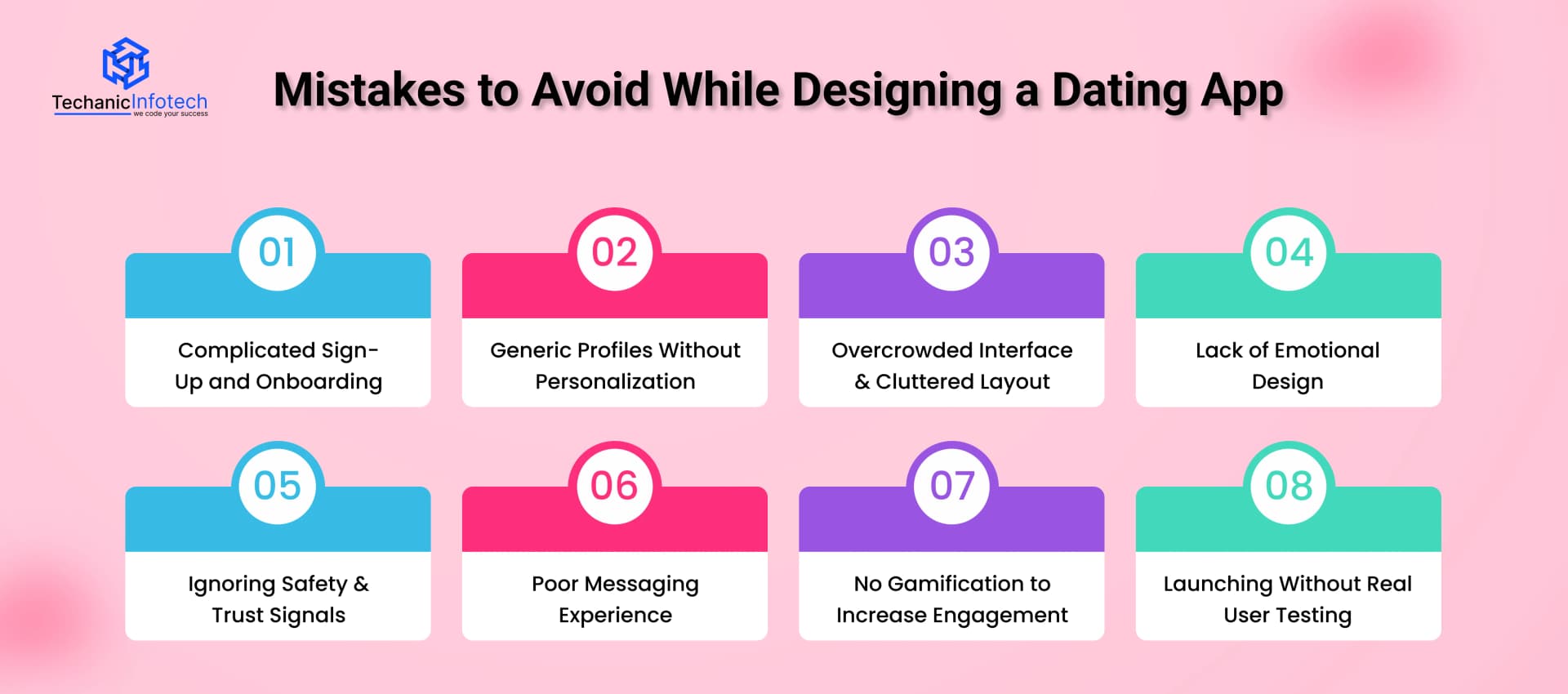
Here are the most common errors developers must avoid:
Making users share too many details right away can push them away. Keep onboarding short and friendly. Allow them to complete profiles later so they do not feel pressured.
If every profile looks similar, users lose interest quickly. Smart matching, hobbies, and interaction suggestions keep people engaged and help them find better connections.
Many creators try to add everything on one screen and end up confusing users. A clean interface, simple navigation, and focused actions keep users comfortable. This is an important tip highlighted in many dating app design guide studies: simplicity always wins.
Dating is emotional, not transactional. If the app feels cold, users disconnect. Warm colors, positive messages, reactions, and pleasing visuals make the experience enjoyable and human.
Without visible safety elements like verification badges, privacy settings, and reporting options, users may feel insecure. Trust-centered design is essential for long-term success.
A dull or buggy chat screen kills user interest fast. Reactions, emojis, voice notes, icebreakers, and date planning reminders can help. Strong messaging features are one of the most important tips for designing a dating app and directly improve user retention.
Modern users need motivation to come back. Points, badges, daily suggestions, and achievements boost swipe rate and session time without feeling boring or forced.
Even visually attractive designs fail if they don’t match real user behavior. Test prototypes with real users before development to avoid costly changes later.
Studying successful platforms is an important part of any dating app design guide because it helps you understand what users already enjoy and what you can improve while building your own dating product, whether it's developing an LGBTQ+ app or creating a casual dating app. Below are some top apps that can inspire strong design decisions.
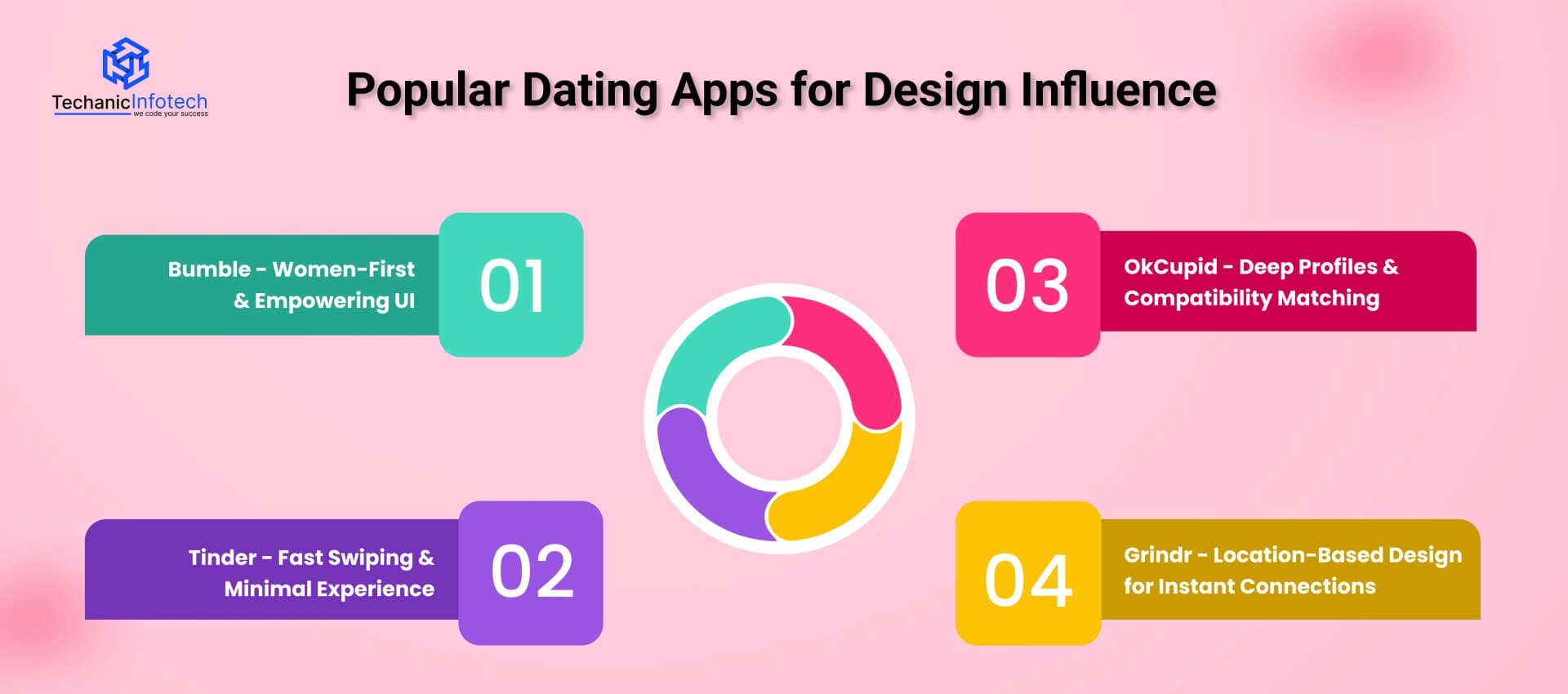
Bumble has proved that design can change user behavior by letting women send the first message. Its bright colors, comforting icons, and safe conversation flow make the experience positive and pressure-free.
If you plan to make an app like Bumble, take inspiration from its safety-focused onboarding, soft design patterns, and friendly tone that builds trust from the first interaction.
Tinder became famous because of its simple features and clean user interface. Swipe-left and swipe-right actions allow users to quickly scroll through potential matches without confusion.
If your focus is how to create an app like Tinder, the platform shows that speed and visual flow matter more than too many features on one screen.
If your app is built around fast and casual social discovery, Tinder’s minimalist card-style layout can be a strong UX reference and help users enjoy a smooth, effortless experience.
OkCupid attracts users looking for meaningful connections rather than quick swipes. The platform uses detailed profiles, personal questions, and compatibility scores to match users thoughtfully. If you are wondering how to create a dating app like OkCupid, take note of its onboarding structure, question-based personalization, and algorithm-driven match results.
Apps designed for LGBTQ+ communities (like HER, Grindr, etc.) show the importance of inclusive design. They use thoughtful profile options, supportive content, and visible safety tools to create safe digital spaces for diverse identities. Their UI proves that comfort and respect make users feel confident while connecting.
.webp&w=1920&q=75)
Techanic Infotech makes the process of creating a dating platform smooth, fast, and stress-free. As a trusted dating app development company, we handle everything from UI/UX design to development, testing, and launch.
Our team studies your business idea, target audience, and competition to build a custom app that feels modern, safe, and user-friendly.
We include features like smart matching, profile verification, real-time chat, and advanced security to ensure users feel comfortable and engaged.
With our scalable architecture, your app can grow easily as the user base increases. We also provide post-launch support, updates, and maintenance so your dating app continues to perform well and attract long-term users.
Building a successful dating platform goes beyond good features; it requires an engaging, safe, and user-friendly experience.
The right design plays a major role in helping users connect, interact, and trust the app from the very first screen.
With this dating app design guide, you now understand the cost, features, and step-by-step process needed to turn an idea into a strong digital product.
Focusing on clean UI, smooth onboarding, personalization, and safety can make your app stand out in a competitive market.
Design with emotion, simplicity, and user comfort, and users will keep coming back.
Usually between 3 to 6 months, depending on features, design complexity, and team size.
The cost varies based on features, UI/UX complexity, and platform, but a basic app typically requires a medium-level budget.
Yes. Features like smart matching, safety tools, and smooth chat increase engagement and retention.
Yes. You can launch on both platforms using native or cross-platform development.
Yes, updates, bug fixes, and new features can be added anytime to maintain performance.


Abhishek Jangid is the CEO of Techanic Infotech, with extensive experience in mobile app and web development. He specializes in helping businesses turn innovative ideas into scalable digital solutions through strategic planning and modern technology.