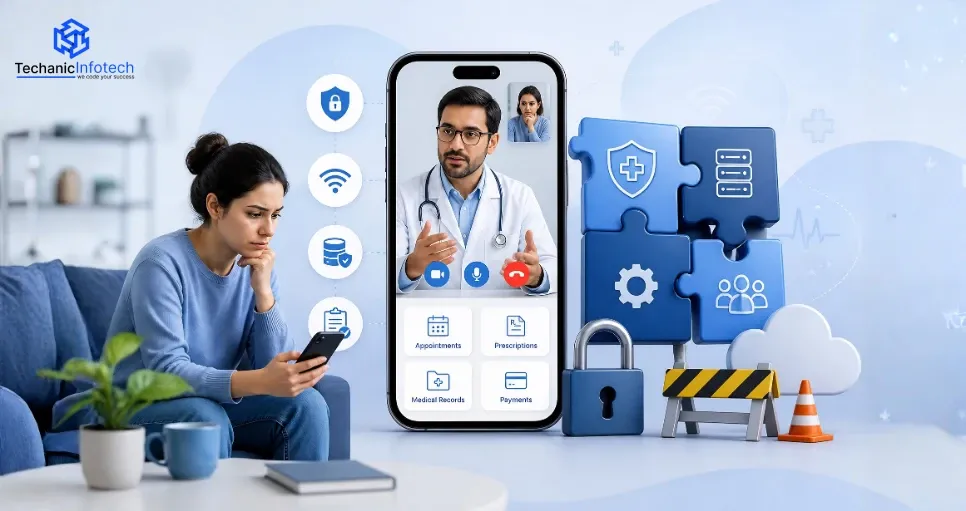
Doctor On Demand App Development
Doctor On Demand App Development Challenges: What to Expect
May 1, 2026
May 1, 2026
In today’s world, convenience is everything.
And when it comes to healthcare, the demand for instant access to medical professionals is growing rapidly.
This has given rise to the doctor-on-demand app industry, where patients can consult doctors from the comfort of their homes with just a few taps on their phones.
The COVID-19 pandemic encouraged the rapid adoption of telemedicine, and it's clear that this trend has not been a fad. More and more people are turning to virtual consultations now, and it looks like the market will keep on growing.
If you are thinking about entering the doctor-on-demand app development realm, you need to know the key challenges you will be facing. Nevertheless, do not panic – despite such obstacles, there are ways to overcome them.
So, in this blog post, we are going to discuss the main challenges in doctor-on-demand app development, tell how to overcome them, and give some tips on how you can guide yourselves to a successful product.
So, without any further ado, let’s get started:
The doctor-on-demand industry has been promising so far, and the number is just growing.
The reasons why growth is happening are as follows:
All these statistics validate the point that the doctor-on-demand application market is not only a trend but a wave that will gain more grandeur in the coming years.
So, now is the time to enter into this space if you are thinking of getting into it!
The question is why you should develop a doctor-on-demand app? Well, not one, but we have many reasons to inspire you.
Starting with:
Patients do not need to visit a clinic to gain access to the doctors but can easily avail doctors at their convenient time and through proper references just with their smartphones.
Users can now consult doctors, get prescriptions, and even get follow-up care at the click of a button.
The market for healthcare apps is growing at an incredible pace. With telemedicine becoming mainstream, getting into developing a doctor-on-demand app puts you right in the heart of a booming industry. Honestly speaking, the growth potential in this sector is enormous as more and more consumers demand ease and speed when it comes to accessing medical professionals.
This is what makes your doctor on-demand app development cost a worthwhile investment because the return will be amazing.
Many individuals have rural or underserved places of living without good health services.
A doctor-on-demand application would fill this gap by providing access to medical consultations so that everybody would have health care.
Since doctor-on-demand applications require no physical visit, they may further minimize healthcare costs for a lot of people. The few overhead expenses benefit both the patients and the doctors, making it possible for patients to receive the kind of care needed at a much lower traditional cost.
This is what will attract users to your app.
Telemedicine helps doctors better manage their schedules. They can see more patients by holding consultations from different locations, increasing the demand for such apps.
With this kind of arrangement, the doctors increase their availability and, consequently, their income without compromising work-life balance, resulting in more engagement on the app.
We believe you understand the benefits, or we say 'reasons', to develop a doctor-on-demand app. Well, coming back to your question about doctor-on-demand app development challenges.
While the market holds a lot of potential, developing a doctor-on-demand app has problems associated with it that need to be addressed. So, let's know the most common doctor-on-demand app development challenges you should know and know how to overcome them:
Healthcare is a highly regulated domain. Different countries and states have their legal frameworks related to telemedicine, patient data privacy, and healthcare practices.
This will also need to take into account laws like HIPAA in the United States or GDPR in Europe that regulate how data has to be stored, shared, and protected about sensitive patient information. Non-compliance will result in illegal consequences, fines, or even a loss of customer confidence.
To evade this doctor-on-demand app development challenge, you would have to work along with experts who know healthcare regulations. You would also have to ensure secure encryption methods and data protection features for your application.
Assuring safe communication between doctors and patients would ensure adherence to the right kind of standards while also inspiring user trust.
Since users will be sharing sensitive medical information, the usability factor will have to focus prominently on security.
Not too long ago, the threats of cybersecurity have led to patient data breaches being harmful to your application's reputation and potential legal liability.
Top-notch security features shall include end-to-end encryption on video consultations, proper and secure storage of patient records, and authorization through two-factor authentications, among others.
In addition, every transfer of data should observe the standards of the industry. Your app's security protocol should be updated periodically for newly emerging threats.
One of the most complex issues in developing a doctor-on-demand application is the integration of an electronic health record system. Combining many systems that might be used by different healthcare providers creates a technical challenge.
Ensuring data may be transferred without violating the right to private health information or affecting compliance with regulations such as HIPAA can prove very costly and time-consuming.
One can solve integration issues with robust & standardized APIs that enable the smooth and safe transmission of data between applications and healthcare providers. Minimizing technical risk, along with providing seamless, efficient user experience to doctors and patients, enhances the compliance of such regulatory health requirements and enhances top-notch workflows in operations.
This is pretty important to make sure that the app works perfectly across all sorts of devices, Android and iOS. Once your app starts slowing down or glitching on users, they will get fed up and may abandon the application completely.
Ensuring your app is user-friendly across various devices can present a significant doctor-on-demand app development challenge, especially when targeting both Android and iOS users.
Selecting a strong and reliable app development company that services both Android as well as iOS is important.
A good Android app development company, along with a good iOS app development company, will ensure that the application runs smoothly across different devices. Testing during the development phase should be comprehensive so that the app will run with minimum bugs and crashes.
With the rise in popularity of your user base, so too will the demand rise. You do not want your app to crash or slow down when it is most needed - during high-traffic periods for patients and healthcare providers.
Balancing scalability with performance during peak usage times is one of the common doctor-on-demand app development challenges that we need to resolve.
Scaling with cloud infrastructure provides a fluid way to deal with growth, along with ensuring that your app will be performing when the time comes. With traffic growing, your cloud solutions will give you room and resources to scale without a hitch. A professional mobile app development company will optimize the backend and database of your app so it can operate smoothly, even when your user base expands.
People look for such features in these apps where they can make a real-time video call with their doctors. But they do face the problem of letting the video consultation go on smoothly and of good quality.
This is because the application might have the problem of network instability, low internet bandwidth, and latency issues.
To bypass this, you would want to optimize your video streaming feature for use on low-bandwidth networks. Using reputable APIs and third-party services such as Twilio, Agora, or Zoom is preferred in offering video communication, designed specifically for telehealth apps. Since such platforms boast a rich feature set for video calls with more stable quality and less disruption compared to other services.
Moreover, your app should adjust the video quality automatically according to the user's network so that the call remains stable.
Scheduling appointments with doctors in other time zones is a big headache in logistics. The patients and doctors are on different schedules, which may create some miscommunication regarding the time for an appointment, leading to a missed consultation and frustration.
Addressing issues related to doctor availability and scheduling effectively is crucial to overcoming doctor-on-demand app development challenges.
The key to overcoming these challenges in doctor-on-demand app development is scheduling smart features. Use a calendar-based system that instantly adjusts for other time zones and provides auto-reminders for both doctors and patients. This would ultimately eliminate the chances of a no-show and will ensure an improved user experience.
Other features like waitlists and instant rescheduling can also be provided to offer choices for both parties.
Let’s be honest here, security in financial transactions is an important concern in doctor-on-demand apps. Payments have to be secure and straightforward for the patients and also have to be quick and error-free.
This shows the need to be a reliable and secure payment gateway.
Provide diverse payment options like credit/debit cards, e-wallets, and even in-app credits to the user so that they can opt for any of them according to their convenience. Make sure to connect with trustworthy and famous online payment gateways to resolve this doctor-on-demand app challenge.
Additionally, you can have invoicing features and generate receipts automatically for all transactions made. It increases transparency and enhances user experience.
One of the biggest challenges in a doctor-on-demand app would be scalability. Meaning, that your app should handle increasing numbers of users both patients and doctors, without compromising its performance. The idea is to carry through with the increasing traffic smoothly to services, enabling easy access with fast response times.
All these can go wrong if an application is not scaled properly, bringing about issues of delay or crashing the application with poor user experience that ultimately affects customer satisfaction as well as retention.
Scalability can be achieved through cloud infrastructure. An app can scale up its resources on demand using cloud-based solutions to be scaled up to handle growing traffic.
Dynamic load balancing and optimal backend/database handling ensure smooth experiences as your user base grows. This means it will always remain fast, responsive, and reliable, no matter what the demand might be.
Once patients download your app, the challenge is how to keep them interested and coming back for consultations. Developing an engaging solution that hooks your user base while keeping costs in check is one of the biggest challenges faced in Telemedicine.
High user churn can be a serious problem if patients do not get enough value out of an app or if it doesn't match their expectations at all.
Engage the user to increase retention. Update the app regularly with new features or enhancements based on the feedback of the users. Provide a loyalty program with discounts for repeat consultations or a reward for referring new users.
Use push notifications to remind patients of follow-up appointments, medication refills, or even seasonal health check-ups to keep the app at the forefront of your patient's mind. Let’s be honest here, smooth development of a seamless doctor-on-demand application may seem quite challenging to overcome, but with the right expertise, it is quite easy.
So, get to know the experts that can help in such times.
Now that we've covered a few of the several doctor-on-demand app development challenges and just how you can be able to overcome them, you are probably wondering how you can ensure your app will not be one of these kinds.
The answer is simple: work with an experienced Doctor-on-demand app development company that understands the complexities of healthcare apps.
Techanic Infotech specializes in the creation of high-quality on-demand doctor's platforms that are secure, scalable, and user-friendly. With us, the risks associated with the development of a doctor-on-demand application are easily dodged by launching a solution that users can trust and rely on for their healthcare needs.
Whether you want to have an application on Android or an iOS application, Techanic Infotech is bound to make your idea come to life.
The doctor-on-demand app industry offers a wealth of opportunities, but so too are the corresponding challenges. Knowing the pitfalls in doctor-on-demand app development can help you make better decisions. We made sure this blog is of help and provided you with every possible piece of information about obstacles in your way.
Remember, with all of the pieces in place, a well-crafted plan, a suitable development partner, and placing an emphasis on user experience, your doctor-on-demand app will excel in a market that is growing and becoming increasingly competitive.
The time required to develop the app depends on the complexity of the features, the platform(s) targeted - iOS, Android, or both, and the scope of the project. In basic cases, 3-6 months are enough. More complex apps may also require nearly a year to develop.
The cost to develop a doctor-on-demand app may vary greatly, depending upon the features you want in your app. So, it’s better to consult with a mobile app development company like Techanic Infotech with all your requirements.
The means of communication must have end-to-end encryption, and app developers must comply with the data privacy legislation, be it HIPAA for US apps or GDPR for European apps. MFA has to be in place, and you should keep updating your app regularly with new security measures meant to protect user data.
Yes, AI and machine learning can be easily added to your app to improve user experience. For example, AI may help out with initial symptom checking, and possible diagnoses, or even send a patient out with a request for a follow-up appointment. It can also support doctors by offering backup when diagnosing while giving consultations.
Doctor-on-demand app development challenges range from patient data security and privacy to being liable for regulatory compliance, such as HIPAA. Moreover, reliable video and audio communications as well as real-time scheduling or notifications are also a part of doctor-patient trust management and ensuring accurate information about medications. Scalability and user-friendliness, including aesthetics, are also some of the greatest concerns.


Neha Sharma is a tech expert at heart who loves exploring new technologies and turning complex ideas into easy-to-understand content. With a passion for learning and writing, she enjoys sharing insights on emerging tech, digital products, and innovation that help businesses stay ahead.