Healthcare App Development
EHR Software Development in 2026 | Cost, Features & Benefits
February 4, 2026
February 4, 2026
EHR software development has become a critical part of modern healthcare systems. Today, hospitals, clinics, and healthcare providers rely on EHR software solutions to manage patient data, improve care quality, and meet strict regulatory standards.
Unlike traditional record-keeping, EHR systems allow healthcare teams to access accurate patient information in real time, improving coordination and decision-making.
With growing demand for digital healthcare, custom EHR software development helps organizations build solutions that fit their workflows and compliance needs. From managing patient records to ensuring data security, electronic health record software plays a key role in healthcare transformation.
In this guide, we’ll explore EHR software features, development cost, benefits, and EHR compliance requirements to help you make informed decisions in 2026.
The EHR software market is expanding rapidly as healthcare providers shift toward digital systems.
Growing data security needs, compliance requirements, and demand for better patient care are driving this growth worldwide.
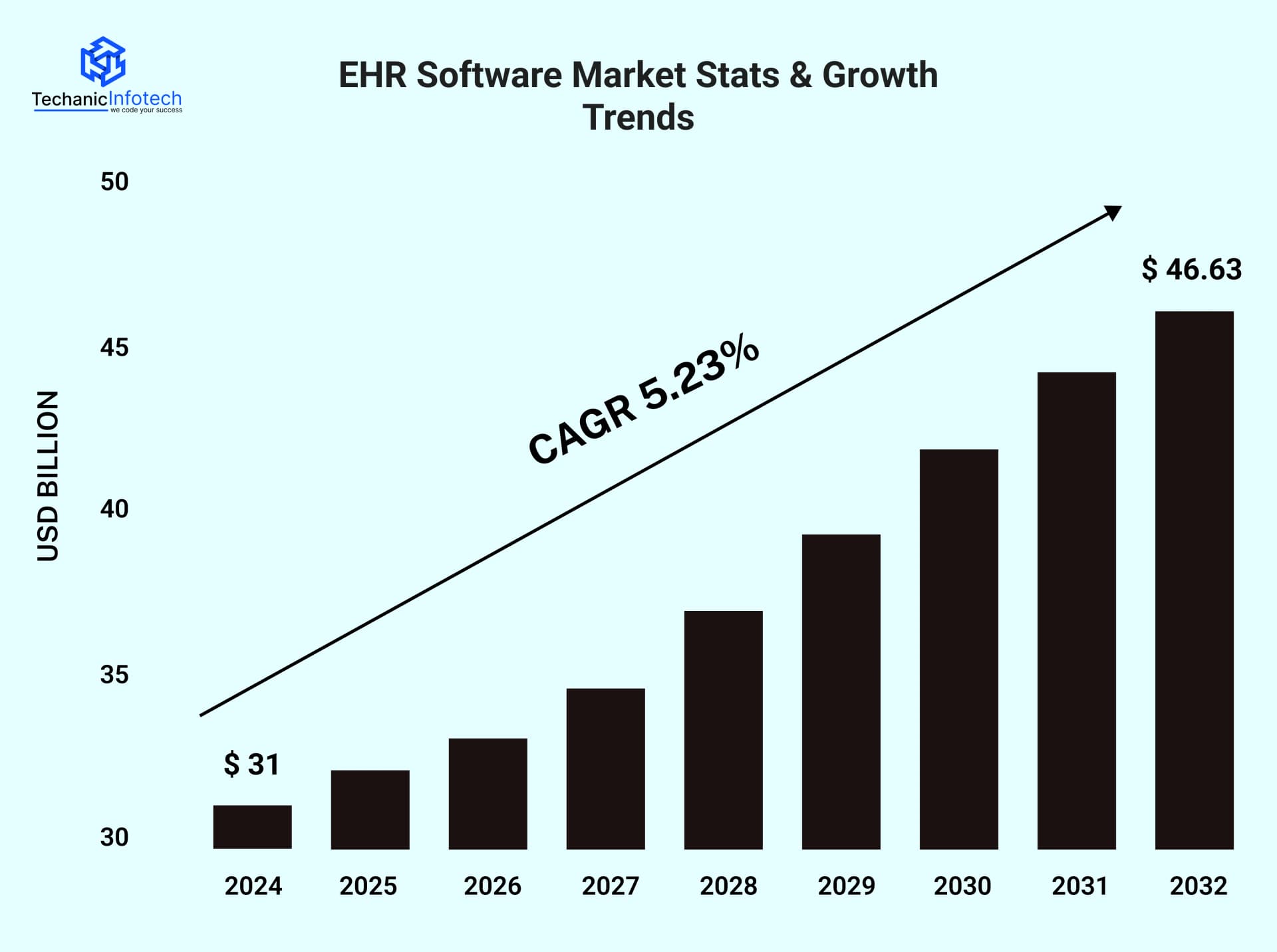
The global EHR market is growing strongly, with an estimated value of about USD 31 billion in 2024 and projected to grow steadily through the next decade.
Forecasts suggest the EHR market could reach around USD 46.63 billion by 2032, exhibiting a compound annual growth rate (CAGR) of approximately 5.2 % during 2024–2032.
Other estimates project that by 2031, the global EHR market may expand to USD 79.43 billion, with a higher CAGR driven by increased adoption of digital records and interoperability demands.
In specific regions like North America, EHR adoption continues to dominate, with electronic records central to driving healthcare IT investments.
Cloud-based and web-accessible EHR systems are gaining strong traction as healthcare providers emphasize remote access and secure interoperability.
EHR software (Electronic Health Record software) is a digital system used to store, manage, and share patient health information securely.
Instead of paper files or disconnected systems, EHR systems keep all patient data such as medical history, diagnoses, medications, lab results, and treatment plans, in one centralized platform.
The main goal of EHR software development is to improve the quality of healthcare by making patient information easily accessible to authorized users. With modern EHR software solutions, healthcare providers can view records in real time, update patient data instantly, and coordinate care more efficiently. This reduces errors, saves time, and improves overall patient outcomes.
Unlike simple record storage, EHR system development focuses on interoperability, security, and compliance. A well-built EHR system can integrate with labs, pharmacies, billing systems, and other healthcare tools while meeting strict EHR compliance requirements.
Although the terms are often used together, EHR and EMR are not the same.
EMR (Electronic Medical Record) is a digital version of patient records used within a single healthcare organization. EMRs mainly store clinical data like diagnoses, prescriptions, and treatment notes for internal use.
EHR (Electronic Health Record) goes a step further. EHRs are designed to be shared across different healthcare providers and systems. This means a patient’s record can move with them, from a primary care doctor to a specialist, lab, or hospital.
Below is a simple comparison table showing the key factors that separate EHR (Electronic Health Record) and EMR (Electronic Medical Record) systems.
|
Factor |
EHR (Electronic Health Record) |
EMR (Electronic Medical Record) |
|
Definition |
A complete digital record of a patient’s health history |
A digital version of paper records in one clinic |
|
Data Sharing |
Can be shared across multiple healthcare providers |
Limited to a single healthcare organization |
|
Scope |
Covers overall patient health across providers |
Focuses on clinical data within one practice |
|
Interoperability |
Designed to integrate with labs, pharmacies, hospitals |
Limited or no interoperability |
|
Accessibility |
Accessible by authorized users across systems |
Accessible only within the same system |
|
Use Case |
Ideal for hospitals, networks, and large practices |
Suitable for small clinics or individual practices |
|
Compliance Focus |
Strong focus on EHR compliance requirements |
Lower compliance complexity |
|
Patient Care |
Supports coordinated and continuous care |
Supports internal patient management |
|
Scalability |
Highly scalable for growing healthcare systems |
Limited scalability |
EHR systems are used by a wide range of healthcare stakeholders, not just doctors.
Doctors, nurses, and specialists use EHR software features to access patient histories, record diagnoses, and plan treatments.
Admin teams use EHRs for scheduling, reporting, billing coordination, and compliance management.
EHR systems help labs receive test requests and send results quickly, while pharmacies use them for e-prescriptions.
Large organizations rely on custom EHR software development to manage data across multiple locations securely.
Many EHR systems offer patient portals where individuals can view reports, prescriptions, and appointment details.
EHR software works as a centralized digital system that collects, stores, and shares patient health information securely.
It connects doctors, nurses, administrators, labs, and other healthcare providers so everyone involved in patient care can access the same accurate data at the right time.
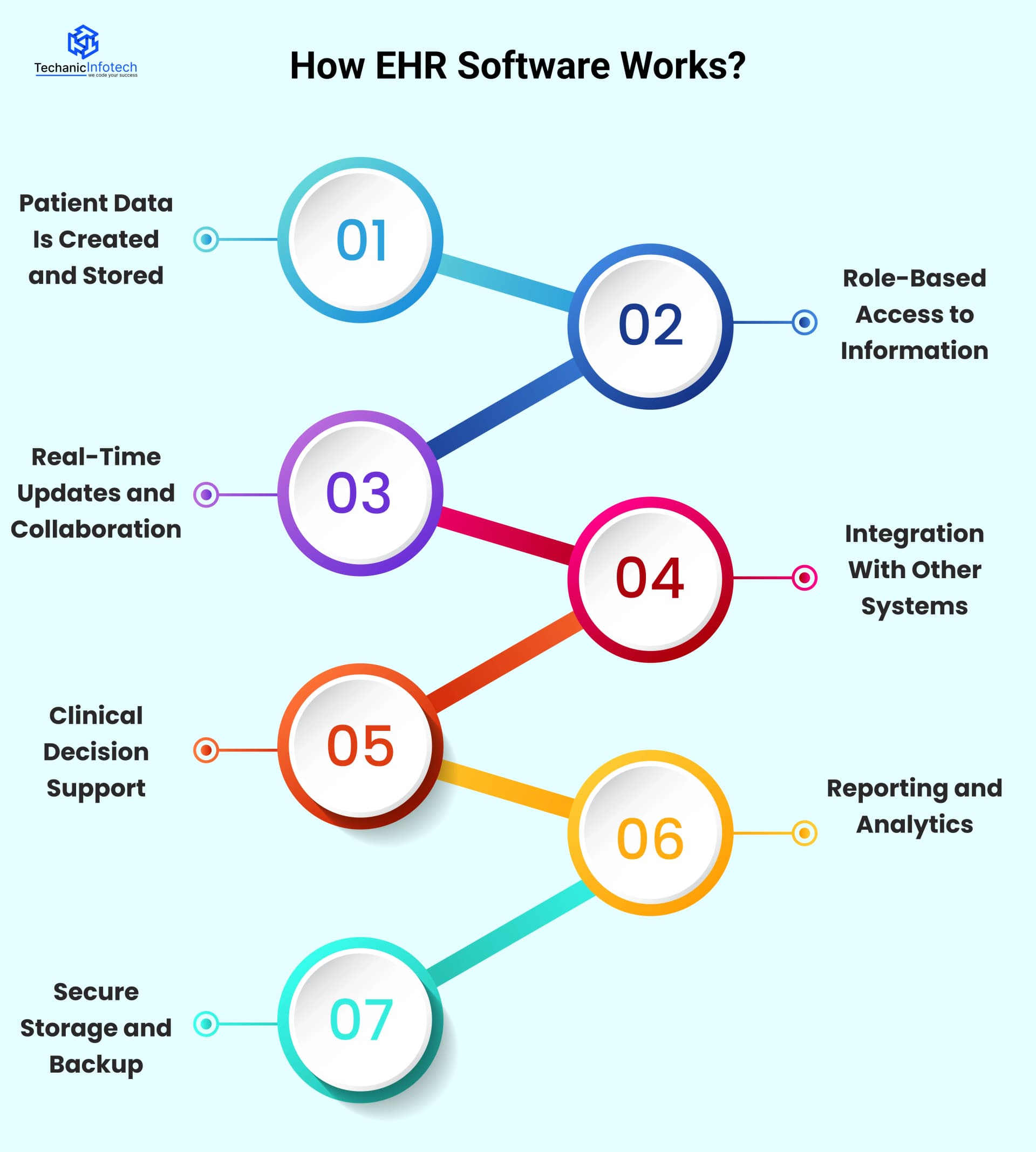
The process starts when a patient visits a healthcare provider. Personal details, medical history, symptoms, diagnoses, prescriptions, and treatment notes are entered into the EHR system. This data is stored digitally instead of on paper, making it easy to update and retrieve later.
One of the key parts of EHR software development is role-based access. Doctors, nurses, and admin staff see only the information they are authorized to access. This helps maintain privacy and meets EHR compliance requirements such as HIPAA.
As soon as a doctor updates a record, the information is available in real time. This allows multiple healthcare professionals to collaborate efficiently. For example, a specialist can review reports while a nurse updates vitals, all within the same EHR software solution.
Modern EHR systems integrate with labs, pharmacies, imaging centers, and billing platforms. Lab results are uploaded automatically, prescriptions are sent digitally to pharmacies, and billing data flows to insurance systems. This reduces manual work and errors.
Many EHR platforms include alerts and reminders. These can notify doctors about allergies, drug interactions, or follow-up care. Such EHR software features help improve patient safety and treatment accuracy.
EHR software also generates reports for clinical performance, patient outcomes, and compliance audits. Healthcare organizations use this data to improve operations and meet regulatory standards.
All patient data is encrypted and securely stored, often in the cloud. Regular backups ensure data is protected against loss, system failures, or cyber threats.
Below are the core EHR software features that modern healthcare providers expect in 2026.
Each feature is explained to show how it adds real value in daily operations.
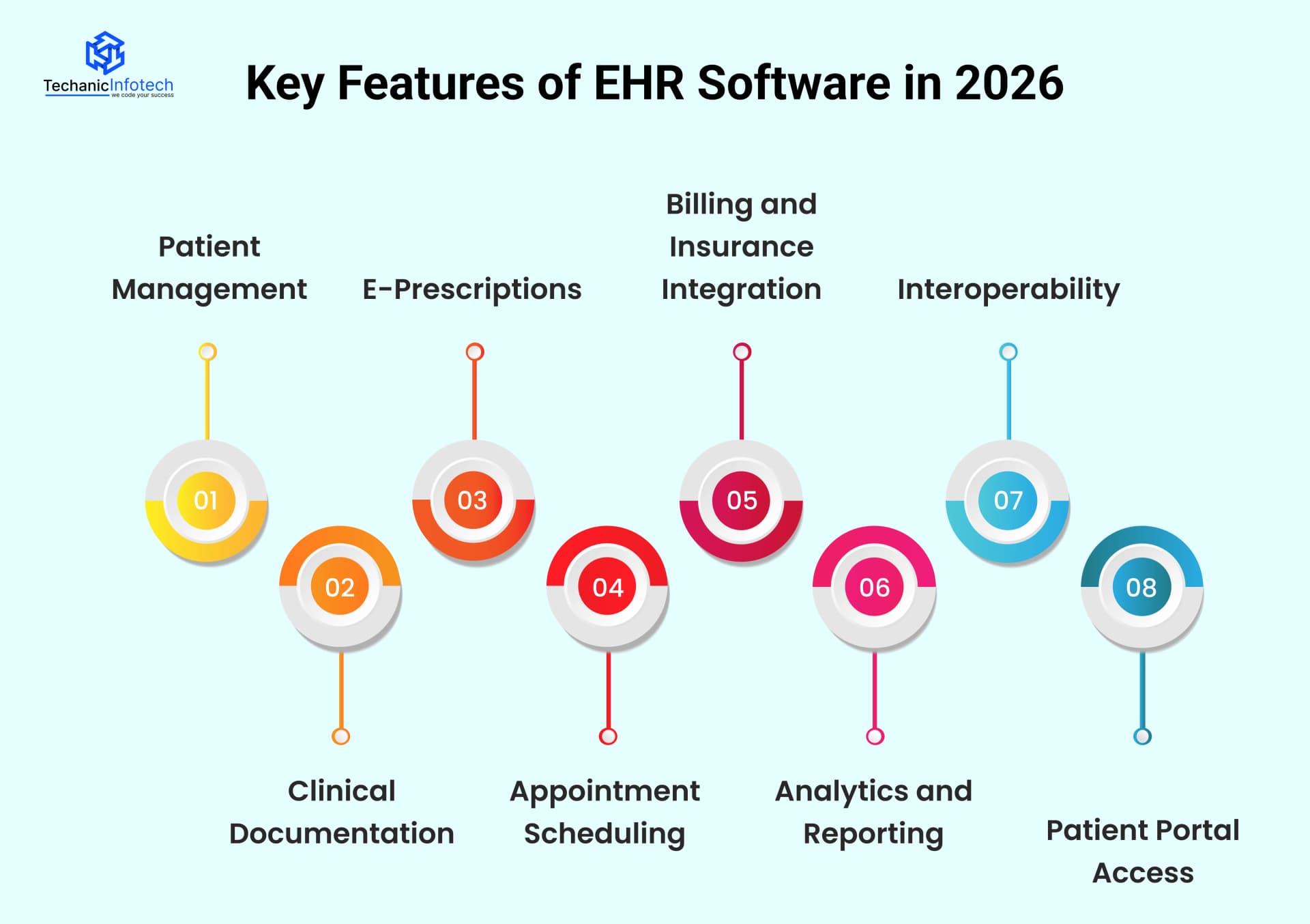
Patient management is the foundation of any EHR system. It allows healthcare providers to store and manage patient demographics, medical history, allergies, diagnoses, and treatment plans in one place.
With effective patient management, doctors and staff can quickly access accurate records, reduce paperwork, and avoid duplicate data entry. This feature improves coordination across departments and ensures continuity of care, especially when patients visit multiple providers or facilities.
Clinical documentation helps doctors and nurses record patient visits, symptoms, diagnoses, and treatment notes digitally. Instead of handwritten notes, EHR systems provide structured templates and easy data entry options.
This improves accuracy, saves time, and reduces errors. In 2026, clinical documentation also supports faster decision-making by keeping patient information clear, consistent, and easy to review during follow-ups or referrals.
E-prescription features allow doctors to send prescriptions directly to pharmacies through the EHR system. This eliminates handwritten prescriptions, reduces medication errors, and improves patient safety.
It also helps track prescription history and avoid drug interactions or allergies. For healthcare providers, e-prescriptions save time, improve compliance, and make medication management more efficient for both patients and pharmacies.
Appointment scheduling helps manage patient visits efficiently. Patients can book, reschedule, or cancel appointments, while staff can view availability in real time. Automated reminders reduce no-shows and missed visits.
This feature improves patient experience and helps clinics optimize their schedules. In 2026, smart scheduling is essential for managing high patient volumes without increasing administrative workload.
This feature connects clinical data with billing and insurance systems. It helps generate accurate invoices, manage insurance claims, and track payments.
By integrating billing with EHR software, healthcare organizations reduce manual errors and speed up reimbursement processes. It also provides transparency into financial operations, making it easier to manage revenue cycles and maintain compliance with healthcare regulations.
Analytics and reporting tools help healthcare providers analyze patient outcomes, operational efficiency, and compliance metrics. EHR systems generate reports for audits, performance tracking, and decision-making.
These insights help organizations improve care quality, identify trends, and optimize workflows. In 2026, data-driven healthcare relies heavily on this feature to support smarter clinical and administrative decisions.
Interoperability allows EHR systems to share data with other healthcare platforms securely. Standards like FHIR and HL7 ensure patient information can move between hospitals, labs, pharmacies, and specialists.
This improves care coordination and reduces repeated tests. Interoperability is a key requirement for modern EHR systems, supporting seamless data exchange across the healthcare ecosystem.
Patient portals give patients secure access to their own health information. They can view reports, prescriptions, appointment details, and communicate with providers.
This feature improves patient engagement and transparency while reducing administrative calls. In 2026, patient portals are essential for empowering patients and supporting digital-first healthcare experiences.
These advanced features are becoming key reasons why healthcare providers are investing in modern EHR software solutions in 2026.
They improve efficiency, accessibility, and quality of care.
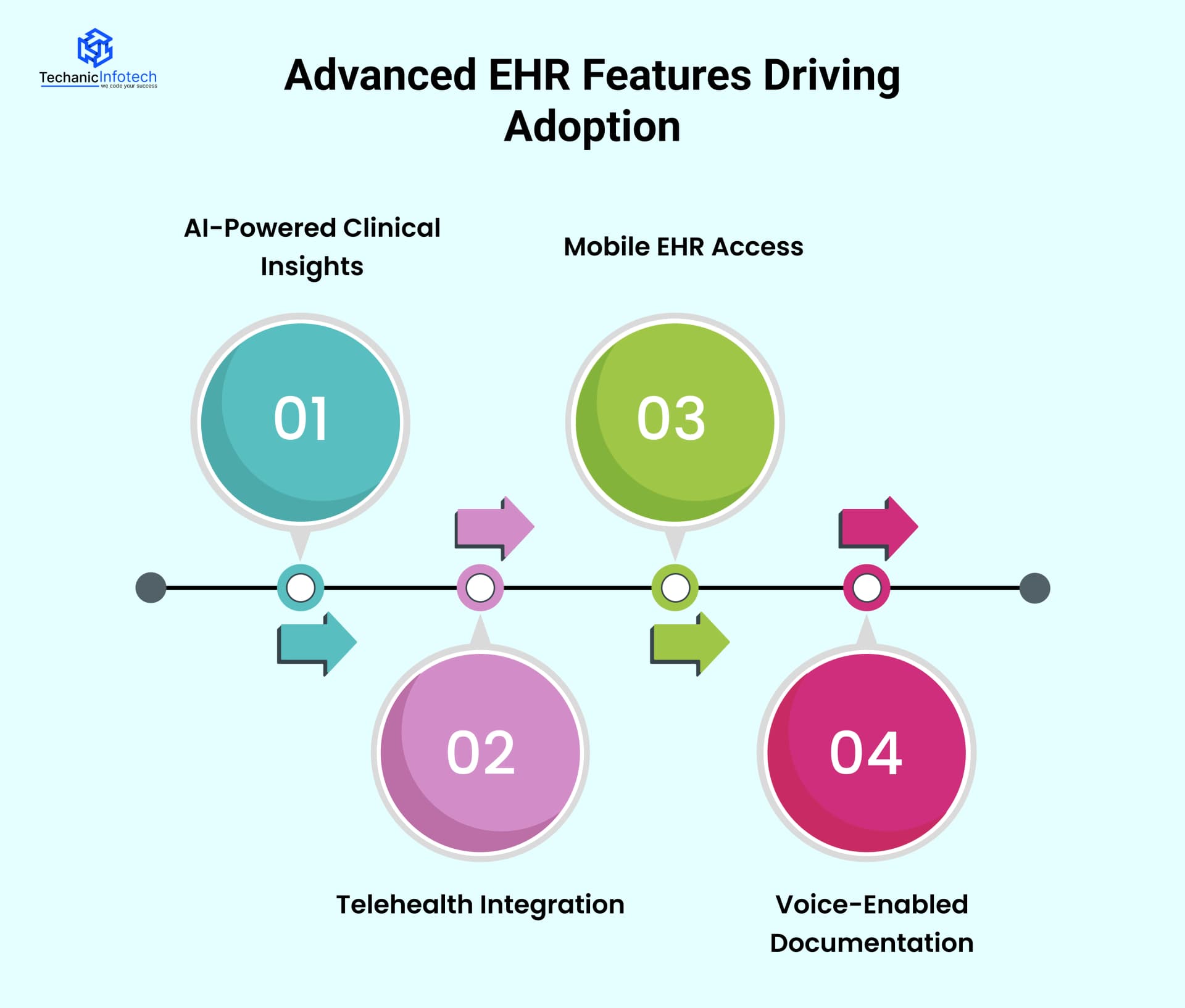
AI-powered clinical insights help healthcare providers make better decisions using data. These tools analyze patient records, medical history, and trends to highlight risks, suggest treatment options, or flag possible issues early.
Instead of replacing doctors, AI supports them by reducing manual analysis and helping spot patterns that may be missed. This feature improves accuracy, saves time, and supports data-driven care, making it a strong value addition in advanced EHR systems.
Telehealth integration allows healthcare providers to offer virtual consultations directly through the EHR system. Doctors can access patient records during video visits, update notes in real time, and prescribe medications digitally.
This seamless connection improves continuity of care and patient convenience. In 2026, telehealth-enabled EHR systems are essential for expanding access to care, reducing in-person visit load, and supporting remote healthcare services.
Mobile EHR access enables doctors, nurses, and staff to view and update patient information using smartphones or tablets. This is especially useful in hospitals, emergency care, and home healthcare settings.
Mobile access improves response time, supports real-time updates, and increases flexibility for healthcare professionals. As mobility becomes a priority, this feature helps healthcare teams stay connected and productive anywhere.
Voice-enabled documentation allows clinicians to record notes using speech instead of typing. This reduces documentation time, minimizes errors, and helps doctors focus more on patient
interaction.
By converting voice into structured clinical notes, this feature improves efficiency and reduces burnout. In 2026, voice-enabled tools are driving EHR adoption by making documentation faster, easier, and more user-friendly.
Healthcare organizations choose different types of EHR software systems based on their size, budget, security needs, and infrastructure.
Below are the three main types of EHR systems used in 2026.
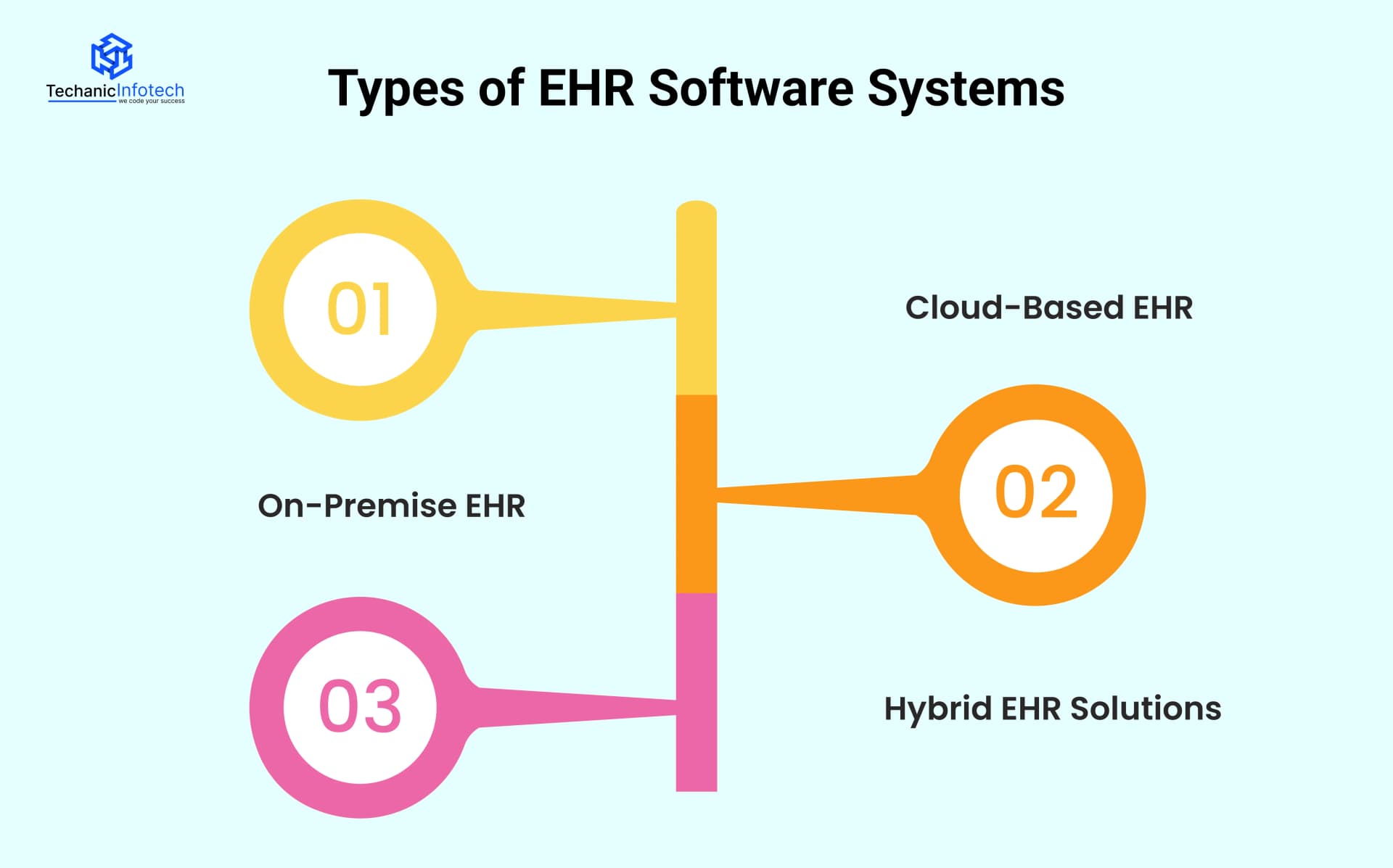
Cloud-based EHR systems are hosted on secure cloud servers and accessed through the internet. They eliminate the need for heavy on-site infrastructure and reduce upfront costs. Updates, maintenance, and data backups are handled automatically by the service provider.
Cloud-based EHR software offers scalability, remote access, and easier integration with other healthcare tools. This option is ideal for clinics, startups, and healthcare organizations looking for flexibility, faster deployment, and lower maintenance effort.
On-premise EHR systems are installed and managed on the healthcare organization’s own servers. This setup gives full control over data storage, security, and system customization. However, it requires higher upfront investment, dedicated IT staff, and ongoing maintenance.
On-premise EHR software is often preferred by large hospitals or organizations with strict data control policies and in-house technical resources.
Hybrid EHR solutions combine both cloud-based and on-premise systems. Sensitive data can be stored on local servers, while other functions run on the cloud. This approach offers flexibility, better control over critical data, and improved scalability.
Hybrid EHR systems are suitable for organizations that want the benefits of the cloud while maintaining control over specific operations.
Building a reliable and compliant EHR system requires a structured approach.
Below is a step-by-step EHR software development process, explained in simple language, with key activities at each stage.
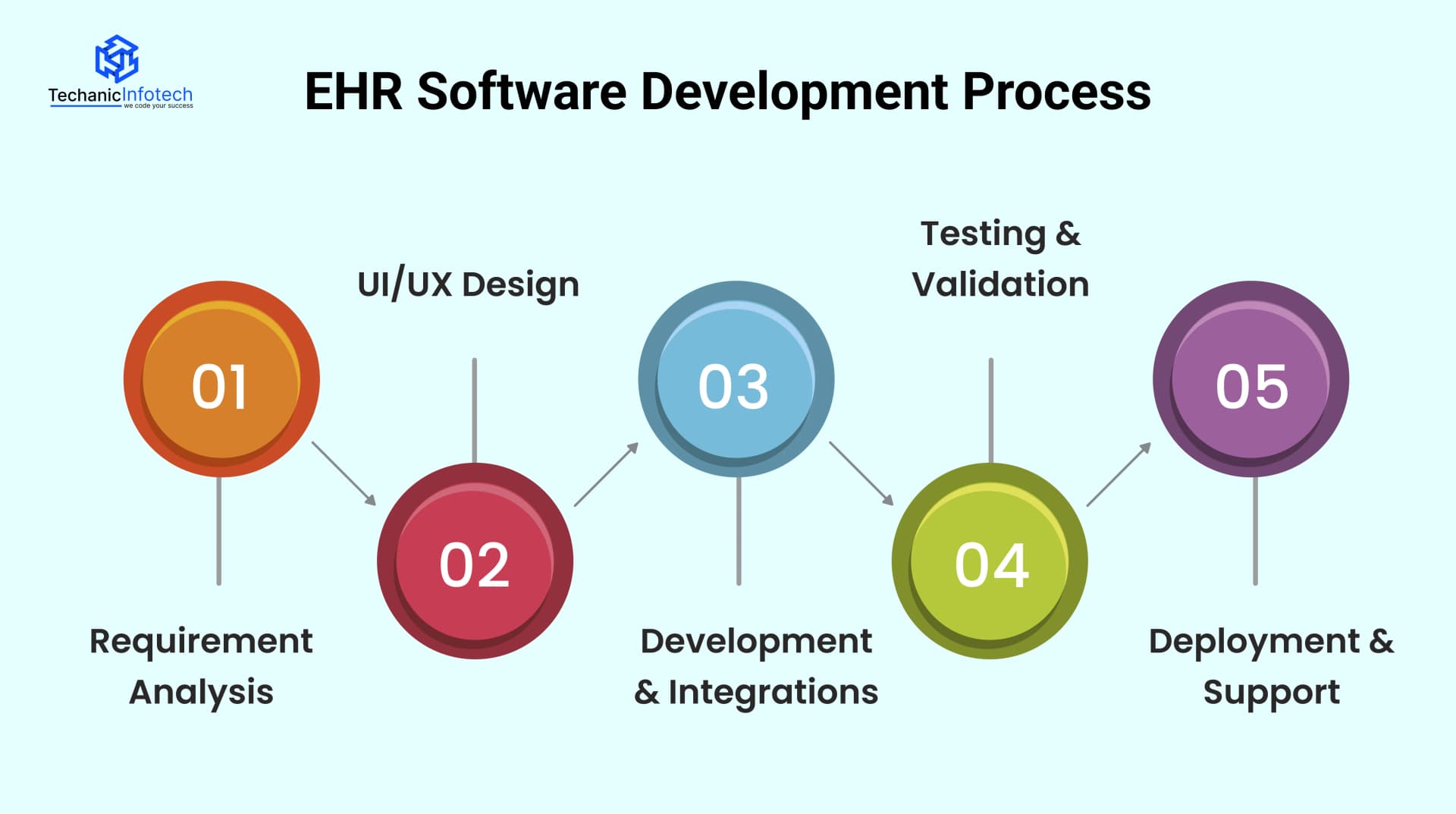
Requirement analysis is the foundation of EHR system development. At this stage, healthcare providers, administrators, and technical teams define what the system needs to do.
This includes identifying required EHR software features, user roles, workflows, integrations, and EHR compliance requirements. Clear requirements help avoid rework later and ensure the system aligns with real clinical and operational needs.
UI/UX design focuses on creating an interface that is easy to use for doctors, nurses, and staff. Since EHR/EMR software solution are used daily, usability is critical.
Designers create wireframes and prototypes to map patient journeys, dashboards, and data entry flows. A well-designed interface reduces training time, minimizes errors, and improves adoption across healthcare teams.
This stage involves building the core system based on approved designs and requirements. Developers create modules for patient records, clinical documentation, billing, and reporting.
Integrations with labs, pharmacies, imaging systems, and third-party tools are also implemented. Strong EHR/EMR development ensures interoperability using standards like FHIR and HL7 while maintaining data security.
Testing ensures the EHR system works as expected and meets quality and compliance standards. Functional testing checks system features, while security testing ensures patient data is protected.
Validation is especially important to meet EHR compliance requirements such as HIPAA. Thorough testing reduces risks, prevents errors, and ensures reliable system performance in real-world healthcare environments.
Once app testing is complete, the EHR system is deployed in a live environment. Deployment includes data migration, user training, and system configuration.
Post-launch support focuses on monitoring performance, fixing issues, and rolling out updates. Ongoing support ensures the EHR software solution remains secure, scalable, and compliant as healthcare needs evolve.
The cost of EHR software development in 2026 depends on the size of the healthcare organization, required features, compliance needs, and integration complexity. There is no one fixed price because every EHR software solution is built around specific workflows and regulations.
On average, the overall cost to develop EHR software ranges from $5,000 to $100,000+. A basic EHR system with core patient management and documentation features falls on the lower end. Advanced systems with AI features, interoperability standards (FHIR/HL7), analytics, and strict EHR compliance requirements require a higher investment.
Custom mobile app development usually costs more than off-the-shelf products, but custom EHR app development gives better flexibility, scalability, and long-term value. Security, data privacy, and regulatory compliance also play a major role in pricing, as healthcare software must meet strict legal standards.
Below is a general cost breakdown to help you understand where the budget goes.
|
Development Stage |
Description |
Estimated Cost (USD) |
|
Requirement Analysis & Planning |
Workflow analysis, compliance mapping |
$5,000 – $15,000 |
|
UI/UX Design |
User-friendly interface for clinicians & staff |
$8,000 – $20,000 |
|
Core Development |
Patient records, clinical modules, admin panel |
$20,000 – $80,000 |
|
Integrations |
Labs, pharmacy, billing, FHIR/HL7 |
$10,000 – $40,000 |
|
Testing & Compliance |
Security testing, HIPAA validation |
$7,000 – $25,000 |
|
Deployment & Support |
Launch, training, maintenance setup |
$5,000 – $20,000 |
EHR software has become an essential part of modern healthcare. It is no longer just about going paperless, it’s about improving care quality, efficiency, and compliance.
Below are the top benefits of EHR software for healthcare providers:
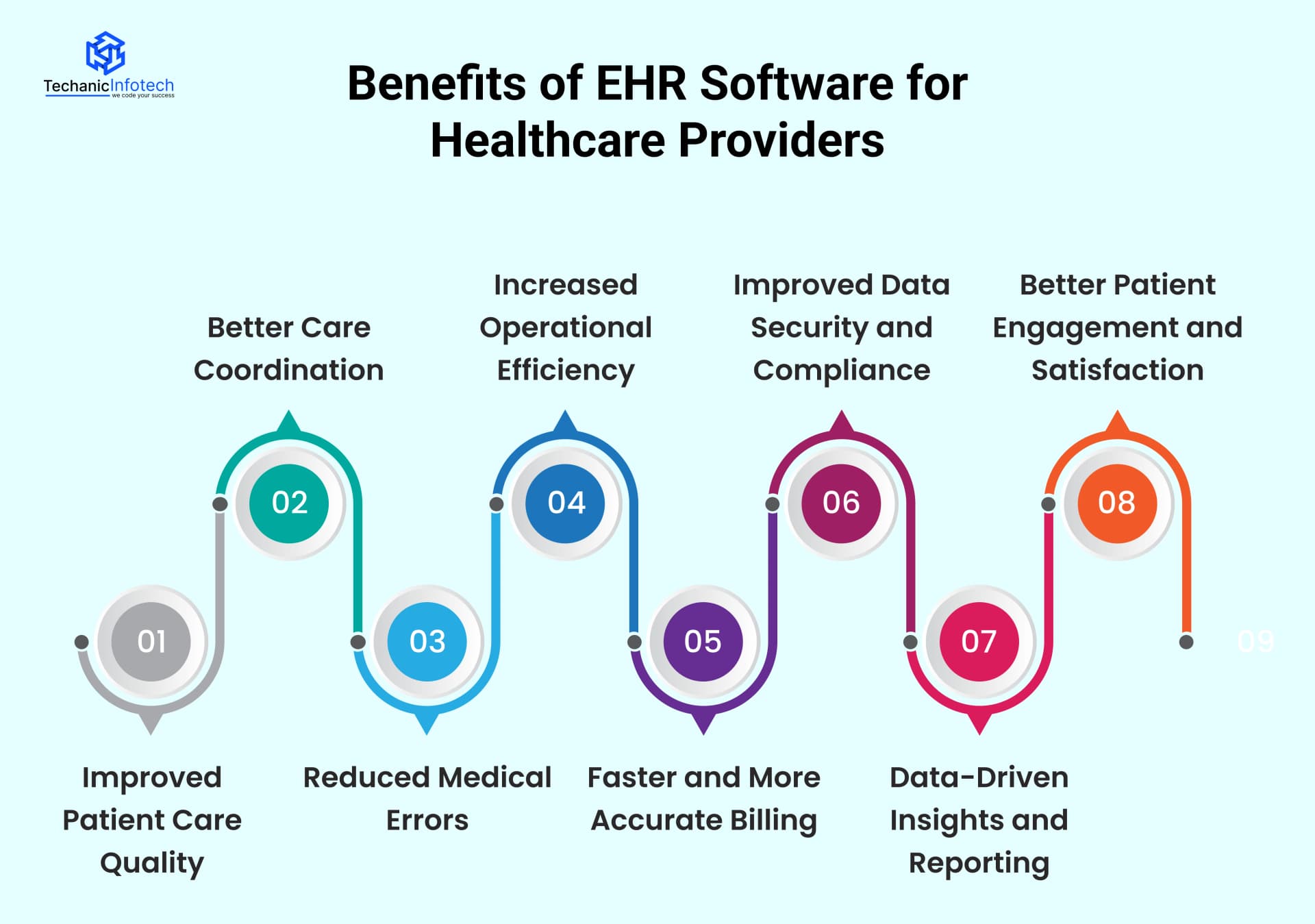
One of the biggest benefits of EHR software is better patient care. Doctors and nurses can instantly access complete patient records, including medical history, allergies, lab results, and previous treatments.
This helps them make faster and more accurate decisions. With all information in one place, the chances of missing critical details are reduced, leading to safer and more effective treatment.
EHR systems make it easier for different healthcare providers to work together. When patient data is shared securely across departments, specialists, labs, and pharmacies, everyone stays on the same page.
This improves coordination, avoids repeated tests, and ensures continuity of care, especially for patients with chronic conditions or complex treatment plans.
Manual paperwork and handwritten notes often lead to mistakes. EHR software reduces these errors by using digital records, alerts, and standardized templates.
Features like drug interaction warnings and allergy alerts help prevent prescription mistakes. Fewer errors mean safer care and greater trust from patients.
EHR software saves time for healthcare staff by automating routine tasks such as documentation, scheduling, billing, and reporting.
Doctors spend less time on paperwork and more time with patients. Administrative teams also benefit from faster workflows, reduced duplication of work, and smoother daily operations.
With billing and insurance integration, EHR systems streamline the revenue cycle. Charges are automatically generated based on clinical data, reducing manual entry and errors.
Claims are processed faster, reimbursements improve, and financial transparency increases. This helps healthcare providers maintain stable cash flow and reduce revenue loss.
EHR software is built with strong security measures such as encryption, access controls, and audit logs. These features help protect sensitive patient data and meet regulatory requirements like HIPAA.
Compared to paper records, digital systems offer better control, monitoring, and accountability, reducing the risk of data breaches.
EHR systems provide analytics and reporting tools that help healthcare providers understand performance, patient outcomes, and operational trends.
These insights support better decision-making, quality improvement initiatives, and compliance reporting. Providers can identify gaps in care, track outcomes, and plan improvements more effectively.
Many EHR systems include patient portals that allow patients to access their records, test results, prescriptions, and appointments.
This transparency empowers patients to take an active role in their care. Better communication and easier access to information lead to higher patient satisfaction and stronger provider-patient relationships.
EHR compliance is one of the most critical aspects of EHR solution. Healthcare systems handle sensitive patient data, and failing to meet regulatory requirements can lead to legal penalties, data breaches, and loss of trust.
Below is a detailed explanation of the key EHR compliance requirements and regulations that healthcare providers and software developers must follow in 2026.
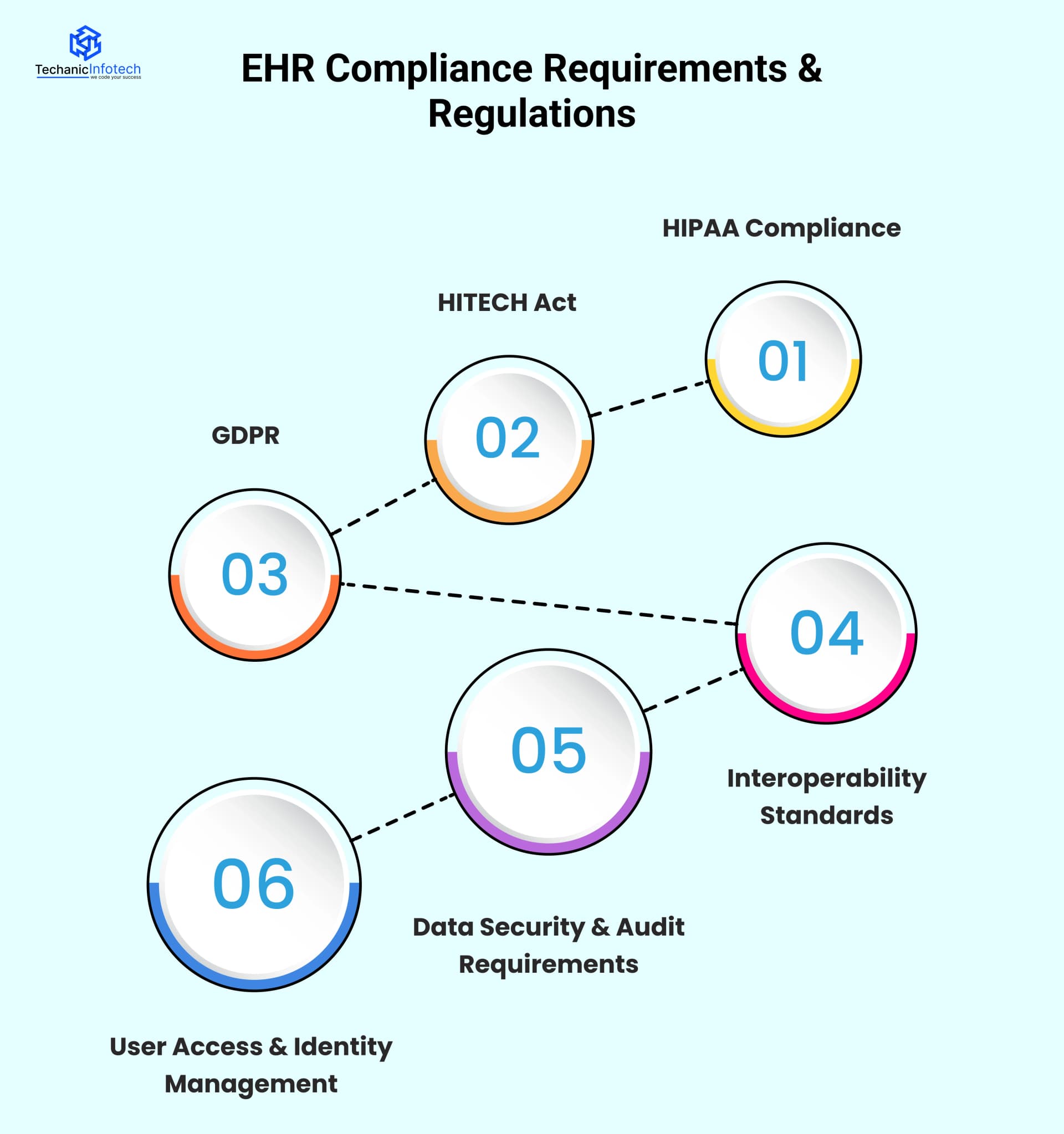
HIPAA (Health Insurance Portability and Accountability Act) is the most important regulation for EHR systems in the United States. It focuses on protecting patient health information (PHI).
EHR software must include:
Data encryption (at rest and in transit)
Role-based access control
Secure authentication
Audit logs to track data access
Automatic session timeouts
HIPAA ensures that only authorized users can access patient data and that every action is traceable. Any EHR software solution used in the US must strictly follow these rules.
The HITECH Act strengthens HIPAA by promoting the adoption of electronic health records and enforcing stricter penalties for data breaches. It requires healthcare organizations to:
Report data breaches
Maintain transparency in data handling
Ensure secure data exchange
For custom EHR software, this means building systems with strong security, monitoring, and reporting capabilities from the start.
If an EHR system handles data of patients from the European Union, it must comply with GDPR (General Data Protection Regulation).
Key GDPR requirements include:
Explicit patient consent for data usage
Right to access, correct, or delete data
Data minimization and purpose limitation
EHR systems must allow patients control over their data and ensure privacy by design.
Modern EHR systems must support secure data exchange. Standards like FHIR and HL7 ensure that patient records can move safely between hospitals, labs, pharmacies, and other systems.
Compliance with interoperability standards improves care coordination and is increasingly required by healthcare authorities.
EHR systems must maintain:
Detailed audit trails
Secure backups and disaster recovery plans
Regular security updates and vulnerability testing
Audit logs are essential for compliance reviews and investigations.
Compliance requires strict control over who can access what data. Role-based permissions ensure doctors, nurses, and admins only see relevant information. This reduces internal data misuse and supports regulatory audits.
Building an EHR system is not just about software, it’s about trust, compliance, and real-world healthcare workflows. At Techanic Infotech, we help healthcare providers and health-tech startups design and develop EHR software that is secure, compliant, and built for long-term growth.
Our mobile app development company understands the complexities of EHR software development, from meeting strict compliance requirements like HIPAA to ensuring smooth interoperability with standards such as FHIR and HL7. We focus on creating user-friendly systems that doctors and staff can actually use without friction.
If it’s custom EHR development, feature planning, cost optimization, or post-launch support, we work closely with clients at every step. The result is an EHR solution that improves care delivery, protects patient data, and scales confidently in 2026 and beyond.
EHR software development plays a vital role in modern healthcare by improving patient care, operational efficiency, and data security. From managing patient records to ensuring compliance with strict regulations, a well-built EHR system supports better decision-making and smoother workflows.
In 2026, healthcare providers need EHR solutions that are secure, scalable, and easy to use. Understanding key features, development cost, benefits, and compliance requirements helps organizations make informed choices.
Whether you are building a new system or upgrading an existing one, investing in the right EHR software creates long-term value, strengthens trust, and supports the future of digital health
EHR software (Electronic Health Record software) is a digital system used to store, manage, and share patient health information securely across healthcare providers.
EMR is used within a single clinic or practice, while EHR can be shared across multiple healthcare organizations, supporting better care coordination.
The cost of in 2026 typically ranges from $5,000 to $100,000+, depending on features, integrations, compliance, and system complexity.
Core EHR software features include patient management, clinical documentation, e-prescriptions, appointment scheduling, billing integration, analytics, and interoperability.
Yes. Any EHR system used in the US must follow HIPAA compliance requirements to protect patient health information and ensure data security.
Developing EHR software usually takes 4 to 8 months, depending on customization level, compliance needs, and integration requirements.
Yes. Modern EHR systems support interoperability standards like FHIR and HL7, allowing integration with labs, pharmacies, and billing systems.


Neha Sharma is a tech expert at heart who loves exploring new technologies and turning complex ideas into easy-to-understand content. With a passion for learning and writing, she enjoys sharing insights on emerging tech, digital products, and innovation that help businesses stay ahead.