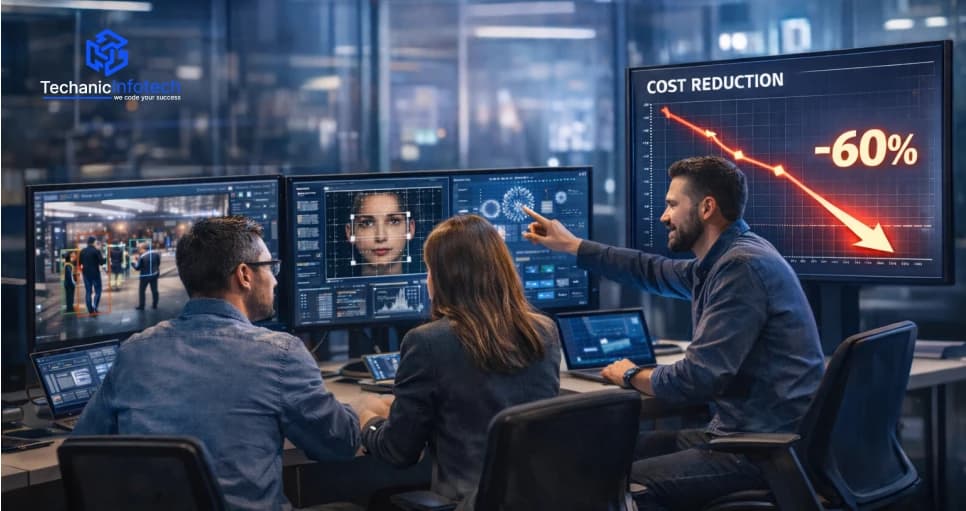
AI development is becoming more advanced and more expensive than ever before.
Businesses often struggle to balance innovation with budget constraints while building intelligent, vision-based solutions.
But what if you could significantly reduce costs without compromising quality or performance? When you hire computer vision engineers, you gain access to specialised expertise that streamlines development and eliminates costly inefficiencies.
These professionals optimise algorithms, improve accuracy, and reduce infrastructure demands.
In this guide, we’ll explore how hiring computer vision engineers can cut AI development costs by up to 60%, the key benefits they offer, essential skills to look for, hiring models, and proven strategies to maximize ROI while building scalable, high-performing AI solutions.
To manage rising AI expenses, businesses hire AI engineering experts who streamline workflows, reduce inefficiencies, and deliver optimized solutions that improve performance while keeping development budgets under control.
Experienced engineers build optimized models faster, reducing trial-and-error costs. With automation demand rising, the computer vision market is growing at 19.8% CAGR, highlighting efficiency-driven cost savings.
They use advanced techniques like data augmentation and edge computing to minimize infrastructure expenses, lowering cloud usage and improving performance without requiring large-scale, high-cost computing resources.
Skilled engineers accelerate development cycles, helping businesses launch AI products quickly. The AI computer vision market is projected to reach $77.69 billion by 2032, proving strong ROI potential.
Choosing the right hiring model plays a crucial role in controlling AI development expenses. When you hire computer vision engineers, smart approaches help reduce costs while improving efficiency and access to skilled talent.
A dedicated software development team provides full control, consistent collaboration, and better resource management, helping businesses reduce overhead costs while ensuring steady progress and long-term efficiency in AI development projects.2. Freelance or Contract-Based Hiring
Freelancers support AI development cost reduction by allowing businesses to pay only for specific tasks, making them ideal for short-term projects or companies aiming to minimise overall development expenses.
Outsourcing computer vision development services gives access to expert teams, advanced tools, and proven workflows, helping businesses reduce costs while maintaining quality and accelerating project delivery timelines.
A hybrid approach combines in-house teams with external experts, such as when you hire chatbot developers, offering flexibility, scalability, and cost efficiency while optimising overall AI development performance.
Computer vision engineers rely on advanced tools to build scalable AI systems. Choosing the right stack becomes easier when working with computer vision developers for hire who ensure efficient development and performance.
OpenCV is widely used for real-time image processing, and many offshore AI developers leverage it to build cost-effective solutions like object detection, facial recognition, and motion tracking with high efficiency.
TensorFlow powers advanced computer vision solutions, enabling engineers to build scalable models for image classification and object detection while supporting deployment across multiple platforms and production environments efficiently.
PyTorch offers flexibility with its dynamic computation graph, allowing faster experimentation and prototyping, making it ideal for developing, testing, and refining innovative computer vision algorithms efficiently.
YOLO enables high-speed object detection in real time, helping identify multiple objects within images and video streams accurately, making it suitable for surveillance, automation, and advanced AI-powered applications.
Cloud platforms like AWS, Google Cloud, and Azure provide scalable infrastructure for training, deploying, and managing computer vision models without heavy upfront investment in hardware or complex system maintenance
Data annotation tools are essential for training accurate models. When comparing dedicated developers vs in-house teams, both rely on labelled datasets to improve performance and ensure reliable computer vision outcomes.
Hiring the right talent is crucial for AI success. When you hire computer vision engineers, a structured approach helps you find skilled experts, reduce costs, and ensure efficient project execution.
Start by outlining goals, use cases, and technical needs, following a clear AI app development guide to ensure alignment and attract engineers with the right expertise for your project.
When you hire AI engineers, focus on skills like machine learning, image processing, and deep learning frameworks to ensure they can handle complex computer vision tasks efficiently.
Selecting a dedicated AI development team or flexible hiring model ensures better collaboration, cost control, and scalability based on your project size, timeline, and long-term business goals.
Look for trusted agencies and platforms offering computer vision development services, helping you access pre-vetted professionals with proven experience in building high-quality AI-powered solutions.
Use coding tests and real-world tasks, along with relevant AI tools for mobile app development, to assess candidates’ practical knowledge and ensure they can deliver efficient and scalable solutions.
Strong communication ensures engineers can clearly understand requirements and contribute effectively to building reliable computer vision solutions while working seamlessly with cross-functional teams.
Assign a trial task to evaluate performance, reliability, and problem-solving skills, helping you make informed decisions before committing to long-term hiring or full-scale development.
Track progress regularly and optimize workflows to control overall mobile app development cost, ensuring continuous improvement, better efficiency, and successful delivery of high-quality AI solutions.
AI development comes with technical, operational, and cost-related challenges. Working with computer vision developers for hire helps businesses overcome these issues and build scalable, high-performing AI solutions efficiently.
AI models rely on high-quality, labeled data, but poor datasets increase errors and even impact factors like AI chatbot development cost, making it harder to build accurate and reliable solutions.
Experts use data cleaning, augmentation, and advanced annotation techniques to improve dataset quality, ensuring models are trained on accurate, diverse, and reliable data for better performance.
Building AI systems requires significant investment in tools, infrastructure, and talent, often creating budget challenges and limiting scalability for businesses aiming to adopt advanced AI technologies.
Professionals optimize resources, use cloud platforms, and implement efficient architectures to reduce costs while maintaining performance and scalability throughout the development lifecycle.
Training AI models can be time-consuming and complex, requiring multiple iterations, especially when working with advanced AI App development services that demand high accuracy and optimized performance.
Experts leverage pre-trained models, automation, and fine-tuning techniques to accelerate training, improve accuracy, and reduce overall development time significantly.
Integrating AI solutions with legacy systems can create compatibility challenges, leading to delays and increased complexity in workflows, especially for businesses adopting AI technologies for the first time.
Developers use APIs, modular frameworks, and flexible architectures to ensure seamless integration with existing systems while minimising disruptions and improving operational efficiency.
Handling sensitive data increases risks of breaches and compliance issues, making it critical to implement strong security measures to protect user information and maintain trust in AI applications.
Experts implement encryption, secure access controls, and compliance standards to ensure safe data handling, protecting both users and businesses from potential security threats.
Finding experienced professionals is challenging, which can delay projects and impact quality, pushing businesses to rely on trusted AI app development companies for skilled talent and faster execution.
Partnering with experienced companies or hiring dedicated experts ensures access to skilled professionals, enabling faster development, improved quality, and successful delivery of AI-powered solutions.
Reducing AI development costs without compromising quality is a top priority for modern businesses.
From choosing the right hiring models to leveraging advanced tools and overcoming common challenges, every step plays a crucial role in optimising budgets and performance.
When you hire computer vision engineers, you gain access to specialised expertise that streamlines development, improves accuracy, and accelerates time-to-market.
These professionals help eliminate inefficiencies, ensuring your AI solutions are both scalable and cost-effective.
By adopting a strategic approach and working with the right talent, businesses can build powerful AI-driven applications while staying within budget and maintaining a competitive edge in an increasingly technology-driven market.
Hiring computer vision engineers helps businesses build accurate AI models, reduce development time, and optimise costs while ensuring high-performance and scalable AI-driven solutions.
Choosing models like freelancers, outsourcing, or dedicated teams allows businesses to control expenses, scale resources efficiently, and avoid long-term overhead costs.
Key skills include machine learning, deep learning frameworks, image processing, Python programming, and experience with tools like TensorFlow, PyTorch, and OpenCV.
They commonly use tools like OpenCV, TensorFlow, PyTorch, YOLO, cloud platforms, and data annotation tools to build, train, and deploy computer vision solutions.
Common challenges include poor data quality, high costs, complex model training, integration issues, data security risks, and a shortage of skilled AI professionals.
Experts optimise resources, use pre-trained models, automate processes, and leverage cloud infrastructure to minimize expenses while maintaining performance and scalability.
High-quality, well-labelled data is essential for training accurate models, improving performance, and ensuring reliable outcomes in real-world applications.
Yes, startups can begin with cost-effective hiring models, MVP development, and scalable solutions to manage budgets while gradually expanding their AI capabilities.
They improve efficiency, automate tasks, reduce operational costs, enhance accuracy, and enable data-driven decisions, ultimately helping businesses achieve long-term growth and profitability.


Bharat Sharma is the CTO of Techanic Infotech, bringing deep technical expertise in software architecture, mobile app development, and scalable system design. He leads the engineering team with a strong focus on innovation, performance, and security.