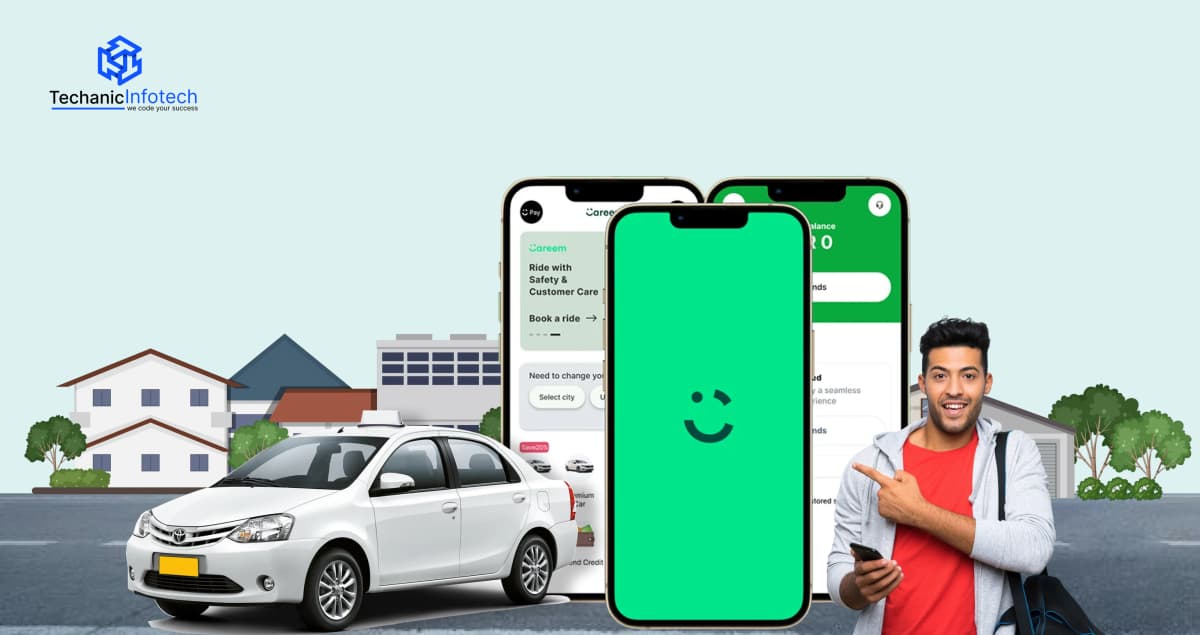
Taxi App Development
How to Build a Careem Like Taxi App in 2026: From Idea to Launch
January 13, 2026
January 13, 2026
Developing a taxi app like Careem in 2026 requires more than replicating features; it demands a deep understanding of evolving user expectations, regional mobility challenges, and modern technology standards.
With ride-hailing markets becoming increasingly competitive, businesses must focus on scalable architecture, AI-driven dispatch systems, secure payments, and compliance with local regulations.
Drawing from proven experience in on-demand app development, this guide explains the strategic, technical, and operational steps needed to build a successful Careem-like taxi app.
You’ll gain expert insights into market research, core features, tech stack selection, cost planning, and post-launch growth strategies.
Whether you’re a startup founder or an enterprise, this blog is designed to help you make informed, trustworthy decisions and build a future-ready ride-hailing platform.
The global ride-hailing market continues to expand in 2026, driven by urbanization, traffic congestion, and the rising preference for app-based transportation.
Consumers increasingly rely on smartphones for daily commuting. A taxi app offers convenience, real-time tracking, and cashless payment taxi booking app features that users now expect as standard, improving customer retention and trust.
Taxi apps support multiple revenue streams, including commission-based rides, surge pricing, subscriptions, advertisements, and corporate travel partnerships, making them a scalable and profitable business model.
Modern technologies such as AI-powered route optimization, predictive demand analysis, and dynamic pricing help improve operational efficiency and user experience, giving new platforms a competitive edge.
Many regions still lack localized, regulation-compliant ride-hailing solutions. Building a Careem-like app enables businesses to customize services for local languages, payment methods, and transport needs.
Taxi apps can integrate electric vehicles, carpooling, and eco-friendly ride options, aligning with global sustainability goals and attracting environmentally conscious users.
A successful taxi app can evolve into a broader mobility ecosystem, offering deliveries, rentals, and logistics services, ensuring long-term business expansion and credibility.

Understanding the core components ensures smooth ride management, secure transactions, and scalable growth.
These essential elements work together to deliver a reliable, user-friendly ride-hailing experience.
The passenger app is the foundation of a taxi platform, enabling users to register, book rides, track drivers in real time, make secure payments, and leave ratings.
A smooth, intuitive interface builds trust and improves user retention.
The top taxi booking app trends allow drivers to accept or reject ride requests, navigate optimized routes, manage earnings, and track trip history.
Reliable performance and transparent earnings management are critical for driver satisfaction.
A robust admin dashboard helps operators monitor rides, manage users and drivers, handle disputes, set pricing rules, and analyze performance metrics.
This ensures operational control and regulatory compliance.
Accurate GPS integration and intelligent ride-matching algorithms connect riders with nearby drivers efficiently.
This improves pickup times, reduces cancellations, and enhances overall user experience.
Multiple payment options, such as cards, wallets, and local payment methods, ensure convenience.
Strong encryption and compliance with data protection standards are essential for user trust.
A cloud-based, scalable backend supports high traffic, data security, and future feature expansion. It ensures app stability as the user base grows.
The following are the essential features that ensure smooth ride operations, enhance safety, and deliver a reliable experience that meets modern user expectations and competitive market standards.

A seamless onboarding process builds trust from the first interaction. Users should be able to register using mobile numbers, email, or social logins with OTP verification for security.
Profile management allows passengers to save locations, manage payment methods, and view ride history.
From practical development experience, reducing registration friction significantly improves conversion rates while maintaining compliance with data protection and privacy regulations.
Real-time ride booking with accurate GPS tracking is central to user satisfaction.
This feature enables passengers to book rides instantly, track driver location, view estimated arrival times, and monitor routes.
Advanced mapping APIs and optimized algorithms help reduce wait times and cancellations.
Proven ride-hailing platforms show that reliable tracking directly impacts user trust, safety perception, and overall app credibility.
An intelligent dispatch system matches riders with the nearest available drivers based on location, traffic conditions, and vehicle type.
AI-powered matching improves operational efficiency and driver utilization.
Drawing on industry best practices, smart dispatch reduces idle time, improves pickup accuracy, and ensures balanced demand-supply management, key factors for scaling a Careem-like taxi app sustainably.
Offering flexible payment methods such as credit/debit cards, digital wallets, cash, and region-specific gateways increases accessibility.
Secure transactions using encryption, tokenization, and PCI-DSS compliance protect user data.
Based on real-world deployment insights, apps with localized payment options experience higher ride completion rates and stronger user confidence, especially in emerging markets.
In-app chat, call masking, and push notifications allow seamless communication between drivers and passengers without exposing personal details.
Notifications keep users informed about ride status, driver arrival, and payment confirmation.
From a safety and usability standpoint, this feature minimizes confusion, enhances coordination, and aligns with global privacy and security standards.
Ratings and reviews promote transparency and accountability across the platform.
Safety features such as SOS buttons, trip sharing, and driver verification build user confidence.
Industry experience shows that trust-focused features significantly improve user retention and brand reputation, making them essential for long-term success in competitive ride-hailing markets.
Developing a taxi app like Careem requires a structured, experience-driven approach that balances technology, business strategy, and regulatory compliance.
The following are the ways to create an app like Uber or Careem in a successful way

Begin by analyzing your target market, competitors, and user behavior.
Study leading platforms such as Careem to understand pricing models, service coverage, and user expectations.
Identify gaps in local or regional markets where a Careem alternative can succeed.
At this stage, define your revenue model: commission per ride, subscriptions, surge pricing, or corporate partnerships.
Strong market validation reduces risk and ensures long-term sustainability.
Clearly outline essential ride-hailing app features for passengers, drivers, and administrators.
This includes ride booking, real-time tracking, secure payments, driver verification, and safety tools.
Focus on UX/UI design that minimizes booking steps and improves accessibility.
From real project experience, designing a taxi booking app significantly improves user adoption and app retention in competitive taxi markets.
Use proven frameworks such as Flutter or React Native for cross-platform apps, cloud services like AWS or Google Cloud for backend scalability, and reliable databases for real-time data handling.
Integration with Google Maps APIs and payment gateways ensures accuracy and trust.
The right stack supports growth and reduces future development costs.
Taxi app development involves building three interconnected systems: the passenger app, driver app, and admin dashboard.
Each module must be developed with role-based access and seamless communication.
Industry experience shows that a powerful admin panel improves operational control, pricing management, and compliance monitoring.
Secure payment gateways, accurate GPS navigation, SMS/email notifications, and in-app communication tools are integrated at this stage.
Supporting local payment methods is especially important in regions like the Middle East and Asia.
These integrations enhance trust, reduce ride failures, and improve user satisfaction.
Before launch, conduct extensive QA testing, performance testing, and security audits.
Ensure compliance with data protection laws (such as GDPR), transport regulations, and app store policies.
Based on real-world deployments, addressing legal and security requirements early prevents costly delays and platform bans.
After deployment on app stores, continuously monitor performance using analytics tools.
Gather user feedback, optimize features, and scale infrastructure based on demand.
Successful taxi platforms evolve into broader mobility ecosystems by adding deliveries, rentals, or corporate services.
Building a taxi app like Careem requires a carefully selected technology stack that ensures scalability, security, and real-time performance.
The right combination of mobile, backend, cloud, and mapping technologies helps deliver a seamless, reliable ride-hailing experience.

Flutter or React Native are widely used for cross-platform development, ensuring faster time-to-market and consistent UI across Android and iOS.
Native technologies like Swift (iOS) and Kotlin (Android) may be chosen for performance-critical features such as real-time tracking and navigation.
A well-optimized mobile stack ensures smooth booking, driver matching, and secure in-app payments.
The backend powers all core operations, including ride matching, fare calculation, notifications, and user management.
Technologies like Node.js, Java (Spring Boot), or Python (Django) are commonly used due to scalability and reliability.
RESTful or GraphQL APIs enable seamless communication between apps and servers.
A robust backend ensures high availability, handles peak ride demand, and supports real-time updates critical for user trust and platform growth.
Accurate real-time tracking is essential for the best taxi apps in USA or other geographical areas. Google Maps API, Mapbox, or Here Maps are used for navigation, route optimization, distance calculation, and ETA prediction. GPS integration allows live driver tracking and ride status updates.
From an experience and trust perspective, precise mapping reduces delays and improves transparency for both riders and drivers, key factors influencing retention and app ratings in competitive markets.
Secure payments are central to user confidence. Integrating trusted gateways like Stripe, Braintree, or PayPal, along with local wallets, ensures flexibility and compliance.
PCI-DSS standards, SSL encryption, and tokenization protect sensitive financial data. From an E-E-A-T standpoint, prioritizing security demonstrates authority and trustworthiness.
Reducing fraud risks and ensuring compliance with global financial and data protection regulations.
Scalability and performance depend on cloud infrastructure. Platforms like AWS, Google Cloud, or Microsoft Azure offer auto-scaling, load balancing, and disaster recovery.
Databases such as PostgreSQL, MySQL, and MongoDB handle structured and real-time data efficiently.
Cloud-based infrastructure ensures high uptime, faster global access, and future scalability, which are essential for growing a taxi app from a local launch to a regional platform like Careem.
Understanding the Careem-like taxi app development cost is essential for planning a scalable and profitable ride-hailing platform.
Following is the cost breakdown of developing a taxi app like Careem based on features, technology choices, and development region, which is crucial for informed decision-making.
The cost to build a taxi app like Careem in 2026 varies based on functionality and scale.
A Minimum Viable Product (MVP) with core features such as user onboarding, ride booking, GPS tracking, driver assignment, and basic payments typically costs between $20,000 and $40,000.
A full-scale Careem-like taxi app, including AI-based dispatch, surge pricing, multi-language support, advanced analytics, and enterprise-grade admin controls, usually ranges from $80,000 to $120,000, depending on customization and integrations.
Passenger and driver apps generally require $15,000–$25,000, while real-time GPS, navigation, and route optimization cost $5,000–$10,000.
Secure payment gateways and wallets add $7,000–$12,000, and a powerful admin panel with reporting tools ranges from $8,000 to $15,000.
Advanced features like AI-powered matching, fraud detection, and surge pricing can add $10,000–$20,000.
North America and Western Europe have higher labor rates, often resulting in total project costs of $100,000–$120,000.
Eastern Europe and Latin America offer balanced pricing and quality, typically costing $50,000–$80,000.
India and Southeast Asia provide cost-effective development options, allowing businesses to develop robust Careem-like taxi apps for $20,000–$60,000+.
Cross-platform frameworks like Flutter or React Native reduce development time and cost.
On the other hand, native development using Swift and Kotlin increases expenses but delivers higher performance.
Backend choices, cloud infrastructure, third-party APIs, and real-time databases also influence total development investment.
Beyond initial development, ongoing expenses include server hosting, cloud services, API usage, security updates, and feature enhancements.
Maintenance costs typically range from 15% to 25% of the initial development cost annually.
Planning for scalability ensures long-term performance, smoother updates, and a consistent user experience as the platform grows.

Techanic Infotech is a trusted taxi app development company with proven experience in building scalable, secure, and high-performance ride-hailing solutions.
Our team specializes in end-to-end taxi booking app development, covering strategy, UI/UX design, development, testing, and post-launch support.
We help businesses create a taxi app like Careem by implementing AI-powered dispatch systems, real-time GPS tracking, secure payment integrations, and compliance-ready architectures.
With expertise in modern mobile app tech stacks, cloud infrastructure, and API integrations, we ensure faster time-to-market and long-term scalability.
Developing a taxi app like Careem in 2026 requires more than technical execution; it demands strategic planning, user-centric design, scalable technology, and regulatory compliance.
From market research and feature selection to choosing the right technology stack and managing development costs, every step plays a vital role in long-term success.
A well-built Careem-like taxi app can unlock multiple revenue streams, improve urban mobility, and evolve into a complete mobility ecosystem.
By partnering with an experienced development company and focusing on innovation, security, and performance, businesses can successfully build a ride-hailing platform that is competitive, profitable, and future-ready.
The development cost ranges from $20,000 to $120,000, depending on features, app complexity, technology stack, and development region.
An MVP typically takes 3–4 months, while a full-scale taxi app may require 6–9 months for development and testing.
Key features include user registration, ride booking, GPS tracking, driver matching, secure payments, an admin panel, ratings, and safety tools.
Popular choices include Flutter or React Native for mobile apps, Node.js or Django for backend, and AWS or Google Cloud for scalability.
Taxi apps earn through commission per ride, surge pricing, subscriptions, advertisements, and corporate travel partnerships, ensuring scalable revenue growth.


Abhishek Jangid is the CEO of Techanic Infotech, with extensive experience in mobile app and web development. He specializes in helping businesses turn innovative ideas into scalable digital solutions through strategic planning and modern technology.