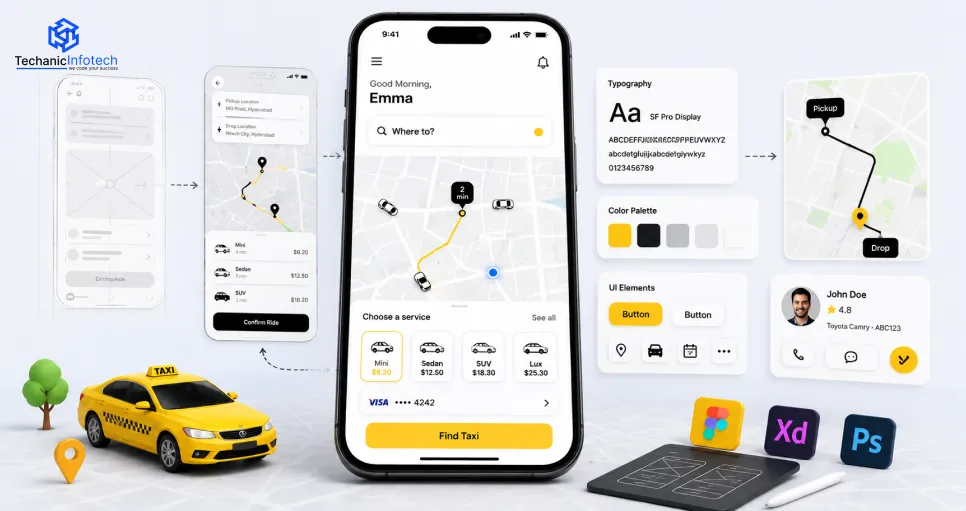
Booking a taxi has become second nature for millions of people. Whether commuting to work, heading to the airport, or traveling within a city, users expect to book a ride within seconds, track their driver in real time, and complete payments seamlessly through their smartphones.
Behind this convenience is a carefully designed taxi booking application that balances the needs of passengers, drivers, and business operators. While many entrepreneurs focus on development and features, the reality is that design often determines whether a taxi app succeeds or struggles to retain users. A confusing booking process, unclear pricing, poor navigation, or a complicated driver interface can quickly lead to abandoned rides, negative reviews, and lower customer retention.
The growing success of ride-hailing platforms such as Uber, Lyft, and Bolt has also raised user expectations. Today's customers expect intuitive interfaces, accurate GPS tracking, transparent fare estimates, multiple payment options, and strong safety features as standard. Meeting these expectations requires much more than attractive screens. It requires a thoughtful combination of user experience (UX), user interface (UI), technology, and business strategy.
In this guide, we will explore everything you need to know about taxi booking app design, including essential features, UX and UI best practices, technology requirements, development costs, common challenges, and emerging industry trends. Whether you are building a new ride-hailing platform or improving an existing taxi application, this guide will help you create a product that delivers a smooth experience for users while supporting long-term business growth.
When people think about taxi booking app design, they often focus on visual elements such as colors, buttons, maps, and layouts. While these components are important, successful taxi app design goes far beyond aesthetics. It is about creating a seamless experience that allows passengers to book rides effortlessly, enables drivers to manage trips efficiently, and gives administrators complete control over operations.
In a highly competitive market, user experience can become a major differentiator. Two taxi apps may offer similar features, pricing, and coverage, but the platform that provides a faster, smoother, and more intuitive experience is more likely to retain users. A passenger who can book a ride within seconds is far more likely to return than one who struggles to navigate through multiple screens or encounters confusion during the booking process.
Design also has a direct impact on business performance. Every unnecessary step in the booking journey increases the risk of user drop-off. If fare estimates are unclear, users may abandon the booking. If ride requests are difficult for drivers to manage, acceptance rates can decline. If administrators struggle to monitor rides or resolve disputes due to a poorly organized dashboard, operational efficiency suffers. These challenges are often design problems rather than technical limitations.
A well-designed taxi booking app must successfully serve three key user groups. Passengers expect convenience, transparency, and safety throughout their journey. Drivers need a simple interface that helps them accept rides quickly, navigate efficiently, and track their earnings without confusion. Administrators require powerful yet easy-to-use tools to manage users, monitor ride activity, configure pricing, and analyze business performance. When the needs of all three groups are addressed effectively, the entire ecosystem operates more smoothly.
This is where UX and UI design play a crucial role. User experience (UX) focuses on how users interact with the app and how easily they can accomplish their goals. User interface (UI) design determines how those interactions are presented visually through layouts, typography, buttons, colors, and navigation elements. Together, UX and UI shape every interaction within the platform and influence how users perceive the overall quality of the service.
The most successful ride-hailing platforms understand this relationship. Companies such as Uber and Lyft have continuously refined their booking flows, driver interfaces, and safety features over the years to reduce friction and improve customer satisfaction. Their success demonstrates that effective design is not simply a visual enhancement but a strategic business investment that contributes to higher retention, stronger engagement, and long-term growth.
For businesses planning to build a taxi booking app, design should therefore be treated as a core component of the product strategy rather than a final step in the development process. The quality of the user experience often determines whether customers book a second ride or move to a competing platform.
The taxi app features you choose can significantly influence user satisfaction, operational efficiency, and the overall success of your platform. However, simply adding more functionality does not guarantee a better user experience. The most successful taxi booking apps focus on delivering the right features at the right time while maintaining a simple, intuitive, and user-friendly interface.
A modern taxi booking platform typically consists of three interconnected systems: the passenger app, the driver app, and the admin panel. Each serves a unique purpose, but all three must work together seamlessly to ensure smooth operations, efficient ride management, and a positive experience for every user. Understanding the essential taxi app features required for each component can help businesses build a reliable and scalable ride-hailing solution.
Passengers are the primary users of the platform, and their expectations have evolved significantly over the years. Inspired by leading ride-hailing platforms, users now expect convenience, transparency, and speed from the moment they open the app.
The registration process should be quick and frictionless, allowing users to sign up through email, phone numbers, or social login options. Once registered, passengers should be able to book a ride within seconds by entering a destination, selecting a vehicle type, and confirming the request.
Real-time GPS tracking has become one of the most important features in modern taxi apps. Users want complete visibility into their driver's location, estimated arrival time, and route updates throughout the journey. This not only improves convenience but also enhances trust in the platform.
Another critical feature is fare estimation. Showing users the approximate cost of their ride before confirmation helps eliminate uncertainty and reduces pricing disputes. Combined with multiple payment methods such as credit cards, digital wallets, UPI, and cash payments, it creates a smoother and more flexible booking experience.
Passengers also expect access to ride history, digital invoices, ratings and reviews, scheduled bookings, and safety tools such as emergency assistance and trip-sharing features. These functionalities help build long-term confidence and encourage repeat usage.
While passengers generate demand, drivers form the supply side of the platform. Even the most user-friendly passenger app will struggle if drivers find the system difficult to use.
The driver experience should prioritize efficiency and simplicity. Onboarding should include a streamlined registration and verification process that allows drivers to upload documents, verify vehicle details, and activate their accounts without unnecessary delays.
Once active, drivers need instant ride notifications that provide all relevant trip information, including pickup location, estimated distance, and expected earnings. Accepting a ride should require minimal effort, as delays can negatively impact ride completion rates and customer satisfaction.
Integrated navigation tools are equally important. Drivers rely on accurate routing information to reduce travel time, avoid traffic congestion, and improve fuel efficiency. Clear navigation directly contributes to better service quality and higher earnings.
An effective driver app should also include an earnings dashboard, trip history, passenger ratings, incentive tracking, and secure communication tools. Providing drivers with transparent access to their performance metrics helps improve engagement and encourages long-term platform participation.
The admin panel serves as the operational backbone of the taxi booking platform. While passengers and drivers interact with the mobile applications, administrators rely on the dashboard to manage the entire ecosystem.
A well-designed admin panel provides complete visibility into user activity, ride status, driver performance, and business operations. Administrators should be able to monitor ongoing trips, review completed rides, manage customer accounts, and oversee driver verification processes from a centralized interface.
Payment management is another essential function. The dashboard should allow administrators to track transactions, process refunds, manage driver payouts, and monitor revenue streams efficiently. Dynamic pricing controls, commission management, and promotional campaign tools can further support business growth.
Analytics and reporting capabilities are equally important. Access to real-time data on ride volume, user acquisition, cancellation rates, customer ratings, and revenue performance helps businesses make informed decisions and identify opportunities for improvement.
When designed effectively, the admin panel becomes much more than a management tool. It serves as the control center that enables operators to maintain service quality, resolve issues quickly, and scale the platform as demand grows.
Together, these passenger, driver, and admin features create the foundation of a successful taxi booking application. However, having the right features alone is not enough. The real challenge lies in organizing them into a seamless user experience that feels effortless for everyone involved. That's where UX design becomes critical.
The success of a taxi booking app depends largely on how easy it is for users to complete their goals. Passengers want to book rides quickly, drivers want to maximize their earnings efficiently, and administrators need access to critical information without unnecessary complexity. UX design is the process of ensuring that each of these users can achieve their objectives with minimal effort.
In the ride-hailing industry, convenience is often the deciding factor between customer retention and customer churn. If a user has to navigate through multiple screens just to book a ride, they may abandon the process altogether. Similarly, if drivers find it difficult to manage ride requests or track their earnings, they may switch to competing platforms. This makes user experience one of the most important factors in the overall success of a taxi booking application.
For passengers, the booking journey should feel natural and predictable. From entering a destination to confirming a ride and tracking the driver, every step should be intuitive. Users should always know what action to take next and what information they need to provide. Clear fare estimates, real-time driver tracking, and transparent ride updates help reduce uncertainty and create a more trustworthy experience.
One of the most effective UX principles for taxi apps is minimizing the number of actions required to complete a task. For example, frequent users should not have to repeatedly enter information that the app already knows. Features such as saved addresses, recent destinations, and one-tap ride booking can significantly improve convenience while reducing friction.
Driver experience is equally important. Unlike passengers who may use the app a few times per week, drivers often spend several hours each day interacting with the platform. A poorly designed driver interface can directly affect ride acceptance rates, trip completion times, and overall driver satisfaction. Ride requests should be clearly displayed, important information should be visible at a glance, and navigation should require as little distraction as possible while driving.
Safety is another critical aspect of taxi app UX design. Both passengers and drivers should feel protected while using the platform. Features such as live trip tracking, emergency assistance buttons, verified profiles, and trip-sharing options contribute to a safer experience while building confidence in the service.
Consistency across the platform also plays a major role in usability. Passengers, drivers, and administrators may use different interfaces, but the design language should remain familiar throughout the ecosystem. Consistent navigation patterns, icons, terminology, and interaction styles help users learn the system faster and reduce confusion.
The most successful ride-hailing platforms continuously refine their user experience based on customer feedback and behavioral data. Companies like Uber regularly test new booking flows, safety features, and navigation improvements to remove friction from the user journey. These incremental improvements may seem small individually, but together they create a smoother experience that encourages long-term user loyalty.
Ultimately, great UX design is not about adding more features. It is about ensuring that every feature serves a purpose and helps users achieve their goals as efficiently as possible. When users can complete tasks without frustration or confusion, they are far more likely to return to the platform, recommend it to others, and contribute to the long-term growth of the business.
While UX focuses on how users interact with an app, UI design determines how those interactions are presented visually. A well-designed user interface helps passengers book rides faster, enables drivers to manage trips efficiently, and allows administrators to navigate complex operations with ease. In a competitive ride-hailing market, an intuitive interface can significantly influence user satisfaction and retention.
One of the most important principles of taxi booking app UI design is simplicity. Users often interact with ride-hailing apps while multitasking, commuting, or navigating busy environments. The interface should therefore minimize distractions and present only the most relevant information at each stage of the journey. Overcrowded screens, excessive options, or unclear navigation can create confusion and slow down critical actions such as booking a ride or accepting a trip request.
Visual hierarchy also plays a crucial role in guiding users through the application. Primary actions such as "Book a Ride," "Confirm Pickup," or "Accept Ride" should be immediately visible and distinguishable from secondary actions. Strategic use of size, spacing, typography, and contrast helps direct attention toward the most important elements without overwhelming users.
Typography should prioritize readability across different devices and screen sizes. Since passengers frequently use taxi apps outdoors or while moving, text must remain clear and legible in various lighting conditions. Simple fonts, appropriate sizing, and sufficient contrast between text and background contribute to a better user experience.
Color selection should support usability rather than serve purely decorative purposes. Colors can help communicate actions, statuses, and alerts. For example, green may indicate successful bookings, while red can highlight cancellations or urgent notifications. Consistent color usage throughout the app helps users quickly understand information without requiring additional explanation.
Maps are another central component of taxi booking app design. Since navigation and location tracking are core functionalities, map interfaces should be clean, responsive, and easy to interpret. Important information such as driver location, estimated arrival time, pickup points, and route directions should remain visible without cluttering the screen.
Consistency across the platform is equally important. Passengers, drivers, and administrators may use different interfaces, but maintaining a unified design language helps strengthen brand identity and improves usability. Consistent button styles, icons, layouts, and interaction patterns reduce the learning curve and create a more professional experience.
Accessibility should also be considered during the UI design process. Features such as larger touch targets, high-contrast themes, readable fonts, and support for screen readers can make the application more inclusive for a wider range of users. Beyond improving usability, accessibility considerations can help businesses reach a broader audience and comply with evolving digital standards.
Leading ride-hailing platforms continually invest in refining their interfaces because even small design improvements can produce measurable results. Simplifying navigation, improving button placement, or reducing visual clutter can shorten booking times, increase ride completion rates, and improve overall user satisfaction.
Ultimately, effective UI design is about creating an interface that feels intuitive from the first interaction. When users can accomplish their goals quickly and confidently without needing instructions, the design has achieved its purpose. Such experiences not only improve engagement but also contribute to stronger customer loyalty and long-term business success.
A well-designed taxi booking app is not only defined by its user experience and visual interface but also by the technology that powers it behind the scenes. Features such as real-time driver tracking, instant ride matching, secure payments, and push notifications rely on a strong technology foundation. Choosing the right tools and frameworks during the design and development phase can significantly impact performance, scalability, security, and long-term maintenance costs.
When planning a taxi booking app, businesses should think beyond the initial launch and consider how the platform will perform as the number of users, drivers, and daily ride requests grows. A scalable technology stack ensures the application can handle increasing demand without compromising user experience.
The technology architecture of a taxi booking platform typically consists of several key layers, including the frontend, backend, database, mapping services, payment processing, communication tools, and analytics systems.
|
Layer |
Purpose |
Popular Technologies |
|
Frontend Development |
Creates the passenger and driver app interfaces |
Flutter, React Native, Swift, Kotlin |
|
Backend Development |
Handles ride requests, user management, and business logic |
Node.js, Python, Java, .NET |
|
Database Management |
Stores user data, ride history, and transactions |
PostgreSQL, MySQL, MongoDB, Firebase |
|
Maps & Navigation |
Supports GPS tracking and route optimization |
Google Maps, Mapbox, OpenStreetMap |
|
Payment Processing |
Enables secure online transactions |
Stripe, Razorpay, PayPal, Braintree |
|
Push Notifications |
Sends ride updates and alerts |
Firebase Cloud Messaging, OneSignal |
|
Communication Services |
Supports in-app chat and calling |
Twilio, Agora |
|
Cloud Infrastructure |
Ensures scalability and reliability |
AWS, Google Cloud, Microsoft Azure |
|
Analytics & Monitoring |
Tracks performance and user behavior |
Firebase Analytics, Mixpanel, Google Analytics |
The frontend is what passengers and drivers interact with daily. The choice of frontend technology directly affects app performance, responsiveness, and user experience.
Cross-platform frameworks such as Flutter and React Native have become increasingly popular because they allow businesses to develop both iOS and Android applications using a single codebase. This approach can reduce development time and costs while maintaining a consistent user experience across platforms.
For businesses seeking maximum platform-specific performance, native development using Swift for iOS and Kotlin for Android remains a strong option, particularly for complex applications requiring advanced device integrations.
The backend acts as the central engine of the taxi booking platform. It processes ride requests, manages user accounts, handles payments, tracks locations, and coordinates communication between passengers and drivers.
Because taxi apps rely heavily on real-time interactions, the backend must be capable of processing large amounts of data with minimal latency. Technologies such as Node.js, Python, and Java are commonly used due to their scalability and ability to handle real-time operations efficiently.
As the business grows, backend architecture should also support high traffic volumes, dynamic pricing calculations, and expanding service areas without affecting performance.
Every taxi booking platform generates a substantial amount of data, including user profiles, ride histories, payment records, ratings, and location information.
Relational databases such as PostgreSQL and MySQL are often used for structured data management, while solutions like MongoDB offer flexibility for handling rapidly changing datasets. Real-time databases such as Firebase can also support instant updates for ride tracking and notifications.
The choice of database should align with the application's scalability requirements and expected transaction volume.
Location tracking is the backbone of every taxi booking application. Accurate mapping services allow users to view driver locations, estimate arrival times, calculate fares, and optimize routes.
Many leading ride-hailing platforms rely on mapping solutions such as Google Maps and Mapbox because of their reliability and comprehensive location data. These services help improve navigation accuracy, reduce pickup delays, and enhance the overall user experience.
Route optimization algorithms can further improve efficiency by identifying the fastest routes based on traffic conditions, road closures, and real-time demand patterns.
Modern users expect flexible and secure payment experiences. Integrating trusted payment gateways allows passengers to complete transactions confidently while reducing administrative complexity for the business.
Supporting multiple payment methods, including credit cards, debit cards, digital wallets, UPI, and contactless payments, can improve conversion rates and accommodate a wider audience.
Security is especially important when handling financial information. Payment systems should comply with industry standards and implement encryption protocols to protect sensitive user data.
Taxi booking platforms experience fluctuating demand throughout the day. Peak traffic periods can generate thousands of ride requests within a short time frame. Cloud infrastructure helps ensure the application remains stable during these spikes.
Platforms such as Amazon Web Services (AWS), Google Cloud, and Microsoft Azure provide scalable computing resources, storage solutions, and security features that support long-term growth. Cloud-based architecture also enables businesses to expand into new regions more efficiently as demand increases.
Successful taxi apps continuously evolve based on user behavior and operational insights. Analytics tools provide valuable information about booking trends, ride completion rates, user retention, and revenue performance.
By analyzing this data, businesses can identify bottlenecks, improve user experiences, optimize driver operations, and make informed product decisions. Performance monitoring tools also help development teams detect issues before they impact users.
Ultimately, selecting the right technology stack is not just a technical decision. It directly influences user experience, operational efficiency, and the future scalability of the platform. A strong technology foundation enables businesses to deliver reliable service today while remaining prepared for future growth and innovation.
A taxi booking app may have an attractive design and a powerful technology stack, but without the right integrations, it cannot deliver the seamless experience that modern users expect. Integrations connect your application with external services that handle navigation, payments, communication, analytics, and security. They play a crucial role in transforming a basic ride-booking platform into a reliable and scalable transportation solution.
The most successful ride-hailing platforms combine multiple integrations to ensure every stage of the customer journey operates smoothly. From the moment a passenger books a ride to the final payment and feedback process, these integrations work behind the scenes to support real-time functionality and improve the overall user experience.
Location tracking is one of the most important features of any taxi booking app. Passengers expect to see where their driver is, how long it will take for the vehicle to arrive, and which route will be followed during the trip.
This is made possible through mapping and navigation services such as Google Maps, Mapbox, or OpenStreetMap. These integrations provide real-time GPS tracking, route calculations, distance measurements, and estimated arrival times.
Beyond improving convenience, accurate navigation also helps drivers reduce travel time, optimize routes, and improve fuel efficiency. Poor mapping functionality can lead to delayed pickups, longer trips, and negative user experiences, making this integration one of the most critical components of the platform.
Today's users expect fast, secure, and flexible payment options. Most passengers prefer cashless transactions because they eliminate the need to carry cash and simplify the checkout process.
Integrating payment gateways allows users to pay through credit cards, debit cards, digital wallets, UPI, and other online payment methods. A smooth payment experience can significantly improve customer satisfaction and reduce booking abandonment rates.
From a business perspective, payment integrations also simplify transaction management, automate driver payouts, improve financial reporting, and reduce administrative workload. Security should remain a top priority, with encryption and industry-standard compliance measures protecting sensitive financial information.
Communication is essential in ride-hailing applications. Users need immediate updates regarding booking confirmations, driver arrivals, trip status changes, payment receipts, and promotional offers.
Push notification services help deliver these updates in real time. For passengers, notifications provide reassurance and keep them informed throughout the journey. For drivers, they ensure that new ride requests are received instantly, reducing missed opportunities and improving acceptance rates.
Well-designed notifications can also support user retention by reminding customers about special offers, referral programs, and loyalty rewards.
Even with accurate navigation systems, situations arise where passengers and drivers need to communicate directly. Finding a pickup location in a crowded area, clarifying directions, or coordinating special requests often requires quick communication.
In-app chat and calling features allow both parties to communicate without revealing personal contact information. This enhances privacy while improving the overall customer experience.
Secure communication channels can also help reduce trip cancellations caused by misunderstandings or pickup difficulties.
Trust and safety are fundamental to any taxi booking platform. Users need confidence that drivers are verified, while businesses need mechanisms to prevent fraudulent accounts and unauthorized access.
Authentication integrations support secure user registration and login processes through methods such as phone verification, email authentication, social logins, and one-time passwords (OTP). Driver verification systems can further validate licenses, vehicle documents, and identity information before allowing drivers onto the platform.
A robust authentication process not only strengthens security but also contributes to user trust and platform credibility.
Launching a taxi booking app is only the beginning. Long-term success depends on continuously improving the platform based on real user behavior.
Analytics integrations provide valuable insights into how users interact with the application. Businesses can monitor ride bookings, cancellation rates, driver activity, revenue performance, customer retention, and user engagement metrics.
For example, if analytics reveal that a significant number of users abandon the booking process before payment, it may indicate a usability issue that needs attention. Similarly, understanding which locations generate the highest demand can help businesses optimize driver availability and marketing efforts.
Data-driven decision-making enables continuous improvement and helps companies stay competitive in an evolving market.
Efficient customer support is essential for maintaining user satisfaction. Integrating support tools allows passengers and drivers to report issues, submit feedback, and resolve disputes quickly.
Features such as ticketing systems, live chat support, automated help centers, and feedback forms help businesses respond more effectively to customer concerns. Positive support experiences can improve user loyalty and strengthen brand reputation, while unresolved issues often lead to negative reviews and customer churn.
Many businesses focus heavily on features when planning a taxi booking app, but integrations are what make those features work effectively. A booking button has little value without accurate maps, a payment screen is ineffective without secure transaction processing, and a ride request becomes frustrating without reliable notifications.
The most successful taxi booking platforms combine intuitive design with powerful integrations to create a smooth, reliable, and trustworthy experience for passengers, drivers, and administrators alike. When selected carefully, these integrations not only improve functionality but also contribute directly to user satisfaction, operational efficiency, and long-term business growth.
Designing a taxi booking app is not simply about adding features and launching a platform. While creating a functional application is important, the real challenge lies in building an experience that can consistently attract passengers, retain drivers, and support business growth. Many taxi app startups struggle not because of poor technology, but because they fail to address common operational and user experience challenges during the design phase.
Understanding these challenges early can help businesses avoid costly mistakes and create a more competitive product from the start.
One of the most common challenges in taxi booking app design is finding the right balance between simplicity and functionality. Business owners often want to include numerous features to compete with established platforms. However, adding too many options can make the app feel cluttered and difficult to use.
Passengers primarily want a fast and effortless booking experience. If users must navigate through multiple screens or complete unnecessary steps before requesting a ride, frustration can quickly lead to abandonment. The solution is to prioritize core actions and keep the user journey focused. Features should be introduced strategically rather than overwhelming users with complexity from the beginning.
Many entrepreneurs focus heavily on attracting passengers while underestimating the importance of driver retention. Without a reliable network of drivers, even the most well-designed passenger app cannot deliver a positive experience.
Drivers expect more than ride requests. They need transparent earnings information, fair commission structures, accurate navigation, and efficient communication tools. A confusing driver interface or lack of visibility into earnings can encourage drivers to switch to competing platforms. Successful taxi apps invest as much effort into the driver experience as they do into passenger-facing features.
Ride cancellations are a persistent challenge across the ride-hailing industry. Passengers may cancel due to long wait times, while drivers may reject trips they consider unprofitable.
Poor communication often contributes to this issue. Providing accurate estimated arrival times, real-time tracking, clear pickup instructions, and instant notifications can significantly reduce cancellations. Some platforms also use cancellation policies and incentives to encourage better behavior from both passengers and drivers.
Real-time location tracking is one of the most critical features of a taxi booking app, but it is also one of the most challenging to perfect. GPS inaccuracies can result in incorrect pickup locations, delayed arrivals, and poor customer experiences.
Urban environments with tall buildings, weak network coverage, and heavy traffic can affect location accuracy. To minimize these issues, businesses should invest in reliable mapping services and continuously test location-based features under real-world conditions. Providing users with the ability to adjust pickup points manually can also help reduce location-related frustrations.
Trust remains one of the biggest factors influencing whether users choose a ride-hailing platform. Passengers need confidence that drivers are verified, routes are monitored, and support is available if problems arise. Drivers also want assurance that they are interacting with legitimate customers.
Safety-focused features such as driver verification, trip-sharing options, emergency assistance buttons, and real-time ride monitoring help strengthen trust. Transparent ratings and review systems further encourage accountability and improve service quality across the platform.
Demand for taxi services can fluctuate dramatically throughout the day. Rush hours, major events, and adverse weather conditions often create sudden spikes in ride requests.
Without proper planning, these demand surges can result in longer wait times, frustrated customers, and lost revenue opportunities. Dynamic pricing models help balance supply and demand, but they must be implemented carefully. Excessive surge pricing can generate negative feedback and damage customer loyalty. Clear communication about pricing changes helps users understand the reasons behind fare increases and reduces frustration.
Many taxi apps perform well during initial launch phases but encounter performance issues as user numbers increase. Slow loading times, delayed notifications, and system outages can quickly impact customer satisfaction.
Scalability should be considered from the beginning of the design and development process. Cloud infrastructure, efficient database architecture, and optimized backend systems allow the platform to handle increasing traffic without compromising performance.
Acquiring new users is expensive, making retention a critical business objective. Even if customers download the app and complete their first ride, retaining them requires consistent value and a positive experience.
Personalized offers, loyalty programs, seamless booking experiences, and responsive customer support can help encourage repeat usage. Understanding user behavior through analytics also allows businesses to identify friction points and improve retention over time.
Leading ride-hailing platforms such as Uber, Lyft, and Bolt have spent years refining their products to address these exact challenges. Their success demonstrates that building a taxi booking app is not simply a development project but an ongoing process of optimization, testing, and user-focused improvement.
By anticipating these challenges during the planning and design stages, businesses can create more resilient platforms, improve customer satisfaction, and establish a stronger position in the competitive ride-hailing market.
One of the first questions entrepreneurs ask before starting a taxi app project is, "How much does taxi app development cost?" The answer depends on several factors, including the complexity of the design, the number of features, the technology stack, and the level of customization required.
There is no fixed taxi app development cost because every business has unique requirements. A startup launching a local taxi service may only need basic functionality, while a large-scale ride-hailing platform may require advanced features such as dynamic pricing, AI-powered route optimization, loyalty programs, and multi-city operations.
The overall budget is influenced by both the design and development phases. While the design process focuses on user experience, interface creation, prototyping, and usability testing, development involves transforming those designs into a fully functional and scalable application. Understanding these factors can help businesses estimate taxi app development costs more accurately and plan their investment accordingly.
The complexity of the user interface is one of the biggest cost drivers. A simple interface with basic booking functionality requires significantly less design effort than a platform featuring multiple ride categories, advanced dashboards, personalized user experiences, and custom animations.
The number of user panels also affects project scope. Most taxi booking platforms require separate interfaces for passengers, drivers, and administrators. Each panel has its own workflows, screens, and user journeys, increasing both design and development requirements.
Another major factor is customization. Businesses that want a unique brand identity often invest in custom UI components, tailored user experiences, and extensive user research. While this increases the initial investment, it can help differentiate the platform from competitors and improve long-term user retention.
Third-party integrations can also impact costs. Features such as GPS navigation, payment gateways, communication systems, analytics platforms, and security solutions require additional implementation and testing. The more integrations a platform relies on, the greater the complexity of the project.
The table below provides a general estimate for taxi booking app projects based on feature complexity and business requirements.
|
App Type |
Estimated Cost Range |
|
Basic Taxi Booking App |
$5,000 – $15,000 |
|
Mid-Level Taxi Booking App |
$15,000 – $40,000 |
|
Advanced Ride-Hailing Platform |
$40,000 – $100,000+ |
|
Enterprise-Level Multi-City Platform |
$100,000 – $250,000+ |
A basic solution typically includes ride booking, GPS tracking, driver management, and payment processing. These apps are suitable for local taxi businesses or startups looking to validate their idea before scaling.
Mid-level applications often include additional functionality such as ride scheduling, loyalty programs, advanced analytics, multiple payment options, and enhanced admin controls.
Advanced ride-hailing platforms require extensive customization, sophisticated backend systems, dynamic pricing engines, real-time communication tools, and scalable infrastructure capable of handling thousands of concurrent users.
Many businesses mistakenly view design as a small part of the overall budget. In reality, investing in quality design can reduce long-term development costs by identifying usability issues before coding begins.
A comprehensive design process typically includes user research, wireframing, user flow creation, UI design, interactive prototyping, and usability testing. These activities help ensure that development teams build the right product from the beginning, reducing costly revisions later in the project.
Poor design decisions often lead to lower user retention, higher support costs, and expensive redesigns after launch. Investing in thoughtful UX and UI design early can improve customer satisfaction while generating a stronger return on investment over time.
Launching the application is only the beginning. Taxi booking platforms require continuous maintenance and optimization to remain competitive.
Ongoing expenses may include cloud hosting, payment processing fees, third-party API subscriptions, security updates, customer support, feature enhancements, and infrastructure scaling. Businesses should account for these recurring costs when planning their overall budget.
Regular updates are particularly important in the ride-hailing industry, where user expectations and technology trends evolve rapidly. Platforms that continuously improve their user experience are generally better positioned to retain customers and compete with established market leaders.
The answer depends on the business model, target market, and execution strategy. A well-designed taxi booking platform can create multiple revenue streams through ride commissions, surge pricing, subscription plans, advertising opportunities, and premium services.
However, success is rarely determined by budget alone. Many expensive projects fail because they overlook user experience, while some leaner platforms succeed by focusing on solving specific customer problems effectively.
The most successful taxi apps combine thoughtful design, reliable technology, and a clear understanding of user needs. Rather than focusing solely on minimizing costs, businesses should aim to create a platform that delivers long-term value for passengers, drivers, and operators alike.
The taxi booking industry has evolved significantly over the past decade, and user expectations continue to rise. Features that were once considered innovative, such as GPS tracking, digital payments, and ride scheduling, have now become standard. As technology advances and customer behavior changes, taxi booking apps must continue to adapt to remain competitive.
Understanding the latest taxi booking app trends is essential for businesses looking to stay ahead in the evolving mobility landscape. Innovations such as AI-powered personalization, intelligent route optimization, voice-enabled booking, sustainability-focused ride options, and predictive demand forecasting are transforming how ride-hailing platforms operate and serve users.
Businesses that embrace these emerging taxi booking app trends can create more future-ready platforms, improve customer satisfaction, and gain a competitive advantage in an increasingly crowded market.
Modern users expect digital experiences that feel tailored to their preferences. Artificial intelligence is making it possible for taxi booking apps to deliver more personalized experiences by analyzing user behavior, booking patterns, and travel preferences.
Future taxi apps may automatically suggest frequently visited destinations, recommend preferred ride categories, and provide personalized promotions based on previous usage. By reducing the number of decisions users need to make, personalization can create a faster and more convenient booking experience while improving customer retention.
Traffic congestion remains one of the biggest challenges in urban transportation. Traditional navigation systems focus primarily on identifying the shortest route, but future taxi apps are expected to leverage AI and predictive analytics to make routing decisions more intelligently.
Advanced route optimization systems can analyze real-time traffic conditions, weather forecasts, road closures, and historical travel data to identify the most efficient routes. This can help reduce travel times, improve fuel efficiency, and enhance the overall customer experience.
For businesses, smarter routing can also contribute to higher driver productivity and lower operational costs.
As voice technology becomes more widely adopted, taxi booking apps are likely to introduce more conversational user experiences. Instead of manually entering pickup and destination details, users may simply speak their requests.
Voice-enabled booking can improve accessibility while making ride requests faster and more convenient. This trend aligns with the growing adoption of voice assistants and hands-free digital experiences across multiple industries.
In the future, users may be able to book rides, check driver locations, and receive trip updates through simple voice commands.
Sustainability is becoming an increasingly important factor for both businesses and consumers. Governments around the world are encouraging the adoption of electric vehicles, while many users are actively seeking environmentally responsible transportation options.
Taxi booking platforms are beginning to incorporate features that allow passengers to choose electric or low-emission vehicles during the booking process. Some applications may also display estimated carbon savings to help users make more environmentally conscious travel decisions.
As sustainability initiatives continue to expand, eco-friendly ride options are expected to become a more prominent part of taxi app design.
Safety will continue to be a major focus for ride-hailing platforms. While current apps already include features such as emergency assistance buttons and live trip sharing, future solutions are likely to become even more sophisticated.
Artificial intelligence may help detect unusual ride patterns, identify potential safety risks, and trigger proactive alerts when suspicious activity is detected. Real-time ride monitoring, advanced driver verification, and automated incident reporting systems could further improve trust and transparency for both passengers and drivers.
As competition increases, safety innovations may become a key differentiator among ride-hailing platforms.
Future taxi booking systems will increasingly rely on predictive analytics to anticipate demand before it occurs. By analyzing historical booking data, local events, weather patterns, and seasonal trends, platforms can position drivers in high-demand areas before ride requests begin to surge.
This approach benefits passengers through shorter wait times while helping drivers maximize earnings opportunities. For platform operators, predictive forecasting can improve resource allocation and overall operational efficiency.
The future of urban mobility extends beyond traditional taxi services. Many transportation platforms are evolving into mobility ecosystems that combine multiple travel options within a single application.
Future taxi booking apps may allow users to seamlessly switch between taxis, ride-sharing services, public transportation, bike rentals, and electric scooters depending on their travel needs. This integrated approach can provide greater flexibility while simplifying the overall travel experience.
As smart city initiatives continue to develop, multi-modal transportation is expected to become an increasingly important trend.
Users are increasingly drawn to experiences that require minimal effort. Future taxi apps will continue to remove friction throughout the customer journey by automating routine processes.
Technologies such as automatic payments, smart destination suggestions, biometric authentication, and one-tap booking experiences can reduce the number of interactions required to complete a trip. The goal is to create a seamless experience where users can move from booking to arrival with as little manual input as possible.
The ride-hailing industry is entering a new phase where convenience alone is no longer enough. Users expect personalized experiences, stronger safety measures, smarter technology, and environmentally responsible transportation options.
Businesses planning to build a taxi booking app should view these trends not as optional enhancements but as opportunities to create long-term competitive advantages. By incorporating future-focused design principles and emerging technologies, companies can build platforms that remain relevant as customer expectations continue to evolve.
The most successful taxi booking apps of the future will be those that combine intuitive design, intelligent automation, and user-centric innovation to deliver experiences that are faster, safer, and more personalized than ever before.
Choosing the right taxi booking app development company can significantly impact the success of your project. Building a taxi booking app requires more than technical expertise it demands a deep understanding of user behavior, operational workflows, and the challenges faced by passengers, drivers, and business operators.
At Techanic Infotech, we help businesses turn transportation ideas into scalable, user-friendly taxi booking solutions. Our team focuses on creating seamless experiences for passengers, efficient tools for drivers, and powerful management systems for administrators.
From user journey mapping and UI/UX design to real-time GPS tracking, secure payment integration, and scalable cloud infrastructure, we develop solutions designed for long-term growth. We also prioritize security, performance, and reliability to ensure a smooth experience for every user.
Beyond development, we support businesses with ongoing maintenance, feature enhancements, and platform optimization to help them stay competitive in the evolving ride-hailing market. Whether you're launching a new taxi booking platform or upgrading an existing one, Techanic Infotech provides the expertise needed to build a secure, scalable, and future-ready solution.
Designing a taxi booking app is about much more than creating an attractive interface or replicating the features of existing ride-hailing platforms. Success depends on building a complete ecosystem that delivers value to passengers, drivers, and business operators alike.
For passengers, the experience should be fast, convenient, and trustworthy. For drivers, the platform should simplify trip management, improve efficiency, and provide transparency into earnings. For administrators, it should offer the tools needed to manage operations, monitor performance, and support long-term growth. When these three components work together seamlessly, a taxi booking app can become a reliable and scalable transportation solution.
Throughout the design process, businesses should focus on more than just functionality. User experience, intuitive interfaces, reliable technology, security, and scalability all play a critical role in determining how users perceive and interact with the platform. Even the most feature-rich application can struggle if the booking process feels complicated, navigation is confusing, or performance issues affect the user journey.
As the ride-hailing industry continues to evolve, emerging technologies such as artificial intelligence, predictive analytics, voice interactions, and sustainable transportation options are reshaping customer expectations. Businesses that embrace these innovations while maintaining a strong focus on usability will be better positioned to compete in an increasingly crowded marketplace.
Whether you are building a local taxi service platform, launching a ride-hailing startup, or expanding an existing transportation business, investing in thoughtful design from the beginning can significantly improve user satisfaction, operational efficiency, and long-term profitability. By combining user-centered design principles, modern technology, and a scalable business strategy, you can create a taxi booking app that not only meets current market demands but is also prepared for future growth.
The most successful taxi apps are not necessarily the ones with the most features. They are the ones that make every interaction simple, reliable, and valuable for the people using them. By keeping user needs at the center of your design decisions, you can build a platform that stands out in the market and creates lasting value for both your business and your customers.
While modern taxi apps include many advanced features, real-time ride booking and GPS tracking remain the foundation of the user experience. These features help passengers book rides quickly, track driver locations, and receive accurate arrival estimates, making the service more reliable and convenient.
The timeline depends on the complexity of the project. A basic taxi booking app may require four to six weeks for research, wireframing, UI design, and prototyping. More advanced platforms with custom features, multiple user panels, and extensive testing can take several months to design before development begins.
User Experience (UX) focuses on how users interact with the application and how easily they can complete tasks such as booking rides or accepting trip requests. User Interface (UI) focuses on the visual presentation of those interactions, including layouts, buttons, typography, colors, and navigation elements. Both work together to create a seamless user experience.
Taxi booking app design costs vary depending on the complexity of the project, the number of screens, customization requirements, and user research involved. Design costs are typically part of the overall app development budget, which can range from a few thousand dollars for a basic solution to well over six figures for large-scale ride-hailing platforms.
Popular technologies include Flutter and React Native for mobile app development, Node.js and Python for backend systems, PostgreSQL and MongoDB for databases, Google Maps or Mapbox for navigation, and cloud platforms such as AWS and Google Cloud for scalable infrastructure.
Passenger safety can be enhanced through features such as driver verification, real-time GPS tracking, emergency assistance buttons, trip-sharing options, secure in-app communication, and transparent ratings and review systems. These features help build trust and improve the overall user experience.
Yes. Most modern taxi booking apps support various payment options, including credit cards, debit cards, digital wallets, UPI payments, contactless transactions, and cash payments. Offering multiple payment choices improves convenience and helps accommodate a wider user base.
Competing with larger platforms requires focusing on a specific market need, delivering an exceptional user experience, maintaining service quality, and offering features that solve real customer problems. Strong driver support, reliable performance, transparent pricing, and localized services can help newer platforms establish a competitive advantage.
Common challenges include driver acquisition, user retention, GPS accuracy, ride cancellations, surge pricing management, platform scalability, and maintaining consistent service quality. Addressing these challenges early during the design and planning phase can significantly improve the chances of long-term success.
Scalability ensures that the platform can handle increasing numbers of users, drivers, and ride requests as the business grows. A scalable architecture helps maintain performance, reliability, and user satisfaction while supporting future expansion into new markets and service areas.


Abhishek Jangid is the CEO of Techanic Infotech, with extensive experience in mobile app and web development. He specializes in helping businesses turn innovative ideas into scalable digital solutions through strategic planning and modern technology.