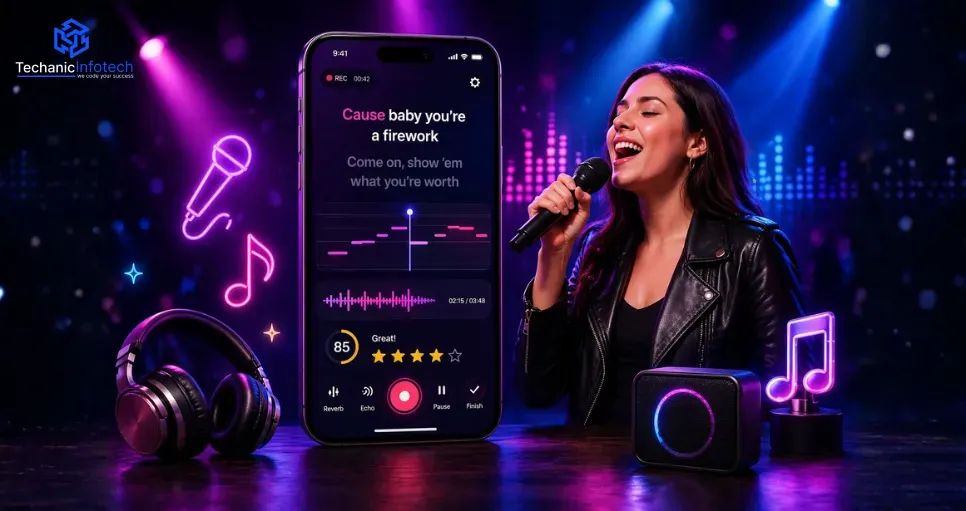
Music Streaming App Development
How to Build a Karaoke App in 2026: Features, Cost, Tech Stack & Step-by-Step Guide
April 22, 2026
April 22, 2026
Karaoke apps combine entertainment and social interaction, enabling users to sing, record, and share performances while leveraging AI-driven features.
Building a karaoke app requires strategic planning, including feature selection, tech stack decisions, and user experience design to ensure scalability and performance.
Development costs vary widely, typically ranging from $10,000 to $70,000+, depending on complexity, features, integrations, and development region.
Modern karaoke apps rely on technologies like cloud storage, AI voice processing, and cross-platform frameworks to deliver high-quality streaming and recording.
Monetization strategies include subscriptions, in-app purchases, ads, and virtual gifts, allowing developers to generate consistent revenue.
Future trends such as AI-generated music, AR/VR experiences, and metaverse concerts are reshaping karaoke apps.
The popularity of music-based apps has surged dramatically, making karaoke applications a standout trend in 2026.
These apps combine entertainment, creativity, and social interaction, allowing users to sing along to their favorite tracks anytime, anywhere.
With advancements in AI, real-time audio processing, and mobile technology, building a karaoke app has become more accessible yet competitive.
This guide explores everything you need to know about developing a karaoke app, from core concepts and features to costs, tech stack, and step-by-step development processes, helping you create a scalable and engaging music platform for modern users.
Karaoke-like music streaming app development is booming due to rising digital entertainment demand, social media integration, and technological advancements, making music creation accessible, interactive, and globally shareable for diverse audiences.
The global karaoke market reached $5.4 billion in 2023, led by commercial use (71%). In Japan, drinking venues accounted for ¥112.2 billion.
Pokekara was the top karaoke app. Surveys show strong popularity among students, especially girls, and positive views on education. Most believe karaoke makes classes more fun, engaging, and improves learning.
Social media integration has amplified karaoke app popularity by enabling users to share performances instantly.
Music-based communities thrive on engagement, collaborations, and viral content, making karaoke apps an extension of social networking and digital entertainment ecosystems.
Startups can capitalize on niche features like AI voice tools, regional music libraries, and community-driven experiences.
The growing demand for personalized and interactive content creates opportunities to innovate and differentiate in a competitive yet expanding market.
A successful karaoke app requires essential user-focused features like recording, lyrics synchronization, and social sharing, combined with advanced capabilities to deliver engaging, seamless, and high-quality music experiences.
User features form the core of karaoke apps, focusing on ease of use and engagement.
These include intuitive navigation, personalized recommendations, and interactive tools that enhance singing experiences while ensuring accessibility for users of all skill levels.
Registration systems allow users to create accounts, manage profiles, and track performances.
Profiles showcase recordings, followers, and achievements, encouraging engagement and personalization while enabling social interaction within the karaoke app ecosystem.
A robust song library with smart search functionality ensures users can quickly find tracks by genre, artist, or language.
Regular updates and regional content inclusion enhance user satisfaction and retention across diverse audiences.
Real-time synchronized lyrics are essential for guiding users during performances.
Accurate timing enhances singing experiences, ensuring users stay in rhythm and deliver better performances while maintaining engagement and usability.
Recording features allow users to capture their performances in audio or video formats.
High-quality recording and playback options enhance user satisfaction, enabling content creation and sharing across multiple platforms seamlessly.
Voice effects and filters improve performance quality by adding reverb, echo, and pitch correction.
These tools help users sound better, boosting confidence and encouraging frequent app usage.
Social sharing features enable users to post performances on platforms or within the app community.
Engagement tools like comments, likes, and duets foster interaction and build vibrant user communities.
Advanced features enhance karaoke apps by integrating AI, collaboration tools, and gamification elements.
It creates immersive, engaging, and innovative user experiences beyond basic singing functionalities.
AI voice enhancement improves pitch, tone, and clarity in real time.
It helps users produce professional-quality performances, increasing satisfaction and retention while differentiating apps with intelligent audio processing capabilities.
Duet features allow users to collaborate remotely with others.
This fosters creativity and social interaction, enabling users to perform together, even from different locations, enhancing community engagement.
Live streaming enables real-time performances and audience interaction.
Events, contests, and virtual concerts increase engagement, providing entertainment and monetization opportunities through virtual gifts and sponsorships.
Gamification elements like leaderboards, badges, and scores motivate users to participate actively.
Competitive features encourage repeat usage and enhance user engagement through rewards and recognition.
Building a karaoke app requires a structured approach combining research, planning, mobile app development, and deployment to create a scalable, engaging, and high-performance music platform for modern users.
Conduct detailed research to identify target audience preferences, trending features, and market gaps.
Analyze competitors to understand strengths and weaknesses, enabling you to define a unique value proposition and build an app like Spotify, a differentiated karaoke app that meets evolving user expectations.
Define core and advanced features based on user needs and business goals. Plan monetization strategies such as subscriptions, ads, and in-app purchases early.
It ensures a sustainable revenue model while maintaining a balance between free and premium user experiences.
Select technologies that ensure scalability, performance, and real-time processing.
Consider cross-platform frameworks, backend architecture, and cloud solutions to build a reliable and efficient karaoke app capable of handling audio-video synchronization and large user traffic.
Mobile app design intuitive interfaces focusing on simplicity and engagement.
Create wireframes and prototypes to visualize user journeys, ensuring smooth navigation, attractive layouts, and seamless interaction that enhances user satisfaction and encourages long-term app usage.
Develop the frontend for user interaction and the backend for data management and processing.
Ensure seamless integration between both layers, focusing on performance, scalability, and security while implementing core functionalities like recording, streaming, and user management.
Integrate high-quality audio and video processing features, including real-time recording, playback, and synchronization.
Use specialized tools to minimize latency and enhance sound quality, ensuring a professional and immersive singing experience for users across different devices.
Perform rigorous mobile app testing to identify bugs, performance issues, and usability problems.
Conduct functional, performance, and compatibility testing to ensure the app runs smoothly across devices and platforms, delivering a consistent and reliable user experience.
Deploy the app on platforms like iOS and Android, ensuring compliance with guidelines.
Plan a strategic launch with marketing campaigns, user onboarding, and feedback collection to optimize performance and drive initial user acquisition effectively.
Choosing the right mobile tech stack is essential for building a high-performance karaoke app, ensuring scalability, seamless user experience, and efficient handling of real-time audio and video processing requirements.
Frameworks like React Native and Flutter enable cross-platform app development with a single codebase.
They provide smooth performance, fast development cycles, and responsive UI components, making them ideal for building visually appealing and efficient karaoke applications.
Node.js and Django are popular backend technologies offering scalability and efficient data handling.
They support real-time communication, secure APIs, and robust server-side logic, ensuring seamless performance for karaoke apps handling multiple users and complex audio processing tasks.
Specialized tools and SDKs handle audio recording, mixing, and synchronization.
These technologies ensure low latency, high-quality sound output, and seamless integration of video features, providing users with professional-grade recording and playback capabilities.
Cloud platforms like AWS and Firebase offer scalable storage, hosting, and real-time database solutions.
They enable efficient data management, global accessibility, and secure storage of user recordings, ensuring reliability and performance for growing karaoke applications.
Third-party APIs provide additional functionalities such as payment gateways, social sharing, and music streaming.
Integrating these services accelerates development, enhances user experience, and reduces the need to build complex features from scratch.
The cost of building a karaoke app in 2026 ranges from $10,000 to $70,000+, depending on features, complexity, music streaming app development company, and technology stack used throughout the project lifecycle.
Cost varies based on included features, from basic functionality to advanced AI-driven capabilities, significantly impacting development budget and overall investment required for building a competitive karaoke application.
Basic features like user registration, song library, and simple recording typically cost between $10,000 and $20,000.
These apps focus on core functionality, offering a minimal viable product suitable for startups testing market demand.
Intermediate features such as social sharing, advanced search, and improved recording capabilities increase the mobile app development cost to $20,000–$40,000.
These apps provide enhanced engagement and usability, making them more competitive and appealing to a broader audience.
Advanced features, including AI voice enhancement, live streaming, and real-time collaboration, raise costs to $40,000–$70,000+.
These capabilities require sophisticated development and infrastructure, significantly increasing complexity and overall project investment.
Integrating APIs for payments, streaming, and analytics adds additional costs depending on usage and licensing fees.
These integrations enhance functionality but require ongoing expenses for maintenance, subscriptions, and scaling based on user activity.
Post-launch maintenance includes bug fixes, updates, and server costs.
These ongoing expenses typically account for 15–25% of initial development costs annually, ensuring the app remains secure, updated, and competitive in the market.
Development costs vary significantly across regions due to differences in labor rates, expertise, and market demand, influencing the overall budget required for building a karaoke application.
Development in North America is the most expensive, with costs driven by high labor rates and advanced expertise.
However, it ensures premium quality, strong project management, and adherence to industry standards for complex karaoke applications.
Western Europe offers high-quality development services at slightly lower costs than North America.
Companies here provide reliable solutions, balancing cost and expertise, making them a preferred choice for mid to high-budget karaoke app development projects.
Eastern Europe provides cost-effective development with skilled developers and strong technical expertise.
It offers a balance between affordability and quality, making it an attractive option for startups looking to optimize development budgets without compromising performance.
Asia, particularly countries like India, offers affordable development services with a large talent pool.
Lower labor costs make it ideal for startups and small businesses aiming to build feature-rich karaoke apps within limited budgets.
Hiring freelancers can reduce costs but may involve risks related to quality and consistency.
Pricing varies widely based on experience and project complexity, making it suitable for small-scale or prototype karaoke app development projects.
Several factors influence karaoke app development costs, including features, design complexity, technology choices, and team structure, all contributing to the final budget and overall project investment.
More complex features like AI tools, live streaming, and real-time collaboration significantly increase development time and cost.
Simpler apps with basic functionalities require fewer resources and are more budget-friendly for early-stage startups.
The choice of technologies impacts development efficiency, scalability, and cost.
Advanced tech stacks may require experienced developers, increasing expenses but ensuring better performance and long-term sustainability for the application.
Custom designs with animations and interactive elements increase development costs.
Simple designs are more affordable but may lack the engagement needed to retain users in competitive karaoke app markets.
Larger teams with experienced developers, designers, and testers increase project costs but ensure faster delivery and higher quality.
Smaller teams may reduce expenses, but can extend the mobile app development timeline and affect overall efficiency.
Ongoing maintenance, updates, and infrastructure scaling add long-term costs.
Apps expecting high user growth must invest in scalable solutions, increasing initial and operational expenses over time.
Basic App: $10,000 – $20,000
Mid-Level App: $20,000 – $40,000
Advanced App: $40,000 – $70,000+
Karaoke apps generate revenue through multiple monetization strategies, balancing free access with premium offerings to maximize user acquisition, engagement, and long-term profitability.
Subscription models offer premium access to exclusive features, ad-free experiences, and expanded song libraries.
Monthly or yearly plans generate recurring revenue while encouraging user loyalty and consistent engagement with the karaoke app platform.
In-app purchases allow users to buy virtual goods such as effects, themes, or song packs.
This model enhances user experience while providing flexible monetization opportunities without restricting access to core features.
Displaying ads within the app generates revenue based on impressions and clicks.
While effective, it requires careful implementation to avoid disrupting user experience and maintaining engagement levels.
Users can purchase premium features like advanced effects or send virtual gifts during live performances.
This model boosts engagement and creates additional revenue streams, especially in social and live streaming karaoke apps.
Developing a karaoke app involves overcoming technical, legal, and user engagement challenges.
It requires careful planning and innovative solutions to ensure performance, compliance, and long-term success.
Obtaining music licenses is complex and costly.
Developers must ensure legal compliance to avoid penalties, requiring agreements with music publishers and rights holders before offering songs within the karaoke application.
Ensuring real-time synchronization between audio, lyrics, and recording is technically challenging.
Latency issues can disrupt user experience, requiring advanced optimization techniques and reliable infrastructure to maintain performance quality.
Handling increasing user traffic and data requires a scalable infrastructure.
Poor scalability can lead to crashes and performance issues, making cloud-based solutions essential for maintaining stability during peak usage.
Keeping users engaged requires continuous updates, new features, and community interaction.
Without strong retention strategies, users may lose interest, impacting growth and revenue potential.
Standing out in a competitive karaoke app market requires innovation, personalization, and strong community engagement, ensuring users have unique, memorable, and highly interactive experiences.
AI-driven personalization recommends songs, improves voice quality, and tailors user experiences.
This increases engagement by offering relevant content and enhancing performance quality for each individual user.
Building strong communities through social features, competitions, and collaborations fosters engagement.
Active communities encourage user interaction, content sharing, and long-term retention.
Innovative design elements and intuitive interfaces improve usability and user satisfaction.
Creative layouts and seamless navigation differentiate your app from competitors.
Offering multilingual support and regional content expands your audience globally.
Localization ensures relevance and accessibility for users across different regions.
Karaoke apps are evolving rapidly with advanced technologies, offering immersive and personalized experiences that redefine digital music entertainment and user engagement.
AI enables users to generate music and clone voices, creating personalized singing experiences.
This innovation enhances creativity and allows users to experiment with different vocal styles and genres.
Augmented and virtual reality technologies create immersive singing environments.
Users can perform in virtual stages or simulated concerts, enhancing engagement and entertainment value.
Metaverse platforms enable virtual concerts and social interactions in digital worlds.
Karaoke apps can integrate these experiences, offering users new ways to perform, interact, and engage globally.
Karaoke apps represent a dynamic intersection of entertainment, technology, and social interaction, making them a promising opportunity in 2026.
With the rise of AI, cloud computing, and mobile-first experiences, building a karaoke app requires careful planning, the right technology stack, and user-centric design.
From essential features like real-time lyrics and recording to advanced capabilities such as AI voice enhancement and live streaming, success depends on delivering engaging and seamless experiences.
Cost considerations, monetization strategies, and scalability must also be addressed to ensure long-term sustainability.
By leveraging emerging trends like AR/VR and personalized content, businesses can create innovative karaoke platforms that stand out and capture a growing global audience.
A karaoke app allows users to sing along with instrumental tracks, record performances, and share them socially, offering entertainment and creative expression through mobile or web platforms.
Development costs range from $10,000 to $70,000+, depending on features, complexity, technology stack, and developer location, with advanced apps requiring higher investment.
Key features include song library, real-time lyrics, recording, voice effects, and social sharing to ensure engaging and user-friendly experiences.
Popular stacks include React Native, Flutter, Node.js, Django, AWS, and Firebase for scalability and performance.
They generate revenue through subscriptions, ads, in-app purchases, and premium features like virtual gifts.
Challenges include licensing, audio latency, scalability, and user retention, requiring technical and strategic solutions.
Yes, with proper monetization strategies and user engagement, karaoke apps can generate consistent revenue.
Development typically takes 3–9 months, depending on features, complexity, and team size.
User-friendly design, engaging features, high-quality audio, and strong community engagement drive success.
Trends include AI-generated music, AR/VR experiences, metaverse concerts, and personalized user experiences, enhancing engagement and innovation.


Abhishek Jangid is the CEO of Techanic Infotech, with extensive experience in mobile app and web development. He specializes in helping businesses turn innovative ideas into scalable digital solutions through strategic planning and modern technology.